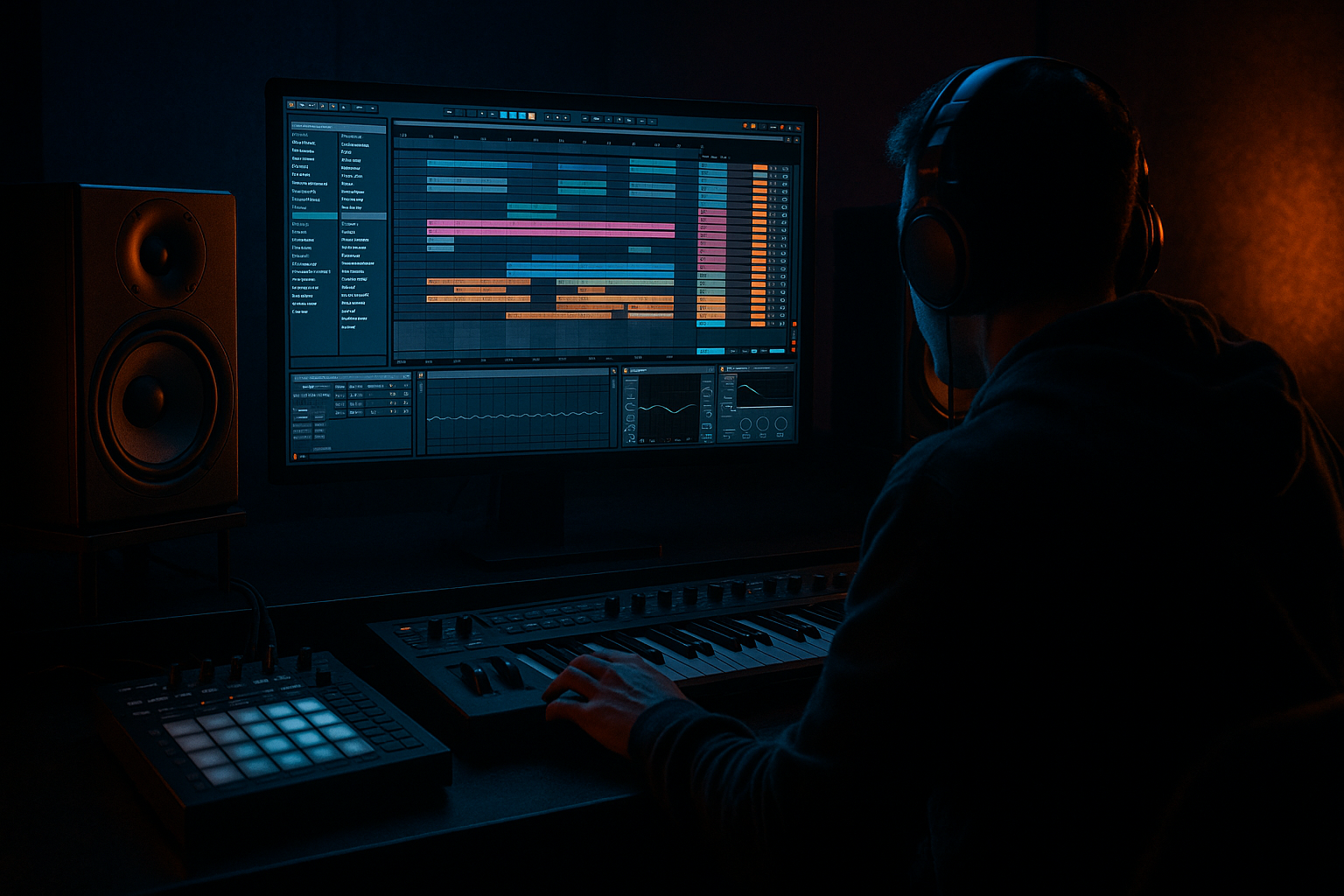
Main tutorial
Workflow: Jungle Arp for Smoky Warehouse Vibes (Ableton Live 12)
Skill level: Advanced • Category: Automation • Context: Drum & Bass / Jungle
---
1) Lesson overview
In this lesson you’ll build a jungle-style arp hook that feels like it’s echoing through a smoky warehouse: gritty, hypnotic, and constantly evolving—without sounding random. The core is automation-driven movement: filter drift, tape wobble, reverb throws, delay feedback swells, and dynamic distortion that reacts to the groove. 🎛️
We’ll do this using Ableton Live 12 stock devices (plus Live 12’s improved modulation/automation workflow).
---
2) What you will build
You’ll end up with:
- A minor-key rave/jungle arp that sits over a rolling DnB drum groove (165–175 BPM).
- A two-layer arp stack:
- A macro-controlled automation system for:
- Arrangement ideas for 32–64 bar DnB structure with evolving tension and releases. 🔥
- Load Wavetable (stock), init preset.
- Osc 1: Saw (or any bright table), Unison 2–4 voices
- Osc 2: Off (keep it focused for now)
- Filter: LP24
- Filter Freq: ~2.5 kHz
- Resonance: 20–30%
- Drive: 3–6 dB (inside Wavetable filter)
- Amp Env: Attack 0 ms, Decay 300–600 ms, Sustain 0, Release 80–150 ms
- Voices: Mono off (we want chord/arp possibility)
- Key idea: Minor 7 / suspended movement is peak smoky warehouse.
- Example in F minor:
- Style: UpDown or Random Other (more jungle chaos, but still musical)
- Rate: 1/16
- Gate: 55–70% (shorter gate = tighter)
- Steps: 8–12 (varies the phrase length against 1-bar drums)
- Retrigger: Off (keeps flow)
- Distance: 12 (one octave up) for that shimmering lift
- Add Groove Pool swing (subtle): try MPC 16 Swing 55–58.
- Commit it only after you like the feel.
- Keep it mostly low (-inf to -18 dB)
- Throw it up to -12 to -6 dB at:
- Bars 1–8: slow rise from ~900 Hz → 2.8 kHz
- Bars 9–16: dip it back to 1.4 kHz (creates call/response)
- Bars 17–24 (build): ramp to 4–5 kHz
- Bars 25–32 (drop): snap down to 1.8–2.2 kHz and let groove do the rest
- At the last 1/4 beat of bar 8, push feedback from 35% → 60%, then back down quickly.
- Repeat every 8 bars with variation.
- Tiny sends on offbeats = subtle depth
- Big sends at phrase ends = dramatic atmosphere
- High-pass aggressively:
- Make it more smeared:
- Lower volume -10 to -18 dB under the main arp.
- 1–8: arp filtered, low send, minimal feedback
- 9–16: introduce feedback spikes + air layer
- 17–24: pre-drop build (cutoff rising, send throws bigger)
- 25–32: drop—cutoff slightly lower, reduce reverb send, keep echo tight
- Alternate every 2 bars:
- Over-wetting the insert reverb: if the arp loses rhythm, move big space to the Return track throws instead.
- Feedback left high: one forgotten 70% feedback automation point can destroy a drop. Keep it spiky and intentional.
- No high-pass on reverbs: warehouse vibe ≠ low-end fog. HP your returns around 300–450 Hz.
- Filter automation too wide: sweeping from 100 Hz to 18 kHz sounds like EDM automation, not smoky jungle control.
- Stereo chaos in the low mids: use Utility Bass Mono and manage width with intention.
- Distortion that follows intensity: automate Saturator Drive up in fills only (end of 4/8 bars). Keeps drops clean.
- Minor 2nd tension notes: add occasional passing notes a semitone above the root (very dark jungle). Keep velocity low.
- Noise layer in Wavetable: blend a touch of noise (very low) and automate filter cutoff—adds “air grit” without extra tracks.
- Mid/Side control:
- Reverb pre-delay = clarity: 20–40 ms pre-delay helps the arp speak even in huge spaces.
- You built a jungle/DnB arp designed for smoky warehouse atmosphere using stock Ableton devices.
- The vibe comes from controlled automation: filter drift, timed reverb throws, and short feedback swells.
- You used a Return track for space (big & dramatic) and kept the insert chain tight and rhythmic.
- You layered an air/ghost arp for depth without losing punch, and locked it all to the groove via sidechain + EQ discipline.
- Mid arp (cleaner, defined transients)
- Air/ghost layer (washed out, reverb/delay-driven texture)
- Filter movement
- “Warehouse send” (reverb throw)
- Delay feedback swells
- Distortion intensity
- Width + stereo control
---
3) Step-by-step walkthrough
Step 0 — Session setup (DnB context first)
1. Set tempo to 172 BPM (classic modern jungle/DnB pocket).
2. Drop in:
- A 2-step or jungle break layer (Amen-style loop or tight modern drums).
- A rolling sub-bass (simple sine or reese—doesn’t matter yet, just ensure it’s present).
3. Sidechain placeholder: Put Compressor on the arp bus later and sidechain from your kick/snare bus (we’ll come back).
> Why first? Because arp automation choices should be made against the groove, not in isolation.
---
Step 1 — Build the MIDI arp clip (musical DNA) 🎹
Create a MIDI track named `ARP MID`.
Instrument:
Wavetable setup (tight but ravey):
Write a jungle-friendly chord source (1 bar loop to start):
- Bar 1: Fm9 (F–Ab–C–Eb–G) but you can simplify to F–Ab–C–Eb
- Bar 2: Ebm9 (Eb–Gb–Bb–Db–F)
- Bar 3–4: Return to Fm with a passing chord (Dbmaj7 vibe works)
Now add MIDI Arpeggiator (stock device) before Wavetable.
Arpeggiator settings (classic rolling):
Groove feel:
---
Step 2 — Create the “smoky warehouse” device chain (tone + space) 🌫️
After Wavetable, build this chain on `ARP MID`:
1. Saturator
- Mode: Soft Sine
- Drive: 2–6 dB
- Output: match to unity
- Optional: enable Soft Clip for controlled peaks
2. Auto Filter (this is your main movement engine)
- Filter: LP (24 dB)
- Freq start around 1.2–2.0 kHz
- Resonance: 15–30%
- Drive: 2–5 dB
- Envelope: small 5–15% (makes hits “breathe”)
3. Echo
- Mode: Ping Pong (or Normal if you want mono)
- Time: 3/16 (very DnB-friendly)
- Feedback: 25–40%
- Filter: HP ~200 Hz, LP ~6–8 kHz
- Reverb: 10–20% inside Echo for glue
- Mod: 3–8% (subtle movement)
4. Hybrid Reverb
- Algorithm: Hall or Warehouse/Room-like impulse (Convolution if you like realism)
- Decay: 2.5–5.5 s
- Pre-delay: 15–35 ms (keeps arp punch)
- EQ: HP 250–400 Hz, LP 7–10 kHz
- Mix: keep low (8–18%) on the insert (we’ll also do throws via Send)
5. Utility
- Bass Mono: On (set to 150–200 Hz)
- Width: start 90–120% depending on mix
Why this chain works:
Saturation adds density, Auto Filter creates the “breathing” motion, Echo supplies rhythmic trails, Hybrid Reverb gives warehouse depth, Utility keeps it from wrecking your low-end.
---
Step 3 — Make it automation-ready with Macros (clean workflow) 🎛️
Group the whole device chain on `ARP MID` (Cmd/Ctrl + G). Name it: `JUNGLE ARP RACK`.
Map these 8 Macros:
1. Cutoff → Auto Filter Freq (important: map a useful range like 400 Hz – 6 kHz)
2. Reso → Auto Filter Resonance (10–40%)
3. Drive → Saturator Drive (2–10 dB)
4. Echo Send → Echo Dry/Wet (5–35%)
5. FB Swell → Echo Feedback (25–70%)
6. Verb Size → Hybrid Reverb Decay (2–8 s)
7. Verb Mix → Hybrid Reverb Dry/Wet (5–30%)
8. Width → Utility Width (80–150%)
> Advanced note: keep macro ranges tight. “Smoky” is controlled; “messy” is what happens when macros go 0–100 with no boundaries.
---
Step 4 — Add a dedicated “Warehouse Throw” Return track (automation weapon) 🚀
Create a Return track named `A - WAREHOUSE`.
Put on it:
1. Hybrid Reverb
- Big space: Decay 6–10 s
- Pre-delay 25–45 ms
- HP 350 Hz, LP 8 kHz
- Mix 100% (because it’s a send)
2. Echo
- Time 1/8 or 1/4
- Feedback 35–60%
- Mod 5–12%
- Filter: HP 300 Hz, LP 6–7 kHz
3. Saturator
- Drive 2–5 dB, Soft Clip on (thickens tails)
Now automate the send level from `ARP MID` to Return A:
- End of 8-bar phrases
- Before drops
- Before vocal chops (if you have them)
This is the “smoke cloud” effect. 🌫️
---
Step 5 — Core automation moves (the actual vibe)
Open Arrangement View. Work in 8-bar blocks.
#### Automation lane 1: Macro 1 “Cutoff”
Tip: Don’t draw perfectly straight lines—add slight curves or steps for human tension.
#### Automation lane 2: Macro 5 “FB Swell” (Echo feedback)
Use short spikes, not constant high feedback:
This creates controlled “runaway” moments without washing the mix.
#### Automation lane 3: Send A “WAREHOUSE”
Automate like a DJ: quick pushes and pulls, not slow drifting (unless it’s a breakdown).
---
Step 6 — Ghost/air layer (the secret sauce) 👻
Duplicate `ARP MID` to a new track: `ARP AIR`.
On `ARP AIR`:
- EQ Eight: HP at 600–1.2 kHz, 24 dB slope
- Hybrid Reverb mix higher (25–45%)
- Echo time different from the mid layer (try 1/8 dotted or 5/16)
Automate ARP AIR volume to rise slightly in breaks and transitions.
Result: the mid arp stays punchy while the air layer paints the warehouse ceiling.
---
Step 7 — Sidechain + pocket (so it rolls with drums) 🥁
On an `ARP BUS` group (group both arp tracks):
1. Add Compressor
- Sidechain from Kick (or drum bus)
- Ratio 3:1 to 5:1
- Attack 5–15 ms
- Release 60–140 ms (tempo dependent)
- Aim for 2–5 dB gain reduction
2. Add EQ Eight (cleanup)
- Small dip around 250–400 Hz if it muddies snares
- Watch 2–4 kHz clash with snare crack
---
Step 8 — Arrangement ideas (32–64 bar DnB-ready)
Option A: 32-bar hook arc
Option B: Jungle call/response
- Bars 1–2: tighter, drier arp
- Bars 3–4: wetter throw + feedback spike
This mirrors jungle sampling phrasing and keeps the dance moving.
---
4) Common mistakes
---
5) Pro tips for darker/heavier DnB 🖤
- Put EQ Eight on arp bus, use M/S mode.
- Cut some ~300 Hz on Sides to keep center punch.
---
6) Mini practice exercise (20 minutes) ✅
1. Create an 8-bar loop with your drums + bass.
2. Build the `JUNGLE ARP RACK` and map 8 macros as above.
3. Write two automation passes:
- Pass 1: Only Cutoff + Send A throws
- Pass 2: Add FB Swell spikes (at bar 4 and bar 8)
4. Duplicate the 8 bars to make 32 bars and:
- Increase automation intensity in bars 17–24
- Pull it back slightly for bar 25 drop
Goal: make the arp feel like it’s “breathing” with the drums, not floating on top.
---
7) Recap
If you want, tell me your target subgenre (deep jungle, techstep-ish, modern neuro-leaning roller) and what key your bass is in, and I’ll give you a tailored arp MIDI pattern + automation map for a 64-bar arrangement.

