Main tutorial
Lesson Overview
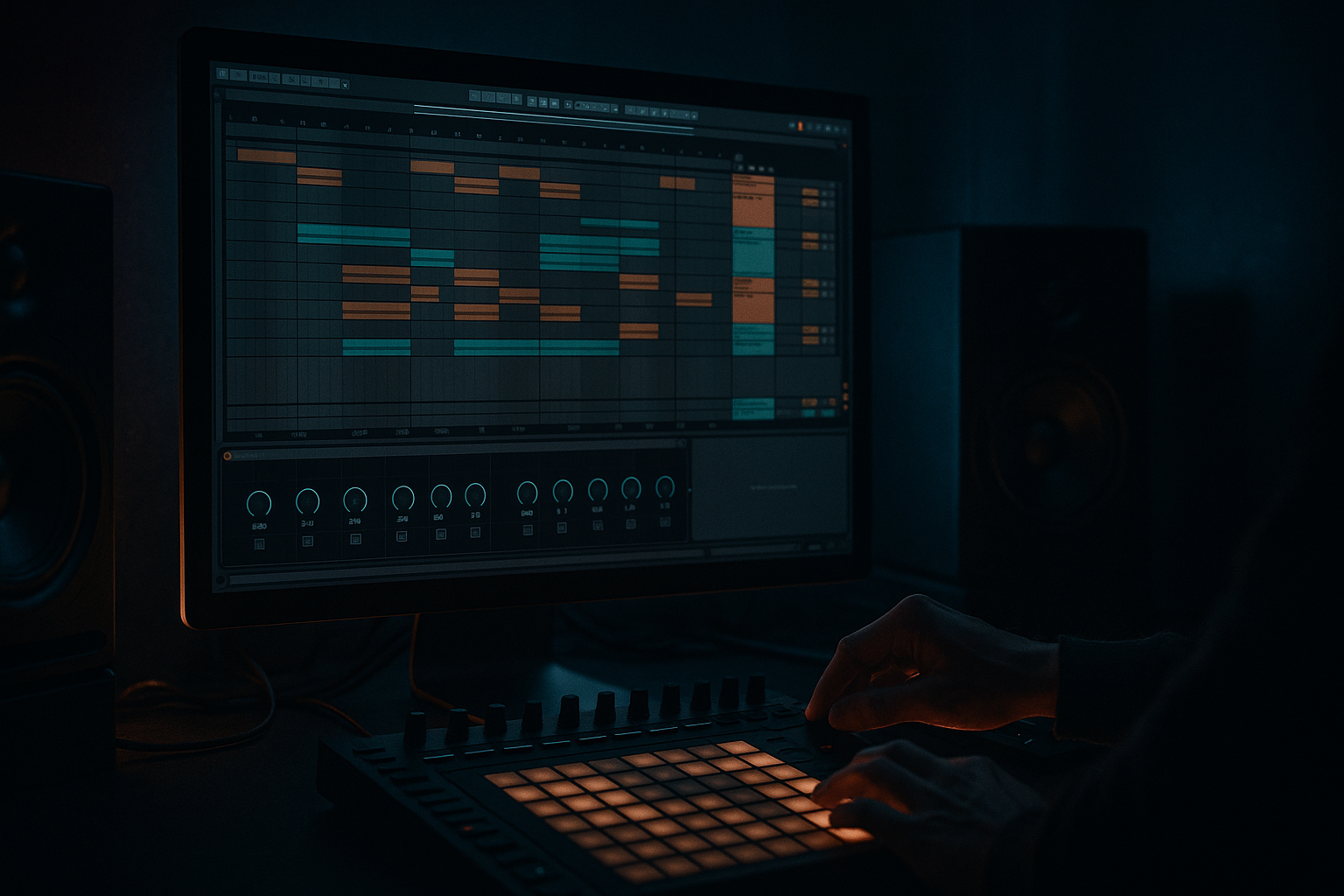
This lesson is about turning one drum break or drum rack into a performance-ready DnB editing workflow using Macro Controls in Ableton Live 12. Instead of manually automating every tiny change, you’ll build a simple setup where a few knobs can shape your break into different jungle-style variations: tighter for a fill, more crushed for a drop, wider for an intro, or more ghost-note-driven for an oldskool switch-up.
In Drum & Bass, this matters because the drum arrangement often carries the energy of the whole track. A solid break edit can make a loop feel like it’s evolving every 4 or 8 bars without rewriting the whole pattern. That’s especially true in jungle, oldskool DnB, rollers, and darker bass music, where movement, grit, and tension are often created by small drum changes rather than huge melodic changes.
You’ll learn how to use stock Ableton devices and Macro mappings to control:
- drum filter movement
- transient bite
- saturation / distortion
- reverb send amount
- sample start or decay behavior
- parallel crush
- variation switches for fills and transitions
- a main break loop with a clean groove
- a heavier drop version with more punch and grit
- a filtered intro version for tension
- a fill variation with more movement and a short delay/reverb tail
- a macro-controlled drum group that lets you tweak all of this from 8 simple knobs
- an oldskool Amen-style chop with ghost notes and snare lifts
- a roller break that opens up before each 8-bar phrase
- a darker half-time switch-up with crushed highs and controlled low-end
- a jungle-style edit where the drums feel like they are “breathing” across the arrangement
- Making the macros do too much at once
- Over-crushing the break
- Ignoring low-end separation
- Automation that changes too abruptly
- Too much stereo width on drums
- No phrase planning
- Use Drum Buss on a return, not just the main drum chain
- Darken the break before the drop, then open it hard
- Use Ghost Notes to keep movement alive
- Keep the bass and kick relationship clean
- Add small bitcrush or sample reduction only on fills
- Use macro-controlled reverb only on the ends of phrases
- Make the drums “speak” in call-and-response
- Use Macro Controls to make your DnB drum edits fast, musical, and repeatable.
- Build a simple drum rack or drum group first, then map key parameters to a few focused macros.
- In jungle and oldskool DnB, filter movement, transient control, grit, and fill FX create evolution without rewriting the whole beat.
- Keep the clean drum signal, then blend in dirt with parallel processing.
- Automate in 4-bar and 8-bar phrases so your drums help the arrangement move.
- Always protect low-end clarity, mono compatibility, and snare/kick punch.
This is a beginner-friendly workflow, but it’s also the kind of setup you can reuse in real tracks to work faster and make more musical decisions. 🎛️
What You Will Build
By the end of this lesson, you’ll have a rack-based break edit system in Ableton Live 12 that lets you move from one core drum loop to several useful DnB variations.
Specifically, you’ll build:
Musically, this could sound like:
This is not just sound design. It’s a workflow for editing drums quickly so your ideas stay in motion.
Step-by-Step Walkthrough
1. Choose a short drum source and organize it first
Start with either:
- a single break sample, or
- a small group of drum hits in a Drum Rack
For a beginner jungle workflow, a break like a 4-bar Amen-style loop is ideal. If you don’t have a break already, use Ableton’s stock browser to load any punchy drum loop, then slice it later.
In Arrangement View, place the break on its own audio track or create a Drum Rack with separate pads for:
- kick
- snare
- hats
- ghost percussion
- fill hit or reverse hit
Keep the session tidy:
- rename tracks clearly
- color-code your drum group
- group all drum elements into one Drum Group
Why this works in DnB: drum editing gets messy fast. If your drum system is organized from the start, you can move quickly between groove ideas instead of getting lost in clip clutter.
2. Build a basic drum chain with stock Ableton devices
On the Drum Group or break track, add these stock devices in this order:
- EQ Eight
- Drum Buss
- Saturator
- optional Glue Compressor
Suggested starter settings:
- EQ Eight: high-pass very gently on non-bass drum layers if needed, around 20–35 Hz, just to remove sub rumble
- Drum Buss: Drive around 5–15%, Crunch around 5–20%, Boom low or off at first
- Saturator: Drive around 2–6 dB, Soft Clip on
- Glue Compressor: light compression, about 1–2 dB gain reduction
If you’re using a sliced break, don’t overprocess it yet. The goal is to create a flexible chain that can be pushed by macros later.
Beginner tip: think of this as your “drum tone rack.” You’re not finalizing the sound yet — you’re making a controllable foundation.
3. Create an Audio Effect Rack and map your key controls
Select the devices on the drum track, then group them into an Audio Effect Rack. This gives you Macro Controls.
Now map a few important parameters to macros. A strong beginner setup is:
- Macro 1: Break Tone
- map to EQ Eight high shelf or filter cutoff
- Macro 2: Punch
- map to Drum Buss Drive
- Macro 3: Dirt
- map to Saturator Drive
- Macro 4: Glue
- map to Glue Compressor threshold or Dry/Wet
- Macro 5: Air
- map to a high-shelf boost or reverb send
- Macro 6: Width
- map to utility stereo width on hats or top layers
- Macro 7: Fill Level
- map to delay/reverb return send amount
- Macro 8: Break Open
- map to a filter cutoff or transient-style change on the break group
If you’re using a single break sample, one excellent move is to map the Auto Filter cutoff and Resonance to a macro pair:
- cutoff range: roughly 200 Hz to 18 kHz
- resonance: keep subtle, around 0.5 to 20%
Keep macro ranges sensible. Don’t let one knob destroy the sound instantly. In DnB, control matters more than extreme movement.
4. Add variation using filter and transient movement
Now make the break feel like it can evolve during the track.
Add Auto Filter before or after your main tone devices. Map the cutoff to a macro so you can create:
- intro versions: darker, more closed
- drop versions: brighter, more open
- build versions: rising movement
Useful settings:
- low-pass filter for tension, cutting highs down to around 3–8 kHz in intros
- open it fully for drop sections
- use a gentle resonance, not a whistle
If you want more punch, use:
- Drum Buss Transients around +10 to +30
- or transient emphasis via EQ shaping around the snare crack and kick click
For jungle and oldskool DnB, this is especially effective on the snare in the 2 and 4 spots, or on chopped break snare hits. A small transient lift can make the break sound more alive without adding extra notes.
Why this works in DnB: the genre relies on contrast. A darker, filtered phrase before the drop makes the open drop feel bigger, even if the pattern barely changes.
5. Set up a parallel crush layer for heavier sections
To get more weight without ruining clarity, create a parallel chain inside the rack.
Duplicate the chain or use a second chain in the rack and process it harder with:
- Saturator
- Redux or Overdrive
- Drum Buss
- maybe a Compressor
Keep this chain quieter than the main chain. Suggested approach:
- crushed chain level: start around -12 to -18 dB lower than the main
- saturation drive: 6–12 dB
- Redux: use lightly, maybe reduce bit depth subtly rather than fully destroying the sample
Map a macro called Crush Blend to this chain’s volume.
This gives you a classic DnB technique: a clean drum signal for punch, plus a dirty layer underneath for aggression. It’s great for:
- neuro-influenced drum weight
- darker roller loops
- oldskool jungle bite
- fills that need more urgency
Keep the low end under control. If the crushed chain starts muddying the kick, reduce its low frequencies with EQ Eight.
6. Use macro-linked send effects for fills and transitions
Create two return tracks:
- Return A: short reverb
- Return B: tempo delay
On Return A, use Reverb with:
- decay around 0.6–1.4 seconds
- low cut on
- high cut to darken the tail
On Return B, use Echo or Delay with:
- short feedback for rhythmic echoes
- filtered repeats
- tempo-synced values like 1/8 or 1/16 for quick fill energy
Now map a macro in the drum rack or group called Fill FX to the send amount.
Practical use:
- keep it at 0 for most of the loop
- automate it up slightly in the last hit of a 4-bar phrase
- use it for snare throws, tom hits, or break stabs
In DnB arrangement terms, this helps your drums “speak” at phrase ends. Even one snare tail or filtered delay can make an 8-bar section feel arranged instead of looped.
7. Automate macro controls instead of individual device parameters
This is the real workflow win.
Go into Arrangement View and draw automation for your macros rather than every device separately. For example:
- Break Tone closes during the first 4 bars of an intro, then opens at the drop
- Punch rises slightly on the last bar before a drop
- Crush Blend comes in only during fills or heavier second halves
- Fill FX spikes on bar 8 or bar 16
- Width narrows for the intro and opens in the drop
Suggested arrangement example for an 8-bar phrase:
- Bars 1–4: darker filtered break, low FX
- Bars 5–6: slight rise in brightness and punch
- Bar 7: fill FX increase
- Bar 8: open filter, add crush blend, let snare tail breathe into the drop
This is a very DnB-friendly way to think:
- intro = controlled
- drop = open and assertive
- transition = small but noticeable change
If you’re working in Session View, you can also record knob movements live and then tidy up later in Arrangement View.
8. Turn one break into multiple clip variants
In Ableton Live 12, duplicate your drum clip and create versions:
- A: clean loop
- B: filtered loop
- C: heavier loop
- D: fill loop
Then assign your macros to make each clip do a slightly different job.
A practical oldskool DnB workflow is:
- Clip A: main groove
- Clip B: loop with slightly more hat energy
- Clip C: snare-heavy variation
- Clip D: one-bar turnaround with delay/reverb tail
You can also use clip envelopes for small edits like:
- velocity changes on ghost notes
- transient hits
- filter sweeps on the break sample
If you’re using a Drum Rack, make one pad a “fill hit” and one pad a “transition crash.” That lets you move between sections without rebuilding the whole rhythm.
Common Mistakes
Fix: keep each macro focused. One for tone, one for punch, one for dirt, one for FX.
Fix: use parallel blend instead of replacing the clean signal. DnB needs impact and clarity, not just distortion.
Fix: high-pass non-kick drum layers gently and keep sub frequencies for the bassline, not the break.
Fix: use smooth curves and small moves. Jungle tension often comes from subtle evolution, not huge sweeps.
Fix: keep kicks and main snares centered. Only widen hats, ambience, or top percussion.
Fix: think in 4-bar and 8-bar sections. DnB arrangements live or die by how the drums mutate over time.
Pro Tips for Darker / Heavier DnB
Blend a compressed, driven return underneath the drums for extra density without flattening transients.
A closed filter into an open filter makes the drop hit harder, especially in rollers and jungle edits.
Lower ghost snare or hat velocities can make a loop feel human and oldskool. Don’t quantize everything to death.
If your drums are heavy, your bassline should leave space. Use Utility to check mono and keep low-end centered.
A little Redux on the final hit of a phrase can add that grimy underground edge without wrecking the whole loop.
Long tails everywhere will blur the groove. In DnB, space is part of the impact.
Let the kick/snare answer the bassline. A strong macro workflow makes it easy to open the break when the bass drops out, then close it when the bass returns.
Mini Practice Exercise
Set aside 10–20 minutes and do this:
1. Load one break or drum loop into Ableton.
2. Group it and build an Audio Effect Rack with at least 4 macros.
3. Map:
- one macro to filter cutoff
- one to saturation or Drum Buss Drive
- one to reverb/delay send
- one to crush blend or drum compression
4. Duplicate the loop into 3 clip versions:
- intro
- drop
- fill
5. Automate the macros over 8 bars:
- bars 1–4 darker and tighter
- bars 5–7 more open
- bar 8 more FX and grit
6. Bounce or loop it and listen for:
- does the drop feel bigger?
- do the fills feel intentional?
- is the break still clear in mono?
If it sounds muddy, reduce the crush amount before anything else.
Recap
If you can make one break feel like multiple sections with macros, you’re already working like a DnB producer.

