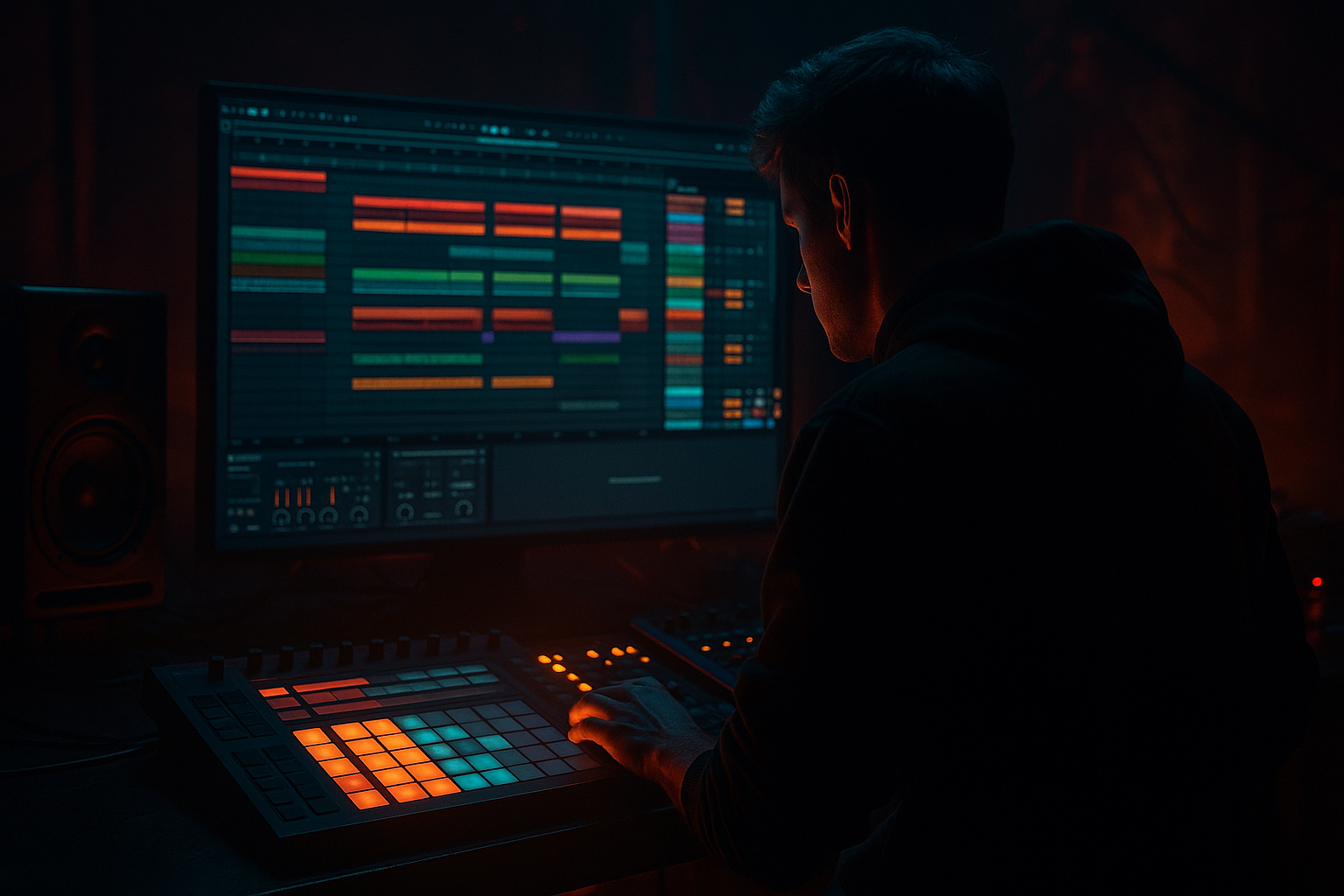
Main tutorial
Warp oldskool DnB swing using resampling workflows in Ableton Live 12 🥁⚡
Skill level: Intermediate
Category: Arrangement (with groove + audio workflows)
---
1. Lesson overview
Oldskool jungle/DnB swing isn’t just “shuffle.” It’s the push-pull of slightly late snares, rushed ghost notes, and hats that breathe—often created by sampling, time-stretching, and re-sampling rather than perfectly programmed MIDI.
In this lesson you’ll build a resampling-based swing workflow in Ableton Live 12 that lets you:
- start from clean programmed drums
- impose authentic oldskool groove via warping + resampling
- “print” that feel into audio so it’s consistent and arrangement-ready
- create variations (fills, drops, edits) quickly—like classic hardware-era production
- A 16–32 bar rolling DnB drum loop (Amen-ish swing, but your own pattern)
- A “printed” swung drum audio stem (tight and consistent)
- 3 variation clips:
- A reusable Resample Swing Rack template for future sessions
- Group your drum tracks and name the group DRUM BUS.
- On RESAMPLE, set Audio From → DRUM BUS (Post FX).
- Use a Drum Rack with: kick, snare, closed hat, open hat, ghost snare, ride.
- Start with a basic 2-step DnB skeleton:
- For full drum loops: Complex is okay, but can smear highs.
- For punchy breaks: try Complex Pro (Formants 0, Envelope ~80–120).
- For tighter transients: Beats mode can work but may get clicky.
- Warp: ON
- Mode: Complex Pro
- Envelope: 100
- Formants: 0
- snares slightly late (a few ms)
- hats rushing into the snare
- small “stutters” before transitions
- Bars 1–8: full drums but filtered hats (low-pass)
- Bars 9–16: open it up + add ghost/snare variation
- Bars 17–24: main full-energy loop
- Bars 25–32: turnaround edits + fill into next section
- Automate Auto Filter on drums:
- Or automate Utility gain down -3 dB then back to 0 at the drop.
- Over-warping everything: if every transient is pinned, you kill the natural bounce. Warp fewer points, move them slightly.
- Wrong warp mode: Beats mode can click; Complex can smear hats. Try Complex Pro and commit.
- Not locking 1.1.1: if your first downbeat drifts, the whole tune fights you later.
- Swing without dynamics: oldskool feel = timing and velocity. After printing, add dynamics with Drum Buss, Saturator, or clip gain edits.
- No A/B reference: keep a break loop muted for instant comparison. If your swing feels “polite,” you’ll hear it immediately.
- Start with clean programmed drums so you can control the swing intentionally.
- Use Groove Pool (or break-extracted groove) as a starting feel, not the final.
- Resample → Warp → Resample again to “bake” oldskool swing into audio.
- Warp lightly: a few markers, tiny nudges, focused on snares/hats.
- Arrange with audio edits and variations—classic jungle workflow that stays fast and musical.
---
2. What you will build
By the end, you’ll have:
1) main groove
2) busier hats/ghosts
3) a 1-bar turnaround fill
---
3. Step-by-step walkthrough
Step 0 — Session setup (fast but important)
1. Set tempo to 172–176 BPM (classic rolling range).
2. Create these tracks:
- DRUMS (MIDI): your programmed kit (Drum Rack or Simpler slices)
- DRUM BUS (AUDIO): for glue + color (group your drums to this)
- RESAMPLE (AUDIO): this will record printed swing
- REFERENCE BREAK (AUDIO) (optional): drop in a classic break for feel comparison
Routing prep:
This captures your groove and your processing.
---
Step 1 — Build a clean “too perfect” DnB pattern (so we can wreck it nicely 😈)
On DRUMS (MIDI):
- Snare: on beats 2 and 4
- Kick: beat 1, plus a couple supporting hits (e.g., 1a / 3& depending on vibe)
- Closed hats: 1/16 notes
Keep velocities fairly even for now; we’ll reintroduce “human” after the warp stage.
---
Step 2 — Add a controlled “break-like” groove source (Groove Pool)
We want oldskool swing—but not the generic 16-swing. Two solid approaches:
#### Option A: Use Ableton Grooves (quick)
1. Open Groove Pool.
2. Load something like:
- Swing 16-55 (start point)
- or any MPC-style groove if you have it
3. Apply the groove to your main drum clip:
- Timing: 30–60%
- Velocity: 10–25%
- Random: 2–8%
4. Commit is NOT the goal yet—we’re using this as a “proto-feel” to print and warp.
#### Option B: Extract groove from a break (more authentic) 🧠
1. Drop a break loop into REFERENCE BREAK (could be Amen, Think, etc.).
2. Right-click the clip → Extract Groove.
3. In Groove Pool, apply that groove to your programmed drum MIDI.
- Timing: 40–80% (oldskool grooves often need more)
- Velocity: 0–20% (depends how dynamic your MIDI already is)
---
Step 3 — Print (resample) your drums into audio
This is where it starts to feel hardware.
1. Arm RESAMPLE track.
2. Set Arrangement Record on and record 8 or 16 bars of your groove.
3. Consolidate the recorded audio (Cmd/Ctrl + J). Name it:
“Drums_Print_175bpm_v1”.
Now you have an audio loop that you can warp as a whole, like an old sampled break.
---
Step 4 — Warp for oldskool swing (the “wonk” stage) ⏱️
Double-click the printed clip on RESAMPLE.
#### Warp Mode choice:
Suggested starting point:
#### Set the downbeat properly
1. Find the true first kick transient.
2. Right-click → Set 1.1.1 Here.
3. Right-click → Warp From Here (Straight) to lock the loop.
#### Create intentional drift (the magic)
Old jungle swing often has:
Do this with warp markers:
1. Add warp markers on key transients:
- main snare hits (2 and 4)
- a couple kicks
- the busiest hat clusters
2. Nudge only a little:
- Late snares: +5 to +15 ms (start with +8 ms)
- Early hats before snare: -3 to -10 ms
- Ghosts: make them slightly late or early depending on your reference
3. Avoid moving the very first downbeat marker after it’s locked.
Workflow tip: zoom to sample level and listen in loop while nudging. Your ears decide; the grid is just a suggestion.
---
Step 5 — Re-print (resample again) to “bake in” the swing
Once it grooves:
1. Create RESAMPLE 2 (Audio).
2. Set Audio From → RESAMPLE (Post FX).
3. Record 8–16 bars again. Consolidate.
Name it: “Drums_SwingPrinted_v2”.
Now your swing is “locked in” as audio—easy to arrange without Warp headaches.
---
Step 6 — Clean-up and enhance with a classic DnB drum bus chain 🔧
Put these on DRUM BUS before resampling if you want the tone printed, or after if you want flexibility. I usually print mild glue, then do final mix processing later.
Suggested stock chain (in order):
1. EQ Eight
- HP filter around 25–35 Hz (24 dB/oct)
- tiny dip 250–400 Hz if boxy
2. Drum Buss
- Drive: 5–15%
- Crunch: 0–10% (careful)
- Boom: 20–40 Hz, Amount 5–20% (subtle)
3. Glue Compressor
- Attack: 3 ms
- Release: Auto
- Ratio: 2:1
- Aim for 1–3 dB GR
4. Saturator (soft clip vibe)
- Mode: Soft Sine or Analog Clip
- Drive: 2–6 dB
- Output: trim to match level
Optional: Roar for darker aggression (see Pro Tips section).
---
Step 7 — Arrangement moves: build that oldskool “rolling narrative” 🧱
Now that your groove is printed, arrange like classic jungle/DnB:
#### A) 32-bar drop structure (simple and effective)
#### B) Create variations fast (audio slicing)
1. Duplicate your printed swung clip into 3 clips.
2. For Variation 2 (busier):
- Use Slice to New MIDI Track (right-click audio)
- Choose Transient slicing
- Re-trigger a few extra hat/ghost slices (very subtle)
3. For the 1-bar fill:
- Take the last bar
- Add a micro-stutter: duplicate a 1/16 snare/hat slice 2–3 times
- Pitch one slice down -2 to -5 semitones (old sampler vibe)
#### C) Oldskool tension trick: “pre-drop suck”
- 2 bars before drop, HP up to 200–400 Hz, then slam back to full
---
4. Common mistakes
---
5. Pro tips for darker/heavier DnB 🌑
1. Parallel crush (classic nasty bus)
- Create a return track “CRUSH”:
- Roar (Medium distortion, Dynamics on)
- EQ Eight (low-pass ~8–12 kHz, small boost 180–220 Hz if needed)
- Glue Compressor (harder: 4:1, 3–6 dB GR)
- Send drums 5–20%. Keeps weight without killing transients.
2. Shadow hats without harshness
- After printing, use EQ Eight to notch any harshness around 7–10 kHz.
- Add Redux lightly (Downsample small amount) for crunchy “tape/sampler air”.
3. Make snares feel late without losing impact
- Instead of moving the snare a lot, move the hats early slightly. The contrast makes the snare feel heavy and behind the beat.
4. Re-sample at different warp intensities
- Print v1 mild swing, v2 heavier swing.
- In arrangement, alternate every 8 bars to create evolving momentum.
---
6. Mini practice exercise (15–20 minutes) 🎯
1. Program a clean 8-bar drum loop at 174 BPM.
2. Extract groove from a break and apply it (Timing 60%, Random 5%).
3. Resample to audio (Print v1).
4. Warp only 4 points: the two snares + two hat clusters.
- Push snares +10 ms
- Pull hats -5 ms
5. Resample again (Print v2).
6. Arrange 16 bars:
- Bars 1–8: filtered hats
- Bars 9–16: full loop + one 1-bar fill at bar 16
Deliverable: a 16-bar drop that feels swung even with the metronome off.
---
7. Recap ✅
If you want, tell me what substyle you’re aiming for (early jungle, techstep, modern rollers) and I’ll suggest specific timing offsets + a drum bus chain tuned to that vibe.

