Main tutorial
Lesson Overview
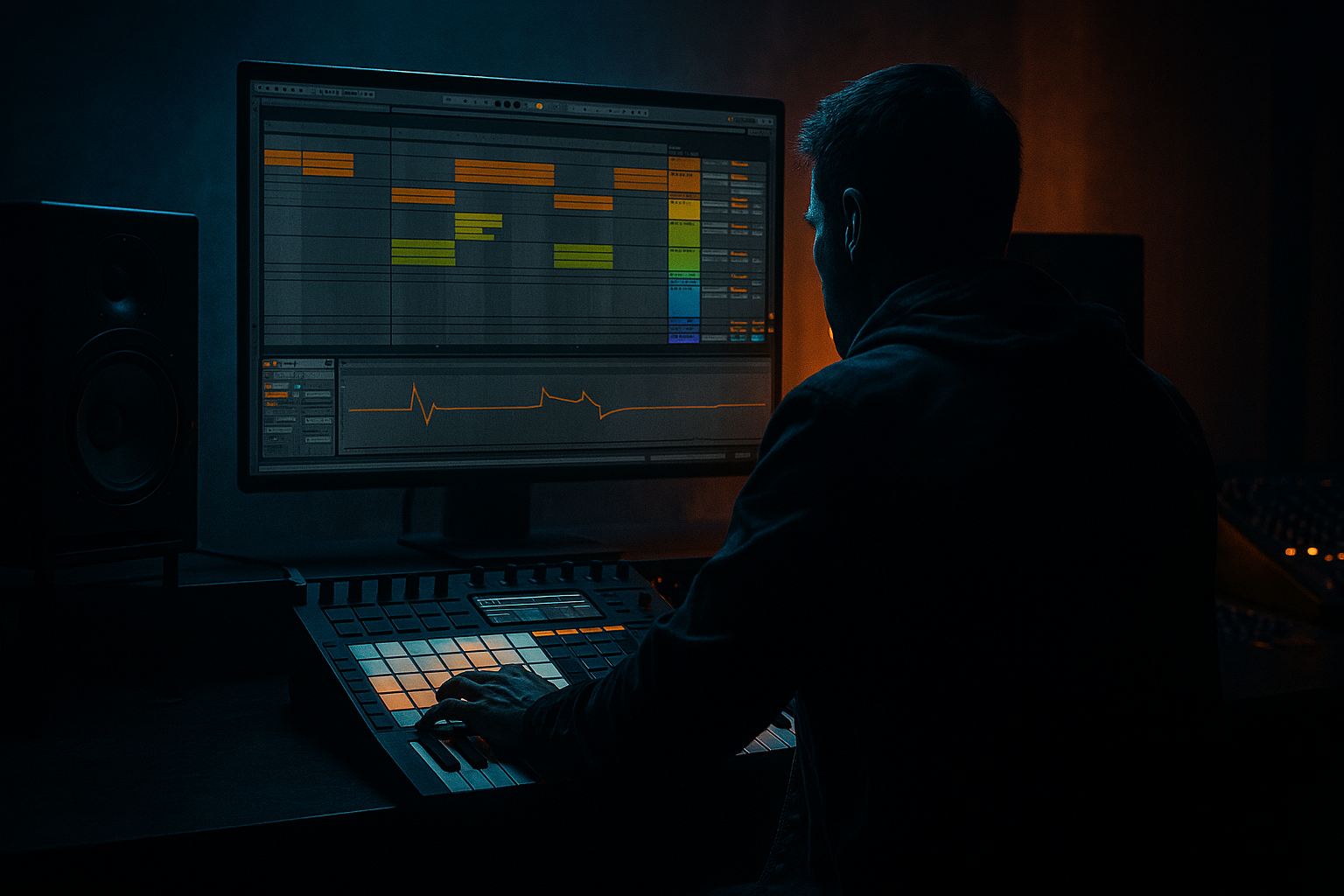
This lesson is about building a warehouse-style amen variation balance for a sunrise set emotional moment in a Drum & Bass track inside Ableton Live 12. In practical terms, that means taking a heavy, DJ-ready section and shaping it so it can evolve from dark, functional pressure into uplifting, cinematic release without losing the physical impact that makes DnB work on a system.
In DnB, especially in rollers, jungle-leaning hybrids, neuro-influenced sections, and darker bass music, the strongest emotional moments usually come from controlled variation rather than big obvious changes. The drop keeps its identity, but the drum phrasing, bass answer phrases, harmonic color, and atmosphere density shift enough to feel like sunrise is arriving. That balance matters because a warehouse crowd needs both:
- sub and drum consistency for movement
- variation and emotional lift for payoff 🌅
- a core amen break with edited ghost notes, tight transient control, and controlled swing
- a sub-bass foundation that stays mono and stable
- a reese or mid-bass answer layer that changes every 4 or 8 bars
- a secondary emotional layer using pads, chords, or resampled texture
- automation-driven tension/release using filters, reverb throws, distortion, and mutes
- a DJ-friendly arrangement that could sit naturally after a darker drop or lead into a euphoric final chorus
- first 8 bars: locked-in warehouse pressure, sparse harmony, raw drums
- next 8 bars: the same groove, but with more open tops, chord hints, and a slightly wider harmonic field
- final bars: a sunrise emotional lift where the groove remains heavy but the palette opens up
- Over-variating the break
- Letting the sub fight the kick or snare
- Making the emotional layer too wide or too bright too early
- Using too much reverb on the drums
- Random bass notes without phrase logic
- Ignoring headroom
- Sidechaining too hard
- Add a parallel distortion return using Saturator or Drum Buss on a send, then blend it in only for the final 4 bars.
- Use Resonators or Corpus very subtly on atmospheric layers to create metallic warehouse resonance without washing out the mix.
- For a darker reese, duplicate the mid-bass, detune one layer slightly, and keep one layer more distorted while the other stays cleaner for definition.
- Use Shifter or very slow pitch automation on texture layers to create unease without obvious FX clichés.
- Keep the sub lane almost boring on purpose; let the upper layers do the emotional work.
- If the section feels too “pretty,” reduce chord brightness, narrow the stereo image, and bring back a more broken break edit.
- For more underground character, add a low-level room sample or vinyl air under the break and automate it up only in transitions.
- Try muting the main snare for half a bar before the sunrise lift, then let the return hit harder by contrast.
- Use a drum bus saturation stage before the compressor to glue the amen and snare layers together, but don’t flatten the transients.
- If the mix feels thin, check whether the bass notes are leaving too much space in the 90–160 Hz zone where the kick and snare body should speak.
- stable drums
- mono sub discipline
- bass phrase call-and-response
- subtle 4-bar variation
- controlled harmonic lift
- automation-led tension and release
You’ll learn how to create that balance using stock Ableton tools: Drum Rack, Simpler, Sampler, Wavetable, Operator, Saturator, Glue Compressor, Auto Filter, Drum Buss, Utility, Echo, Reverb, Shifter, EQ Eight, and automation. The end result should feel like a tune that can open a closing set, turn a dark room toward dawn, and still hit hard enough for a serious soundsystem.
What You Will Build
By the end of this lesson, you’ll have a 16-bar amen variation section that feels like a warehouse-to-sunrise transition:
Musically, think:
The key is not to “change the track.” It’s to change the emotional perception of the same groove.
Step-by-Step Walkthrough
1. Build the core 16-bar groove with a strict DnB backbone
Start with the drums before any harmony. In Ableton Live 12, place your amen on an Audio Track or in Simpler if you want slice control. For advanced control, drag the break into Slice mode in Simpler and set slicing to Transient or 1/16 depending on the break’s cleanliness.
Aim for a classic 174-ish feel:
- kick emphasis on the main downbeats
- snare backbeat with a strong second-hit variation
- ghost hats and kick chatter between the main hits
- subtle push-pull from break timing, not rigid quantization
Use Groove Pool with a light swing source, or extract groove from the original break if it already has vibe. Keep groove amount moderate, roughly 10–30%, because in warehouse DnB you want movement, not wobble. A good advanced trick is to apply groove to the break layers but keep the sub and main snare more stable so the pocket remains solid.
Why this works in DnB: the break’s microtiming creates the human energy, while the kick/snare anchors the mix for club playback.
2. Split the drums into layers for balance and control
Don’t run the entire drum feel from one audio file. Separate your drum system into at least three lanes:
- main break layer
- snare reinforcement layer
- top percussion / ride layer
For the main break, use EQ Eight to carve unnecessary low end below roughly 90–120 Hz if the kick/sub need space. Then add a Drum Buss lightly:
- Drive: around 3–8
- Boom: very subtle, or off if the break already has low weight
- Transients: slightly positive for snap
On the snare reinforcement track, layer a clean snare or rimshot using Drum Rack. Keep it short and punchy. A useful range:
- transient-shaping with Drum Buss Transients: +5 to +20
- a touch of Saturator with Soft Clip on
- EQ boost around 180–220 Hz if it needs chest, and 2–5 kHz for crack
For the top layer, high-pass aggressively and keep it moving subtly with groove. This gives the break air without stealing low-end focus.
3. Write a bassline that answers the drums, not competes with them
The bass should be phrased like a conversation. Use a sub track plus a mid-bass/reese track. In Ableton:
- sub: Operator or Wavetable with a sine/triangle core
- mid: Wavetable, Analog, or resampled audio into Simpler
For the sub:
- keep it mono with Utility
- use a low-passed sine or triangle
- apply subtle saturation only if needed
- keep notes longer under the snare gaps, shorter where the break already talks
For the mid-bass:
- build a reese from two detuned saws in Wavetable
- low-pass around 150–400 Hz depending on how much growl you want
- use slow modulation on wavetable position or detune
- add Auto Filter automation for phrase movement
Write the bass as call-and-response:
- bars 1–2: sparse, heavy, grounded
- bars 3–4: add a short answer phrase
- bars 5–8: introduce a variation note or rhythmic pickup
- bars 9–16: repeat the identity but alter the final tail or octave hit
A strong range for the bass envelope:
- attack: 0–10 ms
- decay: medium-short on mid-bass for punch
- release: short enough to avoid mud, but not so short it feels disconnected
4. Create the amen variation system with 4-bar phrase logic
This is the core of the masterclass. Instead of random fills, design a 4-bar variation cycle that can scale across 16 bars.
Use the following structure:
- Bar 1: original groove, minimal bass movement
- Bar 2: add one ghost snare or kick pickup
- Bar 3: slightly more open hat or ride energy
- Bar 4: fill or micro-break edit into the next phrase
In Ableton Live 12, use Duplicate Loop and then make controlled edits:
- shift one ghost note earlier or later by a few milliseconds
- mute one break slice in bar 4
- add a reverse hit or snare flam
- create a one-beat drop-out before a return
Keep the edits subtle. The goal is to make the break feel alive without destroying the loop’s internal logic. For advanced groove, use Clip Envelope or Automation on filter cutoff and send levels to create variation without changing the MIDI pattern too much.
A useful workflow is to keep the original 4-bar groove intact, then create:
- Variation A: minimal
- Variation B: slightly more open
- Variation C: fill-rich
- Variation D: sunrise release
5. Design the sunrise emotion using harmony, but keep it underground
Sunrise emotion in DnB should not become a soft trance pad blanket. Keep the harmony restrained and functional. Use Wavetable, Operator, or Sampler to create a chord layer with a narrow identity:
- minor 7, sus2, or open fifth voicings
- high-pass the chord layer around 180–300 Hz
- keep low mids under control with EQ Eight
- add slow movement with Auto Filter, Reverb, or Echo
A strong arrangement trick: introduce the chord layer only in the second half of the 16 bars, and automate the send to reverb so it blooms as the set energy starts to feel like dawn. Keep the first half almost dry. Then:
- bars 1–8: chords barely present, maybe filtered texture only
- bars 9–12: more tonal clarity
- bars 13–16: wide, emotional lift
Add a subtle atmospheric layer from resampled vinyl noise, field recording, or processed break tails. Use Reverb with a decay around 4–8 seconds for atmosphere, but high-pass the return so it doesn’t smear the sub.
6. Balance the bass and drums with sidechain and bus discipline
This is where the “balance masterclass” part really matters. Route drums to a drum bus and bass to a bass bus. Then decide what should dominate in each frequency region:
- kick/snare presence around 100 Hz to 5 kHz
- sub authority below 60–80 Hz
- mid-bass texture around 150–800 Hz
- air and motion above 8 kHz
Use Glue Compressor or Compressor on the bass bus for gentle control, and sidechain the bass to the kick/snare if the groove needs breathing room. In DnB, keep sidechain subtle:
- attack: 1–10 ms
- release: sync to the groove, often 60–140 ms
- ratio: 2:1 to 4:1
- aim for 1–3 dB of gain reduction, not pumping for its own sake
Also use Utility on the bass bus to mono everything below the crossover if needed. A simple but powerful approach is to keep the sub fully mono and let only the mid-bass widen slightly with chorus, reverb, or stereo delay. That keeps the floor stable while the top-end emotion opens up.
7. Automate transitions so the section feels like a journey
Your sunrise energy should arrive through automation, not huge arrangement jumps. In Ableton Live 12, automate:
- Auto Filter cutoff on the bass or chord layer
- Reverb send on the last snare or break stab
- Echo feedback on the final fill
- Saturator drive for rising intensity
- Utility width on atmospheres only, never on sub
Try this:
- bars 1–8: filter fairly closed, dry mix, tighter drum presence
- bars 9–12: open the filter by 10–20%, increase ambience slightly
- bars 13–16: widen the atmospheric layer, add a reverb throw on the final snare, and let a delayed chord tail rise into the next phrase
A very effective warehouse technique is to automate a high-pass filter on a return track down to almost no effect during the heavy part, then gradually open it during the sunrise section. That makes the emotional layer appear naturally rather than suddenly.
8. Resample the strongest 2-bar moments for finish-level movement
Advanced DnB often sounds expensive because it commits to resampling. Once your groove is working, resample the best 2-bar or 4-bar section into audio. Then chop it back into:
- drum hits
- bass stabs
- atmospheres
- fills
Use Simpler to reload the resampled audio and play it like an instrument. This lets you create variations that are more organic than MIDI edits alone. You can:
- reverse a tail for a tension pickup
- pitch a one-shot down for a darker stab
- gate a texture with volume automation
- create call-and-response from the resampled reel
This is especially effective for sunrise emotion because the section can gradually become more “memory-like,” as if the original warehouse loop is being heard through dawn light.
Common Mistakes
Fix: keep the core loop stable and only change one or two details per 4 bars.
Fix: mono the sub, check EQ below 120 Hz, and keep the bass envelope tight.
Fix: filter it heavily at first and open it gradually across phrases.
Fix: put ambience on sends and high-pass the return so the low-end stays clean.
Fix: make the bass answer the drum edits every 2 or 4 bars.
Fix: leave space on the master, keep individual channels controlled, and avoid clipping the drum bus.
Fix: in DnB, the groove should breathe, not wobble. Use subtle gain reduction.
Pro Tips for Darker / Heavier DnB
Mini Practice Exercise
Spend 10–20 minutes making a 16-bar sunrise variation pass from an existing 174 BPM DnB loop:
1. Duplicate your current drop or roller loop into a new scene.
2. Make a 4-bar amen variation using only:
- one ghost note edit
- one fill
- one automation move
3. Add a mono sub that only plays in bars 1–8, then opens to a more active answer phrase in bars 9–16.
4. Create a filtered chord or texture layer that starts almost inaudible and becomes clearer by the end.
5. Put one reverb throw on the last snare of bar 16.
6. Resample the full 16 bars and create one reversed fill from it.
7. Bounce the result mentally against a reference: does it still feel like DnB first, emotion second?
If it starts feeling too melodic or too busy, remove one layer and simplify the phrase.
Recap
The goal is to keep the warehouse groove intact while evolving the emotional tone toward sunrise. The winning formula is:
In Ableton Live 12, the fastest path is to build with stock devices, keep the low end disciplined, and let arrangement and automation do the emotional heavy lifting. That’s how you make a DnB section feel both massive in the room and beautiful at dawn.

