Main tutorial
Lesson Overview
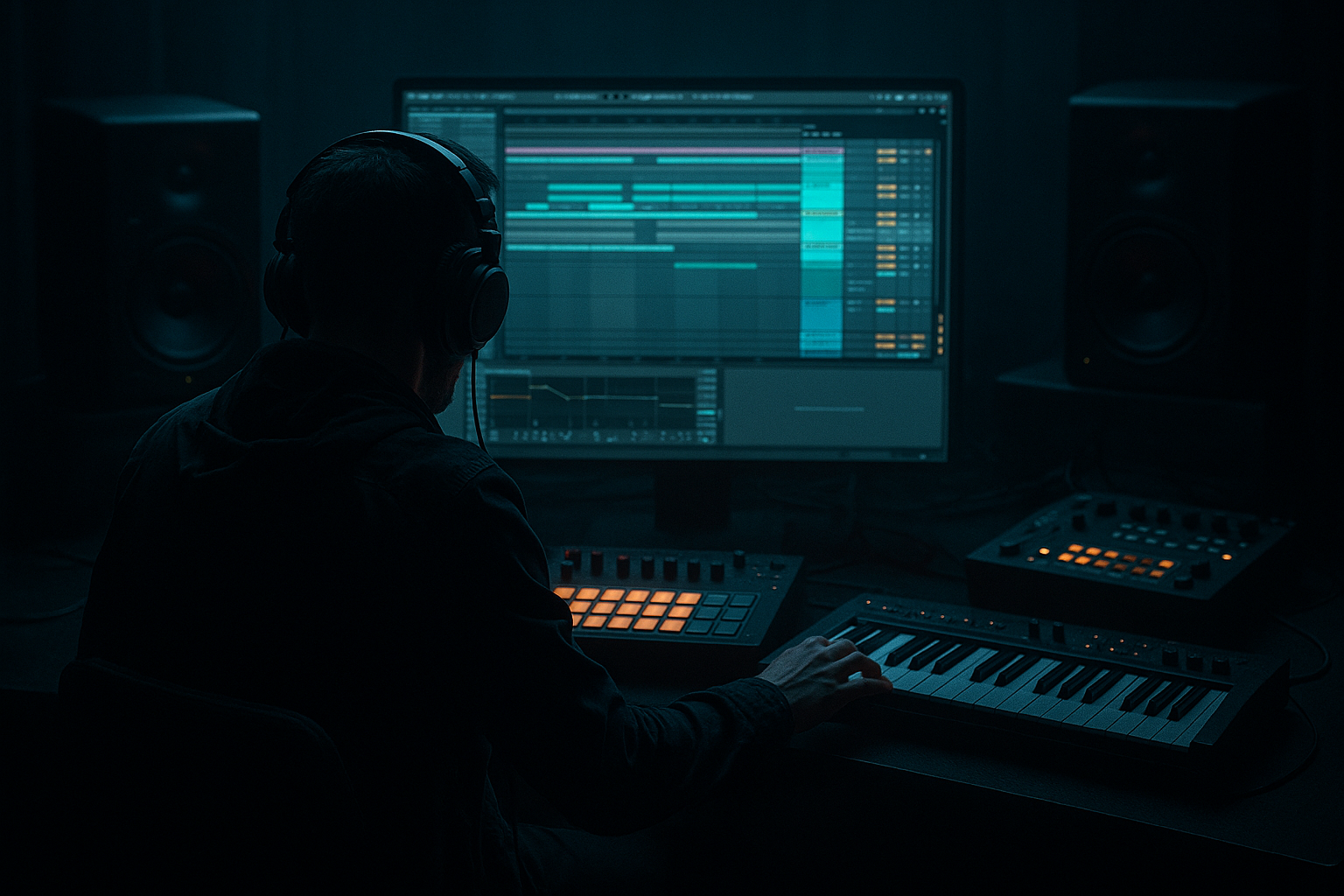
In this lesson, you’ll build a Vinyl Heat-style reese patch layer in Ableton Live 12 for oldskool jungle / early DnB / roller-friendly bassline writing. The goal is not just to make a “big bass sound,” but to make a bass layer that feels like it came from a dusty sampler rack, a worn record, and a late-night rave system — while still being usable in a modern Ableton project.
This technique matters because in Drum & Bass, the bassline is not just low-end support. It is often the main hook, the tension engine, and the thing that makes the drop feel alive. A reese layer gives you movement, width, and attitude. When it’s built carefully, it can sit under a sub, support breakbeats, and provide that classic shadowy, vibrating jungle energy without turning your mix into mud.
For beginner producers, this lesson is especially useful because it teaches a smart workflow:
- build the sound from simple stock devices,
- keep the sub clean,
- create movement with controlled detune and modulation,
- and shape the bass so it works with breakbeats, not against them.
- 1-bar and 2-bar repeating phrases
- call-and-response with drums
- short note stabs under break edits
- darker, moody riffs in the 140–174 BPM range
- DJ-friendly sections where the bass can evolve without needing a huge melody
- sub foundation below
- vintage reese bite in the mids
- a little grit and vinyl heat
- clean enough to leave room for kick and break
- Making the sub too wide
- Using too much detune
- Distorting the sub instead of the reese layer
- Writing too many notes
- Ignoring the drums while designing the bass
- Letting low-mids pile up
- Over-automating everything
- Layer your bass by function, not by “more sound”
- Use tiny pitch movement
- Let the drums lead the groove
- Resample a filtered version
- Control harshness before it hurts
- Use tension/release structure
- Don’t forget arrangement contrast
- Build the bass in two layers: mono sub + stereo reese.
- Use Operator for the clean low end and Wavetable/Analog for the moving reese body.
- Keep detune, saturation, and width controlled, not extreme.
- Write simple DnB phrases with space, especially around the drums.
- Use filter automation, sidechain, and EQ to keep the bass powerful but clear.
- For jungle and oldskool vibes, think worn texture, movement, and tension — not just loudness.
By the end, you’ll have a reusable Ableton rack concept you can drop into oldskool jungle patterns, darker rollers, or stripped-back DnB intros and drops.
What You Will Build
You’ll build a two-layer bass setup:
1. A solid mono sub layer that carries the low-end weight.
2. A Vinyl Heat reese layer above it that adds:
- warm detuned movement,
- a slightly worn / saturated character,
- stereo width in the upper bass only,
- and that classic “alive but controlled” jungle tension.
Musically, this bass works best for:
Think of the result as a bass sound that feels like:
Step-by-Step Walkthrough
1. Set up a simple DnB bass lane
- Create a new MIDI track and name it Vinyl Heat Reese.
- Set your project tempo to a Drum & Bass range, for example 170 BPM for classic jungle energy or 174 BPM for a more modern DnB pace.
- Drop in a simple 1-bar MIDI clip with just one note to start. Use a note like F1, G1, or A1 depending on your track key.
- Keep the first test note short, around 1/8 or 1/4 note length. In DnB, short notes often feel tighter and leave room for the break.
- If you already have drums, loop a break and listen while you design the bass. This matters because a reese that sounds huge alone may fight the kick and snare once the break comes in.
2. Build the sub first with Operator
- On the track, drop in Operator.
- Initialize the patch by simplifying it:
- Use a sine wave for oscillator A.
- Turn off or ignore extra oscillators for the sub part.
- Set the octave low so it lives in the sub region.
- Keep it clean and stable:
- Glide/portamento: optional, very small amounts only if you want sliding oldskool phrases.
- Volume: conservative, so you have headroom.
- This sub should be mono. In Ableton, use Utility after Operator and set Width to 0% for the sub layer if needed.
- Why this works in DnB: the sub provides the physical weight, while the reese layer can move freely above it. That separation is a classic low-end strategy in Drum & Bass, especially when fast breakbeats are involved.
3. Create the reese body with Wavetable or Analog
- Add a second Instrument Rack chain or a second MIDI track if you prefer a clearer beginner workflow.
- For the reese layer, use Wavetable or Analog.
- A simple starter setup in Wavetable:
- Oscillator 1: a saw or saw-like wavetable.
- Oscillator 2: another saw, slightly detuned.
- Keep the unison modest at first.
- If you use Analog, choose two saw oscillators and detune them slightly.
- Good starting ranges:
- Detune: small to moderate, roughly 5–20 cents total between oscillators
- Attack: near zero
- Release: around 100–300 ms for tight notes, or longer if you want a more rolling tail
- The goal is not a supersaw trance sound. You want a nasal, vibrating, unstable reese that feels like it is constantly shifting.
4. Shape the motion with filter movement
- Add a low-pass filter inside the synth or use Ableton’s Auto Filter after it.
- Start with the cutoff fairly low so the sound stays dark:
- Cutoff: somewhere around 200 Hz to 1.5 kHz, depending on how much bite you want
- Resonance: moderate, around 10–35%
- Add slow motion using automation or an LFO if available in your device:
- Make the cutoff move subtly over 1 or 2 bars
- Try a small rise into the end of a phrase, then reset
- Beginner-friendly method: automate the filter cutoff in the Arrangement View so the bass “opens up” on the second half of a 2-bar loop.
- This is a big part of jungle character: the bass should feel like it is breathing and morphing, not sitting flat.
5. Add Vinyl Heat grit with Saturator and Drum Buss
- After the synth, add Saturator.
- Start gently:
- Drive: around 2–6 dB
- Soft Clip: on if you want safer peak control
- Output: trim to avoid getting louder just because of distortion
- If you want more aggressive edge, add Drum Buss after Saturator:
- Drive: low to moderate
- Boom: very carefully, or off for now if your sub is already strong
- Crunch: use lightly for upper harmonic bite
- The “Vinyl Heat” character comes from the idea of slightly worn, warmed, compressed bass energy — not pristine digital smoothness.
- Keep the distortion mostly on the reese layer, not the pure sub. This preserves low-end clarity while adding attitude in the mids.
6. Control stereo width so the bass stays club-safe
- Use Utility on the reese layer:
- Keep the bass mostly centered
- Reduce Width if the sound gets too wide or phasey
- A safe workflow:
- Sub track: mono
- Reese layer: stereo, but controlled
- If you’re using Wavetable or Analog with unison, don’t overdo the width. Wide bass feels exciting solo, but in a DnB mix it can collapse the kick/bass relationship.
- Check your sound in mono occasionally by turning Utility width down or using the mono button where needed.
- For beginner producers, this is one of the most important habits in bassline production: low-end in mono, movement above the sub, width only where it helps.
7. Write a classic jungle-style bass phrase
- In your MIDI clip, create a phrase that supports the drums instead of stepping on them.
- Try this structure:
- Note 1 on beat 1
- A short note or rest on the offbeat
- Another note leading into beat 3
- A pickup note before the bar loops
- Keep the rhythm simple at first. A good oldskool DnB bassline often relies on space, not complexity.
- Example musical context:
- In a 2-bar loop at 170 BPM, let the bass answer the break on bar 1, then open up slightly on bar 2 with a small filter rise or longer note tail.
- Think call-and-response:
- kick/snare/break hit
- bass response
- small variation
- repeat
- This keeps the track danceable and gives the bass a hook-like quality.
8. Use sidechain and envelope shaping for drum clarity
- Add Compressor after the bass layers and enable Sidechain from the kick or from a drum bus.
- Start with mild settings:
- Ratio: around 2:1 to 4:1
- Attack: fast
- Release: medium, adjusted to groove
- If your kick is fighting the bass, increase the sidechain amount slightly.
- You can also use Auto Filter or EQ Eight to carve space:
- cut unnecessary low-mid buildup around 200–400 Hz
- be careful not to hollow the sound completely
- In jungle and DnB, the bass must breathe with the break. Sidechain is not just for EDM pump — it’s a groove tool for letting the drum pattern stay punchy.
9. Add movement and texture with resampling-friendly automation
- Automate one or two parameters only:
- filter cutoff
- saturation drive
- wavetable position
- unison amount
- Keep changes subtle. Beginner mistake is making every bar different. Better approach: make a loop that evolves every 4 or 8 bars.
- If you want extra character, record the bass output to audio and resample it:
- bounce a 1- or 2-bar section
- edit tiny gaps, reverse a tail, or slice a stronger note for a fill
- This is very useful in jungle because resampling can create that chopped, lived-in feel without needing advanced synthesis.
- Even a simple bassline becomes more musical when you resample and re-edit it like a break.
10. Place it in an arrangement like a real DnB track
- Build a basic arrangement:
- Intro: drums and atmosphere first
- First drop: bass enters with restrained energy
- 8 bars later: open the filter or add an extra note
- Breakdown: strip away the sub and leave the reese texture or a filtered tail
- Use automation to create contrast:
- low-pass the bass in the intro
- open it gradually into the drop
- mute or thin the reese layer for 1 bar before a switch-up
- For a classic oldskool feel, keep the intro and outro DJ-friendly with space for mixing. This is especially important in jungle and rollers where tracks often need clean transitions.
- A strong beginner rule: if the bass is already big on bar 1, it has nowhere to go later. Save your widest or grittiest version for the drop.
Common Mistakes
- Fix: keep the sub mono with Utility at 0% width or use a separate mono sub track.
- Fix: reduce oscillator detune until the bass still feels like one note, not a chorus effect.
- Fix: keep saturation mainly on the upper bass layer and preserve the pure low end.
- Fix: simplify the bass phrase. In DnB, space is part of the groove.
- Fix: always test against a breakbeat and kick/snare pattern. Bass that sounds huge alone may clash in context.
- Fix: use EQ Eight to clean around 200–500 Hz if the bass feels cloudy.
- Fix: change one or two key parameters across 4–8 bars instead of constant movement.
Pro Tips for Darker / Heavier DnB
- Sub = weight
- Reese = movement
- Optional high layer = grit
- This keeps the mix readable even when the drop gets heavy.
- Very small pitch drift or filter wobble can make the bass feel more organic and menacing.
- Keep it subtle so it feels like hardware instability, not a synth gimmick.
- In darker rollers and jungle, the break often defines the phrase.
- The bass should support accents in the break, especially snares and ghost notes.
- Bounce the bass with automation printed.
- Then slice the audio for fills, reverses, or one-shot hits before a drop.
- If the reese gets sharp, use EQ Eight to tame painful upper mids.
- A gentle dip around 2–4 kHz can help if the bass is biting too hard.
- Keep the first half of a phrase darker and more muted.
- Open the filter, add more distortion, or lengthen the note on the second half.
- A heavy bassline hits harder after a sparse intro or a filtered break section.
- Oldskool jungle energy often comes from contrast, not constant maximum intensity.
Mini Practice Exercise
Spend 10–20 minutes building a 2-bar bass loop:
1. Create a tempo at 170–174 BPM.
2. Program a simple breakbeat or load a basic drum loop.
3. Build a mono sub with Operator on one MIDI track.
4. Add a reese layer with Wavetable or Analog on another track.
5. Use Detune, Filter, Saturator, and Utility to shape the sound.
6. Write a 2-bar phrase with only 3–5 notes total.
7. Automate the filter cutoff so bar 2 opens slightly more than bar 1.
8. Sidechain the bass lightly to the kick or drum bus.
9. Export or resample 4 bars and listen back in mono.
10. Ask yourself:
- Does the sub stay strong?
- Does the reese move without muddying the drums?
- Does the phrase leave space for the snare?
If you have extra time, make a second version that is darker and thinner, then compare both. This will train your ear fast.

