Main tutorial
Lesson Overview
A Vinyl Heat jungle DJ intro is the kind of opening that immediately tells the listener: this track came up through sound system culture. In DnB, especially jungle, rollers, darker bass music, and neuro-influenced cuts, the intro has a job beyond “sounding cool” — it has to set the room, establish swing, and make the drop feel bigger because of what came before it.
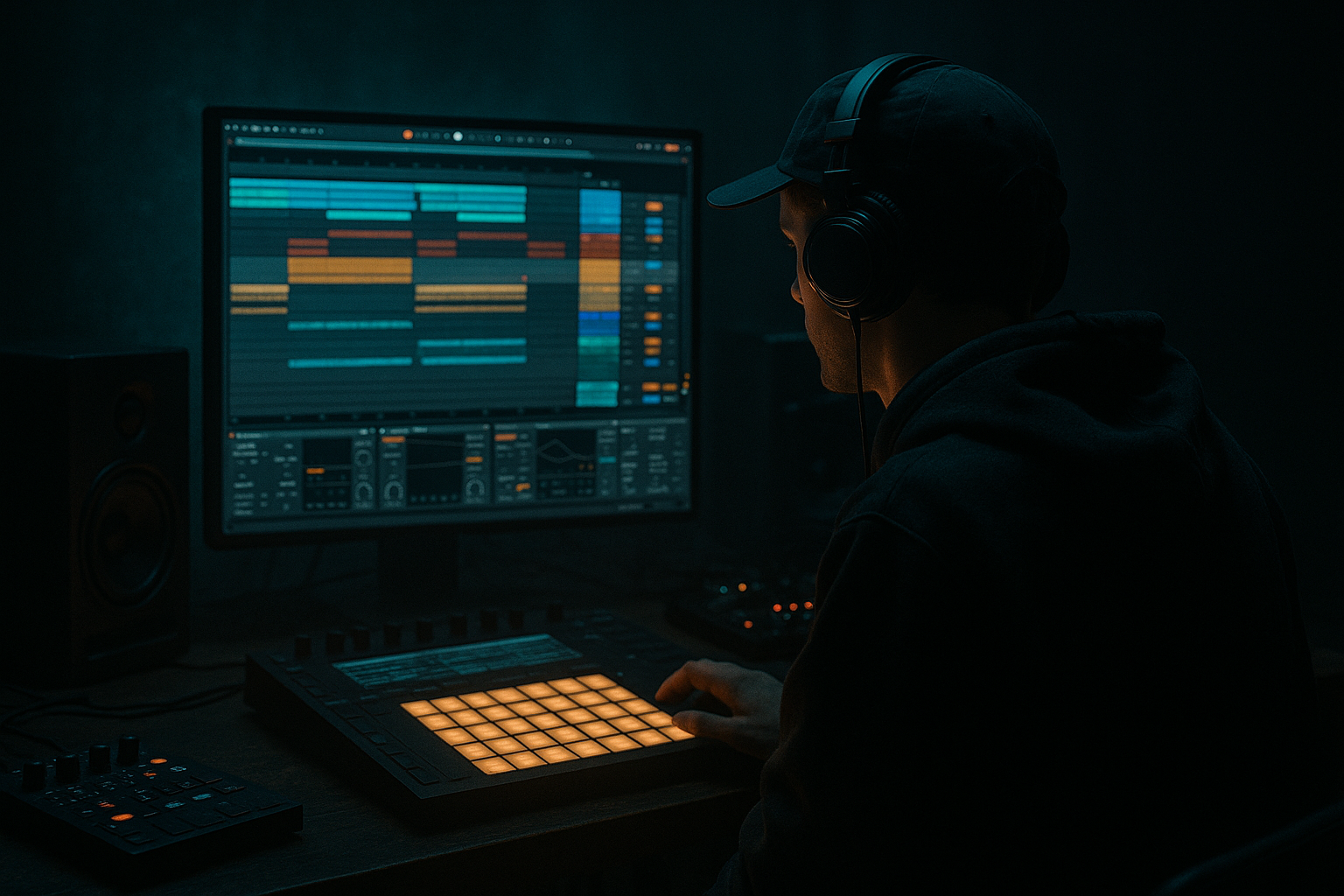
In this lesson, you’ll build a DJ-friendly intro inside Ableton Live 12 by carving space around a break-led groove, shaping a heavy low-end tease, and arranging the opening so it feels like a real vinyl-era mix intro with modern precision. The focus is Groove: making the intro breathe, shuffle, and lock in with enough tension that the drop lands hard.
Why this matters in DnB:
- Jungle and DnB intros often rely on drum identity first, bass second, full energy later.
- A good intro gives DJs space to mix, but still sounds intentional and exciting.
- Groove is what prevents “looped for 16 bars” syndrome — the intro should evolve with micro-edits, ghost hits, and tension automation.
- The best intros hint at the drop’s personality without giving everything away 🎛️
- carve out a break-driven intro with EQ, filtering, and arrangement contrast
- use stock Ableton devices to create vinyl-style movement and grit
- keep sub weight under control while still teasing bass presence
- automate transitions so the intro feels like a performance, not a static loop
- a filtered break loop with swing and ghost-note energy
- a sub or bass teaser that appears in short phrases, not full-on
- tension-building FX like noise, reverse textures, and delay throws
- a DJ-friendly structure that leaves room for a clean mix-in
- a clear pathway into the drop, using arrangement contrast rather than sheer volume
- Bars 1–8: atmosphere, vinyl texture, filtered drums, subtle movement
- Bars 9–16: more drum detail, bass tease, riser or tension lift
- Bars 17–32: stronger groove, one or two impact moments, then a controlled transition into the drop
- Making the intro too full too early
- Using too much stereo width on the low end
- Over-quantizing the break
- Too much FX wash
- No arrangement change across 16 bars
- Bass teaser sounds like the full drop
- Use saturation before EQ, not just after
- Control the low end like a weapons system
- Duplicate the break and process versions differently
- Use micro-mutes for tension
- Resample your own intro movement
- Keep the drop’s future in mind
- No more than 5 tracks
- Only stock devices
- Use at least 3 automation lanes
- Check the result in mono with Utility
- Does the intro groove without the bass?
- Does each 4-bar section feel slightly different?
- Does the transition make the drop feel bigger?
You’ll learn how to:
What You Will Build
By the end, you’ll have a 16- or 32-bar jungle DJ intro that feels like a vinyl-rip-inspired opening for a modern DnB tune.
Musically, it will include:
Think of it like this:
This is not a generic intro. It’s a functional DnB intro that could sit before a jungle switch, a rolling reese drop, or a darker neuro-styled section.
Step-by-Step Walkthrough
1. Set the project up for DJ-intro workflow
Start by opening a new Ableton Live 12 set and set the tempo to a DnB range: 172–174 BPM for classic jungle energy, or 174–176 BPM if you want a tighter modern roll. For a vinyl-heat feel, 174 BPM is a strong default.
Build on 4 or 8 bar blocks and turn on the Arrangement Loop so you can test how each section breathes. If you’re using Session View to sketch, keep your intro elements in separate clips:
- Break loop
- Vinyl/noise texture
- Bass tease
- FX hits
- Atmosphere pad
Put a Utility on your master early and keep the low end in check by monitoring mono compatibility. For DnB, this matters immediately because the intro is often sparse enough that low-end mistakes are obvious.
Suggested starting gain structure:
- Leave master peak headroom around -6 dB
- Keep the break clip peaks around -10 to -8 dB
- Keep bass teaser clips even lower until the arrangement is built
2. Build the break-led groove first
Your intro should start with drums that feel like they came off a dubplate or a battered record. Drop in a jungle break or break-layered loop on an audio track. If you have a clean break, make it behave like a chopped sample using Simpler in Slice mode or by slicing the audio manually.
In Ableton:
- Use Warp carefully if needed, but avoid over-tightening the groove
- Use Slice to New MIDI Track if you want precise kick/snare ghost-note control
- Add Drum Buss lightly for punch and glue
Good starter settings for Drum Buss:
- Drive: 5–15%
- Boom: off or very low for the intro
- Crunch: 5–12%
- Damp: adjust to keep hats from getting harsh
Then shape the break with EQ Eight:
- High-pass around 25–35 Hz to clean sub-rumble
- If the break is muddy, dip 200–400 Hz by 2–4 dB
- If the snare needs snap, try a gentle boost around 2–5 kHz
Why this works in DnB: the intro groove must suggest the track’s energy without fully revealing the drop. A break with ghost notes and swing creates momentum even when the bass is restrained.
3. Create vinyl heat texture without clutter
A vinyl-style intro is not just “noise on top.” It’s a texture layer that helps glue the drums to the atmosphere.
Add a new audio track with:
- a vinyl crackle sample
- room tone
- tape hiss
- distant record rumble
- subtle crowd or field texture if it fits the vibe
Process this with:
- EQ Eight: high-pass around 150–300 Hz
- Auto Filter: low-pass so it stays behind the drums
- Utility: reduce width if the texture feels too distracting
- optional Redux very lightly for grit
Keep this texture low. You should feel it more than hear it. Automate its volume so it blooms in the first 8 bars, then ducks slightly when the bass tease arrives. This gives the intro a “needle drop into atmosphere” effect.
If you want a more authentic feel, automate Auto Filter cutoff from around 4–6 kHz up to 10–14 kHz across the intro so the vinyl texture opens up as the arrangement develops.
4. Design the bass tease, not the full bassline
The intro should hint at the bass identity without dropping the full weight too early. Use a sub or reese fragment that enters in short phrases. This can be done with Operator, Wavetable, or a resampled bass clip.
For a simple bass tease:
- Use Operator with a sine wave sub layer
- Add a second oscillator or a parallel layer for a muted reese edge
- Low-pass the top layer around 200–500 Hz if you want it to stay hidden
- Add Saturator with Soft Clip on, Drive 2–6 dB, but keep the output level controlled
Phrase idea:
- Bars 1–4: no bass, only drums and texture
- Bars 5–8: a single bass note or stab on the downbeat
- Bars 9–12: call-and-response bass phrase with a snare fill
- Bars 13–16: slightly more movement, but still restrained
Keep the bass mono using Utility. For intro sections, stereo bass is usually a liability unless the top layer is carefully filtered. The low end should sit dead-center and be clean enough to mix into the main drop later.
5. Carve the arrangement with DJ mix-in logic
This is where the intro becomes useful in a real set. A DJ intro needs space for another tune to blend in, but it still needs identity.
Arrange your intro in a way that gives the mixer a clear anchor:
- Bars 1–8: drums + texture only
- Bars 9–16: introduce bass tease, one fill, one small FX lift
- Bars 17–24: add extra percussion or chopped break variation
- Bars 25–32: tension peak, then hand off to drop
If your track is designed for DJ play, leave a section where the drums are strong but the harmonic content is minimal. That lets another tune sit on top in a set.
Practical arrangement tactic:
- Duplicate the break track
- In the second loop, remove one kick or shift a snare ghost note
- Add a one-bar fill before the next phrase
- Use the fill to signal a change without overloading the mix
This kind of micro-arrangement is a classic DnB move: the loop repeats, but the details keep evolving.
6. Use automation to make the intro feel performed
A strong intro is mostly automation. In Ableton Live 12, automate parameters that control perceived motion:
- Auto Filter cutoff
- Reverb dry/wet
- Delay feedback
- Utility gain
- Pan on percussion or FX
- Saturator drive
- Drum Buss transient or crunch
Good automation ranges:
- Auto Filter cutoff: sweep from 200 Hz to 8–12 kHz
- Reverb dry/wet on hits: 8–20%
- Delay feedback throws: 15–35%
- Saturator drive on transition hits: +1 to +5 dB for emphasis
A strong trick for jungle intros: automate the break’s filter so the first 8 bars are slightly darker, then gradually open the top end while the bass tease enters. This creates a rising sense of urgency without needing a huge riser.
Use automation to create contrast:
- mute the bass for one bar before a fill
- open the hats right after a snare accent
- push a reverb throw on the final hit before the drop
- slightly widen the FX tail, but keep drums centered
7. Shape transient impact and groove movement
If the break feels flat, don’t just turn it up. Shape the groove.
Use Drum Buss and Glue Compressor carefully on the drum bus:
- Glue Compressor: ratio 2:1, attack 10–30 ms, release Auto or 0.1–0.3 s, only 1–2 dB gain reduction
- Drum Buss: keep it subtle, use drive for density not volume
Then add groove with Ableton’s Groove Pool:
- Try a MPC-style swing or a subtle humanized groove
- Apply 10–25% groove amount
- Bias the break and percussion, but keep the kick/sub alignment solid
This is especially useful in jungle-style intros because the feeling of “push and pull” is part of the genre’s identity. A slight late snare or swung hat can make the loop feel alive without making the mix messy.
If the intro needs more movement, use velocity variation on ghost notes rather than adding more instruments. In DnB, groove often comes from what you leave quieter.
8. Create the transition into the drop
The final 4–8 bars before the drop should deliver tension, not chaos. Pick one or two transition elements and commit.
Options:
- a snare roll using repeated 1/16 or 1/32 notes
- a reversed cymbal or reversed break hit
- a pitch-rising noise layer
- a filtered bass sweep
- a final fill with delay tail
Stock Ableton devices that help:
- Simpler for slicing a snare roll or break fill
- Auto Filter for a controlled sweep
- Echo for deeper delay modulation
- Reverb for space on the last hit
- Frequency Shifter for metallic tension if you want a darker edge
A solid DnB transition example:
- Bar 29: remove bass, keep drums
- Bar 30: bring in a rising noise and open the filter
- Bar 31: snare fill with slight delay
- Bar 32: drop silence or near-silence on the final beat, then slam into the drop
That little gap before the drop is powerful. DnB needs that moment of anticipation so the first downbeat feels massive.
Common Mistakes
- Fix: remove bass or harmonic content for the first 4–8 bars. Let the drums and texture do the work.
- Fix: keep bass and sub mono with Utility. If anything below ~120 Hz is wide, it can weaken the intro and the drop.
- Fix: let the groove breathe. Use subtle groove amounts and preserve ghost-note timing.
- Fix: if the intro becomes cloudy, high-pass reverbs and delays more aggressively, and automate them down during important drum hits.
- Fix: introduce at least one evolution every 4 bars — a fill, filter move, bass tease, or percussion swap.
- Fix: simplify the phrase, reduce brightness, and restrict it to short call-and-response moments.
Pro Tips for Darker / Heavier DnB
- Try Saturator on the bass teaser or break bus with modest drive, then EQ the harshness afterward. This gives density without instant fuzz.
- Keep the sub absent or minimal until the intro is ready. In darker DnB, restraint creates impact.
- One copy can be darker and more filtered; another can be brighter and more present. Crossfade between them for a dramatic shift.
- Briefly drop out the kick, snare, or hats for a beat before a fill. In heavy DnB, absence hits harder than extra layers.
- Print a few bars of the intro, then chop the best hit, reverse it, and place it before the transition. This is a great way to create custom atmosphere and keep the track sounding original.
- If the intro is already too aggressive, the drop loses contrast. Leave headroom in both tone and arrangement.
Mini Practice Exercise
Spend 15 minutes building a 16-bar jungle intro using only stock Ableton tools.
1. Load a break loop and make it feel playable with Simpler, Drum Buss, and EQ Eight.
2. Add a vinyl/noise texture track and filter it so it sits behind the drums.
3. Create a bass teaser with Operator or a resampled sub clip. Keep it mono and use only 2–3 short phrases.
4. Automate one filter sweep across the 16 bars.
5. Add one fill in bar 8 or 12 using a sliced break hit or snare repeat.
6. Finish with a 2-bar transition that removes the bass and opens the top end.
Challenge rules:
When done, listen back and ask:
Recap
A great Vinyl Heat jungle DJ intro is built from groove, restraint, and arrangement control. Keep the break alive, tease the bass instead of fully revealing it, and use automation to create motion across the intro. Stay disciplined with the low end, use Ableton stock devices to shape texture and tension, and design the section so it feels DJ-friendly and emotionally charged. In DnB, the intro is not filler — it’s the pressure system that makes the drop hit harder.

