Main tutorial
Lesson Overview
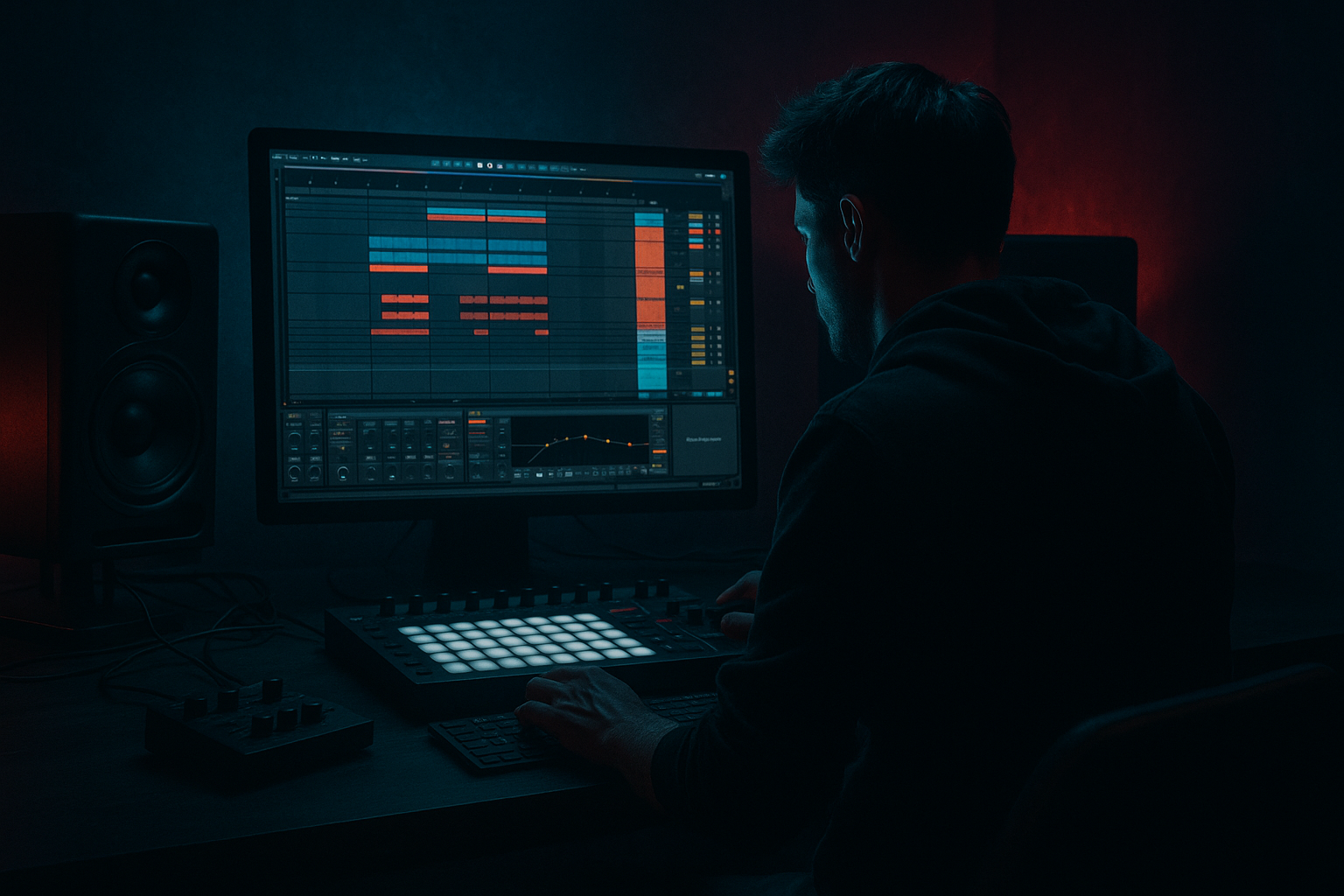
This lesson is about building urban, echo-heavy kick weight for oldskool jungle / DnB inside Ableton Live 12 using a resampling-first workflow. The goal is not just to make the kick louder — it’s to make it feel like it belongs in a real DnB arrangement: short, punchy, textured, and weighty, with enough low-end authority to survive fast break programming, reese bass movement, and dense atmospheric layers.
In Drum & Bass, the kick has a very specific job. It needs to translate at 170–174 BPM, sit cleanly against the sub, and often act as the glue between the break and the bassline. In jungle and oldskool-inspired DnB, the kick often carries a little bit of character, room, and grit — not polished EDM thump. That character is where resampling becomes powerful: you can shape a kick into something more personal, then bounce it, process the audio, and build a layered kick instrument that feels “made” rather than simply selected.
Why this matters in composition: the kick is often the first thing that defines the weight curve of the track. If the kick is too soft, the whole drop feels weak. If it’s too long, the bassline loses room. If it’s too clean, the track can feel sterile for jungle or darker rollers. This workflow gives you control over impact, tone, and vibe while keeping the low end disciplined enough for club playback. 🥁
What You Will Build
You’ll build a three-layer kick system in Ableton Live 12:
1. A sub-focused punch layer that provides the fundamental weight.
2. A mid/body layer created by resampling a processed kick for oldskool texture and audible presence on smaller systems.
3. A short room/echo tail layer that adds urban depth and movement without muddying the drop.
By the end, you’ll have a kick that:
- hits hard around 50–70 Hz for weight
- has a controlled click/attack so it punches through breaks
- carries a subtle resampled grit/space that suggests tape, room, or dubby club depth
- can be programmed in a 4-bar DnB drop phrase with variation
- leaves room for a sub-bass or reese to answer it in call-and-response
- Making the kick too long
- Over-boosting sub on the kick and subbass at the same time
- Letting the echo return carry too much low end
- Printing a kick before checking mono compatibility
- Using too much distortion on the source before resampling
- Ignoring break interaction
- Use two resamples, not one: one for clean body, one for dirt. Blend them like a designer would layer snare shells.
- Put Drum Buss on the kick bus and automate Drive very slightly into the drop for extra aggression.
- Try a subtle Saturator -> EQ Eight -> Glue Compressor chain on the kick bus for more glued weight.
- Keep the kick transient slightly sharper than you think you need. At 172 BPM, that front edge is what makes the kick feel “expensive.”
- If the tune leans neuro or darker rollers, let the kick’s texture layer have a tiny midrange bite around 1–2 kHz, but roll it back before harshness sets in.
- For oldskool jungle energy, offset one kick print by a few milliseconds only if it improves the groove; then bounce and re-check in context. Small timing shifts can add swagger, but they can also blur low-end phase.
- Use Call and Response: a dry kick on bar 1, then an echo-kissed or distorted version on bar 3. This creates movement without needing a new pattern.
- If the track feels too clean, bounce the kick through a deliberately imperfect chain with light saturation and room tone. A little grime often reads as “larger” in DnB.
- Build kick weight in layers, not just with volume.
- Resample your processed kick to capture character, then refine the prints.
- Keep the core kick mono, short, and controlled in the low end.
- Use filtered echo for depth and urban space without washing out the drop.
- Treat the kick as a compositional element: phrase it, automate it, and let it evolve across the arrangement.
- In DnB, the best kick is the one that feels heavy, leaves room, and keeps the track moving.
This is designed for a darker DnB context: think intro tension, sparse half-bar phrases, break-led drops, and a kick that feels like it’s pushing the tune forward rather than just marking time.
Step-by-Step Walkthrough
1. Set the track up for a resampling workflow
Create three audio tracks and one MIDI track:
- MIDI track: `Kick Source`
- Audio track 1: `Kick Resample A`
- Audio track 2: `Kick Resample B`
- Audio track 3: `Kick FX Print`
On `Kick Source`, load Drum Rack or Simpler with a kick sample that already has some weight. For this lesson, start with a kick that is not too clicky and not too boomy — an oldskool-style kick works best. If you’re using Simpler, set it to Classic mode, One-Shot, and keep the envelope snappy.
In Ableton Live 12, turn on Arrangement loop for a 4-bar section and place a simple kick pattern: kick on 1, maybe an extra hit on the “and” of 2 for a jungle-style syncopation, then leave space. The idea is to make the kick feel like part of a phrase, not just a metronome.
Why this works in DnB: fast tempos make low-end clutter obvious. Starting with a sparse phrase lets you hear exactly how the kick interacts with the sub lane and the break.
2. Shape the source kick before resampling
On `Kick Source`, use stock devices in this order:
- EQ Eight
- High-pass very gently only if needed, around 20–25 Hz
- If the kick is too boxy, dip 180–300 Hz by 2–4 dB
- If it needs more body, a subtle wide boost around 55–75 Hz by 1–3 dB
- Saturator
- Drive: 2–6 dB
- Turn on Soft Clip
- Keep Output adjusted so the level doesn’t jump too much
- Drum Buss
- Drive: 5–15%
- Crunch: very light, around 3–8%
- Boom: use cautiously, around 0–20%, tune to the kick’s actual fundamental
- Transients: +5 to +20 if the kick needs more front edge
Don’t overdo the processing yet. You want a kick that still breathes. The point is to create a version worth printing, not to finalize the sound in the device chain.
Advanced move: place a Utility after Saturator and set width to 0% if you want to force the source kick mono before printing. This helps keep the core weight centered and club-safe.
3. Resample the kick as audio and capture the “body” version
Arm `Kick Resample A` and set its input to Resampling. Record a few bars of the kick phrase while the source track plays. You are now printing the kick with its processing, which gives you a commitment point.
After recording:
- Consolidate a clean one-shot or a 1-bar phrase
- Trim the clip so the transient starts exactly at the grid
- Warp only if necessary; for one-shots, usually keep it unwarped or use Complex Pro sparingly if you must time-adjust
- Name this clip something like `Kick Body Print 01`
Now duplicate that audio clip on a second track or in another lane and create a second print with different processing:
- Try Saturator drive at 8–10 dB
- Add Redux subtly for grain: Downsample 2–4, Bit Reduction 12–16
- Put EQ Eight before Redux if the kick has too much top end, so the crunch focuses the midrange rather than fizzing out
This second printed layer is where the oldskool energy comes from. The resampling process captures nonlinear behavior that is harder to fake with one static chain.
4. Build the layered kick instrument from the prints
Drag your best print into Simpler on a new MIDI track called `Kick Layered`. If the print is a single transient with a tail, use Simpler in One-Shot mode. If it has a more complex texture, use Slice or keep it as an audio clip depending on phrasing needs.
Create three parallel layers, either in separate tracks or inside a Drum Rack:
- Layer 1: Sub punch
- Low-pass around 120 Hz
- Focus on the first 80–120 ms
- Layer 2: Body
- Use the printed resample
- EQ boost or cut as needed in the 50–150 Hz range
- Layer 3: Texture
- High-pass around 150–250 Hz
- Let the grit/click/room live here
Use Group Tracks to combine them into a `Kick Bus`. On the bus:
- Glue Compressor
- Ratio 2:1
- Attack 10 ms
- Release Auto or 0.3–0.6 s
- Aim for 1–2 dB gain reduction
- EQ Eight
- Tight notch if any layer is ringing
- Utility
- Width at 0% below the low-end; keep the bus mono
Composition-wise, this gives you a modular kick that can evolve across the track. You can automate the texture layer in the drop, then strip it out for breakdowns or intro teases.
5. Add the echo “urban” dimension with a controlled send
Create a return track called `Urban Echo`. This is not meant to wash the kick out; it’s meant to create a short, grimey space imprint around selected hits.
On the return track:
- Echo
- Sync time: try 1/16, 1/8, or dotted 1/8D
- Feedback: 10–25%
- Filter the lows out aggressively inside Echo or follow it with EQ Eight
- Add a touch of modulation only if it stays subtle
- EQ Eight
- High-pass around 300–500 Hz
- Low-pass around 6–10 kHz
- Optional Saturator
- Drive 1–3 dB for a darker tail
Send only selected kick hits to this return:
- The first kick of a 4-bar phrase
- The kick before a transition
- A call-and-response kick in a sparse bar
Automate the send amount to 0 dB to -12 dB depending on arrangement. In a drop, use the echo sparingly so the kick keeps authority.
Why this works in DnB: a tiny, filtered echo can make a kick feel bigger and more urban without smearing the fast transient language of jungle. It adds perceived depth without needing a longer sample.
6. Program the kick as a compositional device, not just a drum
Write a 4-bar pattern that tells a story. Example in a jungle-leaning drop:
- Bar 1: kick on the one, a syncopated hit on the “and” of 2
- Bar 2: kick on the one, then a late kick before beat 4
- Bar 3: kick stays sparse while the break and sub answer
- Bar 4: add a ghosted or filtered kick leading into the loop restart
Use velocity variation and note length if the kick is MIDI-triggered:
- Strong hits at 110–127 velocity
- Support hits at 80–100 velocity
- Ghost hits lower, around 40–70 velocity
If you’re using an audio clip, vary it with clip gain and automation:
- Make one hit slightly quieter
- Send one hit more to the echo return
- Filter one hit darker using Auto Filter automated across the phrase
This is a composition-focused move: the kick becomes a phrase marker. In darker DnB, that phrase logic matters as much as the sound design.
7. Lock the kick against the sub and break
Now bring in a sub-bass or low reese. For a clean oldskool DnB foundation:
- Sub should sit mostly under the kick’s decay, not on top of the transient
- Use Utility on the sub to keep it mono
- Use EQ Eight to carve a small space if the kick fundamental is strong at, say, 58 Hz, then place the sub more around 43–50 Hz or slightly above, depending on the key
If the kick and sub fight, try:
- Shortening the kick tail with Sample Start/End or Simpler envelope
- Ducking the sub with Compressor sidechained from the kick
- Attack: 1–5 ms
- Release: 50–120 ms
- Aim for 2–4 dB gain reduction
- Adding a tiny gain dip on the sub at the kick fundamental rather than carving the kick too hard
With a break underneath, listen for transient overlap. If the break snare feels crowded, trim the kick’s texture layer slightly. In DnB, the groove is usually won or lost in the first 150 ms of each hit.
8. Automate variation for arrangement and drop evolution
Build the kick’s role across a full DnB arrangement:
- Intro: filtered kick prints, low-pass around 150–250 Hz, sparse echo
- Pre-drop: increase echo send or bring in a distorted texture layer
- Drop 1: full body layer, minimal echo, tight mono
- Drop 2: alternate kick print, slightly more saturation, different tail length
- Breakdown: let the urban echo breathe and remove the sub weight
Use Automation Lanes for:
- Echo send amount
- Auto Filter cutoff on the texture layer
- Saturator drive for a more aggressive second drop
- Drum Buss drive on the kick bus for phrase accents
This is where resampling shines compositionally: instead of one kick sound repeating unchanged, you can treat the kick as a evolving narrative element across the tune.
Common Mistakes
- Fix: trim the tail in Simpler or audio clip view. For fast DnB, a long kick usually steals room from the bass and snare.
- Fix: decide which element owns the deepest fundamental. Use EQ Eight and sidechain compression to separate roles.
- Fix: high-pass the return more aggressively, often 300–500 Hz or higher.
- Fix: use Utility on the kick bus and check in mono before committing the arrangement.
- Fix: resample in stages. Keep one clean-ish body print and one grit print, then blend.
- Fix: solo the kick with the break and adjust transient control. In jungle, the break and kick must feel like one rhythmic system.
Pro Tips for Darker / Heavier DnB
Mini Practice Exercise
Set a timer for 15 minutes and do this:
1. Load one kick into Simpler and make a 4-bar pattern at 174 BPM.
2. Process it with EQ Eight, Saturator, and Drum Buss.
3. Resample two versions:
- one cleaner body print
- one dirtier texture print
4. Build a layered kick on a new MIDI track or audio group.
5. Add an Urban Echo return and send only the first kick of every 2 bars.
6. Program a simple break underneath and test the kick with a sub note on the root.
7. Do one mono check and make one improvement only:
- shorten the tail
- reduce low-end on the echo
- or tighten the kick/sub sidechain
Goal: by the end, your kick should feel like it belongs in a dark jungle drop, not just a drum loop. Save the best print as a reusable rack or clip for future tunes.

