Main tutorial
1. Lesson Overview
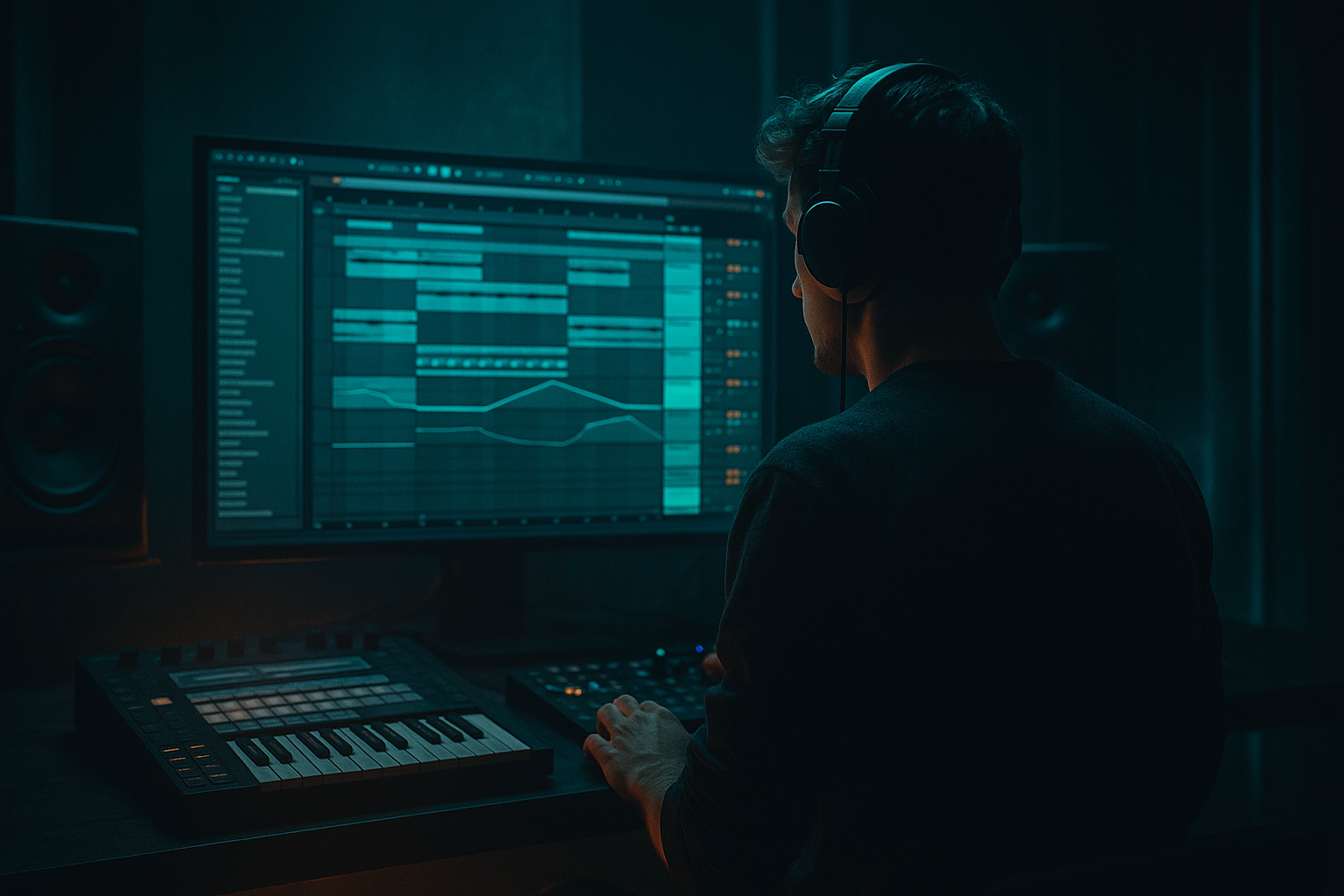
This advanced Arrangement lesson teaches you how to tune an oldskool DnB breakbeat for 90s-inspired darkness in Ableton Live 12. You’ll take a sampled break (think Amen/Apache/Funky Drummer-style material), pitch and time-shape it musically to a dark key, create layered tuned elements (sub, mid grit, transient snap), and arrange those tuned variants across a track so the break feels ominous, cohesive, and true to the 90s DnB aesthetic. The walkthrough uses Ableton Live 12 stock devices and focuses on arrangement techniques—how and where to place tuned variations, automation lanes to darken sections, and resampling to lock in character.
2. What You Will Build
- A grouped breakbeat rack in Arrangement with three tuned variants: Deep Drop (pitched down, saturated), Tension Edit (pitch automation + resonant filter), and Raw Hit (clean transient for drum accents).
- A sub layer locked to the break’s musical pitch.
- A break bus chain using EQ Eight, Saturator, Multiband Dynamics, Auto Filter and Redux to create 90s darkness.
- Arrangement map across ~1 minute showing intro, build, dark drop, breakdown, and reprise using clip-level transposition and automation.
- Over-pitching the break without re-tuning the sub: If you pitch the break -12 semitones but keep the sub at the old pitch, the low-end will clash. Always align sub frequency with break’s musical center.
- Using Complex Pro/warp without understanding artifacts: Heavy pitch changes with Complex Pro can smear transients; for large transposes use Sampler or resample the pitched result and re-slice.
- Killing transients with too much compression or slow Glue attack: The break needs bite in DnB; set attack to allow initial transients through.
- Excessive low-mid boost: A common attempt to darken is to boost 300–700 Hz; too much makes the loop muddy. Use narrow EQ dips to remove boxiness and boost only where it adds weight (60–120 Hz).
- Not checking phase when layering sub/sine: You can lose or weaken low-end if polarities are inverted.
- Automating many devices independently without macros: Hard to manage in Arrangement; map key parameters (filter cutoff, saturator drive, sub level) to Macros for easy automation.
- Macro everything: Group the break tracks and map Filter Cutoff, Saturator Drive, Bus Wet/Dry and Sub Level to 4 macros. Automate macros in Arrangement—this keeps automation tidy and recallable.
- Use subtle clip-level pitch modulation: Clip Envelopes for Transpose are non-destructive and cheap CPU-wise; use small cent-level fluctuations to simulate vinyl instability.
- Parallel saturation: Duplicate the Break_Deep track, saturate the duplicate heavily and low-pass it around 800 Hz, then blend under the original for grit without harsh highs.
- Freeze-and-Resample creatively: Freeze the bus with heavy processing, right-click Freeze Track > Flatten to commit character and then slice/arrange the flattened audio for new dark textures.
- Create a half-time version by duplicating an audio clip and using Warp > Beats > 1/2 speed or manually stretch: apply extra low-pass and more saturation for a darker breakdown moment.
- Automate Utility Width: narrowing stereo width of low mids and sub maintains punch while making high mids wider for eerie atmosphere.
- Use sidechain multiband dynamics on the bus to duck only the low or mid band for punch while maintaining high-texture grit.
- Does the sub follow the tuned break pitch?
- Does the drop feel darker (lower, more saturated, less high-end) than the intro?
- Are transients preserved in the drop (not mushy)?
3. Step-by-Step Walkthrough
Note: keep your sample at original tempo in the Project first. If the sample’s tempo is unknown, set Warp to Beats for precise transient-preserving stretching, otherwise use Complex Pro for heavy stretching. This walkthrough assumes a mono/stereo audio sample of a break on an Audio Track.
A. Prep & Key Detection
1. Drop your break into an audio track in Arrangement.
2. Add Tuner (Audio Effects > Tuner) after the clip and play a single sustained transient (select a hit with a long harmonic, like a tom). Note the closest pitch reported. If a clear pitch isn’t available, use Spectrum to find a dominant low-mid peak. This tells you the approximate musical center for sub layering and musical transposition.
3. Remove the Tuner after noting key. Save initial clip as “Break_original”.
B. Create three Arranged Variants (as separate tracks or grouped tracks) — Deep Drop, Tension Edit, Raw Hit
1. Duplicate the Break_original clip twice in Arrangement so you have three parallel lanes aligned vertically (rename Break_Deep, Break_Tension, Break_Raw).
2. For each track, disable Warp briefly and listen: decide if you want to pitch by Transpose (clip) or by placing into Sampler/Simpler for fine control. For heavy pitch-down without formant artifact, use Sampler; for simple transpose use Clip Transpose (no warp) or simpler.
C. Deep Drop (pitched-down, saturated + sub layer)
1. Warp off or set Warp Mode = Complex Pro to preserve tone if you must keep tempo—prefer: disable warp and use Track Tempo adjustment if needed; but usually pitch down in Sampler.
2. Drop a Simpler (or Sampler for more control) on Break_Deep: right-click the audio clip and “Slice to New MIDI Track” with “Preserve Tone” unchecked to import into Simpler/Sampler OR drag the sample into Sampler.
3. In Sampler:
- Transpose: -7 to -12 semitones (try -7 or -12 for darker vibe). Use coarse Transpose and then fine-tune with Detune.
- Turn on Pitch Envelope (slow attack 0–30 ms, long release), Amount small to avoid pitch wobble unless you want formant drift.
- Set Filter to Low-Pass (24 dB) and set cutoff ~1.2–3 kHz to remove high fizz; add resonance subtly.
4. On Break_Deep track insert (stock devices, order matters):
- EQ Eight: low-cut at 30 Hz (shelf), slight boost 70–120 Hz (+2-4 dB) to fatten, dip 800–1.2 kHz (-2 to -4 dB) to reduce boxiness, cut highs above 6–8 kHz (-3 to -6 dB).
- Saturator: Soft Clip mode, Drive 3–6 dB, To taste. Use “Analog Clip” for grit. Send Dry/Wet ~50%.
- Redux: bit reduction lightly (0–8 bits) to add digital grit; mix in subtle amounts.
- Multiband Dynamics: compress low band lightly to glue sub and tighten mids.
- Auto Filter (sidechain LFO off): place after Saturator, set LP filter with slow envelope/automation for movement.
5. Create a Sub Layer:
- Create an Instrument track with Operator (stock synth).
- Set a sine wave oscillator 1, low-pass filtered, envelope short decay, pitch set to the root determined earlier (if your break was transposed -7 semitones, choose the corresponding note an octave below for sub).
- Sidechain this sub to Break_Deep with Compressor on Sub track set to External sidechain (input: Break_Deep) with fast attack and medium release so the sub ducks under kicks.
6. Route Break_Deep and Sub into a Group track labeled “Break_Bus”. On Break_Bus add:
- Glue Compressor: medium ratio (2:1), slow attack ~10–30 ms to let transients through, release 0.2–0.6 s.
- EQ Eight: final tonal shaping; notch 300–700 Hz if too muddy.
- Return Dry/Wet macro to control overall grit.
D. Tension Edit (pitch automation + resonant sweep)
1. Duplicate Break_Raw or Break_original. Keep it audio (no Sampler) to preserve transients.
2. Enable Warp and set Warp Mode = Beats for tight transients if you plan to time-stretch or keep Complex Pro for timbral shifts.
3. Use Clip Envelope (in Clip View) > Transpose:
- Draw tiny pitch ride automations: e.g., at 4–8 bars before drop, automate Transpose from -3 semitones up to 0 semitones (or reverse for pitch-rising tension).
- For 90s darkness, try pitching up +2 to +7 semitones briefly on pre-drop fills and then dropping to -10 semitones at the impact for a darker re-entry.
4. On this track add:
- Auto Filter: set Bandwidth narrow with resonance high and automate cutoff opening just before drop (adds formant-like howl).
- Phaser/Chorus: subtle movement (Depth small) to get that ‘warbly’ 90s texture.
- Echo (or Delay): short, dark tail for fills, low feedback.
5. On Clip Envelope > Transpose LFO (use clip’s pitch envelope) you can create periodic warble synced to 16th notes to imply instability—map to small cents (+/- 5-25 cents).
E. Raw Hit (clean transient accents)
1. Keep Break_Raw simple: EQ Eight to remove low rumble (<40 Hz), transient shaping by Compressor with fast attack, short release; no heavy saturation.
2. Use these clips sparsely in arrangement to preserve transient clarity—layer these on snare/clap hits in the arrangement to punch through the saturation.
F. Arrangement: Mapping Tuned Variants Over Time
1. Build a basic structure (1 minute example):
- 0:00–0:08 Intro: Break_Deep filtered heavily (Auto Filter cutoff closed, only sub and muffled hits).
- 0:08–0:24 Build: Introduce Break_Tension with pitch automation ramps; automation lane shows Transpose and Filter cutoff rising.
- 0:24–0:48 Dark Drop: Full Break_Deep + Sub, Break_Raw accents on 2 and 4, Break_Bus saturation at full, highcut removed.
- 0:48–0:60 Breakdown/Reprise: Drop to half-time variant — duplicate Break_Deep clip, transpose down another octave or remove high mids, add Reverse hits (Resampling trick below).
2. Use automation lanes on the Break_Bus group in Arrangement to control:
- Saturator Drive (map Drive to a Macro and automate Macro).
- Auto Filter Cutoff for section darkening.
- Group Wet/Dry or Bus Send to echo return for larger space.
3. Create fills & transitions:
- Resample a short 1–2 bar section: right-click Break_Bus group and Freeze/Flatten or create a new Audio track and set its input to “Resampling”, record the processed break hit. Reverse the clip, low-pass it, and place as a fill before dark drop.
- For pre-drop tension, automate Transpose on the recorded resample to sweep pitch quickly.
G. Mix Checks & Phase
1. Solo Break_Bus with the rest of the mix muted, check the attack and sub relation.
2. Use Utility gain when layering sub to avoid clipping. Check phase between sub sine and break’s kick/smash—flip phase if cancellation occurs.
3. Final Bus Processing: a gentle Multiband Dynamics sidechain on the mid/high band to let kick/snare transient through.
4. Common Mistakes
5. Pro Tips
6. Mini Practice Exercise
Goal: In 12 minutes create an arrangement section (Intro → Build → Drop) using one break sample, tuned for darkness.
Steps:
1. Load an oldskool break into Arrangement (2 minutes).
2. Create Break_Deep: import into Sampler, transpose -7 semitones, low-pass at 2.5 kHz, add Saturator (3 dB), Redux lightly (3 bits). (3 minutes)
3. Create Sub: Operator sine one octave below Break_Deep root, sidechain to Break_Deep. (2 minutes)
4. Create Break_Tension: duplicate original audio, enable Warp, automate clip Transpose from +3 semitones down to -10 semitones over 8 bars; add Auto Filter resonance sweep. (3 minutes)
5. Arrange Intro (bar 1–8): Deep filtered; Build (9–16): Tension ramp; Drop (17–32): full Deep + Raw accents. Render a 30-second bounce and listen for dark cohesion. (2 minutes)
Targets to evaluate:
7. Recap
This lesson showed how to tune an oldskool DnB breakbeat for 90s-inspired darkness in Ableton Live 12 using stock devices and Arrangement techniques. Key steps: detect the break’s musical center, create tunings via Sampler/Clip Transpose, layer a keyed sub, employ bus processing (EQ Eight, Saturator, Redux, Multiband Dynamics, Auto Filter) and automate macros in Arrangement to map darkening across sections. Use resampling to commit character and watch phase and transient settings when layering. With these workflows you’ll be able to arrange dramatic, dark-sounding oldskool DnB breaks that sit powerful in a 90s-inspired track.

