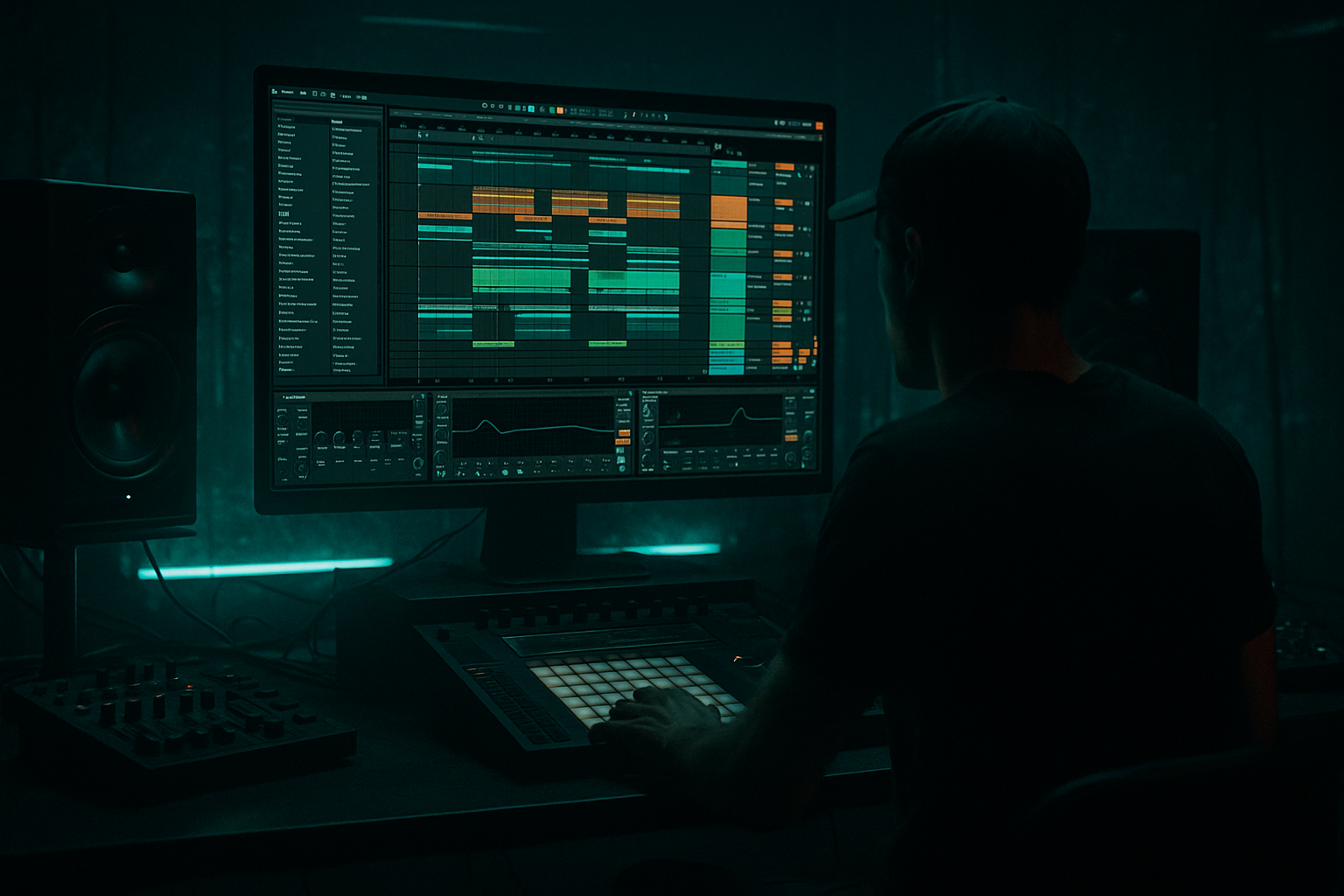
Main tutorial
Lesson Overview
This lesson is about turning a plain jungle-style 808 tail into a usable oldskool DnB bass weapon: crisp enough to punch through the break, dusty enough to feel authentic, and controlled enough to survive a club system.
In a real track, this lives in the drop bassline, often as a sub hit with a short transient front, a call-and-response phrase, or a tail note that answers the snare and break edits. For jungle and early DnB, that 808 tail is not just a sub. It’s the body of the groove: the low-end punctuation that can feel heavy, sly, and slightly unstable in the right way. The trick is to preserve the weight while shaping the front edge and the upper harmonics so the bass reads on smaller systems without losing mono authority.
Technically, this matters because oldskool bass often fails in one of two ways: it is either too clean and flat, or too dirty and smeared. A successful tune here gives you:
- a hard, readable transient that helps the bass speak against breaks
- a dusty midrange layer that carries character on top of the sub
- a tight low-end core that stays mono-safe and club-functional
- movement that feels played, not looped
- a solid fundamental that supports the low end
- a crisp attack layer for definition
- a dusty midrange harmonics layer for jungle character
- a controlled release that sits under breaks without masking snares
- enough polish to be mix-ready, not finished-sounding by accident
- Use the break as the brightness source, not the bass. Let the dusty mids provide attitude, but keep the bass itself focused. That leaves room for the break’s hats and snare noise to carry aggression.
- Print variations. Make two or three resampled versions: one cleaner, one dirtier, one with a slightly longer tail. Then choose between them in arrangement instead of trying to force one patch to do everything.
- Try note-length contrast. A short, aggressive note followed by a slightly longer answer note can create menace without adding more notes. This works especially well around snare fills.
- Keep the sub narrower than you think. Darker DnB often feels bigger when the low end is disciplined. Stereo width in the wrong place makes the drop feel impressive in headphones and weak on a rig.
- Use harmonic change sparingly. A small shift in saturation or filter on the second 4 bars can be enough to evolve the phrase. In heavy jungle, too much change destroys the hypnotic pressure.
- Automate the dust, not the sub. Movement belongs in the mid layer. The sub should feel like a solid authority underneath the chaos.
- Design for the DJ transition. If the tune has a clean intro or outro, let the bass tail collapse neatly there. You want something a DJ can mix with, not a bassline that leaves a messy smear across the handoff.
- Use only one 808-tail sample source
- Use only Ableton stock devices
- Make one clean sub chain and one dusty mid chain
- Write a phrase that works over 4 bars
- No more than three notes total in the pattern
- a clear transient
- a controlled tail
- audible mid grit
- stable mono-compatible low end
- Tune the 808 tail to the track before you over-process it.
- Split the bass into clean sub and dusty mids.
- Keep the sub mono and let the grit live above it.
- Shape the transient and tail so the bass speaks inside the break, not over it.
- Phrase the bass around the snare and refresh it across 4- or 8-bar sections.
- If it sounds great solo but weak in the drop, shorten the tail, reduce low-mid haze, and re-check mono.
This is especially suited to jungle, darkside, rollers with oldskool pressure, and modern tracks borrowing from 90s bass phrasing. By the end, you should be able to hear a bass note that feels like it snaps into the groove, blooms briefly in the mids, then gets out of the way before it blurs the kick/snare relationship. A successful result should sound like a short, nasty sub stab with a gritty vocalized tail — heavy, controlled, and ready to dance with the break.
What You Will Build
You’ll build a tuned 808-tail bass patch in Ableton Live 12 that has:
The finished sound should feel like a tight oldskool bass hit or short bass note that can sit under a chopped break, answer a snare, or land as a one-bar phrase. It should still be recognizable as an 808-derived tail, but not so pure that it feels like trap. Think grainy, disciplined, and purpose-built for a fast drum pattern.
Step-by-Step Walkthrough
1. Start with a clean, single-note source and commit to the note shape first
Load your 808 tail into a Simpler or Sampler track and make sure the sample is behaving like a single, intentional bass note rather than a long accidental tail. In Simpler, set it to one-shot-style playback behavior so the note starts consistently, then trim the start so you’re not hearing dead air before the transient. If the sample has an overly soft front edge, nudge the start a few milliseconds later or earlier until the initial click lands in a useful place.
Why this matters: oldskool jungle bass needs a strong identity on each note. If the source is sloppy, the rest of the chain will only magnify that looseness. Before you process anything, decide whether the core note is meant to feel round and subby or short and percussive.
What to listen for:
- Does the note start immediately, or does it smear into the beat?
- Does the tail decay in a musical way, or does it just fade out lifelessly?
If the sample is already too long, stop here and trim it before adding effects. A better source saves every later decision.
2. Tune the bass to the track, not just the sample
Use Ableton’s tuner or your piano roll to align the fundamental with the key of the tune. For oldskool jungle, the bass often works best when it sits one octave below the musical center and reinforces the root or fifth cleanly. If you’re building around a minor key, test the root note, minor third, and fifth as phrase tones, but keep the actual sub movement simple.
In practice, a tuned 808 tail often feels strongest when the note lands around the track’s center of gravity rather than trying to be overly melodic. If the tail has a pitch fall or drift baked into it, listen to where the strongest body of the note lives and tune that, not just the attack click.
Useful tactic:
- Set your MIDI note, then fine-tune with Simpler transpose in small steps
- Aim for the note to feel stable against the kick, not “correct” in isolation
Why this works in DnB: the drum break already provides a lot of pitch-like noise in the top end. The bass has to be harmonically clear but not musically busy. If it’s tuned properly, it can feel huge without needing extra notes.
3. Shape the transient with an envelope, not with brute distortion
If the note attack is too soft, use a short volume envelope in Simpler or an Amp envelope to define the front edge. Keep the attack extremely fast, and shorten the decay/release until the note reads as a bass hit rather than a lingering wash. As a starting point, try:
- Attack: near zero
- Decay: roughly 120–300 ms depending on tempo
- Release: short enough that the tail stops cleanly before the next drum phrase
- Sustain: low or zero if you want a more hit-like shape
Then audition it against the break. The transient should help the note slice through the pocket, but it should not become a clicky top-end tick that competes with the snare crack.
What to listen for:
- Does the bass note have an obvious “front” when the break is busy?
- Is the note still warm after the attack, or did you accidentally turn it into a stab?
If the transient is too soft, add definition by shortening the start and using a controlled transient shaper through shaping the sample envelope before reaching for distortion.
4. Build the dusty midrange with a split-chain mindset
This is where the jungle character happens. Create a second tonal layer for the mids using a stock processing chain. One reliable option is:
- Audio Effect Rack with two chains
- Chain 1: clean sub
- Chain 2: dusty mids
For the dusty mid chain, try:
- EQ Eight: high-pass around 90–140 Hz so the sub stays clean
- Saturator: add moderate drive, often around 2–6 dB
- Amp or Overdrive: lightly to give texture and bite
- Auto Filter: low-pass or band-pass movement to animate the tail
The point is not to make the bass obviously distorted. The point is to create a midrange dust layer that sounds like it has been abused just enough to speak on small speakers and against chopped breaks.
Two valid flavours here:
- A: Clean grit — Saturator and gentle filtering only. Best if the break is already noisy and you want the bass to stay disciplined.
- B: Ruffer dust — Add Amp or more Saturator drive, then tame with EQ Eight. Best if you want a more authentic, ragged jungle edge.
Choose A if the track needs precision and low-end clarity. Choose B if the tune wants more menace and a rougher 90s feel.
5. Keep the sub mono and separate from the dust
Your clean sub chain should stay brutally simple. Use EQ Eight to remove any unnecessary low-mid haze from the sub layer and keep the useful energy centered. If your source has stereo information, collapse it or ensure the sub region is effectively mono. In Ableton, the safest move is to keep the sub chain narrow and let the mid layer carry the stereo complexity if you need any.
Practical guidelines:
- High-pass the dusty chain somewhere around 90–140 Hz
- Keep the sub chain free of wide stereo effects
- If the bass loses punch in mono, the mid chain is probably carrying too much of the identity
What to listen for:
- In mono, does the bass still feel like one solid object?
- In stereo, does the width live above the sub rather than inside it?
This is one of the main differences between a club-usable jungle bass and a cool-sounding but weak one. You want the dust on top, not wrapped around the foundation.
6. Use saturation and filtering to create motion, not just more harmonics
Once the split layers are working, automate movement carefully. Use Auto Filter or a subtle Filter Envelope to slightly open the mid layer on accented notes and close it on weaker ones. A small change can make the bass phrase feel alive without turning into a wobble. In this style, movement often comes from the tail shape changing across the bar, not from a huge LFO effect.
Good starting ideas:
- Gentle filter movement across 1–2 bars
- Small cutoff lifts on phrase endings
- Slightly more drive on the last note before a turnaround
- Very restrained resonance, if any
Why this works: oldskool DnB often sounds compelling because the bass phrase feels performed around the drum edits. The movement is subtle but intentional. If the filter is too dramatic, it starts to feel modern and synthetic in the wrong way.
Workflow efficiency tip: once you find a useful movement curve, resample the bassline to audio. That lets you commit the character and chop, reverse, or re-tune individual tails quickly without rebuilding the chain every time.
7. Lock the bass phrase against the break and use the snare as your reference
Now place the bass in context with your break and snare. This is where the idea becomes a track element instead of a sound. In jungle, bass often works best when it answers the snare or leaves space around the snare hit. Try phrases where the bass note lands:
- just before the snare for pull
- just after the snare for weight
- on the off-beat to create forward motion
A useful arrangement example:
- Bars 1–2: one bass hit every bar, leaving the snare exposed
- Bars 3–4: add an extra note as a response to the snare fill
- Second 8 bars: vary the last note with a shorter, dustier tail
Check the bass with the kick and snare together, not in solo. In this style, the bass must serve the drum hierarchy. If the bass masks the snare crack, shorten the tail or reduce midrange saturation. If it feels weak, slightly lengthen the decay or add a touch more upper harmonic content.
What to listen for:
- Does the bass “sit behind” the snare and still feel powerful?
- Does the groove breathe, or does the bass fill every hole and kill the break’s momentum?
8. Refine the tail so it lands cleanly in the pocket
This is the advanced pass. Use Clip Envelopes, sample start adjustments, or MIDI note length to make the tail stop where it should. Often the difference between average and excellent is just the release timing. If the bass note is stepping on the next kick or snare, shorten the tail by a surprisingly small amount. In jungle, tiny timing differences matter because the break is so active.
Useful ranges to test:
- Tail length: roughly 1/8 note to 1/4 note for punchier phrases
- Longer tails only when the arrangement has space
- Micro nudges: a few milliseconds earlier or later can change the feel dramatically
Decision point:
- If you want more urgency, shorten the release and let the transient do the talking.
- If you want more dread and weight, let the tail bloom slightly longer, but keep the mid dust filtered so it doesn’t blur the groove.
If the bass feels messy here, commit this to audio and cut it manually. A printed bass line is often faster to finish than endlessly adjusting envelopes.
9. Check the idea in the full drop and compare against a reference role
Drop the bass into the full section with drums, any Reese layers, and a lead or stab if present. Don’t treat the bass as isolated sound design. Ask what job it’s doing in the track:
- Is it the main low-end anchor?
- Is it a support note under a more melodic bass line?
- Is it a call-and-response answer to a stab?
In a darker roller or jungle tune, this bass often works best as a phrase tool rather than a constant drone. If your arrangement needs more energy, add a small variation every 4 or 8 bars: a higher octave hit, a filter-opened note, or a slightly dirtier resampled tail. That keeps the second half of the drop from feeling looped.
A good success check: the bass should feel like it pushes the break forward without overtaking it. You should notice its attitude more than its mechanics.
10. Finish the chain with mix discipline, not extra hype
Use EQ Eight to remove any ugly buildup from the dusty layer, especially in the low mids if the sound starts to box up. Then use a light Glue Compressor or Compressor only if the bass needs tiny dynamic control. Keep it subtle. Heavy compression can flatten the transient and make the tail feel smaller.
Good final targets:
- Remove unnecessary low-mid cloud around 200–400 Hz if needed
- Tame harshness above the useful grit zone if the mid layer gets too fizzy
- Keep overall bass headroom so the kick and snare still own the top of the mix
Mix-clarity note: if the bass sounds great solo but weak in the drop, the problem is usually too much low-mid content or too much release. If it sounds strong solo but disappears in mono, the mid layer is doing too much work in stereo.
Final check: when the loop plays, the bass should feel heavy, dusty, and exact — not over-processed, not too polite, and not stepping on the break’s articulation.
Common Mistakes
1. Leaving the 808 tail too long
- Why it hurts: the bass smears into the next kick or snare and kills jungle momentum.
- Fix in Ableton: shorten the note length, tighten the envelope release, or trim the sample tail directly.
2. Distorting the full-range bass instead of splitting sub and mids
- Why it hurts: the sub loses shape and the low end gets cloudy.
- Fix in Ableton: use an Audio Effect Rack with a clean sub chain and a separate dusty mid chain.
3. Letting the dust layer carry too much low end
- Why it hurts: the bass becomes wide and impressive in solo but weak and unstable in the mix.
- Fix in Ableton: high-pass the mid chain with EQ Eight around 90–140 Hz.
4. Making the transient clicky instead of crisp
- Why it hurts: the bass starts fighting the snare and sounds like a cheap top-end tick.
- Fix in Ableton: reduce attack aggression, shorten only enough to define the note, and keep distortion moderate.
5. Over-automating filter movement
- Why it hurts: the bass starts sounding modern and wobbly instead of oldskool and functional.
- Fix in Ableton: reduce automation depth, keep movement phrase-based, and let note placement do more work.
6. Not checking mono
- Why it hurts: the bass can disappear or lose focus on club systems.
- Fix in Ableton: keep the sub layer mono-oriented, and test the full bass in mono while listening for loss of weight.
7. Ignoring the break when tuning the tail
- Why it hurts: a good-sounding bass in solo can still mask the snare or break ghost notes.
- Fix in Ableton: always audition with drums and adjust tail length and midrange saturation to protect the groove.
Pro Tips for Darker / Heavier DnB
Mini Practice Exercise
Goal: Build one clean, playable jungle 808-tail bass phrase that works against a chopped break.
Time box: 15 minutes.
Constraints:
Deliverable:
A 4-bar loop with drums and bass where the bass has:
Quick self-check:
Mute the drums for 5 seconds, then bring them back. If the bass suddenly sounds too long, too wide, or too polite, shorten the tail and reduce the mid-chain drive until the snare regains authority.

