Main tutorial
Lesson Overview
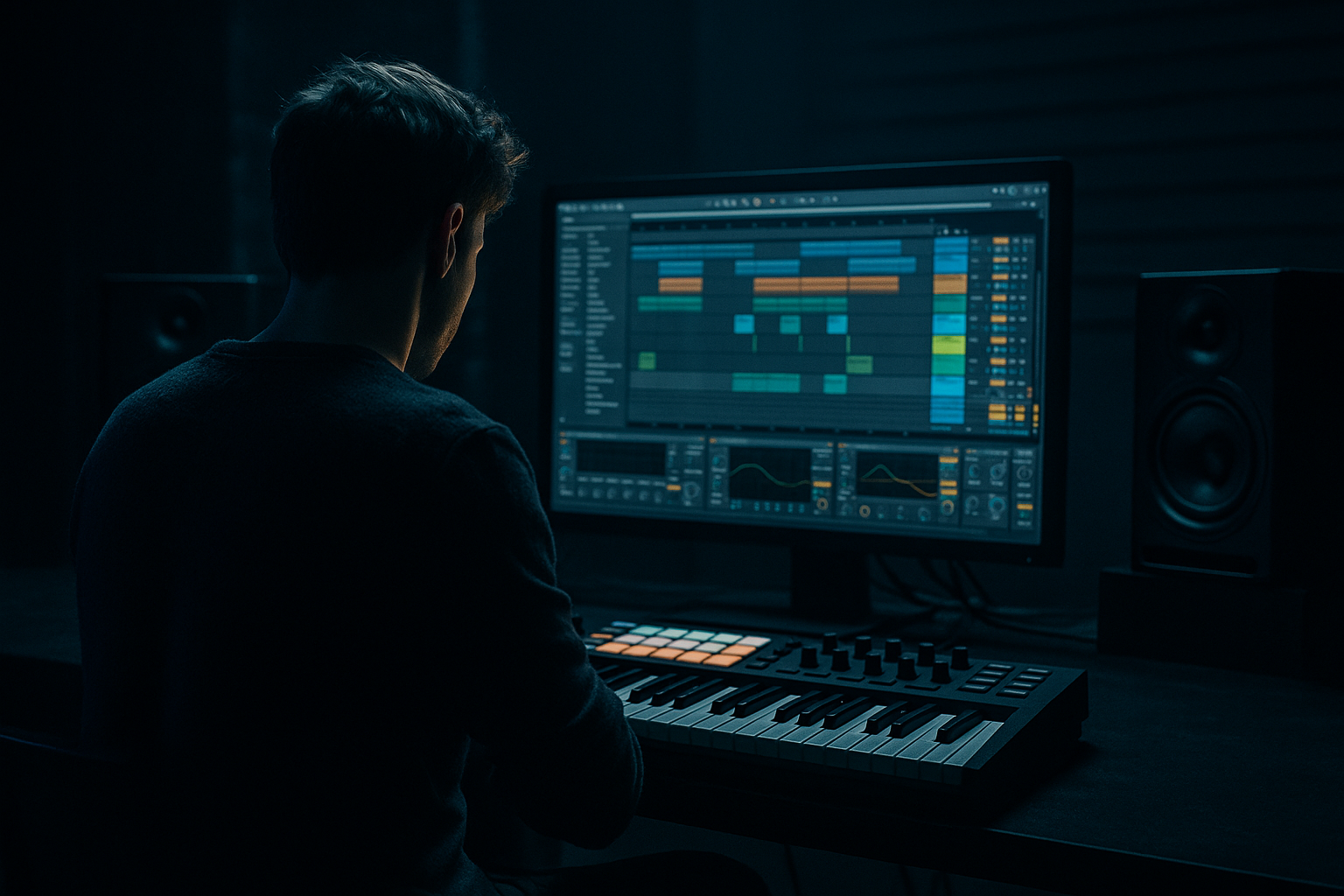
This lesson is about building a mid bass stack over a surgically edited breakbeat in Ableton Live 12 so the whole thing hits like a proper DnB drop: sub solid, mids animated, drums sharp, and the groove still breathable. Think dark rollers, jungly pressure, neuro-flavoured texture, or a modern half-time-to-full-time switch where the drums stay alive and the bass feels like it’s steering the tune.
Why this matters: in Drum & Bass, the difference between a loop that sounds “cool” and one that actually works in a mix is usually arrangement discipline and low-end control. A mid bass stack can be huge, but if it fights the break, you lose punch. A breakbeat can be filthy, but if it isn’t edited and shaped, it turns to mush the second the bass opens up. This lesson focuses on the mastering-stage thinking you need while producing: managing headroom, balance, mono compatibility, transient clarity, and density so the final mix can be pushed later without collapsing.
You’ll use Ableton stock tools to:
- carve a break into a playable, repeatable drum weapon
- build a layered mid bass stack with movement and stereo discipline
- route and shape both into a controlled DnB drop structure
- finish with enough mix headroom and tonal balance that mastering becomes a lift, not a rescue 🥁
- a tight, edited breakbeat made from sliced drum hits and ghost notes
- a sub layer locked to the root notes, clean and mono
- a mid bass stack made from 2–3 complementary layers:
- drum and bass processing routed through sensible buses
- automation on filters, distortion, and space effects for tension/release
- a mix that leaves around -6 dB peak headroom for later mastering
- enough contrast that the drop feels serious in a club system, not just loud on headphones
- Intro: DJ-friendly 16 bars with filtered break and sub tease
- Drop 1: full break + mid bass stack call-and-response
- 8-bar switch-up: break opens, bass goes more sparse, then slams back
- Breakdown: atmosphere and percussion strip-down before drop 2
- Stacking too many mid layers at once
- Letting the break and bass share the same frequency job
- Widening the sub or low mids
- Over-compressing the break
- Making the bass too constant
- Ignoring headroom early
- Resample the bass stack after processing, then cut the best 1–2 bars and rework them like a drum fill. This creates organic, aggressive movement without endless plugin stacking.
- Use Saturator before EQ on the mid bass if you want the harmonics to speak on smaller systems. Drive 2–6 dB is often enough.
- Try Redux very lightly on a resampled bass texture for rough digital grit, but keep it subtle or it will destroy the groove.
- Use Auto Filter automation on the break as a tension tool: closing the top end before a snare lift makes the drop feel heavier when it reopens.
- For a darker rollers vibe, keep the bass phrase more repetitive and let the drum edits evolve instead. That kind of pressure is often stronger than constant bass motion.
- If the track needs more menace, layer a short noise hit or metallic transient on the first beat of each 8-bar section, but high-pass it hard so it doesn’t clog the low end.
- In neuro-leaning material, place subtle automation on wavetable position or filter resonance every 2 bars to keep the bass alive without obvious wobble.
- Check the drop in mono and low volume. If the bass still feels present and the break still punches, your mastering path is in good shape.
- Build sub first, then stack mids around it.
- Edit the break like a performance instrument, not a loop.
- Keep low end mono, clean, and headroom-friendly.
- Use movement through automation, phrasing, and resampling, not endless layering.
- Let drums and bass answer each other so the drop has flow and pressure.
- Think like a mastering engineer while producing: if the mix is already balanced, the final loud version will hit harder.
What You Will Build
By the end, you’ll have a 16-bar DnB drop section with:
- a reese-style foundation
- a higher rasp or talking layer
- optional movement layer for fills and switch-ups
Musically, this could sit in a track like:
Step-by-Step Walkthrough
1. Set up a drop-focused session and reference target
Start with a fresh Ableton Live 12 project at 174–175 BPM for a modern DnB feel. Import one or two reference tracks into separate audio tracks and lower them to a comfortable listening level. Don’t overanalyze yet—just note:
- how loud the sub feels relative to the kick/break
- how busy the mids are in the drop
- how much space there is between fills
On your master, place a Spectrum for visual checking and a Utility set to monitor mono later. Keep the master clean for now; don’t slam a limiter at the beginning. For production-minded mastering, you want to hear whether the arrangement already balances without “fake loudness.”
Create these groups:
- DRUMS
- BASS
- FX
- REFERENCE
This simple structure speeds up decisions later, especially when you start checking drum/bass balance and headroom.
2. Source a break and slice it into performance-ready parts
Drag in a breakbeat with character—think amen, think classic loop, or a tighter break with strong hats and ghost notes. Put it in an audio track and set warp mode appropriately:
- use Beats for punchy transient preservation
- try Transient Loop if you want the loop to stay lively under heavy editing
Right-click and Slice to New MIDI Track using transients. This is where the surgery starts. In the created Drum Rack:
- identify kick, snare, ghost notes, hats, and any usable noise hits
- rename pads so you know what you’re triggering
- duplicate the MIDI clip and begin writing your own break phrasing
Practical setting ideas:
- shorten noisy tail slices with the clip envelope or pad sample start/end
- nudge ghost notes slightly ahead or behind the grid for feel
- keep the main snare around 2 and 4, but add syncopated fills before bar changes
Why this works in DnB: the genre depends on micro-variation. A sliced break gives you the human groove of jungle/DnB while letting you shape the rhythm around the bass rather than letting the bass fight an endless loop.
3. Build the breakbeat as two layers: body and detail
In the Drum Rack, create a second lane or duplicate the pattern so you can separate the break into:
- body layer: kick, snare, main hats
- detail layer: ghosts, ticks, reverse hits, rim noise
Process the body layer with stock devices:
- Drum Buss: Drive around 5–15%, Crunch low or off, Boom very subtle or off if the break already has low end
- EQ Eight: high-pass around 25–35 Hz only if needed; notch harshness around 3–6 kHz if the snare gets papery
- Saturator: Soft Clip on, Drive around 1–4 dB for density
On the detail layer, use:
- Auto Filter with a gentle high-pass around 200–500 Hz
- Utility to narrow width if the top is too wide
- subtle Reverb send only, not insert, so the break doesn’t smear
Set up velocity variation in the MIDI notes. Ghost notes should be lower velocity than core hits. This gives you that rolling, restless feel that works in darker DnB without flattening the groove.
4. Design the sub first, then stack the mids around it
In the BASS group, create an Operator or Wavetable instrument track for sub. Keep it simple:
- sine or near-sine oscillator
- mono mode
- no stereo widening
- low-pass support only
Suggested settings:
- Operator: sine oscillator, filter mostly closed or off, glide off unless you want a slide note
- Utility: Width at 0% on the sub
- EQ Eight: low-pass only if there’s unwanted top noise
Write a bass MIDI pattern that mirrors the break’s phrasing rather than stepping all over it. Use:
- root notes on strong drop points
- short note lengths for punch
- occasional offbeat push notes for call-and-response
Then stack mid layers above the sub:
- Layer 1: Reese-style mid using Wavetable or Analog, detuned unison, low-passed around 120–250 Hz to keep it mid-focused
- Layer 2: Texture or talking layer using Wavetable, Formants, wavetable position movement, or Resonators for a metallic edge
- Optional Layer 3: a resampled distortion layer created from the first two layers with heavy editing, then re-imported and trimmed
Example stack logic:
- Sub owns 20–80 Hz
- Reese owns 80–250 Hz
- Texture owns 250 Hz and above
If the bass feels messy, reduce layers before adding more processing. In DnB, clarity beats sheer layer count.
5. Shape the mid bass stack with movement, not constant noise
Add modulation so the bass feels like it’s evolving across the bar. In Wavetable, map:
- wavetable position to an LFO
- filter cutoff to a slower LFO
- distortion amount or oscillator shape to automation
Good starting ranges:
- LFO rate: 1/8, 1/4, or tempo-synced dotted movement
- filter cutoff: sweep within roughly 200 Hz to 2.5 kHz depending on the layer
- resonance: keep moderate; too much resonance will scream and eat headroom
For a more neuro-leaning result, place Auto Pan on the mid layer with:
- Phase at 0° for tremolo-style motion
- Amount low, around 10–25%
- synced rate at 1/8 or 1/16
Use Chorus-Ensemble carefully only on upper mids, not the core body. If you want width, widen the layer above 250 Hz, not the sub. Keep the bass stack feeling like one instrument with internal motion, not separate instruments arguing in the same lane.
6. Route drums and bass to separate buses and control them like a mix
Put all drum elements into the DRUMS group and bass layers into the BASS group. On each group, use bus processing with restraint:
DRUMS bus:
- Glue Compressor: 1–2 dB gain reduction, attack around 10–30 ms, release Auto or medium
- EQ Eight: slight cut if the snare is honky around 700 Hz–1.2 kHz
- Drum Buss if needed for density, but keep it subtle
BASS bus:
- EQ Eight to tame muddy build-up around 150–300 Hz
- Saturator to help mids read on smaller systems
- Utility to check mono width and trim gain
Now use sidechain compression from the kick or key drum hit to the bass bus if needed. In DnB, the break may already provide the rhythm, so you don’t always want obvious pumping. Keep it subtle:
- attack fast
- release timed to the groove, often around 60–150 ms
- aim for just enough ducking to let the break speak
Mastering mindset here: the mix should already feel internally balanced. If the bass stack is dominating before the master chain, it will become uncontrollable once you push level.
7. Carve the break around the bass with arrangement-aware editing
This is the surgical part. Instead of looping the break unchanged, edit it against the bass phrases. Use mute groups, clip duplicates, and automation to create space:
- remove or thin kick hits when the sub drops hardest
- keep snares strong on main phrase points
- add mini fills at the end of bars 4, 8, and 16
- use 1-bar or 2-bar switch-ups to avoid loop fatigue
Musical context example:
- Bars 1–4: filtered intro with break fragments and teasing bass notes
- Bars 5–8: full drop, bass says a phrase, drums answer
- Bars 9–12: break opens up with extra ghost notes, bass is more percussive
- Bars 13–16: tension build with cutoff automation, then a final hit or turnaround
Use Clip Envelopes or automation on:
- filter cutoff on the break
- send to reverb for fills only
- delay throws on selected snare hits
- bass filter opening in the last 2 bars before a switch-up
This arrangement style is what makes the track feel like a tune, not just a loop.
8. Finish with mastering-aware checks before you print anything
Now do the technical sanity pass. On the master:
- check peak level, aiming to leave around -6 dB headroom
- use Utility to mono-check the bass and low drums
- use Spectrum to spot excessive energy buildup in the low mids
Listen for:
- sub disappearing in mono
- break losing its transient snap when bass comes in
- harshness around 2.5–5 kHz
- mud around 150–350 Hz
If needed:
- high-pass non-essential FX
- reduce stereo width on anything below the midrange
- trim a layer rather than EQing everything
- automate less of the bass if the arrangement feels overbusy
The goal is not “mastered loud.” The goal is master-ready balance. If the drop already has contrast, punch, and space, later mastering becomes straightforward and musical.
Common Mistakes
Fix: keep one layer for body, one for character, one optional for movement. If it sounds cloudy, remove a layer before EQing harder.
Fix: decide who owns the kick-like punch, who owns the snare crack, and who owns the low mids. Make room with arrangement, not just EQ.
Fix: keep the sub mono with Utility Width 0% and only widen upper harmonics.
Fix: preserve transients. Use light bus compression and let the sliced editing do most of the groove work.
Fix: automate filter, distortion, and note phrasing so the bass phrases with the drums.
Fix: keep the master clean and leave space. If you build too loud, you’ll lose impact later.
Pro Tips for Darker / Heavier DnB
Mini Practice Exercise
Set a timer for 15 minutes and build this:
1. Load one breakbeat and slice it into a Drum Rack.
2. Program a 4-bar loop with:
- 2 core snare hits per bar
- 2–4 ghost notes
- one small fill at the end of bar 4
3. Create a sub track in Operator and write a simple root-note bassline.
4. Add one Wavetable mid bass layer with a moving filter or wavetable position.
5. Process the drum group with Drum Buss and light EQ.
6. Process the bass group with Saturator and EQ Eight.
7. Mute the bass for the first 2 beats of bar 4, then bring it back with a filter open.
8. Check mono on the master and reduce any widening below the midrange.
Goal: make the loop feel like a real drop section, not just separate drums and bass.

