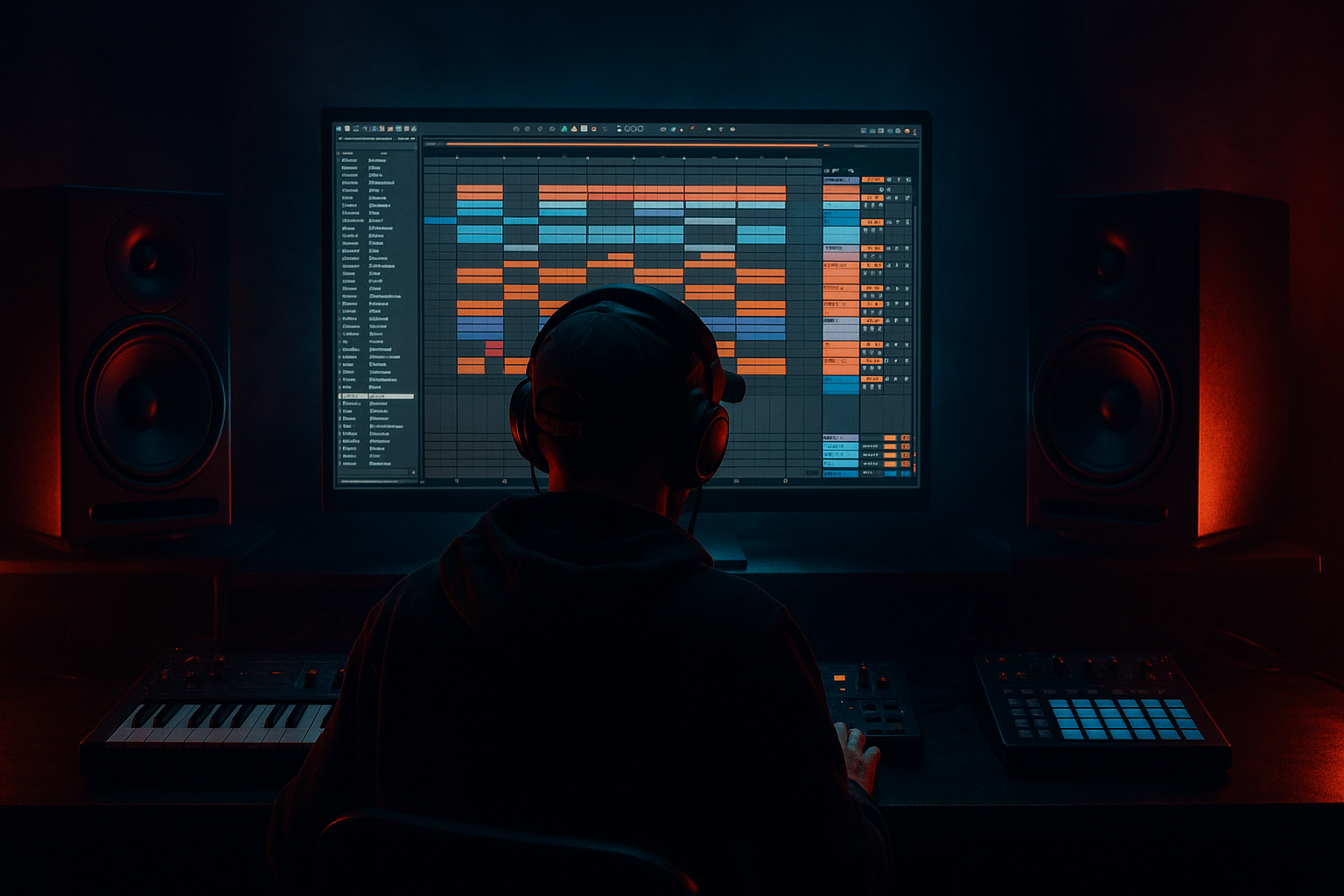
Main tutorial
Lesson Overview
Subweight is the art of making a vocal texture sit under a Drum & Bass or jungle groove as a feeling, not a lead. In this lesson, you’ll build a VHS-rave-style vocal layer that sounds dusty, human, slightly haunted, and glued to the breakbeats — the kind of texture that makes an oldskool roller feel alive without turning the track into a vocal song.
In Ableton Live 12, this is especially powerful because you can shape short vocal snippets into rhythmic support using stock devices only: warp them, degrade them, filter them, duck them, and make them dance around the break. The goal is to create a subweight vocal bed that lives in the midrange and low-mids, adding character and motion under a jungle break or darker DnB drop.
Why it matters: DnB arrangements often rely on repetition and controlled variation. A humanized vocal texture gives you movement between drum hits, adds emotional dust to the groove, and creates that VHS-rave color that feels nostalgic, gritty, and undeniably underground. It works especially well in oldskool jungle, dark rollers, breakbeat-driven halftime sections, and neuro-adjacent intros where you want atmosphere without clutter.
What You Will Build
You’ll build a short vocal texture loop that behaves like a living layer beneath your breakbeats:
- a chopped, time-warped vocal phrase
- filtered and band-limited to sit around the drums and bass
- subtly detuned and degraded for VHS character
- sidechained so the kick and snare still punch through
- rhythmically edited so it follows the break rather than fighting it
- automated to bloom in the intro, thin out in the drop, and reappear in switch-ups
- Making the vocal too clean
- Putting the vocal in the sub range
- Over-widening the whole layer
- Using too much reverb
- Ignoring the snare relationship
- Letting the vocal fight the break
- Layer a second degraded pass
- Use formant-like contrast through filtering
- Build tension with delay throws
- Duck the vocal from the snare, not just the kick
- Resample after every major tone move
- Use the vocal as a transition layer
- Pair it with a reese answer
- Use short, characterful vocal material and warp it into a textured layer.
- Shape it with EQ Eight, Saturator, Redux, Chorus-Ensemble, Auto Filter, and gentle sidechain compression.
- Keep it rhythmically tied to the breakbeats, especially the snare.
- Resample early to commit to the vibe and speed up decisions.
- Preserve mono low-end and let the vocal live in the emotional midrange.
- Automate the texture across the arrangement so it feels alive, not static.
By the end, you should have a texture that feels like a forgotten rave tape sampled into a modern DnB tune: dusty, emotional, and tightly locked to the groove.
Step-by-Step Walkthrough
1. Choose the right vocal source and place it against the break
Start with a short vocal fragment: a spoken line, a shout, a breathy phrase, or even one word with character. For oldskool/jungle flavor, choose something with an expressive attack — not a pristine pop vocal. Think “hey,” “come on,” “inside,” or a chopped rave chant.
Drag it into an audio track and warp it with care. In Ableton Live, turn Warp on and use:
- Beats mode for sharp, rhythmic fragments
- Complex or Complex Pro for more sustained, textured phrases
If you’re making jungle-style breakbeats, set the clip so the vocal lands between snare hits or lightly offsets the snare for push-pull energy. A good starting point is to align the vocal on the “and” of 2 or 4, so it supports the break without stealing the downbeat.
Practical tip: keep the clip short, around 1/2 to 2 bars, so it can loop like texture rather than dominate as a hook.
2. Turn the vocal into a texture with warping and resampling
Duplicate the vocal and make one version your “raw” layer and another your “texture” layer. On the texture layer, use warp markers to create slight time instability:
- nudge a syllable a few milliseconds late
- stretch one vowel slightly longer than the next
- leave a tiny timing inconsistency so it feels hand-cut, not grid-perfect
Then resample it. Create a new audio track, set its input to Resampling, and record 1–2 bars of the vocal processing while the break plays. This is a classic DnB workflow because it commits the vibe and lets you edit the printed audio like a sample.
Why this works in DnB: breakbeat music thrives on micro-variation. A resampled vocal texture can sit like another percussion layer, with human timing baked in, instead of feeling like a clean studio vocal pasted on top.
3. Shape the VHS-rave tone with stock devices
Put an Audio Effect Rack on the resampled vocal and build a simple chain:
- EQ Eight
- Saturator
- Chorus-Ensemble or Phaser-Flanger
- Redux
- Auto Filter
Start with EQ Eight:
- high-pass around 120–180 Hz to clear sub territory
- gentle cut around 250–400 Hz if it’s boxy
- soft dip around 2.5–5 kHz if it’s harsh
Then Saturator:
- Drive: +2 to +6 dB
- Soft Clip: on
- Output adjusted so you don’t get louder just dirtier
Redux is your VHS secret weapon:
- Downsample subtly, around 2x–4x reduction
- Bit reduction: light to moderate
- Keep it audible, but don’t crush intelligibility
Add Chorus-Ensemble with a very small amount:
- Amount: 10–25%
- Rate: slow
- Mix: low
This gives the vocal a slightly wobbling tape-machine smear.
Finally, use Auto Filter as a tone shaper:
- low-pass around 6–10 kHz for haze
- automate cutoff so the vocal opens only during fills or intros
4. Humanize the rhythm so it feels like an MC ghost in the track
This is where the “subweight” part really comes alive. You want the vocal to feel human, not looped.
Use Clip Envelopes or Volume automation to shape individual syllables:
- make some hits quieter by 1–3 dB
- push one syllable slightly louder for emphasis
- trim the tail of words so they don’t smear into the snare
In Ableton Live 12, you can also use Groove Pool lightly. Try applying a swing groove from a break or a subtle MPC-style groove to the vocal clip at around 10–30% Amount. Don’t overdo it — you’re matching the pocket of the drums, not turning the vocal into a dance lead.
If you have a chopped break, let the vocal phrasing answer it:
- vocal hit after the snare = call
- break fill or ghost note = response
- silence before the next bar = tension
This kind of call-and-response is very authentic in DnB and jungle, especially when the break is already busy.
5. Make room for the kick, snare, and sub with sidechain and spectral discipline
The vocal texture should sit behind the main drum and bass elements, not compete with them. Add Compressor on the vocal track and sidechain it from the kick or a ghost trigger if needed.
Good starting settings:
- Attack: 1–10 ms
- Release: 80–180 ms
- Ratio: 2:1 to 4:1
- Gain reduction: 2–5 dB
If the snare is the dominant anchor in your breakbeat, you can also sidechain to the snare or use a duplicate trigger track for precise ducking. This helps the vocal breathe around the backbeat, which is crucial in jungle where the snare often carries the energy of the bar.
Then use EQ Eight again to keep the vocal out of the sub region:
- high-pass no lower than 120 Hz, often higher
- reduce low-mid buildup if your bassline is already thick
The key is separation. Your subweight vocal should add emotional mass in the mids, while the actual sub remains clean and mono.
6. Glue it to the breakbeat with transient-aware editing
Breakbeats are the heartbeat of this technique. If your break has chopped kicks, ghost snares, or ride taps, use them as placement markers for vocal slices.
Edit the vocal in Arrangement View or Session View so that:
- syllable starts often land just before or just after a snare
- breath noises can fill tiny holes in the break
- longer vowel tails are cut before transient-heavy drum hits
If the vocal has a strong transient, soften it with:
- transient reduction via volume shaping
- a tiny fade-in at the clip start
- a high-pass filter if the consonants are muddy
For jungle oldskool vibes, try letting one vocal chop repeat with the break pattern every 2 bars, then slightly change the second half of the phrase. That slight mutation keeps the loop from feeling static.
7. Add movement with automation and resampled layer changes
Once the texture feels good, automate it like part of the arrangement. Use two or three macro-style changes across the track:
- Auto Filter cutoff opening in the intro
- Redux amount increasing before the drop
- Saturator drive pushed slightly in a switch-up
- reverb send raised only on phrase endings
A practical arrangement example:
- Bars 1–8: filtered vocal haze only, no full-range presence
- Bars 9–16: vocal becomes more audible, still washed
- Drop 1: vocal ducks under the drums, becomes a texture
- Bars 17–24: bring in a chopped call phrase with more width and grit
- Switch-up: automate a quick low-pass sweep and an echo tail for tension
If you want a more rave-tape feel, send the vocal to Echo with:
- Time synced to 1/8 or 1/4 dotted
- Feedback: 15–35%
- Filtered repeats
- Dry/Wet kept modest, or automate it only at phrase ends
8. Control width carefully so the low-end stays solid
DnB demands mono discipline where it counts. Keep the vocal texture wider only in the upper mids and highs, not in the low-mids that can cloud the bassline.
Use Utility:
- Bass Mono can be left for the bass channel, not the vocal
- Width: 100–140% is usually enough for the vocal texture
- Use the Mono switch on your master or a check group to test compatibility
If the vocal gets too wide and starts washing over the break, narrow it until the snare and hats regain focus. A VHS-rave texture should feel like smoke around the drums, not a blanket over them.
You can also split the sound with Audio Effect Rack:
- low-mid lane: mono, filtered, subtle
- top texture lane: wider, more chorused, more degraded
This keeps the groove heavy while preserving the aura.
Common Mistakes
- Fix: add subtle Saturator, Redux, or EQ band-limiting so it feels sampled and period-appropriate.
- Fix: high-pass it. The sub should belong to the bass or reese, not the vocal texture.
- Fix: keep the core midrange focused and use width sparingly. Test in mono.
- Fix: shorten the tail or automate reverb only on transitions. DnB needs space for the break and bass.
- Fix: align vocal hits around the backbeat. In jungle and rollers, the snare is often the anchor.
- Fix: cut words around transients, sidechain lightly, and simplify the phrase. Texture should support the drum statement, not compete with it.
Pro Tips for Darker / Heavier DnB
- Duplicate the vocal, push one copy through Redux and Saturator harder, then blend it quietly under the main texture. This adds menace without sacrificing clarity.
- One layer low-passed around 7 kHz, another band-passed around 1.5–4 kHz. The contrast creates depth and that ghost-rave feeling.
- Automate Echo at the end of 2- or 4-bar phrases only. A single blurred repeat before a drop can create classic rave suspense.
- In breakbeat-heavy DnB, the snare is often the loudest emotional point. Let it breathe.
- Once the texture feels right, print it. Then chop it further. This gives you more commit-driven movement and faster decision-making.
- In darker rollers, let the vocal only appear in fills, breakdowns, or 8-bar turnarounds. That scarcity makes it hit harder when it returns.
- Let the vocal phrase open space and the reese close it. This call-and-response is especially strong in neuro-adjacent or hard roller contexts.
Mini Practice Exercise
Spend 15 minutes making a VHS-rave vocal subweight layer from scratch:
1. Pick a 1- to 2-bar vocal sample with attitude.
2. Warp it and chop it into 3–5 short phrases.
3. Add EQ Eight, Saturator, Redux, and Auto Filter.
4. Sidechain it lightly from the kick or snare.
5. Resample one loop of the processed vocal.
6. Cut the resampled audio so it lands around the break’s backbeat.
7. Automate filter cutoff for 8 bars: closed in the intro, slightly open in the drop.
8. Test mono, then adjust width and low-mids until the break punches through.
Goal: finish with one loop that feels like a gritty memory under the drums, not a lead vocal.
Recap
If you get this right, your track gains that oldskool VHS-rave atmosphere: haunted, dusty, and glued to the break in a way that feels unmistakably Drum & Bass.

