Main tutorial
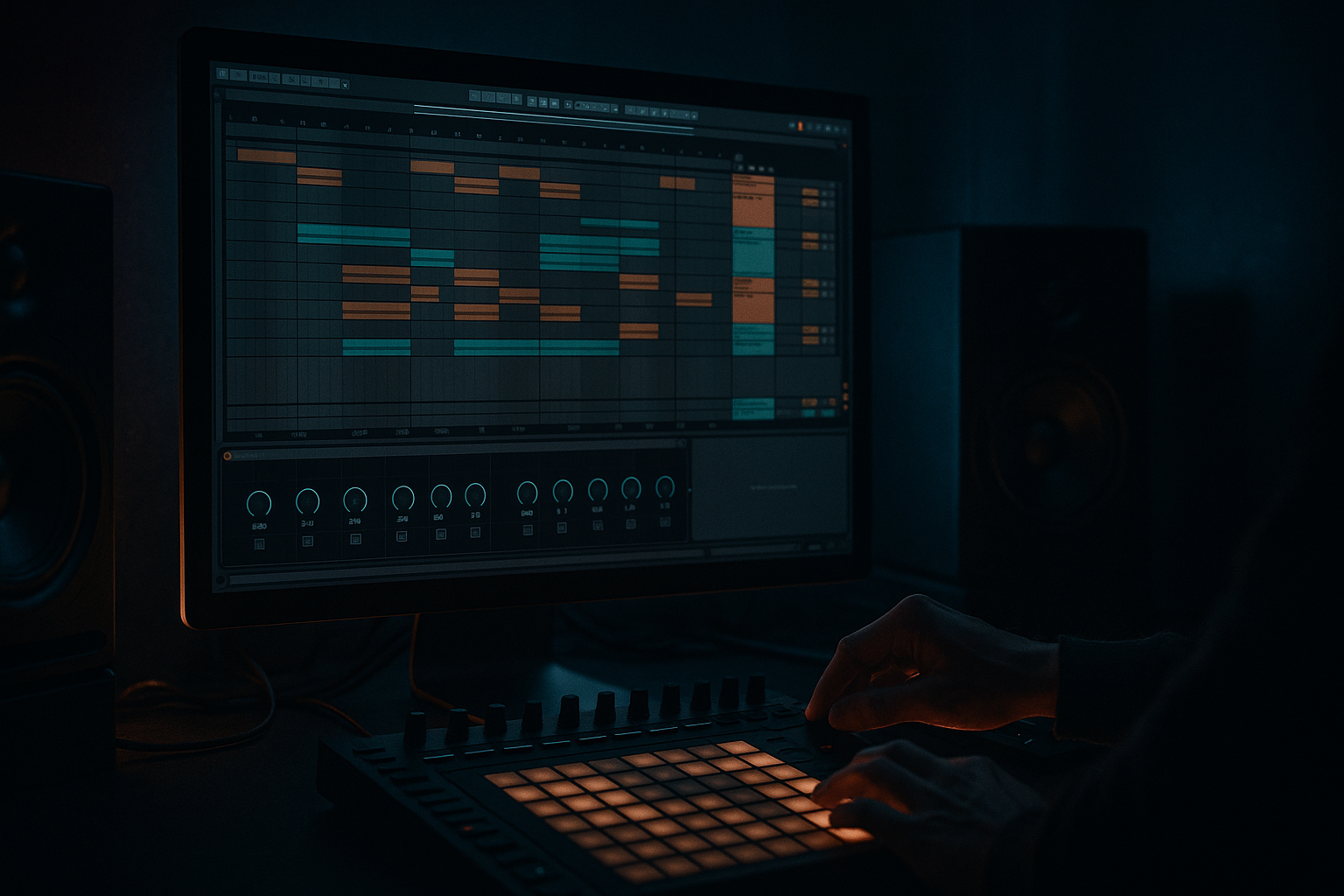
Subweight Jungle Ride Groove: Blend and Arrange in Ableton Live 12
1. Lesson overview
In this lesson, you’ll build a dark, DJ-friendly jungle/DnB ride groove in Ableton Live 12 that feels strong on its own, but also works as a tool section for mixing, looping, and transitioning in a set. The focus is on subweight, ride energy, and arrangement flow — the kind of section that can sit under MCs, blend into another tune, or drive a breakdown into a drop. 🥁⚡
We’ll be working with:
- Drum & bass / jungle timing
- Ride cymbal groove design
- Sub-heavy low-end balance
- Ableton stock devices
- DJ tool arrangement thinking
- Blend techniques for intro/outro utility
- Kick/snare foundation
- Fast break-derived drum loop
- Ride cymbal pattern that lifts energy
- Subweight bass support
- Simple arrangement automation
- Transition elements for blending
- dark warehouse DnB
- junglist tool
- rolling half-step tension with broken-beat movement
- clean intro that DJs can mix from
- strong midrange top from ride and percussion without crowding the bass
- Set tempo to 172–174 BPM for classic DnB/jungle energy.
- Create groups:
- Add markers for:
- 8-bar intro
- 8-bar groove
- 8-bar variation
- 8-bar outro
- Kick: short, punchy, around 50–70 Hz
- Snare: layered snare + clap + noise
- Ghost snare: lower velocity, slightly swung
- Hat/percussion: sparse, supporting the ride
- Drum Rack
- Simpler
- EQ Eight
- Drum Buss
- Saturator
- Utility
- Drive: 5–15%
- Boom: subtle or off if your sub is already strong
- Transients: slightly up if the break needs snap
- Crunch: very light, enough to thicken
- clean metal ride sample
- slightly dirty jungle ride
- short, controlled ride bell
- layered ride with a noise layer
- offbeat patterns
- syncopated 8th-note movement
- rolling 16th-note pulses
- call-and-response with the snare
- ride hits on:
- Operator for a clean sine sub
- Wavetable for a richer moving sub
- Analog for a thicker analog-style low end
- Root note on bar 1 beat 1
- Follow-up notes on offbeats
- Occasional octave movement
- Use rests so the kick can breathe
- Fast attack
- Medium release
- Just enough ducking so the kick cuts through cleanly
- Sub: 30–80 Hz
- Kick body: 50–100 Hz
- Snare crack: 180 Hz–2 kHz
- Ride presence: 3–10 kHz
- the ride to add excitement above the break
- the kick to stay solid and not disappear
- the sub to remain centered and clean
- the snare to cut through the ride without sounding brittle
- If the ride sounds harsh, use EQ Eight and cut a little at 7–9 kHz
- If the snare gets masked, automate the ride down 1–2 dB during snare accents
- If the bass and kick smear together, tighten the bass release and reduce low-end resonance
- Ride Main: full body, low-volume
- Ride Top: high-passed around 1.5–3 kHz, adds sheen
- rain texture
- vinyl noise
- distant pad
- industrial hit
- reversed cymbal swell
- Granulator III if you have it available
- Hybrid Reverb
- Echo
- Auto Filter
- high-pass it above 150–250 Hz
- keep it very low in the mix
- automate a little filter movement
- use short reverb tails for depth, not wash
- filtered drums
- sub in low volume or delayed entry
- ride introduced sparsely
- minimal FX
- full drum pattern
- full ride groove
- sub fully present
- add subtle percussion fills
- remove one ride hit pattern
- add a snare fill
- introduce a short reversed FX
- shift bass note pattern slightly
- strip sub
- reduce kick density
- keep ride and top percussion
- leave a clean transition tail
- a stable intro to beatmatch
- a strong main section for energy
- a variation to keep the loop interesting
- a clear outro to mix out smoothly
- Ride filter cutoff
- Bass low-pass or resonance
- Reverb send amount
- Delay feedback
- Drum Buss drive
- Utility gain on sections
- Intro: ride filtered low, then open over 4 bars
- Main section: subtle rise in high shelf on drums
- Variation: quick reverb swell before a snare fill
- Outro: automate sub level down gradually
- reverse crash
- short riser
- filtered noise burst
- snare roll
- low-end drop-out
- impact hit before a new 8-bar phrase
- Auto Filter
- Reverb
- Echo
- Utility
- Saturator
- strip the bass for 1 bar before a drop
- mute the ride for a half-bar to create tension
- let a ghost snare or tom fill imply momentum
- Saturator on bass
- Drum Buss on drums
- light Overdrive on percussion layers
- sub = weight
- mid bass = grit
- ride/top = motion
- use Drum Buss Transients
- or Glue Compressor on the drum bus
- filter the ride and drums slightly down in the intro
- open them up in the groove
- pull them back in the outro
- how much ride is actually present
- how much space the sub gets
- where the energy changes every 8 bars
- Use a break or programmed kick/snare pattern
- Keep it tight and loopable
- Program a 2-bar ride pattern
- Repeat with a variation every 4 bars
- Use EQ and saturation
- Create a simple sine-based bass line
- Use 2–4 notes only
- Sidechain to the kick
- Add a dark texture or filtered noise
- Keep it subtle
- Bars 1–8: filtered intro
- Bars 9–16: full groove
- Bars 17–24: small variation
- Bars 25–32: mix-out
- drums give the impact
- ride gives the forward motion
- sub gives the weight
- arrangement gives the DJ utility
- keep the ride controlled and purposeful
- use sub that is deep but not muddy
- arrange in clean phrases
- automate for movement
- leave space for mixing and blending
By the end, you’ll have a practical framework for making a ride-led section that feels rolling, menacing, and mix-ready.
---
2. What you will build
You’ll build a 16-bar DJ tool section with:
Target vibe
Think:
Core elements
1. Drum rack or audio break
2. Ride sample or layered ride
3. Sub bass MIDI synth
4. Atmosphere/texture
5. FX for transitions
6. Arrangement with intro, groove, variation, and mix-out
---
3. Step-by-step walkthrough
Step 1: Set tempo and project structure
In Ableton Live 12:
- DRUMS
- BASS
- ATMOS
- FX
- Intro
- Main groove
- Variation
- Mix-out
Workflow tip
If this is a DJ tool, keep the structure simple and loop-friendly:
That gives DJs space to blend in and out naturally.
---
Step 2: Build the drum foundation
You need a groove that supports the ride without making the top end chaotic.
Option A: Break-based foundation
Use a classic break or chopped jungle loop.
1. Drag a break into an Audio Track
2. Warp it to match tempo
3. Slice it into a Drum Rack if you want more control:
- Right-click clip → Slice to New MIDI Track
- Slicing preset: Built-in / Transient
4. Reprogram the break with emphasis on:
- snare on 2 and 4
- ghost hits around the backbeat
- small gaps for the ride to breathe
Option B: Programmed drum layer
If you want a cleaner DJ tool, build from scratch:
Useful stock devices
Drum Buss starting point
On the drum group:
Keep the drums powerful, but don’t let them fight the ride in the 4–10 kHz range.
---
Step 3: Design the ride groove
This is the core of the lesson. The ride is what gives the section forward motion and DJ utility.
Choose the right ride
Use one of these:
Basic rhythm idea
In DnB, the ride often works well in:
Example groove concept
Try this as a starting point in 1 bar:
- 1a
- 2&
- 3e
- 4&
Then vary it across 2 bars so it doesn’t feel static.
In Ableton Live 12
1. Create a MIDI track
2. Load Simpler with a ride sample
3. Set Simpler to:
- Classic mode
- One-Shot if you want a fixed tail
- Trigger if you want tight note control
4. Create a MIDI clip and program the rhythm
Processing chain for the ride
A practical chain:
1. EQ Eight
- High-pass around 250–400 Hz
- Cut harsh zones if needed around 6–8 kHz
2. Saturator
- Soft Clip on
- Drive: very light, around 1–3 dB
3. Drum Buss or Glue Compressor
- Very gentle compression to glue it into the drums
4. Hybrid Reverb or Reverb on a send
- Keep it short and controlled
Important
Your ride should lift the groove, not dominate it. If it’s too loud, the track turns into cymbal soup fast. 🥄
---
Step 4: Create the subweight bass
“Subweight” means the low end feels heavy, stable, and deep, but still leaves space for the drums and ride.
Bass sound options
For this style, use:
Simple sub patch in Operator
1. Load Operator
2. Set oscillator A to Sine
3. Turn off other oscillators or keep them very low
4. Set amp envelope:
- Attack: 0–5 ms
- Decay: short
- Sustain: high
- Release: short to medium
5. If needed, add slight pitch envelope for a small thump
Bass MIDI idea
Keep notes sparse for a DJ tool. Try:
Bass processing chain
A solid chain:
1. EQ Eight
- Cut unnecessary highs above 200–300 Hz on a pure sub
2. Saturator
- Add harmonics so the bass is audible on smaller systems
3. Compressor sidechained to kick
- Sidechain input from kick
- Aim for 2–5 dB gain reduction on kick hits
4. Utility
- Mono below the low end
- Keep sub centered
Sidechain settings
This is especially important in DnB because the low end needs to feel fast, not bloated.
---
Step 5: Blend the ride with the drums and sub
This is where the groove comes alive.
Frequency balance
What to listen for
You want:
Practical balancing moves
Layering trick
Try duplicating the ride track:
Blend both subtly. This gives you energy without a brittle single sample.
---
Step 6: Add atmosphere for depth
A DJ tool still needs space and mood. Darker jungle/DnB often benefits from subtle atmos layers.
Options
Ableton stock tools
Practical approach
Put an atmosphere track under the groove and:
This gives the section a sense of space while keeping it DJ-friendly.
---
Step 7: Arrange for DJ utility
A DJ tool needs clear phrasing and easy mix points.
Example arrangement
#### Bars 1–8: Intro
#### Bars 9–16: Groove
#### Bars 17–24: Variation
#### Bars 25–32: Mix-out
Why this works
DJs need:
---
Step 8: Use automation to create movement
Automation turns a loop into a track.
Good automation targets
Example automation moves
Ableton tip
Use clip envelopes for loop-based automation and track automation for arrangement-wide changes. This keeps your workflow clean and fast.
---
Step 9: Add transition FX the DnB way
Keep transitions functional, not cheesy.
Great DnB transition FX
Stock device chain for FX
Example
For a pre-drop transition:
1. Duplicate the snare on the last 1/2 bar
2. Automate Reverb send up slightly
3. Add a reverse cymbal into the downbeat
4. Drop the sub out for 1 beat before the groove returns
That creates tension without overdoing it.
---
4. Common mistakes
1. Making the ride too loud
If the ride dominates, the groove becomes fatiguing and loses punch.
Fix: lower the ride and EQ harsh highs gently.
2. Letting the sub clash with the kick
In DnB, low-end clarity is everything.
Fix: sidechain properly, shorten bass release, and avoid overlapping notes on kick hits.
3. Using too much reverb
Too much space kills impact and makes DJ blending messy.
Fix: use sends subtly and keep low end out of reverbs.
4. Overcomplicating the arrangement
A DJ tool should be functional first.
Fix: build around strong 8-bar phrases and clear transitions.
5. Forgetting mono compatibility
Big low end that disappears in mono is a problem.
Fix: keep sub mono with Utility and avoid stereo widening below the mids.
6. Not leaving breathing room
If every lane is full, the groove stops rolling.
Fix: leave gaps in the bass and percussion so the ride and snare can speak.
---
5. Pro tips for darker/heavier DnB
Use contrast, not constant density
Heavy DnB feels heavier when elements enter and exit with intention.
Distort carefully
A little saturation makes the track feel louder and meaner.
Try:
Keep sub and top separate
Think in layers:
This separation helps the mix stay powerful.
Use transient control
If the break is too spiky:
Filter for tension
A classic DnB move:
Reference dark rollers
Compare your section to rolling tracks with strong DJ utility. Listen for:
---
6. Mini practice exercise
Exercise: Build a 16-bar ride-led DJ tool
In Ableton Live 12, create a new project and make this:
#### Track 1: Drums
#### Track 2: Ride
#### Track 3: Sub
#### Track 4: Atmos
Arrangement goal
Challenge
Make the track work when looped from bars 9–24. If the loop feels good as a DJ tool, you’ve done it right.
---
7. Recap
A strong subweight jungle ride groove in Ableton Live 12 is all about balance:
Remember:
If you build with these principles, your DnB sections will feel heavier, cleaner, and more usable on the floor. 🔥
If you want, I can also turn this into a bar-by-bar Ableton Live 12 project template with example MIDI patterns and device chains.

