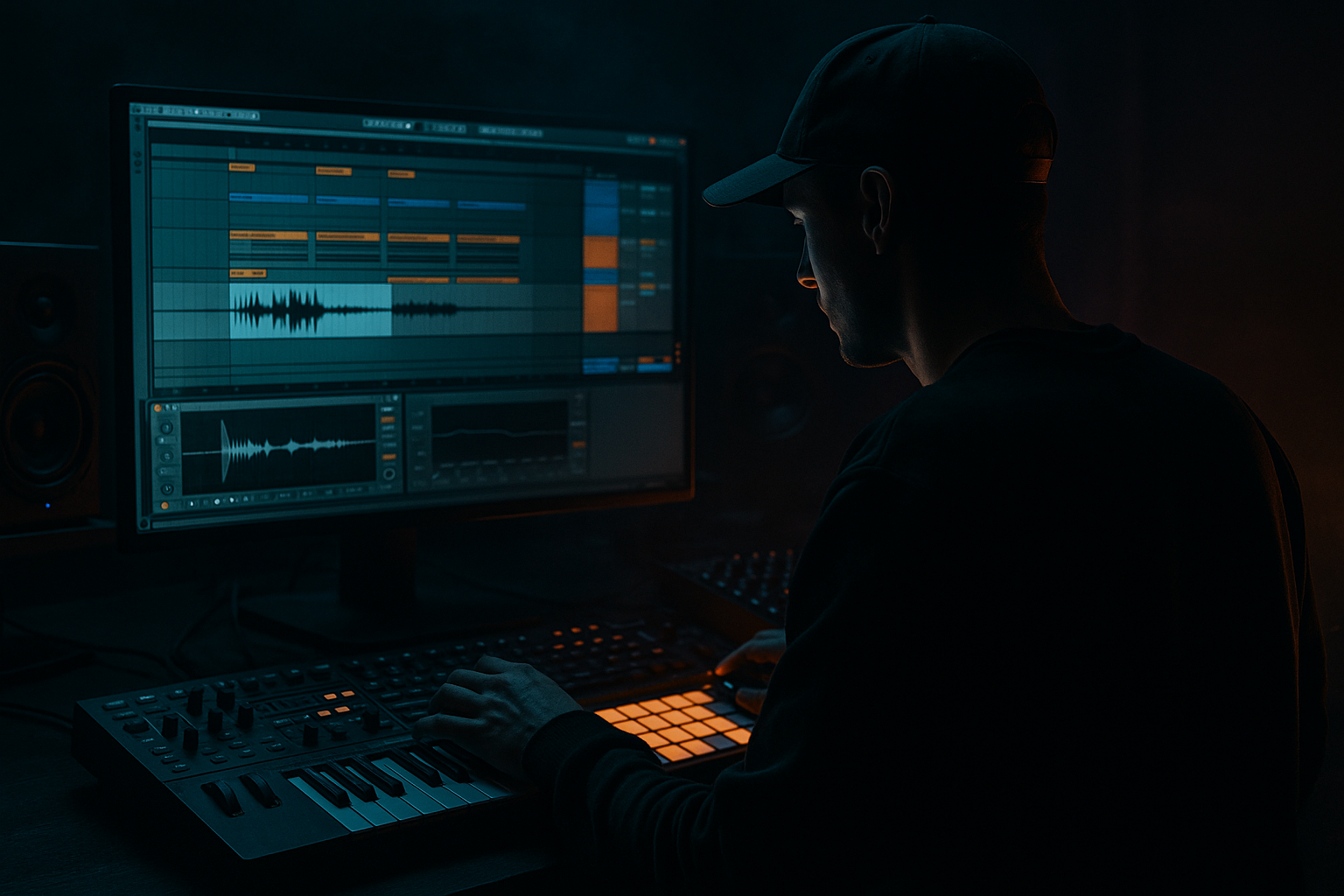
Main tutorial
Lesson Overview
A subweight edit is a short transitional bass move designed to make a DJ-style or pirate-radio-style switch feel heavier, cleaner, and more intentional. In Drum & Bass, this kind of edit usually appears right before a drop, after a 16-bar phrase, or in a quick breakdown between two drum sections. It’s that moment where the track seems to “lean forward” and then slam into the next section with low-end authority. 🔊
In pirate-radio-flavoured DnB, the energy is rougher and more spontaneous than a polished pop arrangement. That means your transition doesn’t need to be huge or overdesigned — it needs to feel urgent, gritty, and physically weighted. This lesson shows you how to build a subweight edit from scratch in Ableton Live 12 using stock devices, simple resampling, and a beginner-friendly workflow.
Why this matters:
- It teaches you how to control sub movement instead of just drawing notes and hoping they hit.
- It helps you create transitions that keep low-end tension without muddying the mix.
- It gives you a reusable method for rollers, jungle, dark DnB, neuro-influenced bass music, and radio-style drop edits.
- It introduces a core DnB production idea: resample, edit, refine, and place the result back into the arrangement.
- A subby bass swell or movement phrase made from a simple synth source
- A resampled audio clip with tighter timing and more character
- A clean low-end fade/shape that doesn’t clash with the kick
- A short transition feel that could sit before a drop, switch-up, or breakdown return
- A version that works in a dark roller or jungle-inspired DnB arrangement
- bar 1: tension building with a low, unstable pulse
- bar 2: weight rising, then a controlled cut or impact into the next section
- Making the sub too long
- Resampling before the bass sounds right
- Leaving clicks at clip edges
- Using too much stereo width on the sub
- Overfilling the transition with too many FX
- Ignoring the drums
- Letting saturation blur the low end
- Split the bass into two layers
- Use a tiny pitch drop at the end
- Cut the bass just before the drop
- Add controlled grit
- Let the break speak
- Keep the sub edit DJ-friendly
- Use call-and-response
- Build the transition around a simple DnB drum context
- Use Operator or Wavetable for a clean sub source
- Shape it with Saturator, Auto Filter, EQ Eight, and Utility
- Resample the bass to audio so you can edit it like a real DnB transition
- Keep the low end mono, controlled, and phrase-aware
- Make the edit work with snare placement, break timing, and arrangement tension
You’ll also get a better feel for where sub belongs in a phrase, how to leave space for drums, and how to make a transition feel clean while still sounding nasty.
What You Will Build
You will create a 2-bar pirate-radio transition that moves from a held groove into a drop-ready impact. The finished result will include:
Musically, the result should feel like:
Think of it like a quick sub pressure bridge between two parts of a tune. It should sound deliberate enough for a track, but raw enough to feel like a pirate-radio moment.
Step-by-Step Walkthrough
1. Set up a simple DnB loop first
Start with a basic 170–174 BPM project. DnB transitions feel most natural when the arrangement already has a rhythmic context.
Build a 2-bar loop with:
- kick on beat 1 and maybe beat 3
- snare on beat 2 and 4
- a basic hat pattern or break
- a placeholder bass note on the first beat only
Keep the drums simple. You’re not writing the full track yet — you’re giving the sub edit something real to respond to.
Arrangement idea:
- bar 1: busy drum groove
- bar 2: short gap or reduced drums
- next section: drop or new pattern
This matters because in DnB, low-end edits feel stronger when they’re framed by clear drum punctuation.
2. Create a sub source with an Ableton stock instrument
On a new MIDI track, load Operator or Wavetable. For beginners, Operator is the easiest choice because it can make a clean sine-based sub very quickly.
Suggested Operator setup:
- Oscillator A: sine wave
- Envelope: short attack, medium decay, low sustain if you want pluck
- Filter: low-pass, mostly open
- Pitch envelope: off for now
Two useful starting points:
- Pure sub: sine wave only, no extra harmonics
- Dirty sub start: sine wave plus a tiny bit of saturation later
Write a simple 1-bar MIDI phrase:
- one long note on the root
- one or two shorter notes near the end of the bar
- optionally a note drop or small pitch movement into bar 2
For now, use a root note that fits the track’s key, like F, G, or A minor territory if you want a dark DnB vibe.
3. Add movement with basic MIDI phrasing
Your subweight edit should not be a straight held note the whole time. Even beginners can make it feel more musical by changing the note lengths.
Try one of these beginner-friendly phrases:
- Long note + short pickup: one held note for most of the bar, then a short note just before the change
- Call-and-response: two short notes, then a gap, then a final low note
- Descent into the drop: root note, then one note down a semitone or whole tone for tension
Good starting values:
- note 1: 1 to 1.5 bars long
- note 2: 1/8 or 1/4 note stab
- note 3: short note right before the transition
Why this works in DnB: bass movement is often more effective when it follows phrase logic rather than constant motion. A small change in note length or timing can make the edit feel like it’s “breathing” with the drums.
4. Shape the sound with stock FX before resampling
Add a simple processing chain after the synth. Keep it basic and intentional.
Suggested stock devices:
- Saturator: for harmonic weight
- Auto Filter: for motion or low-pass control
- Utility: for mono control
- Optional EQ Eight: for cleanup
Starter settings:
- Saturator Drive: 2 to 6 dB
- Saturator Soft Clip: On
- Auto Filter cutoff: start around 80–200 Hz if you want a filtered transition, or higher if you want more movement
- Utility Width: 0% on the sub layer
- EQ Eight: cut unnecessary low-mid buildup around 200–400 Hz if it gets boxy
If you want the transition to feel more pirate-radio and less polished, automate the Auto Filter cutoff down and then open it quickly into the drop. Keep the movement small and readable.
5. Resample the bass to audio
This is the key step. Instead of leaving the bass as a MIDI instrument, resample it into audio so you can edit the waveform like a DnB producer would.
In Ableton Live 12:
- Create a new audio track
- Set the input to Resampling
- Arm the track and record your bass phrase while the loop plays
Record at least:
- the full 2-bar phrase
- one alternate pass if you try a different filter move or note ending
Why resampling matters here:
- You can see the bass tail
- You can cut the exact waveform start/end
- You can reverse or warp tiny sections if needed
- You capture the “performance” of your automation and FX in one audio file
This is a classic DnB workflow because resampling turns a simple synth line into a custom transition asset.
6. Edit the resampled audio for the transition
Now drag the recorded audio onto a new audio track or keep it where it is and edit directly.
Make these edits:
- Trim the start so the bass enters cleanly
- Cut the tail right before the next drop element
- Add a small fade-out if the end clicks
- If there’s a good transient or growl moment, keep it and remove the rest
Beginner-safe editing choices:
- Use Clip View to tighten the start/end points
- Add 3–20 ms fades to prevent clicks
- If the tail is messy, shorten it rather than trying to save everything
You can also split the resampled clip into two pieces:
- first half: fuller bass movement
- second half: cut-down sub hit or muted stop
This gives the transition a more “edit” feeling, which suits pirate-radio and old-school jumpy DnB arrangements.
7. Add drum interaction so the sub feels locked in
A sub edit is only half the story. It needs to work with the drums.
In the arrangement, align the bass cut or accent with:
- a snare hit
- a ghost snare
- a kick pickup
- a break chop or drum fill
If you are using a breakbeat, try this:
- let the sub hit under the main groove
- thin out the drums for half a bar
- bring the snare back hard with the transition impact
Helpful stock devices for the drum bus:
- Drum Buss: light drive and transient shaping
- EQ Eight: clean low-mid buildup
- Utility: mono low-end if needed
A strong beginner approach is:
- keep drums loud and stable
- let the sub edit do the movement
- avoid stacking too many fills at the same moment
This prevents the transition from turning into noise soup.
8. Automate the energy into the drop
Now make the edit feel like it’s actually leading somewhere.
Good automation ideas:
- Auto Filter cutoff opening over 1 bar
- Saturator Drive increasing slightly before the drop
- Utility Gain dipping for a split second, then snapping back
- Reverb send on a final stab or hit, then cut dry again
A simple pirate-radio-style transition:
- bar 1: filtered bass movement
- last 1/4 bar: quick sub stop or mute
- drop: full drums and unfiltered bass enter together
Keep automation bold but not excessive. In DnB, the transition should help the arrangement move forward, not distract from the groove.
9. Do a quick mix check on the low end
Before you call it done, check that the sub edit isn’t fighting the kick.
Use these checks:
- Switch on Utility and test mono on the bass
- Lower the bass track until the kick and sub feel balanced
- Use EQ Eight to remove unnecessary mud
- If the bass feels too wide, keep the sub layer mono and let only higher harmonics spread
Good beginner targets:
- sub energy centered below roughly 120 Hz
- avoid excessive boost in 200–500 Hz
- keep headroom so the transition doesn’t clip the master
If the edit feels heavy but blurry, the problem is usually not “more bass.” It’s usually too much overlap or too much low-mid buildup.
Common Mistakes
- Fix: shorten the note lengths and leave more space before the drop.
- Fix: get the synth, filter, and saturation roughly right first, then print to audio.
- Fix: add tiny fades at the start and end of the resampled region.
- Fix: keep the lowest layer mono with Utility, and only widen higher harmonics if needed.
- Fix: choose one clear idea — filter sweep, bass cut, reverse tail, or impact — not all four.
- Fix: place the edit around the snare and break phrasing so it feels like part of the tune.
- Fix: reduce Drive, or move the distortion higher in the chain and keep the sub clean underneath.
Pro Tips for Darker / Heavier DnB
- Keep a clean mono sub and a dirtier mid layer. This gives you weight without losing definition.
- A quick drop of 1–2 semitones on the final note can make the transition feel more aggressive, especially in dark rollers.
- A micro-gap of even 1/16 or 1/8 note can make the drop hit harder by contrast.
- Use Saturator or Drum Buss lightly on the resampled audio to give it that underground edge without wrecking the bottom.
- If your track has a jungle influence, leave a chopped break or ghost note pattern under the sub edit. The contrast between brittle drums and deep low-end feels very DnB.
- Strong intro/outro phrasing helps the track work in mixes. Even heavy transitions should respect 8-bar and 16-bar structure.
- A short bass answer after a drum fill can feel more dangerous than a constant bass swell.
Mini Practice Exercise
Set a timer for 15 minutes and make one subweight transition from scratch.
1. Create a 2-bar drum loop at 172 BPM.
2. Load Operator with a sine sub.
3. Program a simple phrase: one long note, one short pickup, one final note.
4. Add Saturator and Auto Filter.
5. Resample the phrase to audio.
6. Trim the audio so it ends cleanly before the drop.
7. Add one automation move: filter opening, drive increase, or a tiny volume dip.
8. Test the transition with the drums and adjust the bass tail until it feels tight.
Goal: make it sound like a convincing lead-in to a dark DnB drop, not just a random bass note.
Recap
If you can make one subweight edit feel clean and heavy, you’ve already learned a core DnB workflow you can reuse in rollers, jungle edits, darker drops, and pirate-radio-style switch-ups.

