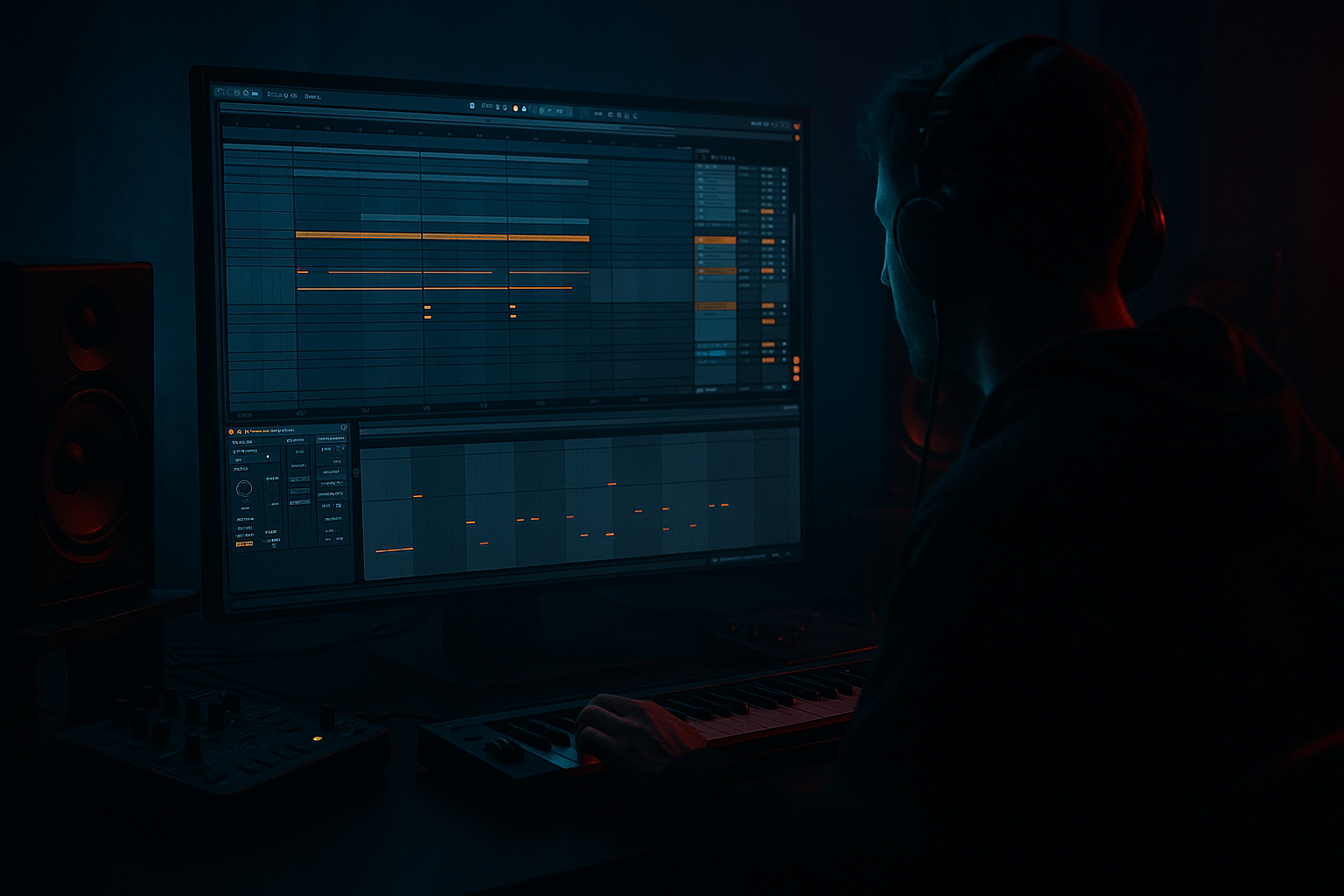
Main tutorial
Subweight Breakbeat Workflow in Ableton Live 12 (Automation‑First) 🎛️🥁
Category: Edits | Skill level: Beginner | Focus: Drum & Bass / Jungle / Rolling styles
---
1. Lesson overview 🚀
In this lesson you’ll learn a subweight, punchy drum & bass breakbeat workflow in Ableton Live 12, built around an automation‑first mindset: you’ll create movement and “edits energy” by automating gain, filters, pitch, sends, and transient control—instead of endlessly chopping and re-rendering.
You’ll work like a modern DnB editor: tight groove, controlled low end, big transitions, and fast arrangement decisions.
---
2. What you will build 🧱
By the end, you’ll have:
- A 2-bar core break loop (classic DnB/jungle feel)
- Subweight drums (clean low end, tight kick/snare, controlled break)
- A simple automation lane system for:
- A 16-bar arrangement sketch: intro → drop → variation → mini fill
- Add Compressor after Drum Buss
- Enable Sidechain
- Audio From: KICK
- Ratio: 4:1
- Attack: 1–3 ms
- Release: 60–120 ms
- Threshold: adjust until you see 2–6 dB ducking
- Auto Filter
- Utility
- Use Send A (reverb) + Send B (delay)
- Hybrid Reverb
- Add EQ Eight after reverb:
- Echo
- Add Utility after Echo:
- Break filtered down (Auto Filter around 400–2k rising)
- Occasional kick ghost (optional)
- Add a small delay throw on the last snare of bar 8
- Full break + full kick/snare
- Add gain cut stutters on the break every 2 bars (tiny 1/16 or 1/8 gaps)
- Keep the low end clean (break high-passed)
- Pitch a small break slice up for a fill
- Add a reverb throw into a 1/2-bar gap at bar 16
- Prepare to loop or move to Drop B
- Leaving break low end untouched: Your kick/sub will feel weak. High-pass breaks around 90–120 Hz almost always.
- Over-reverbing drums: DnB needs impact. Use short rooms and automate throws—don’t wash the whole loop.
- Too much distortion early: Drum Buss/Overdrive can flatten transients. Add bite, don’t destroy punch.
- No automation over time: A loop with zero automation sounds like a demo. Add at least filter + send + 1–2 cuts per 16 bars.
- Sidechain too slow: If release is too long, your break will “pump” awkwardly. Start around 60–120 ms.
- Darkness = controlled highs + gritty mids:
- Parallel smash (beginner-safe):
- Mono your low drum energy:
- Tiny timing offsets for roll:
- Use Saturator for weight (not volume):
- You built a subweight DnB break workflow by separating roles:
- You used stock Ableton tools (EQ Eight, Drum Buss, Compressor/Glue, Auto Filter, Utility, Hybrid Reverb, Echo) for clean, punchy results.
- You adopted an automation-first approach: filter movement, gain cuts, pitch dips, and send throws create “edited” energy fast.
- Break filter sweeps
- Volume cuts (stutters / dropouts)
- Pitch dives into transitions
- Reverb throws and delay throws
---
3. Step-by-step walkthrough ✅
Step 0 — Session setup (fast and correct)
1. Set tempo: 172–176 BPM (start at 174 BPM).
2. Set meter: 4/4.
3. Turn on Warp for samples.
4. Create tracks:
- Audio 1: BREAK
- MIDI 1: KICK
- MIDI 2: SNARE
- Return A: SHORT VERB
- Return B: DUB DELAY
- Optional: Audio 2: TOPS/HATS
Why: Breaks give character, but modern DnB needs anchored kick/snare to stay heavy.
---
Step 1 — Choose and prep your break (the “subweight-ready” prep)
1. Drop a breakbeat (Amen-style, Think, Hot Pants, any crunchy loop) into BREAK (Audio track).
2. In Clip View:
- Warp Mode: Beats
- Preserve: Transients
- Set Transient Loop: Off
- Envelope → Transposition stays at 0 for now
3. Right-click the clip → Slice to New MIDI Track…
- Slicing preset: Built-in
- Slice by: Transient
- This creates a Drum Rack with slices.
Beginner-friendly tip: Keep the original loop too. You’ll A/B the “raw loop feel” vs “edited slices”.
---
Step 2 — Make a clean DnB backbone (kick/snare that owns the low end)
On KICK (MIDI track):
1. Load Drum Rack (or Simpler) with a DnB kick.
2. Pattern: Put kicks on 1 and the “and” before 3 (common DnB drive).
- In 1 bar (16 steps): kicks on 1.1 and 1.3.3 (approx), tweak by ear.
On SNARE (MIDI track):
1. Load a tight snare + optional clap layer.
2. Place snares on 2 and 4 (classic).
Goal: Your break becomes texture and shuffle, while kick/snare provide the “club translation”.
---
Step 3 — Glue the break to the backbone (automation-first instead of over-chopping)
#### 3A) Tighten the break with stock devices (simple chain)
On BREAK track, start with this chain:
1. EQ Eight
- HP filter: 24 dB/oct at 90–120 Hz (start 100 Hz)
- Small cut: 250–400 Hz if boxy (–2 to –4 dB, Q ~1.2)
- Optional: tiny lift 4–8 kHz (+1 to +3 dB) if dull
2. Drum Buss
- Drive: 5–15%
- Crunch: 0–10% (go easy)
- Boom: Off (or very low) because you’re high-passing the break
- Transients: +5 to +20 (more snap)
- Damp: Adjust to keep it from getting fizzy
3. Compressor (or Glue Compressor)
- Ratio: 2:1
- Attack: 10–30 ms (let transients through)
- Release: Auto or 100–200 ms
- Aim: 2–4 dB gain reduction on peaks
Why: The break needs to be controlled and present, but not fighting your kick/sub.
#### 3B) Sidechain the break to your kick (instant subweight clarity)
On BREAK track:
This is the “subweight” feeling: the low-end space stays stable.
---
Step 4 — Automation-first workflow (the core of this lesson) ✍️
You’re going to automate movement like an editor. Make automation lanes early and treat them like performance controls.
#### 4A) Create 4 “go-to” automation targets
On BREAK track, add these devices (if not already):
Now automate:
1. Auto Filter — Frequency
- Mode: LP (low-pass)
- Resonance: 0.7–1.3
- Automate Frequency:
- Intro: 400 Hz → 8 kHz over 8 bars (classic “opening up”)
- Pre-drop: slam it down quickly for tension (8 kHz → 600 Hz in 1 beat)
- Drop: open back to full
2. Utility — Gain
- Use gain automation for micro dropouts
- Example: cut the break –inf for 1/8 note before a snare hit to make it feel huge.
3. Clip Envelopes — Transpose (Pitch edits)
- In the break clip: Envelopes → Transposition
- Do a quick pitch dip into the drop:
- Last 1 beat before drop: 0 → –2 → –5 semitones (fast ramp)
- Or pitch-up a fill: 0 → +3 semitones for 1/4 bar
4. Send automation (throws)
- On the break or snare track, automate:
- Send A (Short Verb): small bursts at the end of phrases
- Send B (Dub Delay): a single hit throw into a gap
Automation mindset: Build energy shapes over 8/16 bars. You’re not just looping—you’re directing.
---
Step 5 — Build your Returns (DnB-friendly and controlled)
#### Return A: SHORT VERB (tight space, not wash)
- Algorithm: Room (or small Plate)
- Decay: 0.4–0.9 s
- Predelay: 10–25 ms
- HiCut: 6–9 kHz
- LowCut: 200–400 Hz
- High-pass at 250–400 Hz
#### Return B: DUB DELAY (movement + darkness)
- Time: 1/8 or 1/4 dotted (try 1/8 D)
- Feedback: 20–40%
- Filter: HP around 200 Hz, LP around 6–8 kHz
- Modulation: subtle
- Reduce gain to keep throws under control
---
Step 6 — Make the edit feel like DnB (arrangement in 16 bars)
Create a 16-bar sketch:
Bars 1–8 (Intro / tease):
Bars 9–12 (Drop A):
Bars 13–16 (Variation / fill):
DnB arrangement trick: Your changes should happen every 4 or 8 bars. That’s the “rolling narrative”.
---
Step 7 — Optional: quick “edited break” using Drum Rack slices
If you sliced the break:
1. In the slice MIDI clip, duplicate the original groove.
2. Replace 2–4 hits per bar:
- Swap a snare ghost for a different slice
- Add a “rush” of 1/16 hats using small break slices
3. Automate Simpler → Filter Frequency on selected slices for variation.
Keep it subtle. The power is in tightness + movement, not chaos.
---
4. Common mistakes ⚠️
---
5. Pro tips for darker/heavier DnB 🌑
Use EQ Eight to slightly dip 8–12 kHz if it’s too bright, then add character at 1–3 kHz carefully.
Duplicate BREAK → on the duplicate add Drum Buss (Drive 20–40%) + Compressor heavy, then low-pass at 6–8 kHz and blend quietly.
Put Utility on the drum bus: Bass Mono 120 Hz (great for club stability).
Nudge a few break slices late by 5–15 ms for swing—don’t move the main snare.
Saturator on the drum bus: Soft Clip On, Drive 1–4 dB, Output down to match.
---
6. Mini practice exercise 📝
Do this in 20 minutes:
1. Build a 2-bar loop: break + kick + snare.
2. Add Auto Filter on the break and automate a 4-bar opening sweep (repeat twice).
3. Add three Utility gain cuts:
- One 1/8 cut before a snare
- One 1/16 stutter near the end of bar 2
- One full 1/4 gap at the end of bar 8 (transition)
4. Add one delay throw on the final snare of bar 8.
5. Export a quick 16-bar bounce and listen on low volume—does the snare still crack?
---
7. Recap 🔁
kick/snare = power, break = character + groove.
If you want, tell me what kind of break you’re using (Amen/Think/other) and the vibe (rollers vs jungle vs jump-up), and I’ll suggest a specific 16-bar automation map you can copy exactly.

