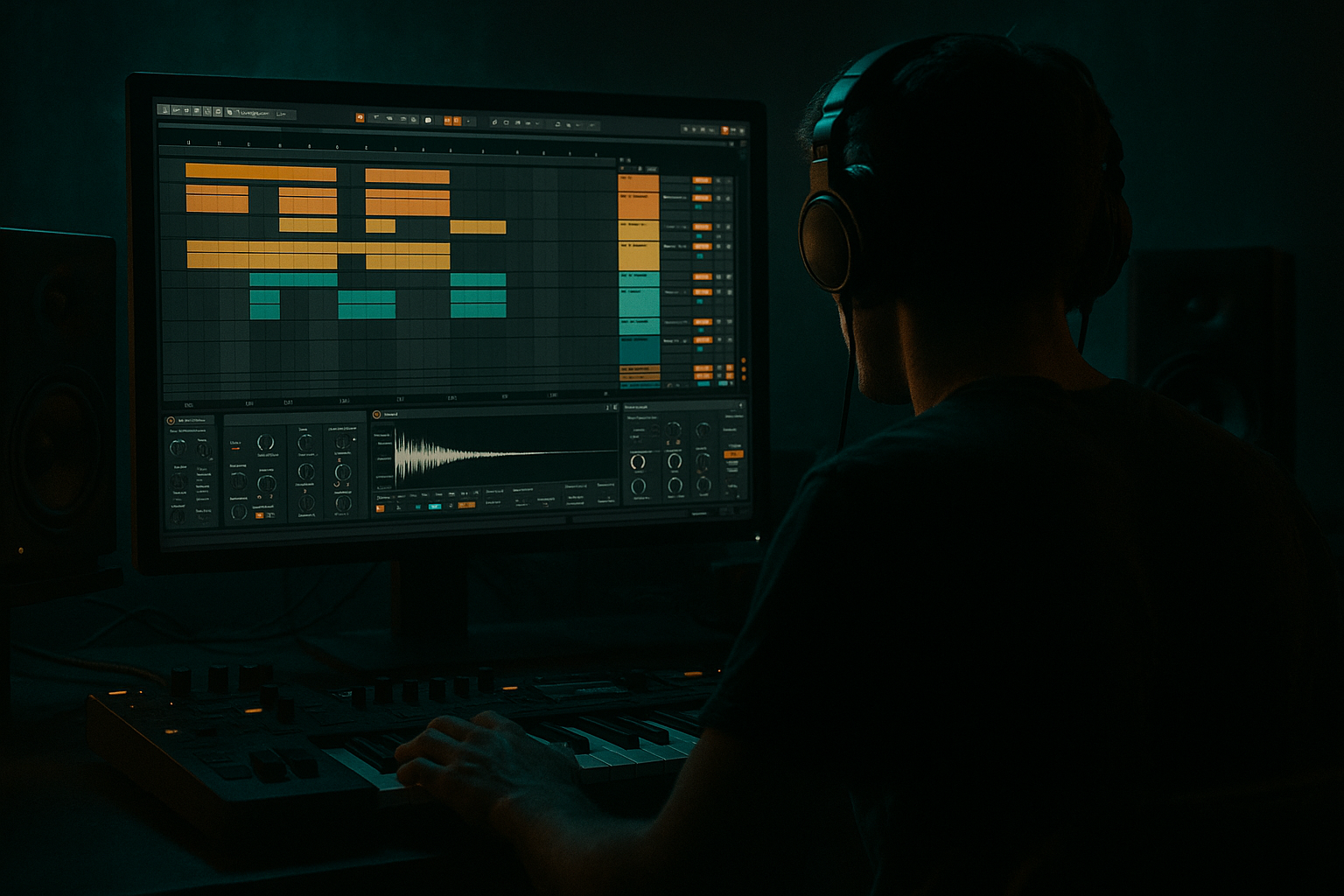
Main tutorial
```markdown
Stereo Width for Pads & FX (Resampling Only) — Advanced Ableton Live (DnB) 🎛️
1. Lesson overview
In drum & bass, pads and atmospheric FX carry space while the drums + bass stay punchy and mono-solid. The problem: wide pads/FX can wreck phase, soften the groove, or smear transients when overdone.
This lesson shows how to create huge stereo pads and FX using resampling only—meaning you’ll generate width by printing (resampling/freezing/flattening) audio versions of your sound and then manipulating the printed audio.
No “just slap a widener on and pray.” You’ll build controlled, mix-ready width that survives mono and hits hard in a club.
We’ll use Ableton stock devices and audio workflows: duplication, micro-delays, mid/side EQ, reverb printing, and intentional “stereo design” via resampling passes.
---
2. What you will build
You’ll create a DnB atmosphere bus made of:
- A mono-safe mid layer (stable core)
- A wide sides layer (movement + air)
- A resampled reverb tail layer (cinematic size)
- Optional “jungle smear” texture layer (grainy, unstable, dark)
- Lock in CPU-light audio
- Edit width rhythmically (arrangement-friendly)
- Keep your low-end and punch safe
- A pad chord (minor 7ths, suspended, or 1–b7 movement)
- An FX tonal wash (noise + pitched tone)
- A vocal/field-recording texture
- Fill gaps between snare hits
- Rise into 16-bar transitions
- Sit behind the bass in drops (don’t fight the sub)
- Tempo: 170–175 BPM
- Grid: work in 8-bar / 16-bar phrases
- Right-click the source track → Freeze Track → Flatten.
- `PAD_MID`
- `PAD_SIDE`
- `PAD_VERB_TAIL` (later)
- Compressor sidechained from Kick + Snare group
- `PAD_MID`: 2–4 dB GR
- `PAD_WIDE_PRINT`: 0.5–2 dB GR
- Make the sides darker, not brighter: in heavy rollers, “air” can turn into hiss.
- Distort the sides only (printed):
- Create “fog” with reverb tail + grain:
- Automate width by section using printed versions:
- Mono check like a pro:
- You built stereo width the DnB way: mid stability + side excitement.
- You used resampling to:
- You created:
- You kept the groove intact using sidechain and low-end discipline.
All of it will be built from your pad/FX source using resampling passes so you can:
---
3. Step-by-step walkthrough
A) Choose a source that fits rolling DnB
Pick one:
DnB arrangement note: pads usually work best as call-and-response with drums:
Set your project context:
---
B) Print your source to audio (the “resampling only” foundation)
You need an audio version to manipulate precisely.
Option 1: Resampling track (best for full chains)
1. Create a new Audio Track named `PAD_PRINT`.
2. Set Audio From = `Resampling`.
3. Arm `PAD_PRINT` and record your pad/FX for 8 or 16 bars.
4. Consolidate (Cmd/Ctrl+J) into a clean clip.
Option 2: Freeze/Flatten (fast)
Now you have a stable audio clip for serious stereo sculpting.
---
C) Split into Mid and Side layers (audio workflow)
Create three audio tracks:
Duplicate your printed audio clip onto `PAD_MID` and `PAD_SIDE`.
#### 1) PAD_MID (mono-safe core)
Device chain (stock):
1. Utility
- Width: 0% (full mono)
- Gain: adjust later
2. EQ Eight
- HPF: 150–300 Hz (steeper if your bass is busy)
- Optional: gentle dip around 250–500 Hz if boxy
Goal: This track keeps the pad present in mono and stops the mix from collapsing.
#### 2) PAD_SIDE (wide-only layer)
Device chain:
1. EQ Eight (pre-clean)
- HPF: 250–500 Hz (keep low end out of the sides)
2. Utility
- Use the Mono/Stereo controls:
- Turn on Bass Mono if available in your Live version (if not, we’ll handle with EQ/HPF)
- Width: start 140–180% (careful—this is just the side layer)
3. EQ Eight in M/S mode
- Set to M/S
- On Mid, reduce some high-mid if needed (to avoid center harshness)
- On Side, add a gentle shelf: +1 to +3 dB @ 8–12 kHz for “air”
Key concept: Your width lives here. Your impact stays elsewhere.
---
D) Create width using printed micro-offsets (no “live” wideners needed)
Now we’ll do the classic audio-based stereo technique: micro-time differences + tonal divergence.
On `PAD_SIDE`, do this as audio edits:
1. Duplicate `PAD_SIDE` into two tracks:
- `PAD_L`
- `PAD_R`
2. Pan:
- `PAD_L` → 100% Left
- `PAD_R` → 100% Right
3. Micro-offset (audio nudge):
- Nudge `PAD_R` clip later by 8–18 ms
(Start at 12 ms; adjust by ear.)
4. Add slight tonal difference (printed or minimal processing):
- On `PAD_L`: EQ Eight slight dip -1.5 dB @ 3 kHz
- On `PAD_R`: EQ Eight slight dip -1.5 dB @ 5 kHz
- Optional: tiny pitch variance using Clip Transpose
- `PAD_L`: -3 cents
- `PAD_R`: +3 cents
5. Resample again to commit:
- Create `PAD_WIDE_PRINT` audio track
- Audio From: resampling
- Record 8/16 bars of the L/R combo
- Replace your L/R layers with this printed stereo clip (keeps it clean + CPU light)
Why this works: width comes from interaural time difference + spectral difference, not just “widening algorithms.” It’s classic, controllable, and very DnB-friendly.
---
E) Build a resampled reverb tail layer (big space, zero mud)
DnB needs reverbs that are huge but not cloudy. The trick: print the tail and treat it like a sample.
1. On `PAD_MID` (or your source), create a Return Track: `RVB_PRINT`
2. Put Hybrid Reverb (or Reverb if you prefer)
- Predelay: 20–35 ms
- Decay: 3.5–7.5 s (depends on tune)
- Low Cut: 250–500 Hz
- High Cut: 8–12 kHz (darker if heavy)
- Keep it 100% wet on the return
3. Create audio track `PAD_VERB_TAIL`:
- Audio From: the return `RVB_PRINT` (or resampling if routing is complex)
- Record only the tail moments (e.g., last 1 bar of every 8)
4. Shape it like an FX sample:
- EQ Eight: HPF 300–600 Hz
- Compressor (gentle glue): Ratio 2:1, slow-ish attack 20–30 ms, release 150–300 ms
- Utility: Width 160–200% (tails can be wider than the pad itself)
Arrangement move (very DnB):
Cut the main pad on bar 15 → let the printed tail bloom into bar 16 → smash into the drop.
---
F) Add movement with “resampled autopan snapshots”
Instead of leaving autopan live, we’ll print motion so it’s repeatable and editable.
1. Take your `PAD_WIDE_PRINT` and duplicate to `PAD_MOTION_PRINT_SOURCE`.
2. Add Auto Pan (temporary):
- Rate: 1/2 or 1 bar (sync)
- Amount: 20–40%
- Phase: 180° (bigger stereo motion)
3. Resample this to `PAD_MOTION_PRINT`.
4. Remove the live Auto Pan track and keep the printed motion audio.
Now you can slice moments where motion happens (fills, transitions) and keep the drop more stable.
---
G) DnB mixing placement: sidechain + dynamic control (still compatible with resampling)
Pads/FX must respect the drums.
On your pad bus (or `PAD_MID` + `PAD_WIDE_PRINT` group):
- Ratio: 2:1
- Attack: 5–15 ms
- Release: 80–150 ms
- Gain reduction: 1–3 dB (subtle groove glue)
Optional: Sidechain only the mid layer harder than the sides:
This keeps the pad wide while letting the center punch through.
---
4. Common mistakes
1. Wide low-end: letting anything below ~200–300 Hz live in the sides = floppy mono + weak bass.
2. Too much width everywhere: if everything is wide, nothing feels wide. Keep the drop’s core tight.
3. Uncontrolled phase: extreme micro-delays + wide reverb + modulation can hollow out your mids.
4. Pads masking snares: pads often sit right where snares crack (1–5 kHz). Use M/S EQ to manage.
5. Never printing: leaving width/motion devices live makes it hard to edit and easy to overcomplicate.
---
5. Pro tips for darker/heavier DnB 🖤
Try shelving the Side layer down slightly above 10 kHz and push 2–4 kHz carefully instead.
- Duplicate your `PAD_WIDE_PRINT`
- EQ away lows, then add Saturator (soft clip, Drive 2–6 dB)
- Resample it and blend low in for gritty width.
- Print a long tail
- Then use Grain Delay lightly (Time 10–30 ms, Spray low, Feedback low)
- Resample and tuck behind the drums for dystopian ambience.
- Verse: mostly mid
- Build: add wide layer
- Drop: reduce wide pad, keep wide reverb moments on fills
- Put Utility (Width 0%) on the master temporarily
- If the vibe collapses, your sides are doing too much “core work.”
---
6. Mini practice exercise (15–25 mins) 🧪
1. Make an 8-bar pad chord audio print (`PAD_PRINT`).
2. Build:
- `PAD_MID` (mono, HPF 200 Hz)
- `PAD_L` + `PAD_R` (panned, one side nudged 12 ms, slight EQ difference)
3. Resample to `PAD_WIDE_PRINT`.
4. Create a printed reverb tail (`PAD_VERB_TAIL`) and place it:
- Bar 8 → spill into bar 9
5. Add sidechain compression from kick+snare:
- Aim for 2 dB GR on `PAD_MID`, 1 dB on `PAD_WIDE_PRINT`.
6. Do a mono check and fix:
- If it vanishes: reduce time offset (e.g., 12 ms → 7 ms) or reduce side EQ boosts.
Deliverable: a loop where the pad feels wide in stereo, present in mono, and doesn’t step on the drums.
---
7. Recap ✅
- Commit sound design
- Keep CPU low
- Edit width rhythmically like audio
- A mono-safe mid layer
- A controlled wide layer via micro-offset + tonal divergence
- A printed reverb tail for cinematic transitions
If you want, tell me what kind of pad/FX you’re starting with (synth pad, vocal wash, jungle sample, field recording) and whether your tune is more liquid, roller, or neuro—I’ll suggest exact frequency ranges and a width strategy that fits the sub/bassline.
```

