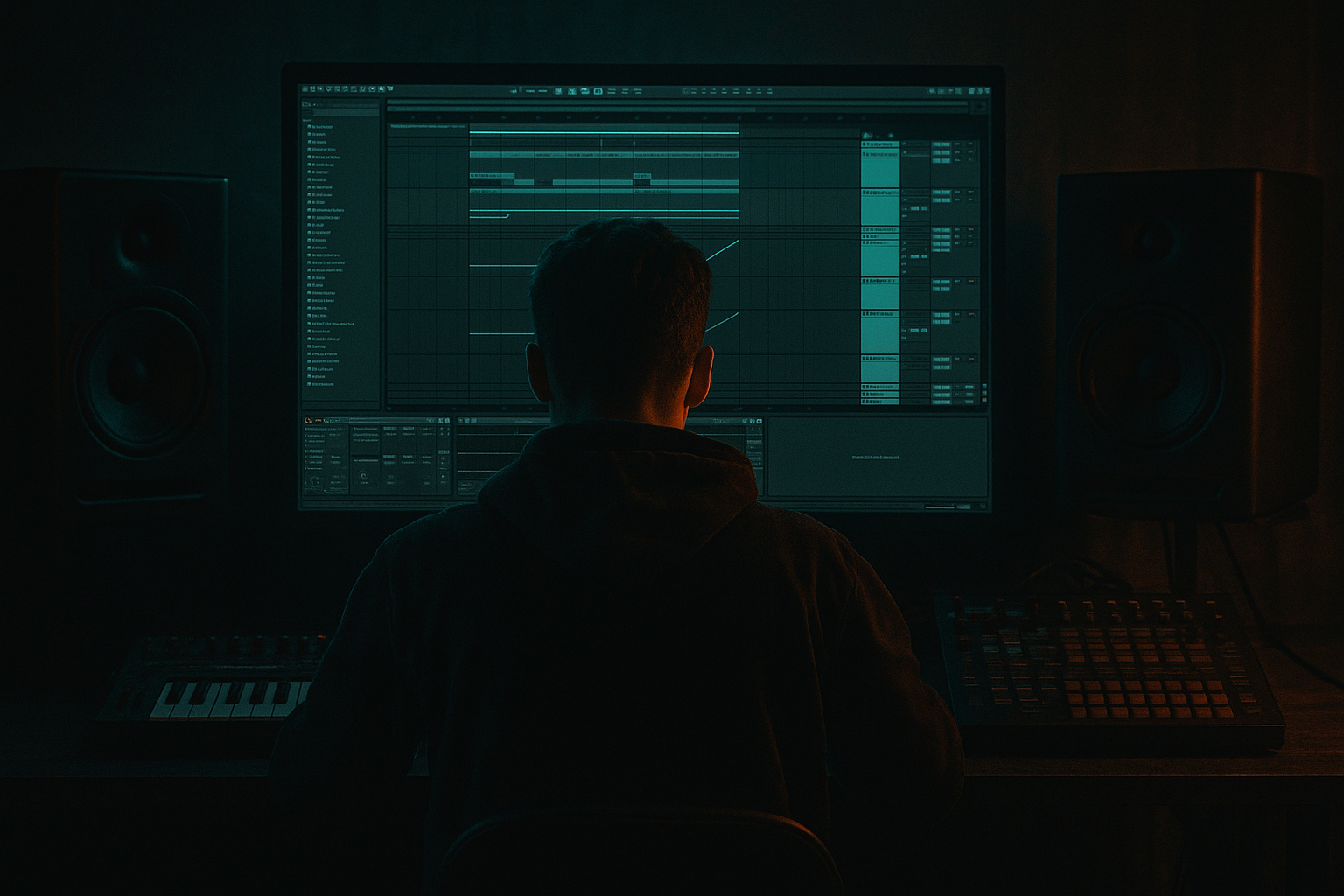
Main tutorial
Lesson Overview
Stepper risers are one of those small DnB transition tools that can make a track feel expensive, intentional, and properly oldskool. In jungle and early DnB, risers were often crude but effective: noisy sweeps, pitch lifts, chopped breaks, and filter motion that created pressure before the drop. In modern Ableton Live 12, you can build that same energy from scratch and make it hit with more control.
This lesson shows you how to create a stepper-style riser resample workflow: you’ll design a rising sound, perform automation into a resample, then chop and process the result so it feels like a real part of a DnB arrangement rather than a generic FX preset. The focus is on oldskool jungle / stepper DnB vibe, where the riser has movement, grit, and a bit of breakbeat chaos.
Why this matters: in DnB, transitions are not just decoration. They manage tension between 16-bar phrases, separate drum and bass sections, and give the listener a clear “lift” into the drop or switch-up. A good riser can make even a simple 2-step or break-led arrangement feel bigger and more alive. And because this is a resample workflow, you’ll end up with audio you can edit like a drum break: slice, reverse, warp, duplicate, and layer with impacts or fills.
What You Will Build
By the end, you’ll have a 1-bar to 4-bar stepper riser audio file made from a synth source, filtered noise, and resampled automation movement. It will have:
- a rising pitch or filter sweep
- stepped or pulsing rhythmic movement
- a gritty, slightly torn oldskool character
- enough top-end motion to cut through drums
- optional reverse tail for extra pre-drop tension
- a version you can drop straight into a DnB arrangement before a snare fill, break switch, or sub drop
- Making the riser too bright too early
- Using a smooth EDM-style sweep with no rhythmic character
- Leaving too much low end in the riser
- Overusing reverb so the build gets blurry
- Not checking against drums and bass
- Too much distortion without control
- Resample through slight clipper-style behavior using Saturator with soft clipping enabled to give the riser a tougher edge.
- Layer a short break fragment underneath the riser so it feels tied to the groove rather than floating above it.
- Automate Utility width: keep the low-mid body narrower, then widen only the top end for tension.
- Use very short noise bursts in the last 1/4 bar for that nervous pre-drop energy.
- Pitch the final half-bar up 1–3 semitones if you want oldskool urgency without sounding too polished.
- Create a negative space moment: mute the bass for a beat before the riser lands, then let the drop hit harder.
- Add a tiny reverse reverb tail if your section needs a more haunted, underground feel.
- Mono-check the transition. The riser can be wide on top, but the actual impact should still work in mono.
- Build the riser from a simple synth + noise source.
- Use stepped automation to get a proper stepper / oldskool DnB feel.
- Resample the movement so you can edit it like audio.
- Shape the result with saturation, EQ, and controlled reverb.
- Place it in a real arrangement with drums, bass, and a clear phrase transition.
- Keep it tight, gritty, and low-end clean so it supports the drop instead of cluttering it.
Think of it as a riser that sits naturally in a jungle or darker roller context: not glossy EDM lift, but more like a pressure build that feels connected to the break and bassline.
Step-by-Step Walkthrough
1. Set up a clean resample lane and reference the arrangement
Start by loading an empty Ableton Live 12 project and set the tempo somewhere in the 165–174 BPM range. For oldskool jungle energy, 170 BPM is a great starting point.
Create:
- one MIDI track for the source riser
- one audio track set to Resampling
- one return or audio track for optional reverb/delay throws if needed
Place a 4-bar loop in Arrangement View. Even if you’re building only one riser, think in phrase lengths. DnB arrangements often breathe in 8, 16, or 32-bar chunks, and your riser should support that structure.
Put a rough kick/snare or break loop underneath while designing. This matters because a riser that sounds huge solo may still fight the drums in context. You want to hear how the top-end and movement work against a break, not in isolation.
2. Build the source sound with simple devices, not a complex chain
Create a MIDI track with Wavetable, Operator, or even Analog. For this workflow, Wavetable gives you the most control while staying stock.
Start with:
- Oscillator 1: a saw or square-based wavetable
- Oscillator 2: optional second saw an octave up, slightly detuned
- Filter: low-pass 24 dB or similar
- Envelope amount to filter: moderate
Suggested starting points:
- Osc 2 detune: 5–12 cents
- Filter cutoff: start around 150–400 Hz
- Resonance: 10–25%
- Amp envelope attack: 5–20 ms
- Release: 200–600 ms
For a more jungle-flavored source, layer a noise component:
- Add Operator with noise, or use Wavetable’s noise source
- High-pass it so it only lives in the upper mids and highs
- Blend it subtly; it should add hiss and motion, not dominate
The goal is not a final riser yet. You’re creating a rich source that can be resampled into something more interesting later.
3. Program a stepped rise instead of a smooth sweep
The “stepper” feeling comes from movement that feels rhythmic or segmented, not just a straight filter ramp. In your MIDI clip, draw a simple 1-bar note or chord and automate one or more parameters in stepped chunks.
Good controls to automate:
- Filter cutoff
- Oscillator semitone/pitch
- Noise level
- LFO amount
- Drive or distortion amount
In Ableton Live 12, use automation lanes or clip envelopes and create movement in 4, 8, or 16-step increments. For example:
- Bar 1: cutoff at 20%
- Beat 2: jump to 35%
- Beat 3: jump to 55%
- Beat 4: jump to 80%
Then add a final push in the last half-bar. The stepped motion gives you that oldskool “machine rising” feel, especially when combined with break edits or a snare roll later.
Why this works in DnB: stepped automation creates rhythmic tension that locks to the pulse. In jungle and rollers, the build often needs to feel like part of the groove, not a separate glossy effect.
4. Add rhythmic pressure with Auto Filter, Gate, or LFO-style modulation
To make the riser pulse, place Auto Filter after the synth. Use it to shape the motion:
- Filter type: low-pass or band-pass
- Envelope follower amount: subtle if you want the source to “breathe”
- Resonance: 15–35% for extra edge
If you want a choppier stepper feel, try Gate after the synth or after distortion:
- Set it to a rhythmic pattern, then automate the Dry/Wet
- Use short open/close values so it feels like a tension tremolo
- Sync the movement to 1/8 or 1/16 pulses
Another good stock option is Shaper or LFO mapped to filter cutoff or pitch, if you want precision without drawing every automation lane manually.
A strong combo is:
- Wavetable source
- Auto Filter
- Saturator
- Gate or Tremolo-style movement
- Echo/Reverb lightly at the end
Keep the motion controlled. For risers in darker DnB, you want tension and dirt, not trance-style wobble.
5. Resample the performance into audio
Once the source automation feels alive, route it to your Resampling audio track and record 1–4 bars of the build. Perform the automation in real time if possible, or play back the clip and record the resulting output.
Why resample? Because once it becomes audio, you can:
- reverse sections
- warp tiny parts for extra tension
- slice transients
- apply transient shaping or fades
- layer the riser with break fragments
- bounce the sound into a more “finished” texture
When recording, do at least two passes:
- one clean pass
- one more aggressive pass with extra drive or filter movement
You may prefer the second one because resampling often captures microscopic imperfections that make the riser feel more handmade and less preset-like.
6. Edit the audio like a breakbeat, not just an FX file
Now take the recorded audio and treat it like a source for arrangement and slicing. This is where the oldskool character really appears.
Useful edits:
- Trim the start so the rise begins tightly on the phrase
- Add a fade-in if the resample clicks
- Try reverse on the first 1/2 bar or last hit
- Use Warp in Beats mode if the rhythm needs tightening
- Slice the audio into 1/8 or 1/16 chunks and rearrange the pieces
For an oldskool jungle feel, you can even take the resampled riser and chop it so it mirrors break edits:
- short repeated fragments
- a tiny reverse tail before the drop
- a final noisy burst before the impact
If the riser needs more urgency, duplicate the last quarter bar and pitch it up slightly or increase filter brightness on the duplicate.
7. Process the resample with character, then control the harshness
Now add processing to make the riser sit in a DnB mix. In darker styles, the upper mids can get nasty fast, so process with intention.
Try this chain:
- Saturator: Drive around 2–6 dB
- Dynamic Tube or Overdrive: add harmonics and bite
- EQ Eight: cut muddy lows, tame harsh spikes
- Reverb: very short to medium decay
- Utility: narrow or widen selectively
Suggested EQ moves:
- High-pass around 120–250 Hz so the riser doesn’t clutter sub space
- Small dip around 2.5–5 kHz if the top gets brittle
- Gentle high shelf if it needs air, but don’t overdo it
Reverb settings to try:
- Decay: 0.8–2.5 s
- Pre-delay: 15–35 ms
- Dry/Wet: 5–18%
Keep the low end out. In DnB, the riser should build above the drums and bass, not compete with the sub or kick punch.
8. Create a musical arrangement moment around the riser
Place the riser into a real arrangement context. For example:
- 16-bar intro with drums and bass establishing the groove
- 2-bar breakdown where the bass drops out
- 1-bar or 2-bar stepper riser into the drop
- snare fill or break fill on the final half-bar
- full drop on the downbeat
In a jungle track, you might use the riser right before a breakbeat switch-up: strip the sub for one bar, let the riser step upward, then reintroduce the Amen variation and bass stab on the drop.
A classic move is to pair the riser with:
- a snare flam
- a cymbal choke
- a short sub pre-hit
- a reverse break fragment leading into the downbeat
This creates a full transition event, not just a single FX element. That’s what makes the arrangement feel intentional.
9. Make alternate versions for different drop types
Don’t stop at one riser. In DnB production, having a few variations helps you make better arrangement decisions quickly.
Make:
- a clean version for rollers
- a gritty version for jungle/oldskool sections
- a shorter 1-bar version for quick switch-ups
- a longer 4-bar version for breakdown-to-drop transitions
A useful workflow is to duplicate the resampled audio and process each version differently:
- one with more saturation
- one with heavier filter automation
- one with reverse start
- one with a small pitch rise
This gives you fast options when arranging. You’re not committing to one “perfect” riser; you’re building a toolkit.
10. Bounce, label, and keep the workflow reusable
Freeze or consolidate the best version and name it clearly:
- `Stepper_Riser_170BPM_4bar_Clean`
- `Stepper_Riser_170BPM_2bar_Dirty`
- `Reverse_Stepper_Riser_Final`
Save the device chain as an Ableton preset or store it in a template track. The real win here is speed: next time you need a transition for a jungle drop or a dark roller switch, you can recreate the process in minutes.
If you want to go further, keep a folder of your own resampled risers. In DnB, original transition sounds become part of your signature very quickly.
Common Mistakes
Fix: keep the source darker at first and add brightness later through resampling and EQ.
Fix: introduce stepped automation, gating, or chopped resample edits so it feels like DnB phrasing.
Fix: high-pass aggressively. Risers should rarely carry useful energy below 120 Hz.
Fix: shorten decay, reduce wet level, and use pre-delay to keep the attack clear.
Fix: always audition the riser with kick, snare, and sub. A riser that sounds huge solo may destroy the drop impact in context.
Fix: use EQ after saturation and tame 2–5 kHz if the top becomes painful.
Pro Tips for Darker / Heavier DnB
Mini Practice Exercise
Spend 10–20 minutes making three risers from the same source:
1. Build one Wavetable patch with saw + noise.
2. Create a 2-bar automation pass with stepped cutoff movement.
3. Resample it once clean, once gritty.
4. Edit one version into a 1-bar riser.
5. Reverse the first 1/2 bar on the second version.
6. Add Saturator and EQ Eight to both.
7. Place them before a snare fill in an 8-bar loop at 170 BPM.
8. Compare which one feels more like jungle, which one feels more like a roller, and which one cuts best against the drums.
Goal: make at least one version that sounds like it belongs in a real DnB drop transition, not just an FX rack demo.

