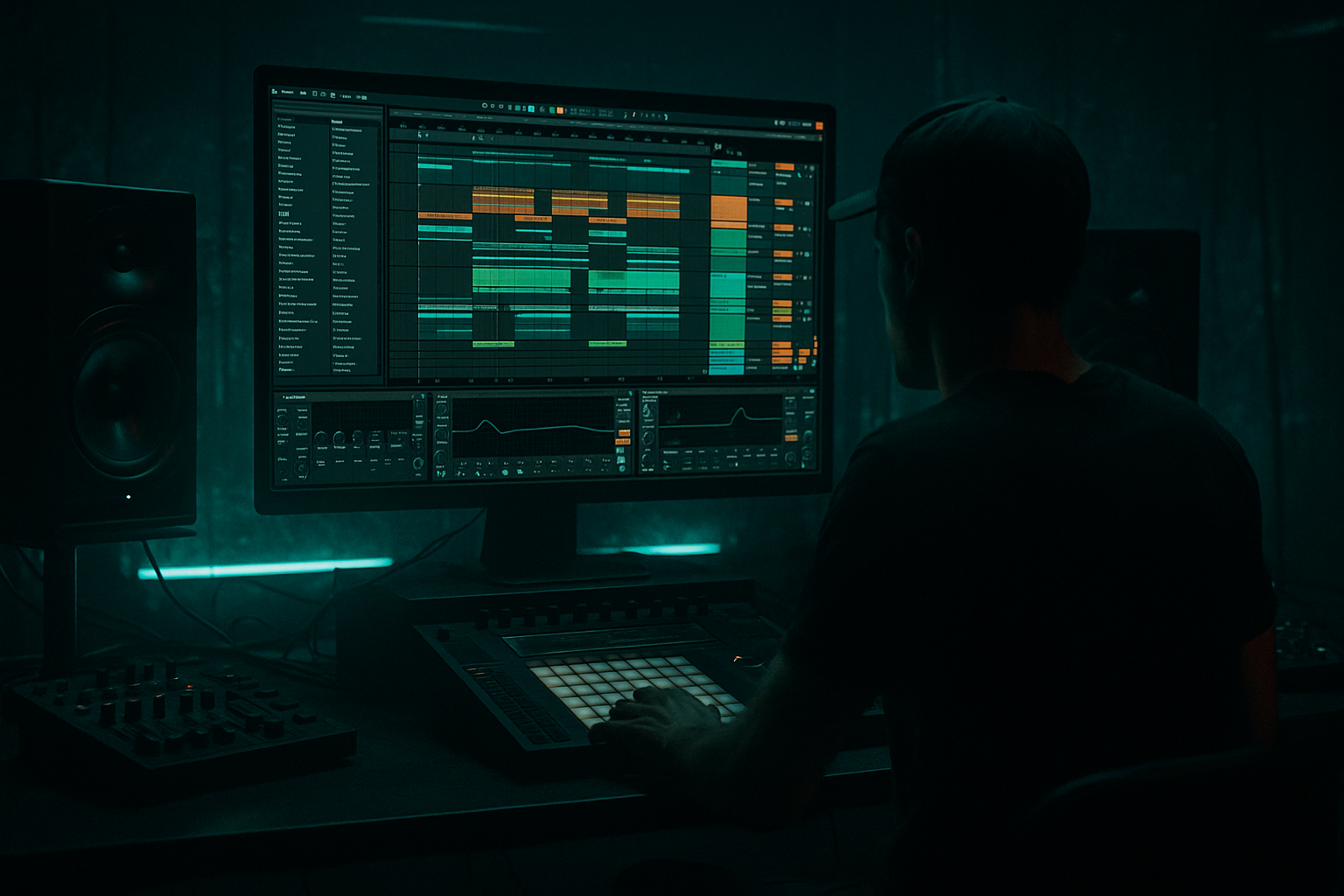
Main tutorial
Stack an Oldskool DnB Drum Bus From Scratch (Ableton Live 12) 🥁⚡
Category: Mastering (Drum Bus / Mix-Bus finishing for drums)
Skill level: Advanced
Goal: Build a stacked, oldskool jungle/DnB drum bus that hits hard, glues like tape, and still keeps transient punch.
---
1. Lesson overview
Oldskool jungle / early DnB drums aren’t “clean.” They’re layered, clipped, saturated, and glued, often with a slightly mid-forward crunch and controlled sub. In modern Ableton Live 12, we can recreate this vibe using stock devices and a disciplined gain-staged chain.
This lesson focuses on a mastering-style drum bus chain: the final “drum system” that makes your already-arranged drum groups feel like a record.
---
2. What you will build
You’ll build a two-stage drum bus stack:
1) Drum Pre-Master (tone + glue)
- Sub cleanup, mid bite, transient control
- “Tape-ish” saturation
- Parallel crush return for oldskool smack
- Soft clipping into a limiter
- Metering & headroom discipline
- A/B switchable macros for quick vibe changes
- Put Kick, Snare, Hats, Breaks, Perc, Rides/Crashes into a group:
- Inside that, consider a subgroup just for breaks:
- Return A: “DRUM CRUSH”
- Return B: “DRUM AIR” (optional, for top sheen/space)
- Route `DRUMS (GROUP)` output → “DRUM BUS” audio track (set Monitoring to In)
- HPF at 25–30 Hz, 24 dB/oct (removes rumble that steals headroom)
- Small dip if needed:
- Attack: 3 ms (keeps crack while controlling spikes)
- Release: Auto or 0.3 s (Auto is often perfect for rolling loops)
- Ratio: 2:1
- Threshold: aim for 1–3 dB gain reduction on peaks
- Makeup: off (manual gain staging is cleaner)
- Soft Clip: ON (this is part of the oldskool vibe 😈)
- Mode: Analog Clip or Soft Sine (pick by ear)
- Drive: start +2.5 to +6 dB
- Output: reduce to match level (do level-matched A/B!)
- Wet/Dry: 70–100% (usually full on for oldskool crunch)
- Turn on Color and set:
- Drive: 5–15%
- Crunch: 10–25% (more = more 90s edge)
- Transient: +5 to +20 (if you want more attack)
- Boom: 0–10% (careful in DnB; you probably already have sub elsewhere)
- Damp: 5–15% if cymbals get hashy
- Mode: Hard Clip
- Drive: raise until you see 1–3 dB of “flattening” on peaks
- Output: level match
- Use a mild setting, not a full distortion patch.
- Start with a gentle Soft Clip / Drive style preset and keep Mix under control (20–60% depending).
- Ceiling: -0.3 dB
- Lookahead: default is fine
- Lower Threshold until you get 1–3 dB reduction on loudest hits
- Add Spectrum (post limiter)
- Add LUFS meter if you use a Max for Live meter; otherwise watch overall headroom and compare by ear.
- Automate a gentle high-pass on BREAKS group from ~120 Hz down to 30 Hz over 16 bars.
- Let the kick/sub “arrive” with impact.
- Bar 1 of drop: less parallel crush (send lower)
- Bar 5 or 9: increase DRUM CRUSH send slightly for “lift” without adding new samples.
- Route fills to a separate FILL group and keep them 1–2 dB lower into the bus so the limiter doesn’t clamp the whole groove.
- Macro 1: Glue Amount → Glue threshold (small range)
- Macro 2: Clip Drive → Saturator drive (clip stage)
- Macro 3: Crunch → Drum Buss Crunch
- Macro 4: Air Send → Return B send (or post EQ shelf)
- “Cleaner rollers” vs “crunchy jungle” in seconds.
- Mono your low punch: Put Utility before the limiter and set Bass Mono style manually:
- Add controlled 200 Hz menace: A tiny wide bell +0.5 to +1.5 dB at 180–240 Hz can make breaks feel thicker—only if it doesn’t box out the snare.
- Sidechain the CRUSH return to the snare (micro-duck):
- Resample your drum bus for authenticity:
- Make the bus “breathe” with release times:
- Oldskool DnB drum impact comes from stacking: gentle glue + harmonic density + controlled clipping + light limiting.
- Build a DRUM BUS with: EQ → Glue → Saturation → Drum Buss → Clip → Limiter.
- Use parallel CRUSH to get that jungle smack without flattening your main transients.
- Keep the limiter as a safety net, not the main loudness tool.
- Use arrangement automation (send levels, filtering) to make the drum bus feel alive across the track.
2) Drum Print / Finalizer (loudness + safety)
End result: tight kick, snappy snare, rolling hats, Amen-style energy, and controlled cymbal fizz—ready to sit against a reese and sub without collapsing.
---
3. Step-by-step walkthrough
A) Session routing: set up like a pro
1) Group your drums properly
`DRUMS (GROUP)`
`BREAKS (GROUP)` (Amen, Think, edits, fills)
2) Create two return tracks (parallel processing)
3) Create a dedicated Drum Bus track
This gives you a print-style stage for mastering moves without cluttering the group.
> Gain staging target: Aim for -12 to -8 dBFS peak at the DRUM BUS input before processing. Oldskool loudness comes from controlled distortion, not slamming the input randomly.
---
B) Build the DRUM BUS chain (core stack)
Put these devices on DRUM BUS in order.
#### 1) EQ Eight – clean the sub + tame harshness
- 200–350 Hz: -1 to -3 dB (reduces boxiness in breaks)
- 6–9 kHz: -1 to -2 dB (if hats get “spray can” harsh)
Workflow tip: Do tiny moves. On a drum bus, 1–2 dB is a lot.
---
#### 2) Glue Compressor – oldskool “mix glue”
Optional:
> If your snare loses snap, slow the attack to 10 ms. If the loop feels jumpy, shorten release.
---
#### 3) Saturator – “tape-ish” density
Advanced move:
- Base: ~200 Hz
- Depth: 2–4
This adds a subtle low-mid push reminiscent of sampled breaks hitting cheap converters.
---
#### 4) Drum Buss (yes, even on the drum bus) – transient + boom control
Use it like a finishing shaper, not a gimmick.
- Set Freq around 55–80 Hz if used
> For jungle breaks, a little Crunch + Damp combo is often the “instant VHS” button.
---
#### 5) Clipper (Roar or Saturator as clipper) – controlled loudness
Ableton doesn’t have a single “Clipper” device, but you can do it cleanly:
Option A (simple): Saturator as a soft clipper
Option B (more character): Roar
> The goal: shave transients before limiting so your limiter isn’t doing all the work.
---
#### 6) Limiter – safety, not smashing
If you’re already clipping a bit, the limiter should be barely working.
---
#### 7) Metering (optional but smart)
---
C) Parallel returns (the secret sauce) 🔥
#### Return A: DRUM CRUSH (parallel compression + distortion)
Chain example:
1) EQ Eight
- HPF 120 Hz (stop low end from “whoofing”)
- Gentle shelf down around 10–12k if it gets fizzy
2) Compressor (not Glue; use regular Compressor for aggressive control)
- Ratio: 8:1 to 12:1
- Attack: 1–3 ms
- Release: 50–120 ms
- Aim for 10–20 dB GR (yes, really)
3) Saturator
- Drive +6 to +12 dB
- Soft Clip ON
4) Utility
- Width: 0% (keep it mono for punch)
Send your DRUMS group to this return at about -18 to -8 dB send level and blend until the loop “leans forward” but doesn’t turn into fuzz.
---
#### Return B: DRUM AIR (optional top lift + space)
Great for rides/hats in atmospheric rollers.
1) EQ Eight
- HPF 400–800 Hz
- Gentle shelf +1 to +3 dB at 10k (if needed)
2) Reverb
- Decay: 0.4–0.9 s
- Pre-delay: 5–15 ms
- High Cut: 7–10 kHz
- Dry/Wet: 100% (because it’s a return)
Keep this subtle—oldskool is roomy, but not washed out.
---
D) Arrangement ideas that make the bus work (DnB-specific) 🎛️
A stacked drum bus shines when your arrangement feeds it correctly.
1) Intro filtering without killing energy
2) Two-stage drop impact
3) Fill control
---
E) Macro workflow (fast A/B like a mastering engineer)
Group your DRUM BUS devices into an Audio Effect Rack and map:
Now you can audition:
---
4. Common mistakes
1) Over-compressing before transient design
If you smash with Glue first, you can’t get snap back. Shape → glue → clip → limit.
2) Too much Boom on Drum Buss
In DnB, sub belongs to sub/bass. Too much Boom makes the drum bus fight the bassline.
3) Harsh top from stacked saturation
Saturation + crunch + clipping can turn hats into white noise. Use Damp, EQ dips at 7–10k, or reduce parallel AIR.
4) Limiter doing 6–10 dB constantly
That’s not “oldskool loud,” that’s “flat.” Clip a bit first, then limit lightly.
5) Not level-matching A/B
Louder always “wins.” Use Utility to match output when comparing.
---
5. Pro tips for darker/heavier DnB 🕶️
Use EQ Eight in M/S mode or simply keep returns mono and avoid widening on drum bus.
Put Compressor after saturation on DRUM CRUSH, sidechain from snare, 1–2 dB GR. Snare pops through the dirt.
Print 8 or 16 bars of your DRUM BUS, then re-import and do micro edits (tiny fades, single-hit trims). This is very jungle: commit and cut.
Faster release = more chatter; slower = heavier stomp. Tune release to tempo (170–176 BPM sweet spot).
---
6. Mini practice exercise 🎯
Timebox: 20 minutes
1) Load a classic break (Amen or Think) and a one-shot kick + snare.
2) Build the routing: `DRUMS` → `DRUM BUS`, plus DRUM CRUSH return.
3) Set targets:
- DRUM BUS input peaks around -10 dBFS
- Glue doing ~2 dB GR
- Clip stage shaving 1–3 dB
- Limiter doing ~1–2 dB
4) Print two versions (resample):
- Version A: cleaner (less crush, less crunch)
- Version B: dirtier (more crush, more crunch, slightly more clipping)
5) A/B in context with a rolling reese + sub. Pick which holds groove without stealing bass headroom.
---
7. Recap ✅
If you want, tell me what kind of drum source you’re using (pure breaks, break + one-shots, or fully synthetic), and I’ll tailor exact settings for your specific drum palette and tempo.

