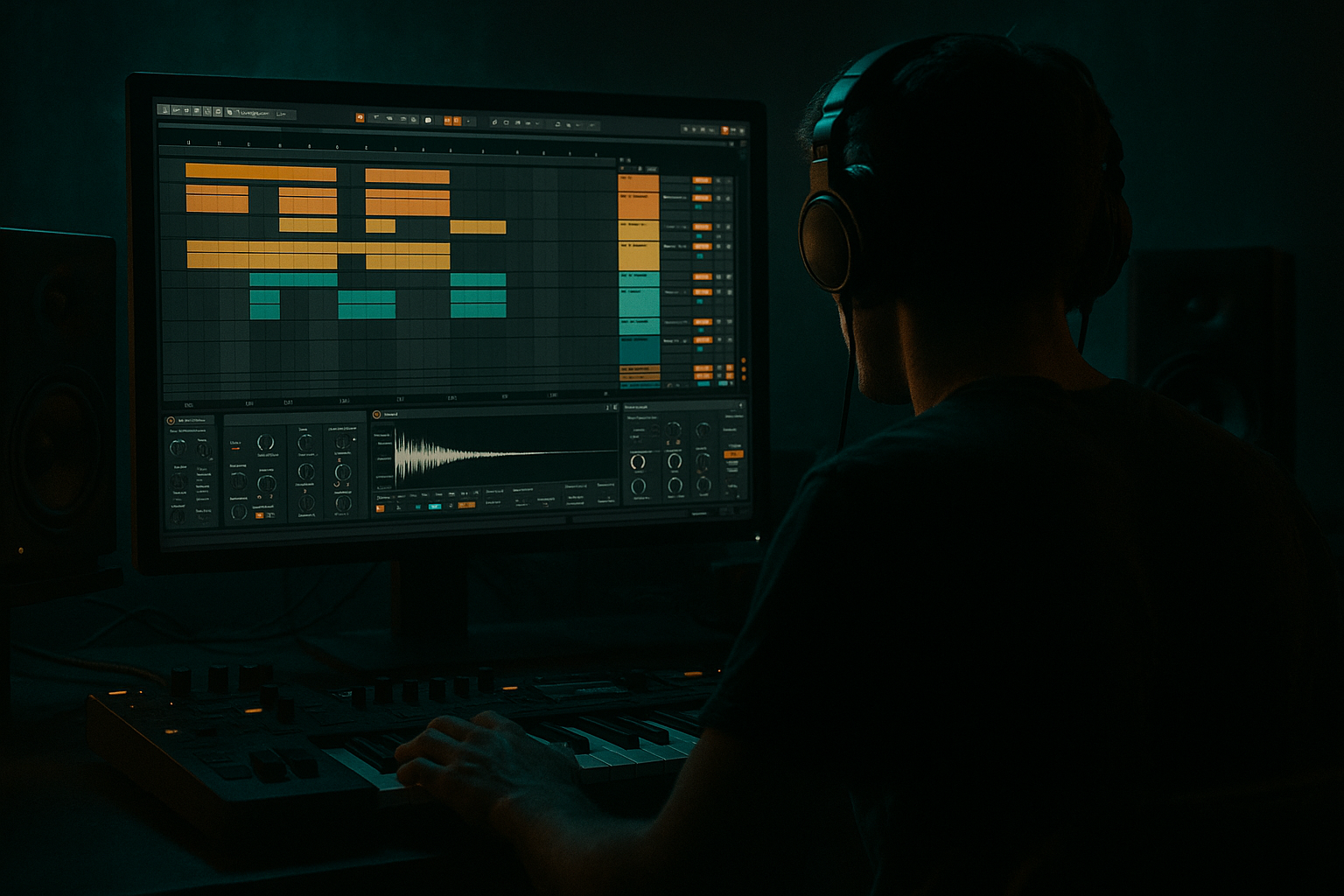
Main tutorial
Lesson Overview
A classic Amen break switch-up is one of the most effective ways to re-energize a DnB drop, but in heavier modern music it needs to do more than just “change the drums.” The goal here is to sequence an Amen-style variation that creates a moment of rhythmic surprise while making the sub hit harder, not softer.
In this lesson, you’ll build a composition-focused switch-up inside Ableton Live 12 that works in a dark roller, jungle-influenced halftime section, or a neuro-leaning drop. The key idea is contrast: let the main pattern establish weight, then use an Amen-derived drum phrase to reset the listener’s ear, open a pocket for the bass, and make the next sub note feel enormous.
Why this matters in DnB: the genre lives on phrasing, tension, and impact. A well-placed Amen switch-up can create a “breath” in the groove without killing momentum. Done right, it also gives your sub bass more perceived punch because the ear gets a brief rhythmic frame shift before the next low-end hit lands. That’s especially useful in heavyweight DnB where the bass often needs to feel physically larger without simply turning it louder.
You’ll use Ableton stock devices and editing tools to:
- slice and re-sequence an Amen break
- reinforce the low end with tightly controlled sub phrasing
- automate energy with drum fills, filter movement, and send effects
- arrange the switch-up so it lands like a proper drop weapon, not a random edit
- a chopped Amen phrase with ghost notes and edited transients
- a heavyweight sub pattern that “answers” the break
- a bass call-and-response structure with the drums
- controlled saturation and mono-safe low end
- an arrangement moment where the groove flips, the sub reappears, and the drop feels bigger
- Overloading the switch-up with too many slices
- Letting the sub play continuously through every drum hit
- Processing the break so hard that it loses attack
- Making the bass stereo-heavy below the crossover
- Placing the Amen switch-up at a random point in the drop
- Using too much reverb on the break
- Use ghost notes as impact separators: a quiet snare slice before a big sub note often makes the sub feel harder than adding another kick.
- Resample your break bus: bounce the edited Amen phrase to audio, then re-slice it. This often gives you more decisive arrangement choices and cleaner commit points.
- Layer a short noise burst under the snare: use a tiny bit of texture, filtered down, to help the break cut through dense bass.
- Automate saturation, not just volume: a small rise in harmonic content during the switch-up can feel heavier without increasing peak level.
- Use a controlled band of distortion on the mid-bass: let the sub stay clean while the upper layer gets nastier.
- Keep the return of the main groove undeniable: after the switch-up, restore the anchor elements clearly so the drop feels like it locks back in.
- Reference darker rollers and jungle hybrids: listen for how they use rhythm to create weight, not just low-end loudness.
- Think in dancers, not waveforms: the best switch-up creates a body movement moment on the dancefloor, especially when the bass re-enters after a rhythmic gap.
- place the switch-up at a phrase boundary
- let the break and bass answer each other
- keep the sub clean, centered, and intentional
- use ghost notes and micro-gaps for impact
- shape the arrangement so the return to the groove feels huge
What You Will Build
By the end of this lesson, you’ll have a 2-bar Amen-style switch-up that can sit inside an 8- or 16-bar DnB drop section. It will include:
Musically, think of it like this: you’re in a driving 174 BPM roller with a dark bassline. Bar 7 keeps the main groove locked. Bar 8 introduces the Amen switch-up: the break briefly becomes more syncopated, the snare placement shifts the listener’s expectation, and the sub hits only on the strongest anchor notes. That tension-release cycle makes the next 2 or 4 bars slam harder.
Step-by-Step Walkthrough
1. Set up the drop context before touching the break
Start by placing this switch-up in a realistic DnB arrangement, not as a standalone loop. In Ableton Live 12, set the project to around 172–176 BPM. Create a reference 8-bar drop section with:
- a main drum loop or programmed kick/snare skeleton
- a sub bass MIDI track
- a mid-bass or reese layer
- one empty bar reserved for the switch-up
For advanced composition, think in phrases of 4 or 8 bars, not single loops. The switch-up should usually arrive at the end of a phrase, for example:
- bars 1–4: established roller groove
- bars 5–6: slight tension build
- bars 7–8: Amen-style switch-up + sub re-entry
This setup matters because in DnB the listener needs a clear map. The more predictable the phrase grid, the more effective the rhythmic disruption becomes.
2. Find or build an Amen break slice and clean the source material
Drop an Amen break into an audio track and use Ableton’s built-in editing tools to isolate the most useful hits. You want the classic snare, kick, and ghost-note energy, but you do not need every transient from the original loop.
Use:
- Warp: turn it on if the sample needs tempo lock
- Transient Loop Mode or manual warp markers to preserve punch
- Split at important hits so you can rearrange individual pieces
- Gain adjustments on clips so the snare and kick are balanced before any processing
Practical approach:
- keep the main kick and snare hits
- preserve 1–2 ghost notes for movement
- trim out messy tails that compete with the sub
- if the break is too roomy, shorten the decay with clip fades or move the slices tighter
If you’re using Simpler, load the break in Slice mode and let Ableton detect transients. This is ideal for fast composition because you can trigger slices from MIDI and quickly audition variations. For a more surgical approach, convert the break to a Drum Rack and map key slices to pads.
3. Program the switch-up as a call-and-response phrase
The switch-up should not just be “more drums.” It should behave like a conversation between the break and the bass. Create a 2-bar MIDI clip for your drum sequencing and place it directly against the bassline.
A strong advanced DnB pattern often uses:
- snare emphasis on 2 and 4
- ghosted break slices between the main hits
- a kick pickup into the first sub note
- a tiny gap before the next phrase lands
Example phrasing concept:
- Bar 1: full groove with kick, snare, and one ghost slice after beat 2
- Bar 2: Amen snare flourish into a short drum fill, then a deliberate hole for the sub
In Ableton, use MIDI note lengths and velocity to create dynamics:
- ghost notes around velocity 25–55
- main snare accents around velocity 90–120
- kick accents around velocity 80–110
This is where the composition side becomes musical. The break should feel like it is pulling the bassline into a new phrase, not fighting it.
4. Write the sub bass to exploit the rhythmic reset
The biggest impact comes from how the sub enters after the Amen phrase. Create a dedicated sub track with a pure low-end source:
- Operator with a sine wave
- or Wavetable set to a simple sine/triangle source if you want subtle harmonics
Keep the sub mono and disciplined. Suggested starting settings:
- oscillator: sine
- envelope attack: 0–5 ms
- release: 70–140 ms
- low-pass filtering if needed above the fundamental
- utility gain staged so the sub doesn’t clip the chain
Now program the sub so it “answers” the switch-up:
- hold longer notes under the main groove
- then use shorter, punchier notes during the Amen flip
- leave at least one intentional gap so the transient of the drum slice reads clearly
A strong trick: have the sub drop out for a fraction of a beat right before the heaviest snare or break kick lands. That micro-silence often makes the impact feel larger than adding more bass.
Why this works in DnB: the ear localizes punch through contrast. A brief rhythmic reset in the drums creates a stronger perceived low-end hit when the sub returns, especially in a dense mix where the bass is already occupying a lot of attention.
5. Layer the low-end character without smearing the mono center
For a heavyweight modern sound, the sub is not the whole bass story. Add a mid-bass or reese layer above it, but keep the low-end lanes separate.
On the bass bus, use:
- Auto Filter for movement and automation
- Saturator for harmonic density
- Drum Buss sparingly if you want extra punch in the upper bass range
- EQ Eight to carve out low-end overlap
Practical starting points:
- on the mid-bass, high-pass around 90–140 Hz
- on the sub, low-pass around 80–120 Hz depending on the sound
- on the bass bus, use gentle saturation rather than aggressive distortion first
For the switch-up section, automate a slight increase in harmonic content on the mid-bass while keeping the sub stable. That means the drop feels bigger without losing focus. If you want a darker neuro edge, use a narrow band boost or resonance sweep in Auto Filter for just a bar or two, then pull it back.
Also check stereo discipline:
- keep sub mono with Utility
- let only the upper bass and FX widen
- avoid stereo widening on anything below the bass crossover point
6. Shape the drum bus for transient authority
The Amen-style switch-up needs punch, but not at the expense of headroom. Route your break slices and supporting drums to a Drum Bus group. Then use gentle bus shaping rather than over-processing individual hits.
Suggested chain on the drum bus:
- EQ Eight: remove mud around 200–400 Hz if needed
- Drum Buss: drive lightly, usually subtle settings
- Glue Compressor: slow enough to preserve attack, fast enough to glue the loop
Good starting points:
- Glue Compressor attack: 10–30 ms
- release: Auto or 0.1–0.3 s
- ratio: 2:1 or 4:1
- aim for just a few dB of gain reduction
If the switch-up needs more bite, use parallel processing instead of crushing the main drum bus. Duplicate the drum group or create a return track with distortion and blend it underneath. In heavier DnB, that preserves transient clarity while adding grit.
7. Automate tension and release around the switch-up
Now make it feel like part of an arrangement, not a beat edit. Automate movement into and out of the switch-up with stock Ableton devices and clip automation.
Focus on:
- Auto Filter cutoff on the bass or drum FX
- reverb send automation on the final snare or break hit
- delay throw on one ghost note or snare pickup
- short impact or downlifter leading into the phrase change
A strong arrangement move:
- final bar before switch-up: low-pass the mid-bass slightly
- last beat: add a small snare reverb send
- first beat of switch-up: remove the filter, bring the full break back in
- next bar: restore dry sub focus
Keep automation curves deliberate. In darker DnB, too many effects can blur the groove. One strong transition is more effective than several weak ones.
8. Use clip duplication and micro-edits to create variation across the drop
An advanced composition trick is to make the switch-up evolve over 2–4 repetitions. Duplicate the Amen phrase and vary just a few elements each time:
- move one ghost note earlier by a 16th
- remove a kick on the second pass
- replace one slice with a tight tom or rim hit
- change the final snare pickup so the next bar lands differently
In Ableton, this is easy with clip duplication and scene-based arrangement. Create:
- Version A: more break energy, fewer bass hits
- Version B: heavier sub, fewer drum fills
- Version C: return to the main groove with one last accent
This keeps the listener engaged while preserving DJ-friendly structure. You’re essentially using composition as a tension engine.
If you want an authentic jungle-to-DnB bridge moment, let the Amen switch-up briefly dominate the groove for 1 bar, then reintroduce the rolling kick-sub pattern underneath it. That hybrid approach feels underground and modern at the same time.
9. Final mix checks: protect the low end and the transient story
Before calling it done, check the switch-up in context at low and moderate volume. Turn on Utility on the bass group and switch to mono to confirm the sub stays centered and the kick relationship doesn’t collapse.
Do these checks:
- does the sub hit hardest when the Amen phrase leaves space?
- are the ghost notes audible without making the mix busy?
- does the snare still cut through after saturation?
- is the transition still strong when the track is quieter?
Use EQ Eight to remove harshness if the break slices get brittle around the upper mids, often near 3–6 kHz. Don’t over-shave the presence region, though, or the break loses attitude.
The final test is simple: if the switch-up makes the next bass note feel like a physical event, it’s working.
Common Mistakes
- Fix: keep the phrase readable. One or two ghost notes can be more powerful than a fully crowded fill.
- Fix: create intentional holes. Micro-silence increases impact.
- Fix: use gentle bus control and parallel dirt instead of flattening the main transient.
- Fix: keep the sub mono with Utility and widen only the upper layer.
- Fix: align it to phrase boundaries, usually the end of a 4- or 8-bar idea.
- Fix: keep the room tight and short; DnB needs energy density, not wash.
Pro Tips for Darker / Heavier DnB
Mini Practice Exercise
Set a 15-minute timer and do this:
1. Create an 8-bar drop at 174 BPM.
2. Program a simple main groove with a sub and a rough drum skeleton.
3. Add an Amen break to bars 7–8 only.
4. Slice the break into 6–10 pieces and build a 2-bar switch-up.
5. Mute the sub for one short gap right before the loudest switch-up hit.
6. Add one automation move:
- either a filter sweep on the mid-bass
- or a reverb throw on the final snare
7. Duplicate the switch-up once and change only one detail, such as the final kick or ghost note.
Goal: make the second sub hit after the break feel noticeably heavier than the first. If you can hear that contrast instantly, you’ve got the concept.
Recap
The core idea is simple: use an Amen-style switch-up to reset rhythm and make the sub hit harder. In Ableton Live 12, that means careful slicing, phrase-aware drum programming, disciplined mono sub design, and just enough automation to create tension and release.
Remember the essentials:
If the listener feels the low end more after the switch-up than before it, you’ve nailed the DnB physics.

