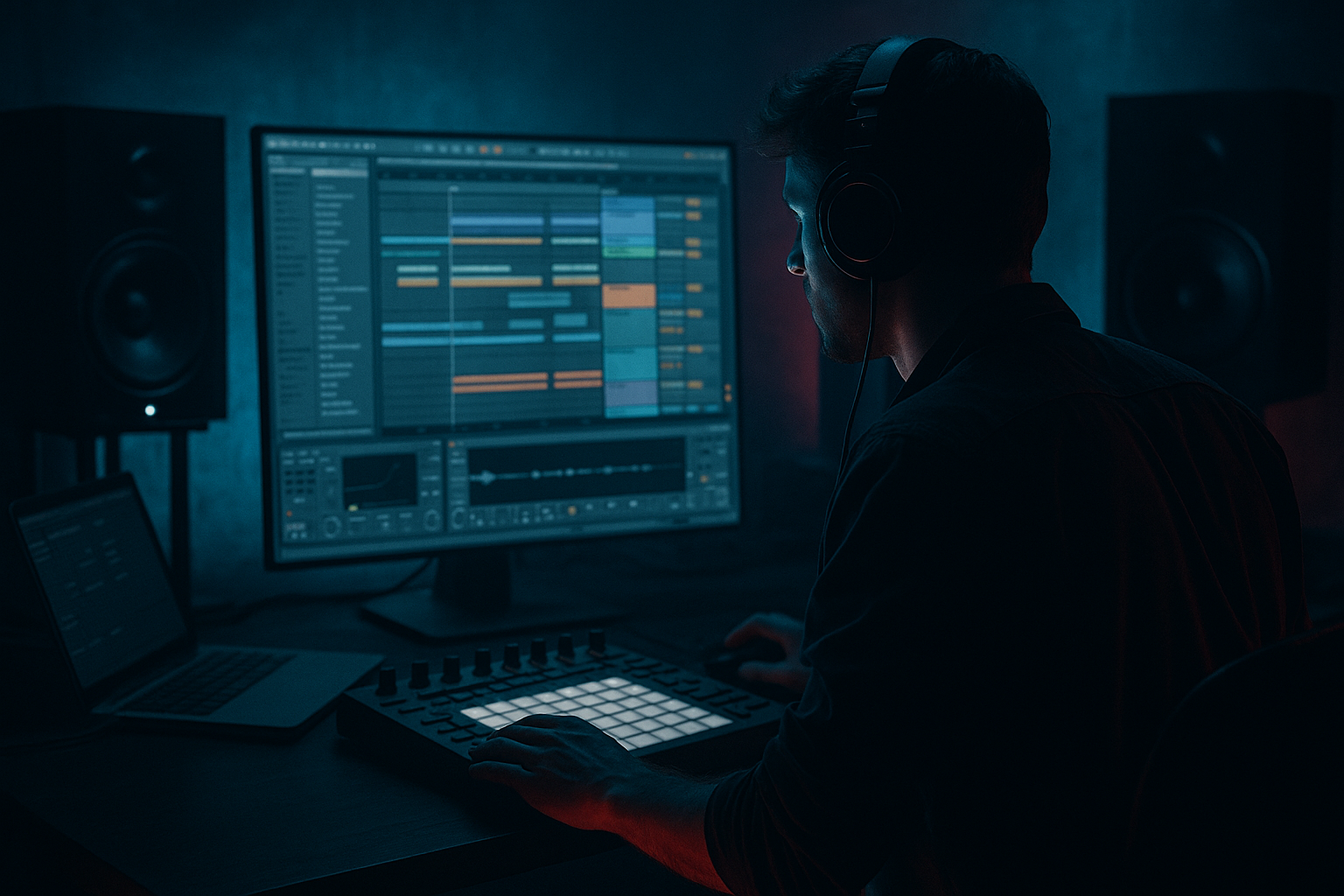
Main tutorial
Saturate an Amen-Style Breakbeat with Minimal CPU Load in Ableton Live 12
1) Lesson overview
In this lesson, you’ll learn how to add weight, grit, and perceived loudness to an Amen-style breakbeat in Ableton Live 12 without crushing your CPU. The goal is a break that feels darker, denser, and more forward in the mix, while still keeping the groove alive for DnB / jungle / rolling bass music.
We’ll focus on a practical, efficient workflow:
- Use one solid break source
- Split clean transient control from saturation
- Use stock Ableton devices only
- Keep processing simple and CPU-friendly
- Build the sound so it works in an arrangement, not just in solo
- A saturated Amen break chain that sounds energetic and gritty
- A setup that uses very little CPU
- A break that can be arranged into:
- A method that keeps the break tight and controlled, not smashed into mush
- Drum Rack
- EQ Eight
- Drum Buss
- Saturator
- Glue Compressor
- Utility
- Redux (optional for edge)
- Auto Filter (for arrangement movement)
- Drag the Amen break onto an audio track or into Simpler if you want easier slicing.
- If the sample has too much room tone or unwanted tail, trim it first.
- Set Gain to taste, usually -3 to -6 dB if the sample is hot
- Turn on Bass Mono only if the break’s low end feels too wide or messy
- If needed, use Width around 80–100%
- High-pass around 30–40 Hz to remove sub-rumble
- If the break is boxy, cut a little around 200–400 Hz
- If the hats are too sharp, try a gentle cut around 7–10 kHz
- Drive: 5–20%
- Crunch: 5–15%
- Boom: very low, or off at first
- Transients: slightly positive if the break needs snap
- Damp: adjust to tame brightness
- Dry/Wet: 30–70% depending on how heavy you want it
- Start with Drive until the break gains presence
- Add a little Crunch for that crunchy jungle bite
- Be careful with Boom on Amen-style breaks, because you already have kick/snare movement in the sample
- Drive: 2–8 dB
- Soft Clip: ON
- Curve Type: try Analog Clip or default soft curve
- Color: on if you want a darker harmonic edge
- Output: lower it so the gain boost doesn’t clip the track
- Push the drive until the break starts to feel more present and aggressive
- Then lower the output to match the bypass level
- Use your ears to check whether the snare cracks harder and the hats feel denser
- Attack: 3 ms or 10 ms
- Release: Auto
- Ratio: 2:1 or 4:1
- Threshold: aim for 1–3 dB gain reduction
- Soft Clip: ON if needed
- EQ Eight: high-pass around 120–200 Hz
- Saturator: drive 6–10 dB
- Utility: control level
- The dry break keeps its transient clarity
- The return adds grime and density
- You can automate send levels for arrangement changes
- Increase drive slightly in the drop
- Reduce it in breakdowns or intro sections
- Add more crunch during high-energy bars
- Pull it back for space before big reintroductions
- Low-pass the break in the intro
- Open it gradually into the drop
- Narrow the frequency range for tension fills
- Narrow the break slightly before a transition
- Widen it again in the drop for impact
- Start with a filtered Amen loop
- Keep saturation light
- Use a return send for only a hint of grit
- Leave space for atmospheres, FX, or a filtered sub pulse
- Bring in the full saturated break
- Increase Drum Buss Drive and Saturator Drive slightly
- Add a bassline underneath, but keep the kick/snare readable
- Automate a short filter dip
- Reduce saturation for 2 bars
- Bring in a fill or reverse hit
- Re-open the filter on the next bar
- Strip back to a cleaner version of the break
- Reduce wet saturation
- Remove Glue Compressor if needed for a more open feel
- Bring back the heavier setting
- Push the parallel saturation send higher
- Add a final automated distortion rise for maximum impact
- Lower Downsample only a little
- Keep the dry break clean
- Blend the return subtly
- Saturator Drive
- Return send amount
- Filter cutoff
- Utility gain
- One Amen loop on an audio track or in Simpler
- Utility
- EQ Eight
- Drum Buss
- Saturator
- One return track with parallel distortion
- Whether the snare stays punchy
- Whether the hats become harsh
- Whether the break still works with a bassline underneath
- Start with a clean Amen loop
- Use Utility + EQ Eight to control gain and frequency clutter
- Add Drum Buss for punch and grime
- Use Saturator for harmonic thickness and soft clipping
- Add Glue Compressor only if needed
- Use parallel saturation on a return for extra weight without flattening the dry break
- Automate saturation and filtering across the arrangement to keep the track moving
- a specific Ableton device chain preset recipe
- a step-by-step Amen slicing workflow in Simpler
- or a full 16-bar jungle arrangement template for this sound.
This is especially useful if you’re building tracks around an Amen loop that needs to punch through sub-heavy basslines, Reese layers, and atmospheric pads 🎛️
---
2) What you will build
By the end, you’ll have:
- Intro
- Drop
- Variation / fill
- Breakdown
You’ll be working with these kinds of Ableton stock devices:
---
3) Step-by-step walkthrough
Step 1: Load and clean the Amen break
Start with a clean Amen sample.
Best practice:
#### Option A: Use it as audio
This is the lightest option for CPU if you’re only looping a break.
1. Drag the Amen audio loop into Arrangement View.
2. Warp it if needed so it locks to your project tempo.
3. Set the clip so it loops cleanly over 1 or 2 bars.
#### Option B: Use Simpler
This is better if you want rearrangement and MIDI control.
1. Drop the Amen into Simpler.
2. Set Mode to Slice.
3. Slice by Transient.
4. Trigger slices from MIDI for custom fills and variations.
For minimal CPU, both are fine, but one Simpler instance or one audio clip is better than loading multiple layered break tracks.
---
Step 2: Set up a lean processing chain
Put the following devices on the break track in this order:
1. Utility
2. EQ Eight
3. Drum Buss
4. Saturator
5. Glue Compressor
(optional, only if needed)
This is a very efficient chain because each device does a specific job.
---
Step 3: Control the break before you saturate it
Before adding grit, clean up the break so the low end and harsh top don’t run wild.
#### Utility
Use Utility first:
This gives you cleaner headroom before saturation.
#### EQ Eight
Use EQ Eight to remove unnecessary junk:
Keep the EQ moves small. You’re shaping the break, not sterilizing it.
---
Step 4: Add body with Drum Buss
Drum Buss is one of the best stock devices for this job because it adds punch, harmonic weight, and controlled dirt without needing a heavy plugin chain.
Suggested starting settings:
#### How to use it:
If your break starts to lose definition, back off the wet amount and use the Transients control to restore attack.
---
Step 5: Add saturation with Saturator
Now add Saturator to thicken the break and make it feel louder without using lots of headroom.
Suggested settings:
#### Practical move:
This is the key mindset:
You’re not trying to make the break louder in solo. You’re trying to make it cut better in the arrangement.
---
Step 6: Tame the peaks with Glue Compressor
Use Glue Compressor only if the break is too spiky after saturation.
Suggested starting settings:
The goal here is subtle control, not obvious pumping unless that’s the vibe.
For dark jungle energy, a touch of glue can make the loop feel more “locked in” and less like separate hits.
---
Step 7: Use parallel saturation if you want more power without overcooking the dry break
A very CPU-friendly trick in Ableton Live is to keep the main break fairly clean and add a parallel return track for saturation.
#### Create a Return Track:
1. Add a Return Track
2. Put Saturator or Drum Buss on it
3. Add EQ Eight before or after saturation
4. Send the Amen break to this return
Suggested return chain:
This is excellent because:
Very jungle-friendly, very efficient 🔥
---
Step 8: Create movement with arrangement automation
Saturated breaks sound best when they evolve across the track.
In Arrangement View, automate:
#### Saturator Drive
#### Drum Buss Crunch
#### Auto Filter
Use Auto Filter to create tension:
#### Utility Width
This gives your arrangement movement without needing extra layers.
---
Step 9: Build a simple DnB arrangement with break variation
Here’s a practical arrangement idea for a rolling DnB track:
#### Intro
#### First drop
#### 8-bar variation
#### Breakdown
#### Second drop
This arrangement approach helps the break feel like it’s developing, not just repeating.
---
Step 10: Save the chain as a preset
Once you’ve got a sound you like:
1. Select the device chain
2. Save it as an Audio Effect Rack or preset
3. Name it clearly, for example:
- `Amen Grime - Light CPU`
- `Amen Crunch - Dark Roll`
- `Jungle Break - Parallel Saturation`
This saves time when starting new tracks.
---
4) Common mistakes
Over-saturating the break
Too much drive can flatten the snare and blur the groove. If the break loses its swing and impact, ease back.
Using too many heavy plugins
You do not need five saturators, three compressors, and a vintage emulation to make a break hit. Keep the chain lean.
Ignoring the low end
Amen breaks often carry kick energy. If you saturate the low end too hard, it can fight the sub bass. Use EQ to control the bottom.
Not gain staging
If the input is too hot, saturation can become harsh very quickly. Leave headroom before and after each device.
Soloing too much
A break that sounds “filthy” in solo may mask the bass and synths in the full mix. Always check it with the rest of the track.
Forgetting arrangement automation
A static saturated loop gets boring fast. Even small changes in drive, filter, or send level make a big difference.
---
5) Pro tips for darker/heavier DnB
Tip 1: Saturate the mids more than the sub
For darker DnB, the magic is often in the 150 Hz–5 kHz region. Let the sub bass own the lowest frequencies.
Tip 2: Use parallel distortion for industrial bite
If you want a nastier edge, put Redux on the return track with very light settings:
This can add a broken, crunchy jungle texture without destroying the core groove.
Tip 3: Pair saturation with transient control
A little Drum Buss Transients boost after saturation can restore snare attack. Great for heavy rollers.
Tip 4: Chop the break around the kick and snare
For a heavier arrangement, edit the Amen so the important hits land cleanly against the bassline. A saturated break works best when the main accents are intentional.
Tip 5: Use automation to fake “more processing”
Instead of adding more plugins, automate:
That’s how you keep the CPU down and the arrangement alive.
---
6) Mini practice exercise
Try this in a new 16-bar loop:
Goal:
Make one Amen break evolve from clean to heavy using only stock devices.
Setup:
Exercise:
1. Bars 1–4:
Light saturation only. Keep the return send low.
2. Bars 5–8:
Increase Saturator Drive by 2 dB and Drum Buss Crunch slightly.
3. Bars 9–12:
Automate Auto Filter to open up more high end.
4. Bars 13–16:
Increase the return send and add a tiny bit more Glue Compressor.
Listen for:
If it feels too flat, reduce compression and add more parallel saturation instead.
---
7) Recap
To saturate an Amen-style breakbeat with minimal CPU in Ableton Live 12:
The big DnB lesson here is simple:
A great breakbeat isn’t just distorted — it’s controlled, shaped, and arranged so it punches through the whole tune. 💥
If you want, I can also give you:

