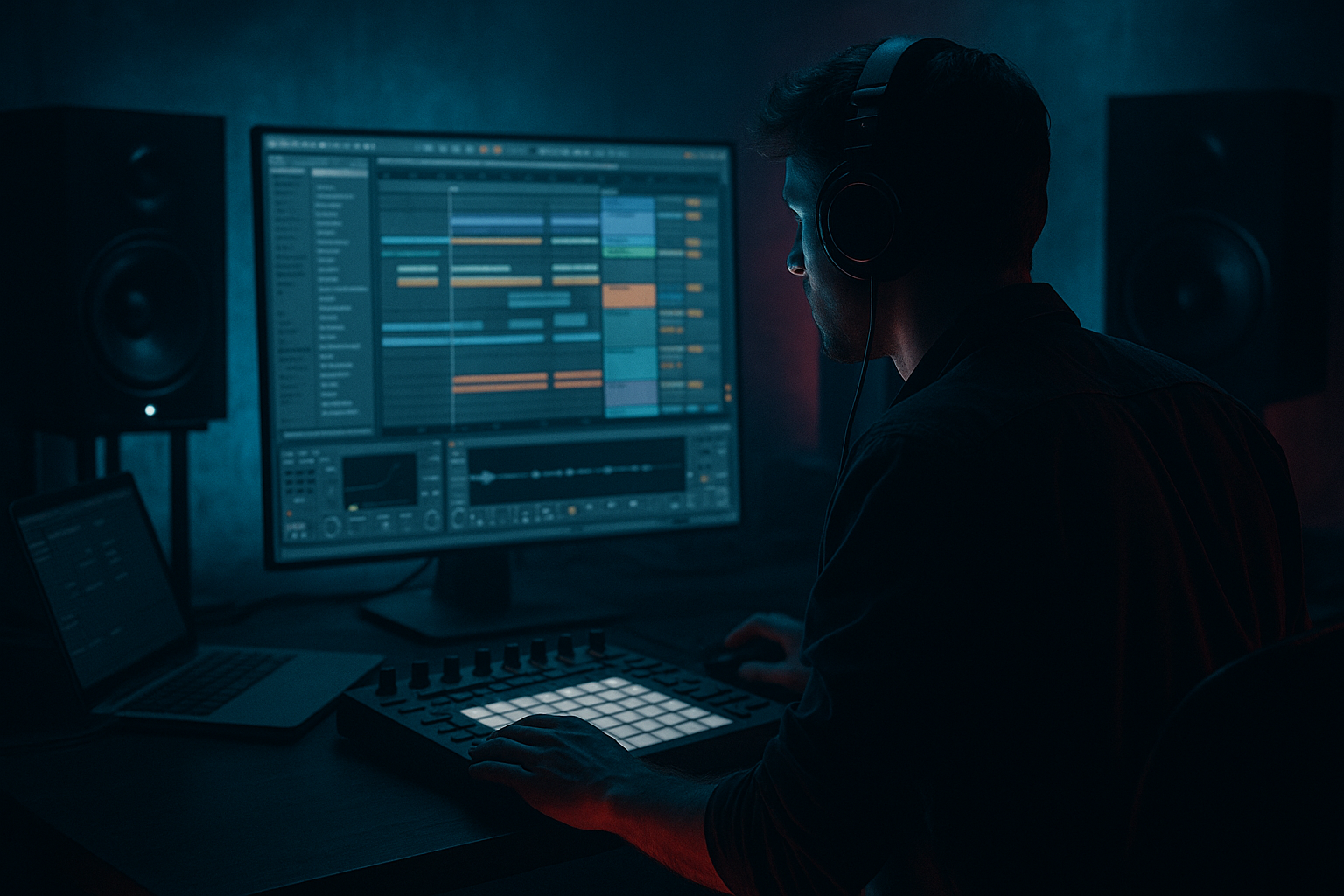
Main tutorial
Lesson Overview
A classic rewind moment is one of the most iconic DJ tools in Drum & Bass: the tune drops, the crowd reacts, and the selector pulls the track back for that “one more time” reload. In pirate-radio culture, this creates instant pressure, hype, and connection. In modern Ableton Live 12, you can build that same energy directly into your arrangement so your track feels like it was designed for the set, not just the playlist.
This lesson shows you how to create a DJ-friendly rewind section in a DnB track using Ableton stock tools. You’ll learn how to arrange a fake-out, automate the stop, add a vinyl-style backspin feel, and bring the tune back in with proper pirate-radio attitude. The goal is not just a gimmick — it’s to make your intro, drop, and switch-up feel like a live moment with weight, tension, and personality.
This technique matters because DnB is built around energy control: tension, release, and impact. A rewind gives you a dramatic reset point that can work in jump-up, oldskool jungle, rollers, darker minimal DnB, and even neuro-inflected tracks if you keep the execution tight. It also helps your tune feel performance-ready, which is a huge advantage when you want your track to work in a mix, on a radio show, or in a set recording.
What You Will Build
By the end of this lesson, you’ll have a short rewind moment inside Ableton Live 12 that sounds like a DJ pulled the tune back on pirate radio.
Specifically, you’ll build:
- a 4-, 8-, or 16-bar drop section
- a fake stop with automation and impact
- a rewind-style backspin / reverse feel
- a reload pickup with drums, bass, and FX
- a DJ-friendly arrangement that leaves space for the moment to breathe
- Making the rewind too long
- Letting the low end smear during the FX moment
- Using too many FX at once
- No real drop before the rewind
- Reload sounds identical to the first drop
- Harsh top end after the stop
- Too much reverb on the whole master
- Use a grimy midrange rewind texture
- Let the sub vanish, then return hard
- Add a tiny pitch fall before the stop
- Use break edits to “pull backward”
- Keep the reload darker than the first hit
- Use call-and-response with bass and drums
Musically, this could sit after an energetic 16-bar drop: the drums slam, the bass answers, the crowd-pleaser motif hits, then the music cuts, rewinds, and returns with even more intent. Think oldskool jungle rave energy, pirate-radio MC hype, and modern DnB control.
Step-by-Step Walkthrough
1. Choose the exact section where the rewind will happen
Start by picking a moment in your arrangement where the energy is already high. For beginner workflow, place the rewind after a clear phrase length such as:
- 8 bars after the drop
- 16 bars after the drop
- after a call-and-response between drums and bass
In DnB, rewind moments work best when the listener has just experienced a strong payoff. If you rewind too early, it feels random. If you rewind too late, the tension is gone.
A good beginner-friendly layout:
- Intro: 16 bars
- Build: 8 bars
- Drop 1: 16 bars
- Rewind moment: 1–2 bars
- Reloaded drop: 8–16 bars
Why this works in DnB: DnB relies on phrase-based momentum. A rewind resets the listener right after a peak, which increases anticipation for the reload and makes the drop feel bigger the second time.
2. Build a clean drum-and-bass drop first
Before adding rewind FX, make sure the underlying groove actually bangs. Use your core DnB elements:
- Drums: kick, snare, break layer, ghost hits
- Bass: sub + mid bass or reese
- Atmosphere: a subtle loop, vinyl noise, or reverb tail
In Ableton Live, keep this simple:
- Use a Drum Rack for your break edits and one-shots
- Use Simpler or Wavetable for bass if you want to make the sound yourself
- Put EQ Eight on the drum bus to control low-end overlap
- Use Utility on bass to keep low frequencies centered
Beginner settings to aim for:
- Kick and sub should not fight below roughly 80–100 Hz
- Keep the bass mono below 120 Hz
- Leave enough headroom so the drop isn’t clipping when the rewind FX hits
If your drop is weak, the rewind won’t feel powerful. The stunt only works if the music already has authority.
3. Create a dedicated rewind return track
Add a new audio track or return track for your rewind FX. This keeps the effect organized and easy to automate.
On that track, build a small chain with stock Ableton devices:
- Utility for gain control
- Reverb for space
- Echo for a dub-style tail
- Auto Filter for movement
- optional Saturator for grit
Suggested starting settings:
- Utility: leave at 0 dB, use it later for dips if needed
- Reverb: decay around 1.2–2.5 s, dry/wet 10–25%
- Echo: time at 1/8 or 1/4, feedback 15–35%
- Auto Filter: low-pass with resonance around 0.5–1.2
- Saturator: drive around 2–6 dB
This track gives you a place to print or automate the vibe without destroying the main arrangement.
4. Add the “stop” moment with automation
The rewind starts with a dramatic stop. In Ableton Live, you can do this by automating a quick drop in volume, filter cutoff, or both.
On your drum bus and bass bus, draw automation so the music cuts out over a very short time:
- Fade the main drop down over 1/4 beat to 1 beat
- Close a filter on the bass or master bus slightly
- Pull the drum group volume down rapidly
- Leave a short tail of reverb or echo so it doesn’t feel dead
Good beginner approach:
- On the bass group, automate Utility gain from 0 dB to -inf in under a beat
- On a return FX track, automate Reverb dry/wet up to 20–30% right before the stop
- Use Auto Filter to sweep down from open to closed, creating a sucking motion
Keep the stop sharp. A rewind moment should feel like someone grabbed the record, not like the track slowly got tired.
5. Design the rewind sound using reverse and short snippets
The most convincing rewind moments often use a combination of reversed audio, short samples, and stop-start rhythm. In Ableton, you can do this cleanly without complicated editing.
Try these options:
- Duplicate a short drum hit, snare roll, or vocal shout
- Reverse it using the clip’s reverse function
- Place it just before the stop or just after the stop
- Add a short delay or reverb tail to blur the transition
Great DnB choices for rewind audio:
- a snare flam
- a break slice
- a vocal “rewind” call
- a rimshot
- a sub drop
- a ride cymbal tail
Keep the rewind audio short and punchy. A common beginner mistake is making the reverse effect too long. In DnB, the rewind should be a strong punctuation mark, not a cinematic trailer.
A useful approach:
- reverse a snare
- follow it with a quick silence
- then bring the drop back in on the next downbeat
6. Make the rewind feel like a DJ action, not just an FX cue
To get authentic pirate-radio energy, shape the rewind like a live selector move. That means the timing and contour matter.
Try these moves in Arrangement View:
- automate a quick pitch dip on a sample player or clip if you’re using a resampled phrase
- use Beat Repeat very lightly on a drum return to create a stutter before the stop
- use Vinyl Distortion subtly on a short return bus for grit
- add a short Silence or empty bar to make the rewind breathe
Ableton stock devices that help here:
- Beat Repeat for rapid fragments
- Vinyl Distortion for oldskool grime
- Redux for lo-fi edge if you want a rougher tape-like feel
- Saturator to thicken the transient before the cut
Suggested Beat Repeat starting point:
- Interval: 1/8 or 1/16
- Grid: 1/8
- Chance: 20–40%
- Mix: low enough that it feels like a gesture, not a permanent effect
Use it briefly — maybe only the last half-bar before the stop. That keeps the energy focused and believable.
7. Reload the drop with a stronger second entrance
The best rewind moments lead to a bigger reload, not a copy-paste of the first drop. After the rewind, bring the track back with a slight upgrade.
Good reload ideas for beginner DnB arrangement:
- bring the bass back first, then the full drums
- add a new hat pattern
- open the filter slightly more on the second drop
- switch the snare layer or add a clap top
- bring in a new bass note phrase or call-and-response
In a rollers or jungle context, this might mean the second drop has:
- a more active break edit
- stronger offbeat hats
- a bass answer that comes in later for tension
In darker/neuro DnB, the reload could be:
- a cleaner sub hit
- a more aggressive reese movement
- a brief muted bar before the full return
Arrangement tip: let the reload hit on a strong downbeat after the rewind silence. That makes the listener feel the return physically.
8. Balance the rewind in the mix so it doesn’t wreck headroom
Rewind moments often create mix problems because they stack FX, transients, and low-end movement all at once. Keep it clean.
Use these checks:
- Turn on mono with Utility if you need to confirm bass stays centered
- Use EQ Eight to reduce muddy low mids in the rewind FX
- High-pass the rewind effects if they are cluttering the sub zone
- Watch the master for unwanted peaks when the drop snaps back in
Practical settings:
- High-pass the rewind FX around 120–200 Hz if it isn’t meant to carry low end
- Cut harshness around 2–5 kHz if the reverse sound gets brittle
- Keep the sub separate from the FX return so the rewind doesn’t smear the bass
For beginner workflow, think of the rewind as mostly mid/high frequency drama. Let the bass remain controlled and let the FX tell the story.
9. Use arrangement spacing like a real DJ would
A pirate-radio rewind is about crowd reaction and breathing room. So don’t clutter the bars around it.
Good arrangement choices:
- leave a half-bar or full bar of space before the rewind
- avoid too many fills right after the stop
- keep the reload clean for the first beat or two
- if you use a vocal tag, keep it short and rhythmic
Example context:
- Your drop plays for 16 bars
- At bar 17, the snare hits with a vocal phrase like “rewind!”
- The track cuts for 1 beat
- A reverse snare and echo tail pull backward
- The tune reloads with the bass and drums on the next bar
This is classic DnB arrangement language: tension, punch, space, return. It works because the listener gets a clear cue that the track is performing, not just looping.
10. Render or freeze the rewind if you want more control
Once the rewind feels good, consider printing it to audio. This is especially useful if the automation feels too messy or you want tighter control.
In Ableton:
- Freeze and Flatten the FX return if you want a committed sound
- Or Resample the rewind into a new audio track
- Then trim the audio so the stop and reverse are exact
Beginner benefit:
- it becomes easier to see the rewind shape
- you can edit the silence and impact cleanly
- you reduce CPU if you’re using several FX devices
This is a great DJ-tools workflow because it turns an abstract effect into a reliable, repeatable arrangement element.
Common Mistakes
Fix: Keep the stop/reverse moment tight, usually around 1 beat to 2 beats. DnB needs momentum.
Fix: High-pass the rewind FX and keep sub separate. Use Utility and EQ Eight to stay clean.
Fix: Pick one main rewind character — reverse, stutter, or filter stop — and let it lead.
Fix: Build a strong phrase first. The rewind should reward energy, not replace it.
Fix: Add a small variation: different hats, new bass notes, or an extra break layer.
Fix: Use EQ Eight to tame 2–5 kHz, especially on reverse cymbals and white-noise FX.
Fix: Put reverb on a return or a specific FX track, not across everything.
Pro Tips for Darker / Heavier DnB
Layer a short reversed break with Vinyl Distortion or Saturator for underground dirt. Keep it short so it sounds intentional, not washed out.
A sudden sub cut creates a huge psychological impact. When the bass re-enters, it feels heavier than if it never stopped.
If you’re using a sampled phrase, a small pitch dip can make it feel like a real deck drag. Keep it subtle — think -1 to -3 semitones or a quick downward motion, not a dramatic effect.
Slice a break into quarter-note or eighth-note pieces and reverse one tiny slice before the rewind. This creates jungle-style motion.
After the rewind, bring back a more focused, less flashy version of the drop. In heavier DnB, restraint often hits harder than extra decoration.
For example, let the snare and top loop answer the bass after the reload. This keeps the track moving while preserving the raw pirate-radio feel.
Mini Practice Exercise
Spend 10–20 minutes building a rewind moment from scratch in Ableton Live:
1. Load a simple 8-bar DnB loop with kick, snare, hats, and a bassline.
2. Duplicate it so you have a short drop section.
3. Add a return track with Reverb, Echo, and Auto Filter.
4. Choose one bar near the end and automate a quick stop in the drum and bass groups.
5. Add one reversed snare or break slice just before the stop.
6. Make a 1-bar silence or near-silence moment.
7. Bring the drop back with a slightly different drum top or bass variation.
8. Listen once in mono, then once in stereo, and check whether the rewind still feels punchy.
Goal: make the rewind feel like a real reload moment, not just an empty gap.
Recap
A strong rewind moment in DnB is about timing, space, and control. Build a proper drop first, then create a sharp stop, a short reverse/FX cue, and a strong reload. Use Ableton stock devices like Utility, EQ Eight, Auto Filter, Reverb, Echo, Beat Repeat, Saturator, and Vinyl Distortion to shape the energy. Keep the low end clean, the timing tight, and the arrangement DJ-friendly. If the drop feels massive and the rewind feels deliberate, you’ve nailed that classic pirate-radio reload energy 🎛️

