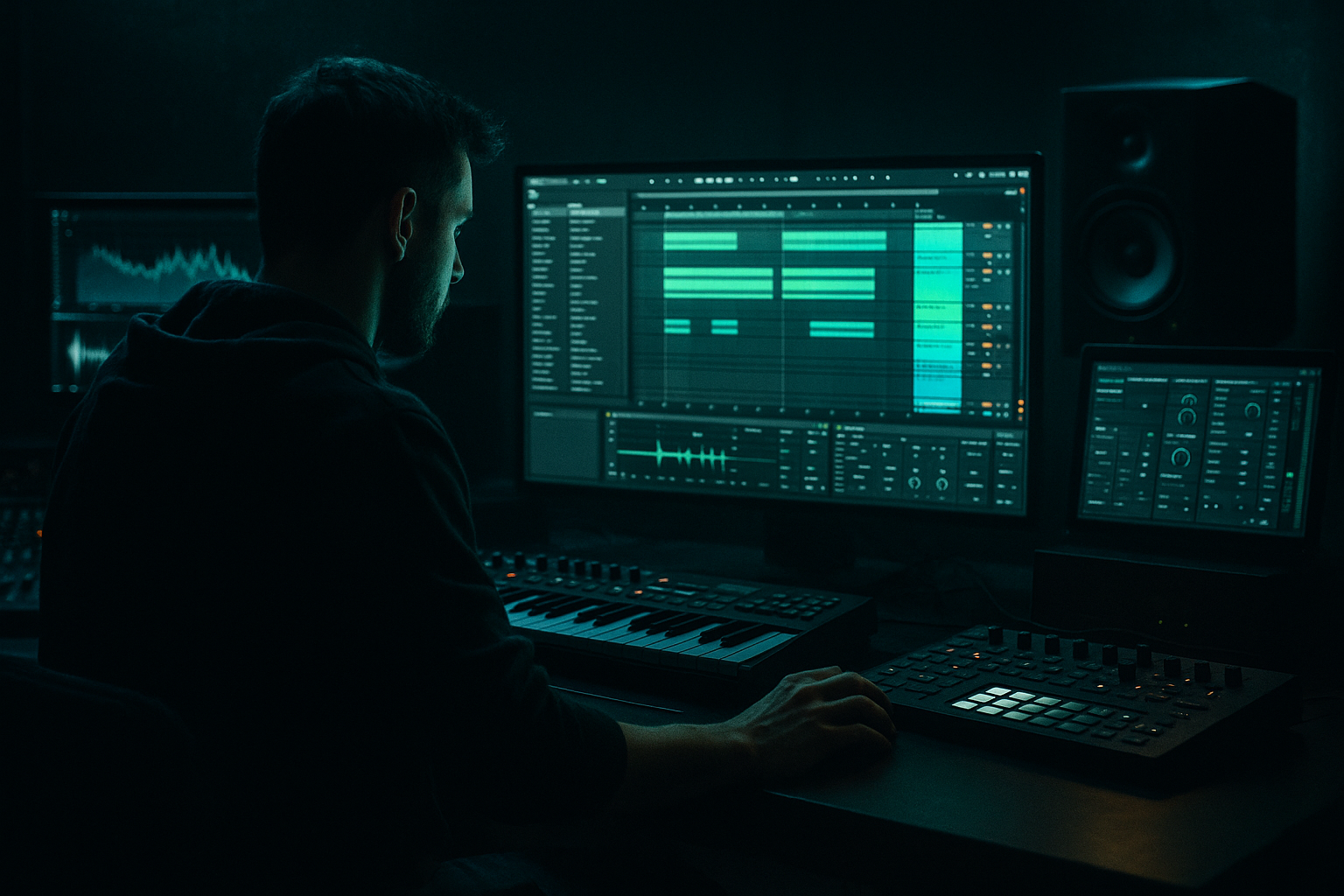
Main tutorial
Lesson Overview
This lesson is about building a think-break switchup blueprint for a deep jungle / roller DnB track inside Ableton Live 12. The goal is to take a steady, hypnotic roller groove and turn it into a sudden, musical breakbeat switchup that feels organic, tense, and atmospheric rather than random.
In real DnB arrangements, this kind of move is gold. You use it when the drop has been rolling long enough to lock the listener in, and you want to create a second wind: a short breakdown, a break edit, a fill, or a half-time-feeling turn that refreshes the energy without killing momentum. Think of it as a DJ-friendly tension tool and a storytelling device at the same time.
Why it matters:
- It keeps rollers from becoming too flat or looped
- It creates contrast between driving 2-step / rolling drums and cut-up jungle break energy
- It gives you a place to introduce atmosphere, bass commentary, and impact FX
- It helps your track feel like a real journey, not just an 8-bar loop on repeat
- A rolling drum groove with tight sub support
- A short break switchup using chopped break hits and ghost notes
- Atmospheric tails, noise texture, and filtered ambience
- A bass call-and-response moment that leaves space for the drums
- A controlled drop-back-in with stronger energy than before
- Break editing
- Bass phrasing
- Automation-based tension
- Atmospheric arrangement
- Clean mix decisions that keep the low end powerful
- Overfilling the break
- Too much low-end in the break sample
- Switchup arriving with no phrasing logic
- Bass and drums fighting for the same space
- Atmosphere masking the snare
- FX getting too wide and blurry
- Resample your drum bus
- Use tiny bass rests before big hits
- Distort the break, not the sub
- Automate the reese filter in sections
- Use short dubby delays on occasional snare ghosts
- Double the final fill with a reversed texture
- Check mono on the drop
- Build a strong roller first, then switch it up
- Use chopped break edits and ghost notes to create the think-break feel
- Keep sub simple and mono while the reese answers in phrases
- Use atmosphere, filters, and short FX to frame the transition
- Arrange the switchup on clean DnB phrase boundaries
- Control the low end so the drop return feels bigger, not messier
This technique is especially useful in deep jungle atmosphere because the switchup can reveal the emotional core of the track: dusty breaks, haunted ambience, sub pressure, and just enough distortion to feel underground. In Ableton Live 12, you can build it fast using stock devices, resampling, and clever arrangement moves.
What You Will Build
You’ll build a 16-bar roller section that flips into a 4- or 8-bar think-break switchup with a darker jungle atmosphere, then returns into the drop with more impact.
Musically, the result should sound like:
By the end, you’ll have a blueprint for:
This is not just a fill. It’s a reusable roller-to-break switchup system you can adapt across deep jungle, darkstep, techstep, and neuro-influenced DnB.
Step-by-Step Walkthrough
1. Set up a lean DnB session and define the switchup zone
Start at a tempo between 170 and 174 BPM. For a darker jungle roller, 172 BPM is a strong middle ground: fast enough to feel alive, slow enough for weighted groove.
In Ableton Live 12, create these core tracks:
- Kick
- Snare / Clap layer
- Break loop or break chop track
- Sub
- Reese or mid bass
- Atmosphere / texture
- FX return(s)
Before writing the switchup, place a 16-bar roller loop in the Arrangement View. Make sure the groove already works on its own. The switchup should feel like a disruption to something solid, not a fix for a weak loop.
Set a marker at bar 9 or bar 17 for your switchup entry. Most DnB switchups work best when they arrive at the end of a phrase, especially after 8 or 16 bars. That’s where listeners expect change, so your break edit feels intentional.
2. Build the core roller drum groove first
Use a strong, minimal DnB skeleton:
- Kick on the 1 and occasional syncopations
- Snare on 2 and 4
- Ghosted percussion between the main hits
- A break layer that supports, not smears, the core groove
In Ableton, use Drum Rack or a simple audio track with chopped break slices. If you’re layering a break under programmed drums, keep the break filtered and controlled.
Useful stock devices:
- EQ Eight: high-pass the break around 120–180 Hz so it doesn’t fight the kick/sub
- Drum Buss: add body and punch; start with Drive 5–15%, Boom low, and keep it subtle
- Saturator: mild warmth on drum bus, try Drive 1–4 dB
- Utility: keep low end mono if needed
For the break layer, use a jungle-friendly break like an amen-style loop, but don’t just loop it straight. Chop it into 1/8 and 1/16 slices. The groove should have a rolling swing rather than a rigid grid.
Why this works in DnB: the listener needs a stable drum identity before you destabilize it. The switchup lands harder when the original groove has already established momentum.
3. Create the think-break by resampling and chopping the break
The “think-break” vibe comes from making the drums feel like they’re thinking, hesitating, and answering themselves. It’s a short, psychological break moment with edits, gaps, and weird little turns.
In Ableton:
- Record or freeze/flatten your break layer to audio
- Slice it into a new Simpler or onto a Drum Rack
- Focus on kick/snare/ghost-hit fragments that can be rearranged
Try these chop ideas:
- Keep the original snare on the downbeat, then answer with a reversed or truncated break hit
- Place a ghost snare just before beat 4 to create a stumble
- Use a 1/16 gap before the next hit to create tension
A practical pattern:
- Bar 1: normal roller
- Bar 2: remove the kick on beat 1 and let the break speak first
- Bar 3: add a chopped fill across the last half of the bar
- Bar 4: strip the pattern back to snare + sub tail + texture, then re-enter
Keep the think-break short. For deep jungle atmosphere, the goal is usually 4 bars of suggestion, not a full breakdown.
4. Shape the break with groove, swing, and transient control
A think-break only feels alive if the timing breathes. In Ableton Live 12, use:
- Groove Pool: apply swing from an MPC-style or break-inspired groove
- Warp markers on chopped audio slices: nudge certain hits slightly late for drag
- Envelope shaping in Simpler: shorten tails so hits stay punchy
Practical timing choices:
- Keep main snare hits tight, within a few milliseconds of the grid
- Push ghost notes slightly late for feel
- Nudge some break taps earlier to create urgency
On the drum bus, use Drum Buss sparingly:
- Drive: 5–10%
- Crunch: low or off if the break is already dirty
- Transient: a touch up if the hits need more edge
If the break feels too busy, high-pass it more aggressively or reduce the sample tails. In jungle, space around the snare is part of the groove. Don’t let the edit turn into mush.
5. Design the bass answer: sub support plus reese commentary
The switchup should not be only drums. In DnB, the bass makes the transition feel deliberate.
Build two bass layers:
- Sub layer: a clean sine or very simple waveform in Operator or Wavetable, mono, centered, and short
- Mid bass / reese layer: detuned saws or a filtered harmonically rich patch for character
Bass movement ideas:
- In the roller section, hold a repeated low note or sparse phrase
- In the switchup, mute the reese for 1 bar and let the sub speak alone
- Then reintroduce the reese with a filtered swell or a rising note answer
Good starting settings:
- Sub: low-pass, no stereo widening, amplitude envelope with short release
- Reese: high-pass around 90–140 Hz so it doesn’t crowd the sub
- Use Auto Filter on the reese with cutoff automation from roughly 250 Hz to 1.5 kHz during the switchup
A strong DnB call-and-response trick:
- Drums fill the first half of the bar
- Bass answers in the second half
- Then both drop out for a half-beat of tension before the drop return
This works in DnB because the rhythm is as important as the note choice. The bass doesn’t need to be busy; it needs to phrase like a percussion section with weight.
6. Add deep jungle atmosphere with textures, tails, and space
The atmosphere is what makes this feel like a deep jungle switchup instead of a generic drum fill.
Create one or two atmosphere tracks using stock devices:
- A field recording, vinyl hiss, or noise bed
- A reverb-heavy stab or chord wash
- A resampled break tail with heavy filtering
Process the atmospheres with:
- Auto Filter: band-pass or high-pass sweeping during transition
- Reverb: long decay, but keep it blended quietly
- Echo: short, dark feedback for ghosted movement
- Delay: subtle dub-style repeats on select hits
A practical automation move:
- During the last 2 bars before the switchup, automate the atmosphere high-pass down from 1.2 kHz to 300 Hz
- Then snap it back open after the switchup hits
That creates a shadowy “closing in” effect. In jungle, atmosphere is not just background; it helps the drums feel like they’re moving through a physical space.
7. Use FX to frame the switchup, not cover it
The best switchups are readable. FX should support the drums, not bury them.
Add:
- Reverse cymbal or reverse break tail into the switch
- Short noise riser
- Impact hit on the first bar of the new section
- Very small fill-down before the drop re-entry
Stock Ableton workflow:
- Use Simpler for reversed FX slices
- Use Echo for tension tails
- Use Reverb sends so the FX live in the same space as the drums
Automation ideas:
- Automate Auto Filter cutoff on the drum return for a brief low-pass dip
- Increase Echo feedback only on the last hit before the switchup, then cut it hard
- Use Utility to momentarily reduce width on the mix bus, then widen atmospheres only after the switch
Keep the FX short. In darker DnB, a switchup feels heavier when it’s almost restrained.
8. Arrange the switchup like a mini scene change
A musical arrangement example:
- Bars 1–8: rolling groove, sub locked, bass phrase repeating
- Bars 9–12: filter rise, sparse break edits, atmosphere thickens
- Bars 13–16: think-break switchup, bass calls shrink, ghost notes and fills dominate
- Bar 17: full drop returns with the kick/snare restored and bass reintroduced wider and louder
For DJ-friendliness:
- Leave your intro and outro clean enough for mixing
- Make sure the switchup doesn’t destroy the track’s phrase structure
- Let the transition happen on an 8-bar or 16-bar boundary where possible
A smart move is to use the switchup once in the first drop and again later with a variation. The second time can be drier, faster, or more aggressive. That keeps arrangement logic strong and avoids copy-paste fatigue.
9. Mix the drum-bass relationship so the switchup hits harder
The switchup only works if the low end stays disciplined.
In the drum bus:
- Keep headroom on the master; aim for peaks around -6 dB to -3 dB before mastering
- Use EQ Eight to remove unnecessary low-end rumble from breaks and atmospheres
- If the snare needs punch, a small boost around 180–250 Hz can help, but watch mud
On the bass bus:
- Keep sub mono with Utility
- Check phase between sub and kick
- Use Saturator or Roar lightly if you want harmonics on the reese, but avoid smearing the sub
During the switchup:
- Let the drums own the transient space
- Pull the bass down 1–2 dB if the break fill feels crowded
- Open it back up on the drop return
This is why it works in DnB: the ear perceives energy from contrast, not just loudness. A controlled dip makes the return feel massive.
Common Mistakes
- Fix: leave at least one clear breath point every bar. In DnB, emptiness is part of the rhythm.
- Fix: high-pass the break and let the kick/sub own the bottom. Try filtering from 120–180 Hz upward.
- Fix: place it on a strong 4-, 8-, or 16-bar boundary so it feels like part of the arrangement.
- Fix: reduce bass notes during drum fills, and let the sub stay simple when the break becomes busy.
- Fix: use sidechain-style volume shaping manually with automation, or simply lower ambience during snare-heavy moments.
- Fix: keep low frequencies mono and widen only the top atmosphere layers.
Pro Tips for Darker / Heavier DnB
- Print 4 bars of your roller and chop that audio. The slight compression and glue from the render often makes the switchup feel more authentic.
- A 1/16 or 1/8 mute before the downbeat can make a re-entry feel brutal.
- If you want grime, put it on the break layer with Saturator, Drum Buss, or light Roar. Keep the sub clean.
- Try a closed filter during the roller, then a rapid open-close move in the switchup to create emotional tension.
- A low-feedback Echo send can add haunted space without clutter.
- A reversed break tail or reversed cymbal under the last half-bar can make the transition feel cinematic.
- If the switchup sounds huge in stereo but weak in mono, your bass and drums will collapse on club systems. Keep the fundamentals stable.
Mini Practice Exercise
Spend 10–20 minutes making a usable switchup sketch:
1. Set your project to 172 BPM.
2. Build an 8-bar roller with kick, snare, sub, and one break layer.
3. Duplicate bars 7–8 and turn them into a 2-bar think-break by chopping the break into shorter slices.
4. Remove the bass for the first half of the break and bring it back with one filtered answer note.
5. Add a reversed FX tail into the switch.
6. Automate a filter sweep on the atmosphere from dark to darker, then open it again after the re-entry.
7. Render the 4-bar switchup to audio and listen once with eyes closed.
Your goal is not a full arrangement. Your goal is to create a switchup that feels like a real DnB turn: rolling, tense, readable, and atmospheric.
Recap
If the groove, bass phrasing, and atmosphere all serve the same moment, your switchup will sound like a proper deep jungle DnB move — dark, musical, and worth replaying.

