Main tutorial
Lesson Overview
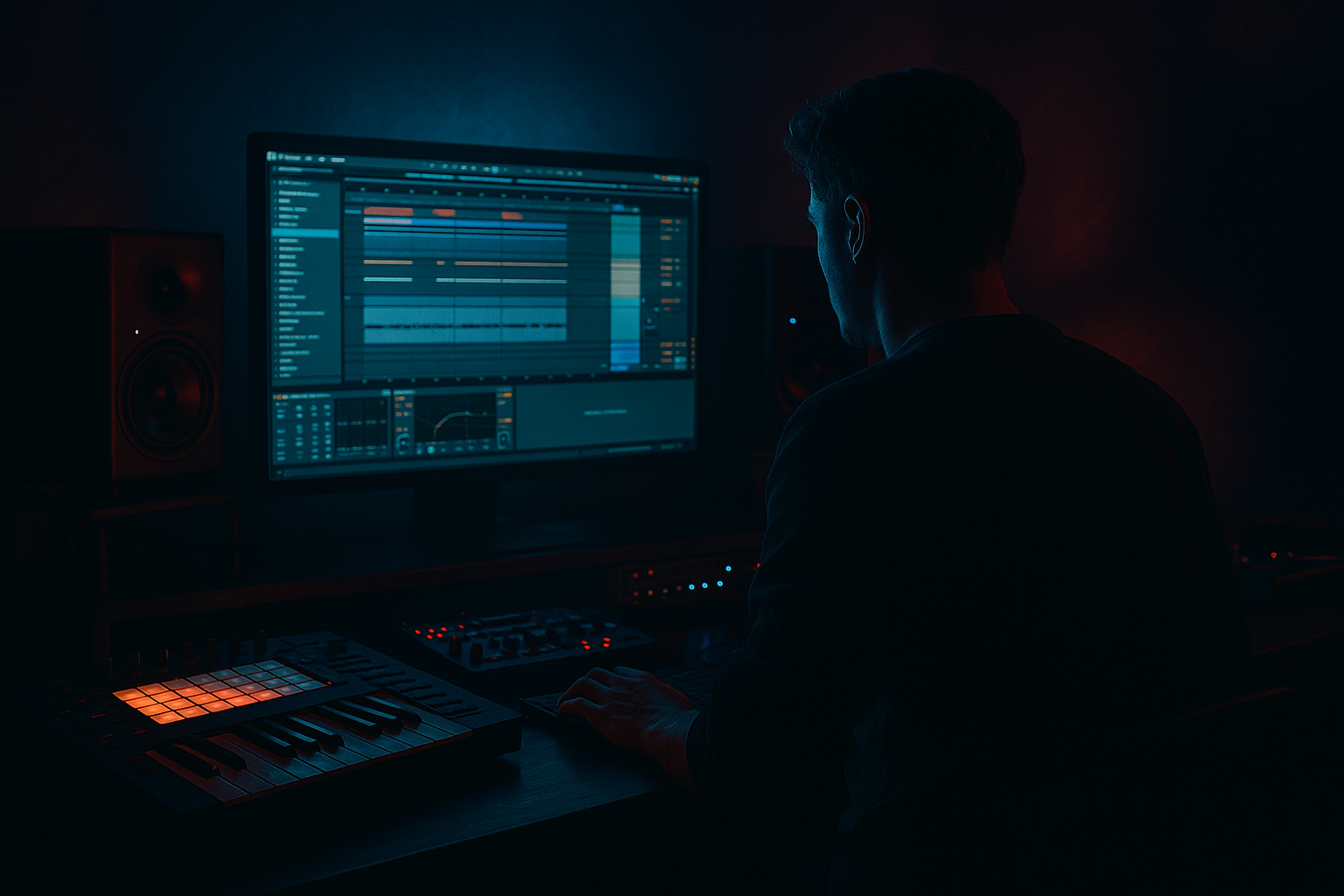
This lesson is about building a roller pad carve that sits behind a jungle / oldskool DnB breakbeat and keeps moving with very little CPU hit in Ableton Live 12. The goal is not a giant supersaw wall or a modern cinematic pad wash. It’s a tight, restless, filtered harmonic bed that supports the break, leaves space for the sub, and adds that smoked-out, late-night tension you hear in classic roller and jungle-inflected DnB.
In a proper DnB arrangement, this kind of pad usually lives in the midrange support lane: underneath the main break, around the bassline, and above the sub. It can carry atmosphere through an intro, help glue the drop, and create motion in a loop without demanding extra drum layers. In oldskool and jungle-influenced writing, a carved pad often does more than “pad” the mix — it defines the emotional identity of the tune.
Why this technique matters:
- It gives you continuous movement without adding extra drum programming.
- It keeps the low end clean by carving the pad around kick, snare, and sub.
- It works as a low-CPU alternative to stacked synths, heavy unison, or endless resampling.
- It supports breakbeat-driven phrasing, so your loop feels alive even when the drum edit is minimal.
- starts as a simple sustained chord texture,
- gets carved rhythmically around the break,
- uses filter, envelope, and resonant movement to breathe with the drums,
- avoids low-end conflict with a mono sub and kick,
- stays CPU-friendly by relying on one synth chain, one effect rack, and automation rather than heavy layering.
- a dark, hazy minor-key pad sitting behind a chopped break,
- subtle call-and-response with the snare and ghost notes,
- a pad that swells into transitions and drops back out for DJs,
- a texture that can sit under a 1/2-time halftime feel or fast 170–174 roller groove without clutter.
- Making the pad too wide in the low mids
- Using too much resonance on the filter
- Letting the pad fight the snare
- Over-sidechaining
- Stacking too many unison voices
- Ignoring arrangement
- Leaving muddy low mids untouched
- Use minor 2nd or 9th tension sparingly
- Print the pad through saturation at low drive
- Pair the pad with a filtered noise layer
- Automate a high-pass up in builds
- Use a short reverb send, not a huge insert
- Bounce alternate versions
- Make the pad answer the drums
- Start with a simple, CPU-light synth and shape the movement with filters and envelopes.
- Keep the pad mid-focused, dark, and carved around the breakbeat.
- Use Auto Filter, EQ Eight, Utility, and gentle sidechain as your core toolkit.
- Automate the carve across the arrangement so the pad supports phrasing, not just harmony.
- Freeze or resample when the idea works to keep your session lean.
- In DnB, the best pads don’t dominate — they push tension, clear space, and make the break feel deeper.
This is especially useful if you’re making rollers, dark jungle, atmospheric DnB, or stripped-back neuro-adjacent pressure and need a pad that feels expensive but runs light in Ableton Live 12 ⚡
What You Will Build
By the end, you’ll have a 16-bar roller pad loop built from stock Ableton devices that:
Musically, the result should feel like:
A good reference target: think of a muted chord cloud with rhythmic holes that leaves the break audible and still delivers that deep, submerged jungle atmosphere.
Step-by-Step Walkthrough
1. Start with a lean instrument chain
Create a new MIDI track and load Wavetable, Operator, or Analog. For minimal CPU, Operator is the most efficient choice, especially if you’re layering a pad under a busy break.
Build a simple sustained patch:
- Oscillator: sine or triangle-based foundation
- Add a second oscillator an octave above if needed
- Keep voices modest: 4–6 voice polyphony is plenty
- Use a slow amp envelope: attack around 40–120 ms, release around 600 ms to 2 s
If you want more harmonic grit, add a little filter drive or a second oscillator detuned by only 3–9 cents. Don’t go wide yet — this is a roller pad carve, not a trance stack.
Why this works in DnB: the pad must survive dense drums and bass without stealing attention. A simple source is easier to shape and easier to make rhythmically intentional.
2. Write a chord shape that supports the roller energy
Keep the harmony dark and sparse. Good starting zones:
- Minor 7
- Minor 9
- Sus2 / sus4 with a lower extension
- Two-note dyads if the arrangement is already dense
In a jungle or oldskool context, you do not need lush jazz voicings every time. Try a chord that moves between:
- root + minor third + fifth
- root + minor seventh
- root + ninth for tension
Example in A minor:
- A–C–E–G
- A–C–E–B
- G–B–D–F for a shifting pre-drop color
Keep voicings in the midrange, roughly around C2–C5 depending on how full the break is. If the break is already busy, use higher voicings and let the sub own the floor.
3. Turn the pad into a “carve” using Auto Filter
Drop Auto Filter after the synth. This is the core of the playbook.
Settings to try:
- Filter type: Low-pass 12 dB for smooth movement, or Low-pass 24 dB if the pad is too bright
- Cutoff: start around 180–500 Hz for a heavily muted intro, then open to 1.2–4 kHz in the drop
- Resonance: 5–20% for a subtle edge, 20–35% for a more haunted sweep
- Drive: light, around 2–6 dB, if you want grit without obvious distortion
Automate the cutoff so the pad “breathes” around the break. Don’t just open it linearly. Make the movement phrase-based:
- slightly darker on the first two bars,
- opening on bar 3,
- dipping before the snare fill,
- opening again into the next phrase.
If you want the pad to carve rhythmically with the drums, use a MIDI clip envelope or LFO-style automation by hand so the filter closes a touch on the snare or kick accents. That creates the illusion that the pad is reacting to the break.
4. Build rhythmic motion with Amp and Filter envelopes
For a roller feel, the pad should not just sustain — it should pulse. Use the synth’s envelopes to shape note behavior before you even touch the effects.
Practical starting points:
- Amp attack: 20–80 ms for a soft front edge
- Amp release: 400 ms–1.5 s
- Filter envelope amount: moderate, around 10–35%
- Filter decay: 300 ms–900 ms
This gives each chord a gentle inhale and exhale. If you’re using Operator, map envelope modulation to filter cutoff or oscillator level so the pad opens slightly at note onset and settles back. That creates the “carved” feel without extra processing.
In jungle and oldskool DnB, the break already carries enough attack. Your pad can be deliberately soft at the front so the snare and chopped hats remain the leading transients.
5. Carve space for the drum break with EQ Eight
Add EQ Eight after Auto Filter and make it behave like a supporting engineer, not a tone-shaper first.
Start with these moves:
- High-pass around 120–250 Hz depending on the sub and kick
- If the pad is muddy, dip 250–500 Hz by 2–4 dB
- If it masks snare body, carve a small notch around 180–220 Hz only if needed
- If it gets harsh after filter opening, gently tame 2.5–5 kHz
Use the spectrum view to watch where the break’s ghost notes and snare tone live. In DnB, a pad that sits too hard in the low mids can flatten the groove instantly.
Pro move: if the break has a strong mid-snare crack, side-step the pad with a narrow dip around that band rather than over-high-passing it. That preserves weight while clearing the snare lane.
6. Add movement with Chorus-Ensemble or Phaser-Flanger, but keep it restrained
To keep CPU low, use only one light modulation device. Chorus-Ensemble is usually the safest for width. Phaser-Flanger can be more characterful for darker rollers, but use it subtly.
Good starting settings for Chorus-Ensemble:
- Mode: subtle ensemble style
- Amount: 10–25%
- Rate: slow, around 0.10–0.35 Hz
- Width: moderate to wide, but not extreme
If you use Phaser-Flanger:
- Very low feedback
- Slow rate
- Mix around 5–15%
The aim is movement, not obvious wobble. The pad should feel like it’s drifting behind the break, not chewing through the mix.
Why this works in DnB: the breakbeat is already rhythmically rich. A tiny amount of harmonic motion makes the pad feel alive while the drums stay the main event.
7. Shape the stereo field carefully with Utility and a rack mindset
Add Utility near the end of the chain.
Key controls:
- Keep bass frequencies mono by avoiding wide low-end content in the pad source
- Use Width 100–140% if the pad needs space
- If the mix starts sounding cloudy, reduce width rather than adding more EQ cuts
If you want a more advanced workflow, place the pad inside an Audio Effect Rack with two chains:
- Chain 1: dry/center
- Chain 2: filtered/wide
Blend the chains subtly. The center chain helps the pad stay anchored behind the break, while the wide chain gives atmosphere. This is a very efficient way to create perceived size without resorting to heavy layering.
8. Use sidechain compression sparingly and musically
Add Compressor after the tonal shaping and use sidechain from the kick or main drum bus. You do not want the pad pumping like a house record unless that is the aesthetic. For jungle rollers, the movement should be tighter and more restrained.
Starting point:
- Ratio: 2:1 to 4:1
- Attack: 10–30 ms
- Release: 80–200 ms
- Gain reduction: around 1–3 dB, more only if the arrangement is dense
If the kick isn’t the main low-end driver, sidechain from the snare or full drum bus for a subtle duck that clears the groove on key hits. This can be especially useful when the break has strong syncopation and you want the pad to breathe with the loop rather than only the kick.
In advanced DnB writing, subtle sidechain is often better than aggressive pumping because the break already creates motion. You’re reinforcing the rhythm, not replacing it.
9. Automate the carve across arrangement sections
Now turn the loop into a track tool, not just a sound.
Use clip envelopes or automation lanes to shift:
- filter cutoff
- resonance
- effect mix
- Utility width
- reverb send amount
Arrangement suggestions:
- Intro (8–16 bars): pad heavily filtered, no sub, break teased in pieces
- Drop 1: open the pad slightly but keep it carved so the drums remain dominant
- Mid-phrase switch-up: narrow the pad or close the filter for 2 bars before the fill
- Breakdown: widen the pad and let the harmonics bloom briefly
- DJ-friendly outro: strip back to filter-muted pad fragments and drums
A strong musical example: in a 170 BPM tune, use a 16-bar section where the pad opens only on bars 5, 9, and 13, each time answering a snare fill or break chop. That creates phrasing tension without adding a new melodic line.
10. Freeze, flatten, and resample if the idea is working
Once the pad carve feels right, don’t keep stacking devices endlessly. To stay light on CPU:
- Freeze Track and audition the result
- If you need more editing flexibility, Flatten or resample to audio
- Then use Warp and simple clip fades if you want micro-chops
Resampling is especially effective in jungle workflows. A printed pad can be:
- reverse-faded into transitions,
- chopped into one-shots for fills,
- filtered differently in different arrangement sections,
- or layered under a second break edit without increasing synth load.
This is one of the most reliable ways to keep Ableton sessions lean while still sounding finished.
Common Mistakes
- Fix: keep width controlled, high-pass more aggressively, and center the harmonic body.
- Fix: resonance should support tension, not whistle over the break. Reduce it and automate the cutoff more musically.
- Fix: carve around snare body or move the pad register higher.
- Fix: the breakbeat already creates motion. Use subtle ducking, not EDM-style pumping.
- Fix: use fewer voices, simple oscillators, and smart automation instead of CPU-heavy thickness.
- Fix: a pad that sounds great in a loop can still fail in a track if it never changes. Automate openness by section.
- Fix: check 250–500 Hz early. That area can instantly blur oldskool break energy.
Pro Tips for Darker / Heavier DnB
- A held semitone cluster above the root can make the pad feel dangerous without turning it into horror-film mush.
- Try Saturator with Soft Clip on and Drive around 1–4 dB. This can add density while keeping the CPU low.
- A tiny amount of Analog noise or Operator noise can make the pad breathe in a smoky way, especially in intros.
- Raising the pad’s high-pass before a drop clears space and increases perceived impact when the full low end returns.
- Send to Reverb with short decay and darker tone. Keep it in a return track so the dry pad stays manageable.
- Print a “dark” version, a “wide” version, and a “muted” version. This is a fast way to build arrangement tension without resynthesizing.
- If the break has a busy ghost-note run, let the pad open on the gaps. That call-and-response feel is very authentic in jungle-influenced writing.
Mini Practice Exercise
Set a timer for 15 minutes and build one roller pad carve loop in Ableton Live 12.
1. Load Operator or Wavetable and make a simple minor chord.
2. Add Auto Filter, EQ Eight, Utility, and optionally Chorus-Ensemble.
3. Write an 8-bar MIDI clip with one chord held for 4 bars, then a second chord for 4 bars.
4. Automate filter cutoff so it opens slightly every 2 bars.
5. High-pass the pad and carve a small dip around the muddy low-mid zone.
6. Add subtle sidechain compression from the drum bus.
7. Loop a chopped breakbeat under it and check whether the pad supports the groove or clouds it.
8. Freeze the track if you like the result, then duplicate it and make one darker version and one wider version.
Goal: by the end of 15 minutes, you should have two usable pad variations that could sit in an intro or drop section of a jungle / oldskool DnB track.

