Show spoken script
Title: Riser timing for jungle drops from scratch using Arrangement View (Advanced)

Alright, let’s build a proper jungle riser system in Ableton Live using Arrangement View, and we’re doing it the way it actually works in real tunes: phrasing first, timing second, and sound design serving the drop, not the other way around.

Because in jungle and drum and bass, the drop doesn’t just happen. The drop is earned. And the difference between an okay build and a “how did that hit so hard?” build is usually not a magic sample. It’s bar-aware automation, a couple of intentional silence moments, and the discipline to not peak too early.

First, set your context.

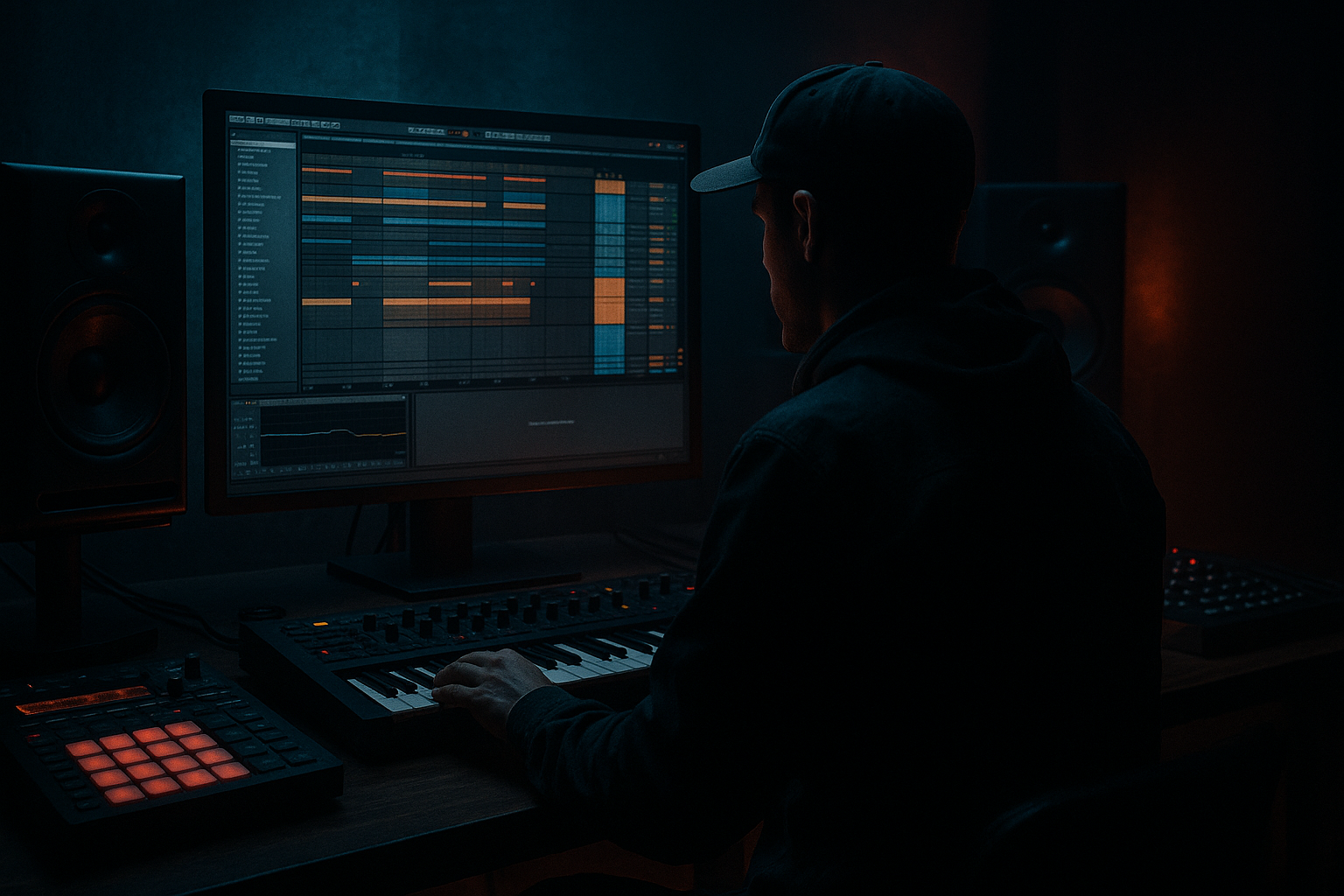
Open Arrangement View and set your tempo somewhere in that classic range: 165 to 174 BPM. Now, don’t start designing risers yet. Start by laying out the phrase.

A very standard jungle layout is 16 bars of intro, 16 bars of build, and then the drop. So for example, your drop might land at bar 33. Yours can be different, but pick a landing point and commit.

Now place locators. This is huge for advanced timing because it stops you drawing random curves that don’t respect the grid. Add locators for Build Start, 8 bars to Drop, 4 bars to Drop, 1 bar to Drop, and then DROP.

And here’s the mindset upgrade: think in events, not ramps. Your build is going to be four to seven distinct moments. A layer appears. The rhythm doubles. The stereo opens. The density spikes. Then a pullback. Then silence. Then impact. In Arrangement View, those are easy to see and easy to control.

Now let’s create the riser architecture.

Make three tracks. Name them Riser - Noise, Riser - Tone, and Riser - Break. Select all three and group them, Command or Control G, and name the group RISER BUS.

This is not just organization. This is power. It means you can hard-stop the entire riser on the downbeat and protect your drop transients in one move.

Now add two return tracks if you don’t already have them: one for a big reverb wash, and one for delay spice. Use Hybrid Reverb for the wash, Echo for delay. Don’t overthink the settings yet, because the important part is that we’ll automate what goes into these returns and how those tails behave right before the drop.

Layer one: the noise riser.

This is your “air” layer. Wide, exciting, but controlled. It should not be the thing that makes your track harsh at 10k.

You can do it fast with a white noise sample, stretched to 16 bars before the drop. Or do it clean with a synth.

If you go synth, put Wavetable on the Noise track. Choose a noise source, like white noise. Put a low-pass filter on it, a 24 dB slope is great. Add a bit of drive in the filter, just enough to make it speak.

Then build a simple chain: Wavetable, maybe Auto Filter for extra shaping, Saturator with soft clip on, Utility for width control, and EQ Eight to keep it sane.

Now automation in Arrangement View. And this is where the lesson really is.

Automate the filter cutoff so it starts dark, like 200 to 500 hertz, and rises up to around 10 to 14k. Automate Utility width so it starts fairly narrow, maybe 0 to 30 percent, and opens up wide near the end, 120 to 160 percent.

Automate saturation drive as well, but here’s the trick: don’t just draw one continuous rise from start to finish. Put corners on meaningful bar and beat points. For example: a steady rise through bar minus 8, a stronger push at bar minus 4, another push at bar minus 2, and then the real “oh no” moment in the final bar.

Now the advanced timing move: aim for 95 percent intensity at “1 bar to drop.” Not at the drop. One bar before. Then, in that final bar, you do something that feels almost wrong on paper: you dip slightly in the last beat, or even the last eighth note, to create a vacuum.

That tiny pullback is what makes the drop feel larger. Your ear measures impact by contrast, not absolute loudness.

Layer two: the tonal riser.

This is your keyed tension. If noise is air, tone is intention. It says, “We’re going somewhere.”

On Riser - Tone, load Operator or Wavetable. Keep it simple. Saw or square works. Or a sine that you distort into something mean if you’re going darker.

Make a MIDI clip for 16 bars leading into the drop, and hold a root note, like F or G, or a two-note drone if you want slight movement.

Now the chain: Operator, Auto Filter, a distortion stage like Roar if you have it or Pedal if you don’t, maybe Corpus if you want metallic tension, then EQ Eight, then Utility.

Teacher note here: keep the low end of this tonal riser under control. Either high-pass it, or at least mono the low region. The tonal riser is not your sub. Let the drop own the sub.

Now automate pitch. In Arrangement View, ramp Operator transpose up by 12 to 24 semitones over the 16 bars. And again, you can make this more musical by doing a pitch staircase instead of a smooth glide. For example, step it every two bars: zero, plus two, plus five, plus seven, and then the big jump to plus twelve near the end. That makes chapters. Your listener feels the story.

Then automate the filter. Slow movement early, faster movement in the last four bars. And right near the end, add subtle vibrato with an LFO mapped to pitch or filter frequency. Keep it small. This is tension, not wobble.

Now, the jungle urgency trick: rhythmic gating without writing extra notes.

Add Auto Pan, set phase to zero degrees so it becomes tremolo, set amount to 100 percent, and automate the rate. In the last two bars, push it from eighth notes toward sixteenths.

And if you want it to feel unsettled, go polyrhythmic for the last bar: set the tremolo rate to something like three-sixteenths or five-sixteenths. It creates that “something is slipping” feeling while still being locked to the grid.

Layer three: the break riser.

This is the genre identity layer. This is where it stops being “EDM build” and becomes jungle.

Grab a break: Amen, Think, Hot Pants, whatever fits. Place it on Riser - Break starting 16 bars before the drop.

Warp it, but avoid Complex Pro here because it smears transients. Use Beats mode. Tighten it with transients and envelope. You want that crisp break bite as you unmask it.

Now, the riser strategy is basically: reveal and accelerate.

From 16 to 8 bars before the drop, keep it filtered and quieter. Ghost energy. From 8 to 4, reveal more highs, add a touch of drive, maybe a little reverb send. From 4 to 1, bring it up, brighten, and start increasing slicing and retrigs. Then the last bar is where you do the jungle fill.

Device chain: Auto Filter in high-pass mode, Drum Buss for drive and transient shaping, Redux very subtly for grit, EQ Eight to control fizz, Utility for low-end mono control.

Automation targets: high-pass frequency starting around 80 to 150 hertz and rising up to maybe 1 to 3k by the end. Drive increasing, transient amount increasing, volume ramping, but again: don’t peak too early. If you’re at max intensity with four bars left, you’ve killed your own ending.

Now, the last bar fill, Arrangement View style.

Duplicate that last bar of the break and manually slice it. Command or Control E, chop it into eighth or sixteenth chunks. Rearrange into a chop-roll. Even a simple pattern can scream jungle if it’s clean and confident.

Optional spice: a tiny tape-stop style dip right at the end. You can automate clip transpose down a couple semitones in the final eighth note. Don’t overdo it. It’s a wink, not a gimmick.

Now we move into the thing that actually makes drops feel massive: pre-drop suck-out.

This is the “room inhales” moment. And you can do it two ways.

Option one: automate your drum and bass groups directly. In the last half bar, automate a quick high-pass on drums or music buses, push reverb sends up so you get a tail, and pull the volume down just a hair, like one to two dB. Then snap back at the drop.

Option two: create a dedicated Build FX return. Route selected elements into it, put a big dark hall reverb on it, high-pass the return around 200 to 400 hertz so you don’t get mud, and compress it to glue the wash. Then automate send levels upward into the drop.

Now the timing move that separates “pretty” from “deadly” in DnB:

Mute most build elements exactly on the last eighth note before the drop.

Not a whole beat. Not a whole bar. The last eighth. That tiny silence is insanely effective. It makes the downbeat feel like the track slams back into place.

And here’s a micro-timing variation if you’re going for darkside or techstep: let your tonal riser peak slightly early, like beat 4.2, and leave the last eighth emptier than you think it should be. Your ear stops tracking the riser right before impact, so the drop feels heavier.

Now protect the landing.

At the drop, you want no flabby sub, no reverb blanket over the first snare, and immediate transient clarity.

On the RISER BUS, put a limiter as safety. Ceiling at minus 0.3 dB. Do not crush it. It should barely touch peaks.

Then automate the RISER BUS volume to hard stop exactly at the drop. Not fade. Stop.

If your reverb or delay tails are still masking the downbeat, you’ve exceeded your tail budget. Fix it by automating return track volume down on the drop, or put a gate after the reverb with a fast release so it shuts quickly. Another very pro, very practical move: print your riser bus to audio and literally carve the last 100 to 250 milliseconds with clip gain and fades. Audio editing is often faster and cleaner than juggling 12 automation lanes.

Now let’s talk timing templates you can trust.

Classic 16-bar build: bars 16 to 9 are a slow rise, about 40 percent energy. Bars 8 to 5, faster rise, about 70 percent. Bars 4 to 2, aggressive, 90 percent. Final bar: fakeout dip plus stutter fill, so it feels like 95 down to 50 then back to 100. Then at the drop, hard mute risers.

8-bar reload build: bars 8 to 3, quick ramp and break unmask. Bars 2 to 1, stutter and silence. Drop hits instantly.

32-bar narrative build: first 16, tone establishes key and subtle noise. Next 8, break enters filtered with more movement. Final 8, full intensity, heavy automation, fills, and that final vacuum.

Now, quick list of the common mistakes to avoid while you’re working.

If the riser peaks too early, you have nowhere to go. If there’s no contrast at the drop, the drop will feel the same size as the build, even if it’s louder. If you go too wide in the low end, you’ll get phasey nonsense; wide noise is fine, wide low mids and sub is not. If reverb tails mask your first snare, the whole drop loses authority. And if you ignore bar lines, jungle will punish you. This music is phrased. Respect the landmarks.

Before we wrap, here’s a mini exercise you can do in like 20 minutes.

Set a locator so your drop is at bar 9. Build an 8-bar riser ending at bar 9. Use only stock devices.

Noise layer: Wavetable noise, filter sweep, width automation.
Tone layer: Operator, plus 12 semitone rise, tremolo in the last two bars.
Break layer: break loop filtered with drive, last bar chopped.

Then add a one-eighth-note silence right before the drop by muting the riser group and most build elements. Bounce a quick render and listen to one thing: does the first drop snare feel clean and louder than the build? Not on the meter. In your body.

Bonus: make two versions. One with the fakeout dip on the last beat, one without. Level-match them roughly and choose the one that makes the drop feel bigger.

Final recap to lock it in.

Great jungle and DnB risers are about timing, phrasing, and contrast. Build in layers: noise for space, tone for key and tension, break for identity. Automate like a narrative: slow, faster, chaos, silence, impact. And protect the downbeat: hard stop risers, manage tails, keep the low end clean.

If you tell me your tempo, exactly what bar your drop lands on, and whether you’re aiming for 96-style jungle, modern rollers, or techstep darkside, I can map you a precise locator plan with exact bar and beat automation breakpoints so your build tells a story and lands perfectly every time.