Main tutorial
Lesson Overview
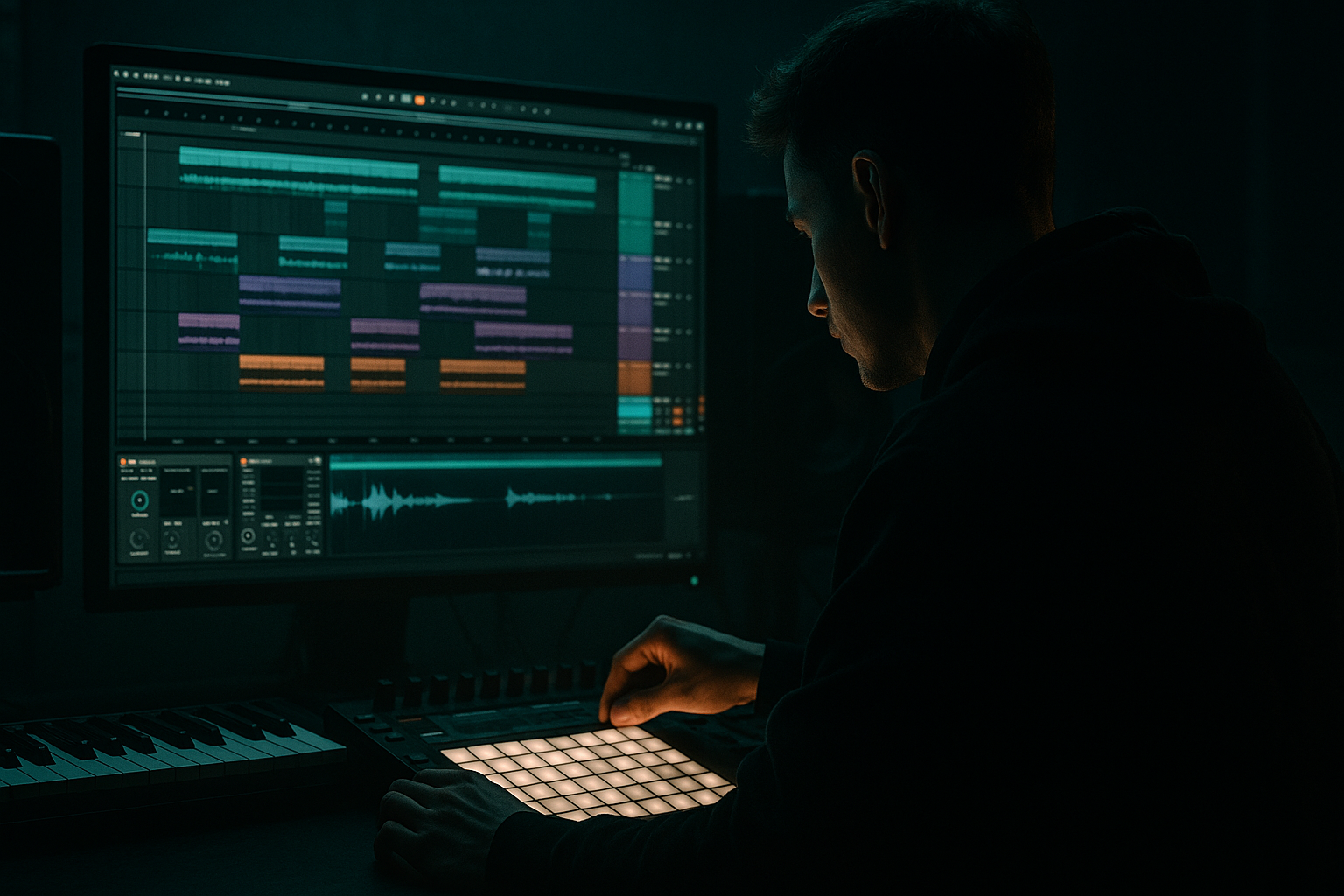
This lesson is about building a ride groove flip session in Ableton Live 12 and using Macro controls to make the groove move like a living part of the arrangement rather than a static loop. In jungle and oldskool DnB, rides are not just “top end decoration” — they can act like a second rhythm section, flipping energy between sections, lifting drops, and adding that ragga-tinted, sweaty dancefloor push.
For Ragga Elements specifically, this matters because the ride can sit on top of chopped breaks, vocal shouts, dubby delays, and skanking bass phrases to create that urgent, hands-in-the-air tension associated with jungle crews and early sound system pressure. The goal is not a polished trance-style build; it’s a dirty, musical groove switch that feels borrowed from old tapes, vinyl pressure, and live mix energy.
You’ll build a device rack that lets one ride loop morph between:
- dry and wide
- straight and swung
- bright and dark
- upfront and tucked back
- sparse and busy
- intro tension: filtered and distant ride pulses under vocal chops
- pre-drop lift: opening the ride brightness over 4 or 8 bars
- drop variation: flipping the groove to support a breakdown or turnaround
- oldskool jungle energy: quick, syncopated top-end motion that sits on chopped breaks
- darker roller sections: reduced stereo width, shorter tails, more focused rhythmic drive
- filter cutoff and resonance
- transient brightness
- delay amount and feedback
- groove timing / swing feel
- reverb size and decay
- saturation / edge
- stereo width
- output level
- Making the ride too loud
- Over-widening the top end
- Using too much reverb
- Ignoring the break interaction
- Letting saturation get harsh
- Automating everything at once
- High-pass the ride, but not too aggressively
- Layer a subtle noise tail
- Use call-and-response with the bass
- Make the flip happen before the drop, not on it
- Keep the center stable
- Resample your best moment
- Reference classic jungle transitions
- Build the ride as a performance-ready groove tool, not a static loop.
- Use Macro controls to shift tone, edge, groove, space, and throw.
- Keep the rhythm tied to the break and bass phrasing so it feels like real DnB arrangement language.
- Use Ableton stock devices like Simpler, EQ Eight, Saturator, Auto Filter, Echo, Reverb, and Utility to create movement.
- For jungle and ragga vibes, focus on call-and-response, tension/release, and short transitional effects.
- Save the rack and reuse it as a fast workflow weapon for rollers, oldskool jungle, and darker bass music.
That means you can perform the groove live, automate the energy across 8–16 bar sections, and quickly create drop variations, tension bars, and switch-ups without rewriting the part from scratch.
Why this technique matters in DnB: in fast music, tiny top-end changes create huge perceived movement. A ride groove flip gives you a controlled way to change momentum while keeping the low-end and break continuity solid. That’s gold in jungle, rollers, and darker bass music. 🔥
What You Will Build
By the end of this lesson, you’ll have a single Ableton Drum Rack / Audio Effect Rack for a ride loop that can morph through several groove states using macros. The final result is a ride that can flip from a loose offbeat skank into a tighter, brighter, more aggressive pattern, with optional ragga-style delay throws and tape-ish grit.
Musically, you’ll be able to use it for:
The rack will let you control things like:
You’ll also create a performance-ready macro setup so the ride can be “played” like an instrument instead of automated one parameter at a time.
Step-by-Step Walkthrough
1. Start with a clean, repeatable ride source
Create a new MIDI track and load a simple ride sample or short cymbal loop into a Simpler or Sampler device. For this lesson, a short, slightly trashy ride works better than a pristine EDM cymbal. Oldskool DnB rides often have a bit of wash and character.
Recommended starting point in Simpler:
- Mode: Classic
- Warp: Off for one-shots, or On if using a loop
- Start: trim so the transient is immediate
- Filter: On, but not too aggressive yet
- Amp Envelope: Attack 0 ms, Decay 250–500 ms, Sustain 0, Release 50–120 ms
Program a 1-bar or 2-bar ride pattern that supports a jungle rhythm rather than a straight house pulse. Try:
- offbeats on the “and”s
- a few syncopated anticipations before snare hits
- occasional doubled hits in the last beat of the bar
In a ragga-influenced tune, the ride should feel like it’s answering the vocal phrasing or pushing against the break, not just sitting above it.
2. Build the core groove with MIDI timing, not just sound design
Before adding effects, get the ride rhythm right. In the MIDI clip, vary note velocities so the groove breathes:
- main offbeats: velocity around 85–110
- ghost/extra hits: velocity around 45–70
- accent hits leading into transitions: 115–127
Use Ableton Groove Pool if your project already has a break groove you like. Drag a break swing or MPC-style groove onto the ride clip and keep the timing subtle:
- Timing: 10–25%
- Random: 0–5%
- Velocity: 5–15%
- Base: set so the feel remains locked to the drums
Why this works in DnB: jungle and rollers are all about micro-timing tension. A ride that is too quantized can sound flat and modern in the wrong way. A small amount of swing helps it glue to chopped breaks and makes the groove feel human without falling apart.
3. Group the ride chain and prepare your macro rack
Select the Simplersample track and group the key devices into an Audio Effect Rack or keep the instrument chain inside an Instrument Rack and then add effects after it. For this lesson, a practical setup is:
- Simplersample
- EQ Eight
- Saturator
- Auto Filter
- Echo
- Reverb
- Utility
Map these into one rack and expose 8 Macros. Rename them for speed:
- Macro 1: Tone
- Macro 2: Edge
- Macro 3: Groove
- Macro 4: Width
- Macro 5: Space
- Macro 6: Throw
- Macro 7: Dirt
- Macro 8: Level
Keep the rack organized with color coding and save it as a preset called something like Jungle Ride Flip Rack. That makes it reusable for future rollers, ragga breakdowns, and intro tools.
4. Map Macro 1: Tone with filtering for arrangement movement
Open Auto Filter or the Simplersample filter and map Tone to cutoff frequency. This is your biggest arrangement lever because ride brightness instantly changes perceived energy.
Good starting ranges:
- Low section / intro: cutoff around 2.5–4 kHz
- Mid section / groove: cutoff around 6–9 kHz
- Lifted section / drop topper: cutoff around 10–14 kHz
If using Auto Filter, choose:
- Filter type: HP12 or BP12 for thinner intro states
- Resonance: 5–20% depending on bite
- Envelope amount: low or off unless you want extra attack movement
Automate Tone over 4 or 8 bars so the ride opens gradually during a build, then snap it back down after a fill. That “open/close” motion is classic DnB arrangement language and works especially well before vocal cuts or dubwise breaks.
5. Map Macro 2: Edge with Saturator for aggressive top-end presence
Add Saturator after the filter. This is where the ride can go from polite to rude. Map Drive to Macro 2: Edge.
Suggested settings:
- Drive: 1 to 6 dB for subtle body
- Drive: 6 to 10 dB for more obvious grit
- Soft Clip: On
- Curve: default or slightly upward if you want extra density
The trick is to let the ride become more audible on small speakers without turning into harsh fizz. In jungle, a little saturation helps the ride cut through dense breaks and bass reese layers.
If you want more character, combine Saturator with Redux very lightly in parallel, but keep it restrained. A touch of bit reduction can create old tape weirdness, but too much turns the top end into sandpaper.
6. Map Macro 3: Groove with delay timing and rhythmic feel
Add Echo and map a few parameters to Macro 3: Groove. Use this to create rhythmic echoes that feel like dub influences but still stay tight enough for DnB.
Recommended Echo settings:
- Sync: On
- Time: 1/16, 1/8, or dotted 1/8 for variety
- Feedback: 10–35%
- Dry/Wet: 5–20% for subtle groove, up to 30% for transitions
- Filter: roll off lows around 300–500 Hz
- Modulation: light, just enough to thicken
For authentic jungle energy, automate this macro only in select moments:
- end of 4-bar phrases
- before a snare fill
- during vocal stabs or ragga callouts
- on the last bar before a drop
A quick one-bar delay throw on the ride can make the groove feel like it’s “answering” the rhythm section. That call-and-response energy is a big part of oldskool DnB and ragga jungle.
7. Map Macro 4 and 5: Width and Space for section contrast
Add Utility and Reverb to shape spatial position.
Macro 4: Width
- Map Utility Width
- Intro / breakdown: 130–150%
- Main drop: 80–110%
- Heavy sections: 60–90% if you want a more focused center
- Keep an eye on mono compatibility
Macro 5: Space
- Map Reverb Dry/Wet and Decay
- Short space: 5–12% wet, 0.4–0.8 s decay
- Bigger transitional space: 15–25% wet, 1.0–1.8 s decay
For darker DnB, don’t overdo the reverb. A ride that is too wet can blur your snare and break transients. Use Space mainly for sectional contrast — for example, a slightly washed intro ride that collapses into a dry, hard drop.
8. Map Macro 6: Throw for performance-style fills and switches
Use this macro to automate the most noticeable “flip” moments. Map a combination of:
- Echo Dry/Wet
- Echo Feedback
- Reverb Dry/Wet
- Filter resonance or cutoff bump
This macro should act like a momentary transition button:
- 0–20%: dry and controlled
- 20–50%: subtle movement
- 50–100%: obvious throw / wash / transitional burst
In practice, you can draw automation so Macro 6 rises over the final half of bar 4 in a phrase, then snaps back on the downbeat. That creates a classic DnB turnaround without needing extra MIDI notes.
Example musical context: in a 16-bar drop, use the throw on bars 7–8 to support a ragga vocal chop answer, then reduce it again when the bass phrase returns. This makes the arrangement feel conversational rather than looped.
9. Map Macro 7 and 8: Dirt and Level for mix discipline
Macro 7: Dirt
- Map Saturator Drive or a second distortion stage if needed
- Add a little EQ Eight high shelf if you want to tame excessive fizz after distortion
- Suggested range: 0–5 dB subtle, 5–8 dB for more raw jungle texture
Macro 8: Level
- Map Utility Gain
- Use it to keep the ride parked correctly against the break and bass
- Typical range: -6 dB to 0 dB depending on density
This macro setup is important because DnB mixes get crowded fast. You want fast control over how much the ride sits above the kit without constantly reaching for track faders. It also helps when switching between intro and drop states during arrangement edits.
10. Automate the flip across an arrangement, not just the loop
Now turn the ride rack into a section tool. Duplicate the clip and create 2–3 states:
- Intro version: darker Tone, more Space, reduced Level
- Drop version: brighter Tone, less Space, more Edge
- Transition version: increased Throw, slightly wider, more resonance
A useful arrangement approach:
- Bars 1–8: intro ride filtered and distant under atmospheres
- Bars 9–16: pre-drop build with Tone opening and Throw increasing
- Drop 1: tighter, brighter, less reverb
- Bars 17–24: variation with Groove and Dirt increased
- Breakdown: Space and Width push up again for atmosphere
This is where Ableton Live 12 workflow shines: you can quickly switch between clip duplication, automation lanes, and macro movement. Keep the ride part moving in 8-bar phrases so it feels like a proper DnB arrangement rather than endless loop playback.
Common Mistakes
- Fix: ride should support the break, not dominate it. Pull Level down before boosting any high end.
- Fix: keep Utility Width under control, and check mono. Wide rides can disappear or feel phasey in club systems.
- Fix: shorten decay and reduce wet amount. In fast DnB, space needs to be felt, not smeared.
- Fix: solo is helpful, but always check the ride with the main break. If the ride fights the snare or hats, reduce brightness or shift timing.
- Fix: use Soft Clip and watch the upper mids around 6–10 kHz. If it hurts, back off the drive or add EQ Eight to tame the edge.
- Fix: choose one or two main macros for each phrase. Too much motion kills impact.
Pro Tips for Darker / Heavier DnB
- Try a gentle HP around 250–500 Hz. You want to remove low grime while keeping some body if the sample has character.
- Resample the ride with Echo or Reverb, then print it and layer the tail very low under the main hit. This creates haunted movement without clutter.
- Let the ride open up in spaces where the bass phrase drops out. In darker DnB, the top-end groove often highlights bass phrasing more than it fills every gap.
- A half-bar or one-bar ramp into the drop often feels bigger than a sudden change on beat 1.
- If the rest of the mix is heavy and stereo-rich, keep the ride mostly focused so the low-end and snare remain dominant.
- Once you find a great groove flip, record it to audio and cut the best 1–2 bars into the arrangement. This is a classic finishing move in DnB because it locks the vibe and saves CPU.
- Think of oldskool records where hats, rides, and delay tails create pressure before the next break. The goal is not perfection — it’s momentum.
Mini Practice Exercise
Set a 15-minute timer and do this:
1. Load a short ride sample into Simpler.
2. Program a 2-bar pattern with at least 3 velocity variations.
3. Build a rack with these 5 devices only: EQ Eight, Saturator, Auto Filter, Echo, Utility.
4. Map 4 macros: Tone, Edge, Groove, Level.
5. Automate Tone from dark to bright over 8 bars.
6. Add a 1-bar Echo throw on the last bar before a drop.
7. Duplicate the clip and make one darker intro version and one brighter drop version.
8. Check mono compatibility and reduce Width if the ride feels phasey.
9. Bounce or resample the best version and drop it into your arrangement.
Goal: by the end, you should have a ride groove that can convincingly move between intro tension, ragga-flavoured transition, and drop support without rewriting the part.

