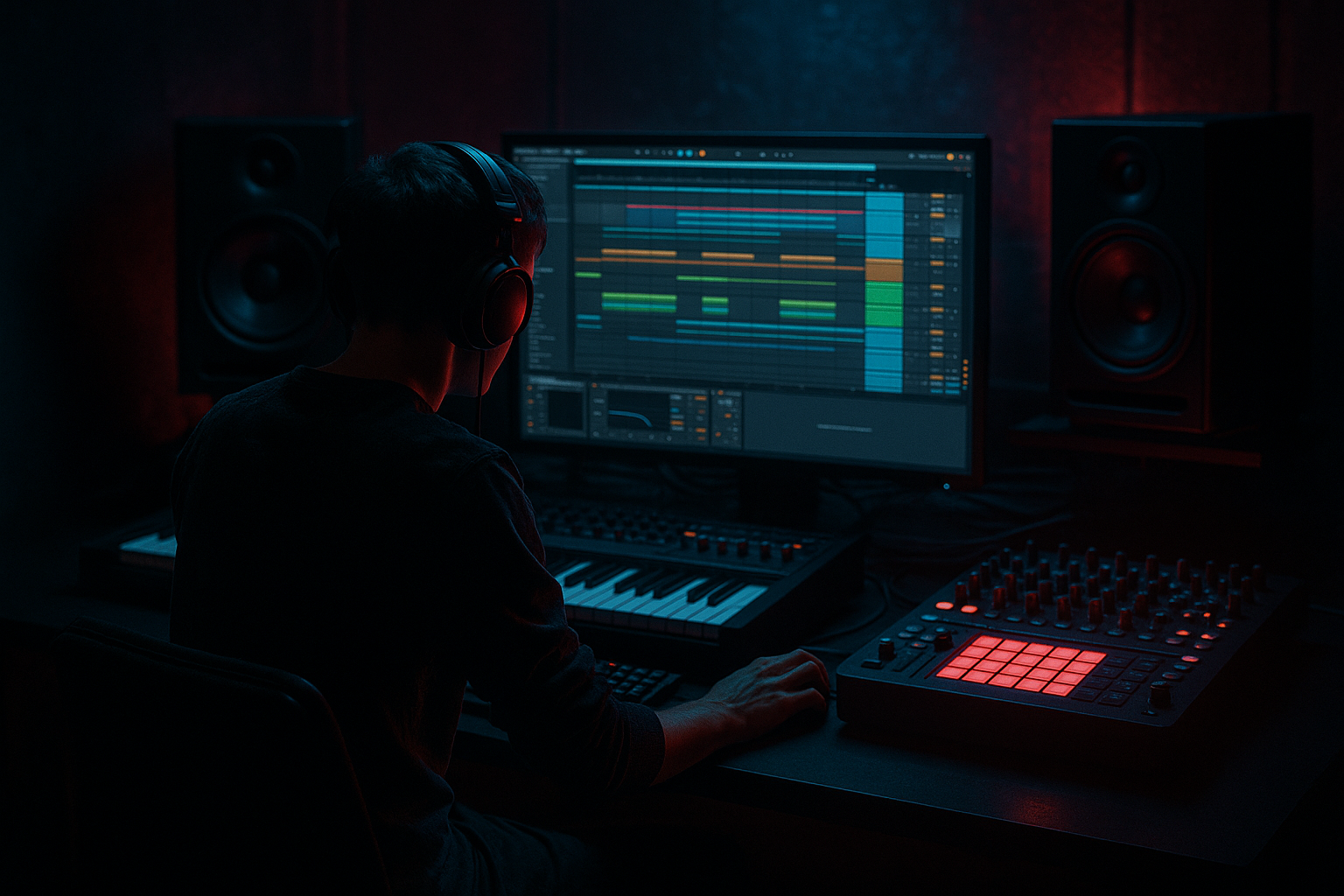
Main tutorial
Lesson Overview
A rewind moment is one of the most powerful tension tools in Drum & Bass and jungle. It’s that instant where the track feels like it’s being pulled backward before slamming forward again — perfect for a drop reset, a breakdown lift, or a DJ-style switch-up. In oldskool jungle and modern darker DnB, rewinds are often paired with gritty sample textures: chopped breaks, crunchy resampling, tape-like warble, and abrupt modulation that feels raw and physical.
In this lesson, you’ll build a rewind-style riser in Ableton Live 12 using stock devices only. The sound will have a crunchy sampler texture, oldskool flavor, and enough movement to work in a jungle intro, a pre-drop tension bar, or a mid-track reload moment. This matters because DnB thrives on contrast: clean sub vs. dirty texture, tight drums vs. smeared transition, forward momentum vs. sudden pullback. A strong rewind riser can make your drop feel bigger without needing a giant synth lead. 🎛️
Why this works in DnB: the rewind gesture creates a psychological “reset,” and the gritty sampler processing gives it that pirate radio / cassette / chopped break character that fits jungle and rollers. You’re not just making a riser — you’re making a transition that sounds like it belongs in a DnB set.
What You Will Build
By the end, you’ll have a short rewind moment modulate riser made from a sampled drum hit or break fragment, with:
- a reverse-like pullback feel
- crunchy sampler texture
- filter movement
- pitch wobble / modulation
- glitchy time-smear
- enough grit to sit in an oldskool jungle or darker roller arrangement
- a version that can be used as a 1-bar or 2-bar riser into a drop
- Using too much low end in the riser
- Making the rewind too long
- Overusing distortion until the sample turns to noise
- No clear automation arc
- Riser is too bright and clashes with hats or cymbals
- No arrangement space before the drop
- Use a break fragment instead of a clean synth sample
- Layer a very quiet vinyl crackle or room noise under the riser
- Try a parallel heavy chain
- Add a tiny reverb tail, then cut it hard
- Use call-and-response with the drums
- Keep the main character in the mids
- Make it DJ-friendly
- A rewind moment is a powerful DnB transition tool for drops, reloads, and switch-ups.
- Start with a short sampled hit or break fragment in Simpler.
- Build the texture with Saturator, Drum Buss, and optional Redux.
- Use Auto Filter and simple automation to create movement.
- Keep the riser midrange-focused and high-pass the low end.
- Resample it for a more authentic crunchy sampler texture.
- Place it in a clear 1–2 bar arrangement window before the drop for maximum impact.
Musically, it should sound like a sample being sucked backward through tape, then blooming into a noisy lift before the drop lands. Think of it as a transition between an 8-bar buildup and the drop, or a “reload” moment after a breakdown. You’ll keep it beginner-friendly, but the result will still feel authentic and usable in a real DnB arrangement.
Step-by-Step Walkthrough
1. Choose a source with character
Start with an audio clip that already has texture. Best beginner options in Ableton Live:
- a breakbeat slice
- a snare hit
- a rimshot
- a short vocal stab
- a chopped Amen-style fragment if you have one
For this lesson, pick a short sound with some midrange bite. A snare from a break works great because it feels very jungle when reversed or modulated.
In the Clip View, trim the sample so you’re only using a short section — around 100 ms to 500 ms depending on the source. You want something that has a clear transient or texture, not a long pad.
If you’re using a break fragment, try a snare or ghost note rather than a full loop. That keeps the rewind moment focused and punchy.
2. Load the sample into Simpler
Drag the sample into a new MIDI track and let Ableton create a Simpler device automatically. Simpler is ideal here because it’s fast, clean, and easy for beginner workflow.
Set Simpler to:
- Mode: Classic
- Trigger: One-Shot
- Warp: Off for now if the sample is short and percussive
Why this matters: you’re building a transition sound, not a loop instrument. One-shot playback keeps it direct and reliable.
If the sample feels too long, shorten the start/end in Simpler until only the useful texture remains. For a rewind riser, shorter is often better because the modulation will do the movement for you.
3. Create the rewind feel with reverse-style movement
The simplest beginner method is to freeze the source into a reversed-sounding gesture using clip editing and envelopes rather than complicated editing.
Try one of these approaches:
- In the audio clip, right-click and Reverse the sample
- Or, if you want more control, duplicate the clip and manually place it just before the drop so it feels like a pulled-back stab
- In Simpler, use the sample start position and filter movement to mimic a rewind if full reverse feels too obvious
A good rewind moment often works best when it is very short:
- 1/4 bar for a subtle refresh
- 1 bar for a clear pre-drop tension moment
- 2 bars if you want a dramatic reload or MC-style callout space
For oldskool jungle energy, the rewind should feel like a quick “pull and slam,” not a long cinematic rise.
4. Add Crunch with Ableton’s stock distortion chain
The crunchy texture is where this becomes DnB-ready. Place these devices after Simpler:
- Saturator
- Drum Buss
- optional Redux if you want extra lo-fi edge
Start with Saturator:
- Drive: +3 to +8 dB
- Soft Clip: On
- Output: reduce to keep the level balanced
Then add Drum Buss:
- Drive: 5–15%
- Crunch: 10–25%
- Boom: keep low or off for this sound
- Transients: slightly positive if you want more bite
If you want extra crunchy sampler texture, add Redux very lightly:
- Downsample: just enough to hear aliasing, not destroy the sample
- Bit Reduction: subtle, around 12–16 bits equivalent feel
The goal is not to obliterate the sound. You want the grain to remind the listener of vintage jungle sampling and old hardware resampling.
5. Shape the modulation with Auto Filter
Add Auto Filter after the distortion chain. This is where the rewind moment starts to “move.”
Use:
- Low-Pass filter
- Resonance: 15–35%
- Drive: small amount if needed
- LFO: optional, but keep it subtle for beginners
Automate the Cutoff over the length of the riser:
- Start fairly closed: around 200 Hz to 800 Hz
- Open toward the drop: around 2 kHz to 8 kHz
For a darker DnB sound, don’t fully open the filter unless you want a big shine. Often the best tension is when the top end opens just enough to tease the drop.
Why this works in DnB: filter movement creates tension without needing a melody. In jungle and rollers, the ear is already focused on groove and impact, so a rising filter sweep on a gritty sample feels immediate and musical.
6. Add pitch and warble with Simple Delay or Frequency Shifter
For a rewind moment, pitch motion helps create the sensation of things being pulled backward. You can do this cleanly with stock devices.
Option A: Clip Transpose Automation
- Automate the clip transpose down slightly at the start and back up near the drop
- Use a small range like -2 to -5 semitones
Option B: Frequency Shifter
- Use Fine mode
- Set Shift very subtly, around +5 to +20 Hz or slightly negative
- Automate the dry/wet if needed
Option C: Simple Delay for smeared movement
- Time: very short, sync off if necessary
- Feedback: low, around 10–20%
- Dry/Wet: 5–15%
If this is your first time, keep it simple: transpose automation plus filter sweep is enough. Add Frequency Shifter only if you want a more unstable, tape-like character.
7. Bounce to audio and resample for a real sampler texture
This is a classic DnB workflow. Once your rough rewind sound is working, resample it so you can edit it like an audio transition.
In Ableton:
- Solo the track
- Create a new audio track
- Set Audio From to Resampling
- Record the processed riser into audio
Then you can:
- cut the tail tighter
- reverse the audio again for more swirl
- fade the end
- add tiny gap edits for stutter energy
This step is especially useful in jungle and oldskool workflows because resampling makes the sound feel like it came from a sampler or hardware box, not a pristine synth patch.
8. Add a short stutter or repeat before the drop
To make the rewind moment more DJ-friendly, add a tiny repeat before the drop.
Easy beginner method:
- Duplicate the last 1/8 note or 1/16 note of the riser
- Repeat it 2–4 times
- Lower the volume slightly on each repeat
Or use Beat Repeat very lightly:
- Grid: 1/8 or 1/16
- Interval: low or manual
- Chance: 10–25%
- Mix: keep subtle
The point is to create a moment where the energy briefly hiccups, like a rewind being caught in the sampler. That tiny hesitation gives the drop more impact.
For an oldskool jungle vibe, you can also place a single snare flam or ghost hit right before the drop to mimic classic break editing.
9. Automate a tension ramp in the arrangement
Place the riser in the last 1 or 2 bars before your drop.
A strong beginner arrangement example:
- Bars 1–8: full drum groove and bassline
- Bars 9–12: breakdown or reduced drums
- Bars 13–14: rewind moment riser begins
- Bar 15: tiny gap or drum stop
- Bar 16: drop returns hard
In that riser section, automate:
- Filter cutoff up
- Reverb send up slightly near the end
- Volume up by a small amount, then cut sharply before the drop
- Optional Stereo Width effect only on the top layer if needed
A clean arrangement trick: leave one beat of silence or near-silence before the drop. In DnB, that short vacuum makes the kick and sub feel much heavier when they return.
10. Check the low end and keep the riser out of the way
Risers can easily mess with your drum/bass balance if they contain too much low frequency.
Add EQ Eight at the end of the chain:
- High-pass around 150 Hz to 300 Hz
- If needed, cut a little around 2.5 kHz to 5 kHz if the sample is harsh
- If the sound is too thin, don’t add low end back — just use more midrange crunch
This keeps your sub and kick clean. In DnB, the riser should support the drop, not fight the bassline.
Also do a quick mono check if your riser has stereo effects. The core impact should still read in mono, especially in club playback.
Common Mistakes
Fix: high-pass with EQ Eight so the sub area stays for the kick and bass.
Fix: shorten it. In DnB, tension often works better when it’s fast and precise.
Fix: keep Saturator and Drum Buss controlled. You want crunchy texture, not a washed-out blur.
Fix: make sure at least one main parameter moves over time, usually filter cutoff or volume.
Fix: tame 3–8 kHz with EQ Eight or reduce the filter opening.
Fix: leave a short gap or drum stop so the rewind actually reads as a transition.
Pro Tips for Darker / Heavier DnB
This instantly gives the rewind moment more jungle DNA.
Keep it subtle and band-pass it. This adds “old tape” atmosphere without clutter.
- Duplicate the track
- On the duplicate, add heavier Saturator/Redux
- Blend it quietly underneath the main riser for grit without losing clarity
Use Reverb with short decay and low mix, then automate a hard stop before the drop. That sudden cut makes the drop feel more violent.
Let the rewind riser answer the last drum fill. For example, a snare roll ends, then the rewind moment takes over for one bar.
Darker DnB transitions often hit hardest when the important texture sits in the midrange, leaving room for the sub to dominate the drop.
If you’re building for mixable arrangements, use the rewind moment as a clean phrase marker at the end of 16 or 32 bars. That makes the track easier to blend in a set.
Mini Practice Exercise
Spend 10–20 minutes making three rewind riser versions from the same sample.
1. Pick one snare or break fragment.
2. Build a first version with just:
- Simpler
- Auto Filter
- Saturator
3. Make a second version with:
- Drum Buss
- Redux lightly
- higher filter resonance
4. Make a third version by resampling the second version and chopping the tail shorter.
5. Place each version before a fake drop point in your arrangement.
6. Compare which one feels most like:
- oldskool jungle
- darker roller
- more aggressive neuro-influenced tension
Aim to finish with one version that you could actually use in a real track.
Recap
If you keep it short, gritty, and controlled, this rewind riser will sit perfectly in jungle oldskool DnB vibes and give your drop that proper reload energy.

