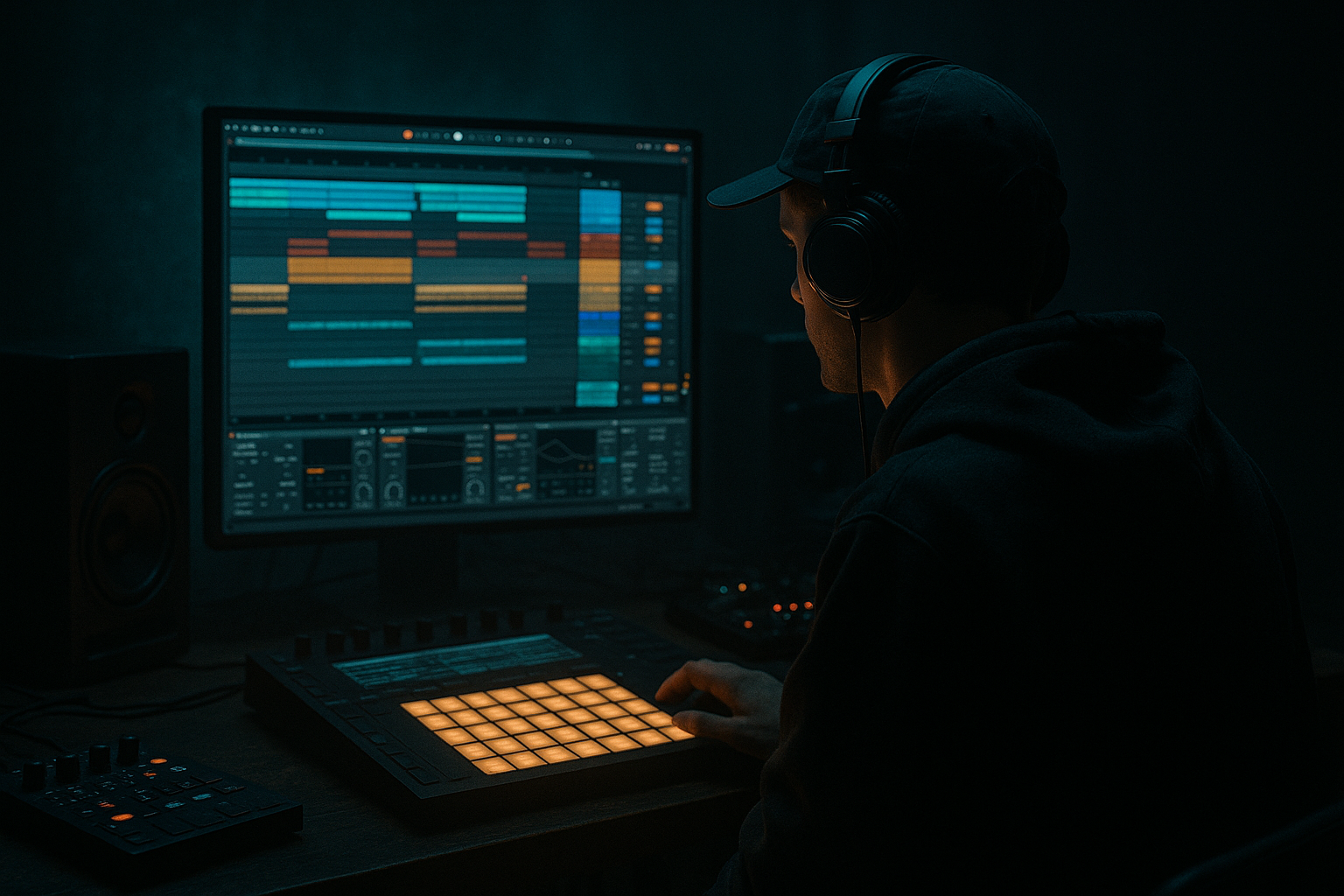
Main tutorial
Lesson Overview
Retro rave jungle atmosphere is all about making a DnB track feel like it was beamed in from a sweaty 90s warehouse, but still hitting with modern arrangement discipline. In Ableton Live 12, that means combining chopped break energy, rave-stab nostalgia, eerie textures, and tightly controlled bass movement so the track has both character and impact.
This lesson focuses on arrangement, not just sound design. You’ll learn how to build a full track arc in a way that feels authentic to jungle, rollers, and darker bass music: tension in the intro, clear DJ-friendly phrasing, a drop that feels earned, and switch-ups that keep the listener locked without losing momentum. The goal is not to overload the project with ideas — it’s to place the right ideas in the right bars.
Why this matters in DnB: because the genre lives and dies on momentum. A great kick/snare and a heavy bassline are important, but the arrangement is what makes the track feel like a journey. Retro rave jungle especially needs contrast: clean intro vs. chaotic drop, spacious breakdown vs. clipped drum pressure, nostalgia vs. menace. If the arrangement is weak, the vibe collapses. If it’s tight, even simple material can sound massive.
---
What You Will Build
By the end of this lesson, you’ll have a full arrangement blueprint for a retro rave jungle/DnB tune in Ableton Live 12 with:
- a DJ-friendly intro built from filtered breaks, atmospheres, and tease elements
- a drop with chopped jungle drums, a reese/sub bass combination, and rave stab call-and-response
- automation-driven tension, including filter sweeps, reverb throws, and delay cutoffs
- a mid-track switch-up that refreshes the groove without killing the dancefloor
- a second drop variation with heavier drums, extra fills, and more aggressive bass movement
- a clean outro for mixdowns or DJ use
- Bars 1–16: intro
- Bars 17–32: tension build
- Bars 33–48: first drop
- Bars 49–64: variation / breakdown
- Bars 65–80: second drop
- Bars 81–96: outro
- Drag a break into Simpler and switch to Slice mode
- Trigger slices from MIDI to create a new chopped pattern
- Layer a solid kick and snare underneath if needed, but keep the break audible
- Simpler slice envelope: short and tight, around 5–20 ms if you want crisp transients
- EQ Eight on the break bus: high-pass around 25–35 Hz to clear sub rumble
- Saturator after the break: drive around 2–5 dB for grit
- Glue Compressor on the drum bus: slowish attack, medium release, 1–2 dB gain reduction
- sub bass: clean, mono, stable
- mid bass / reese: movement, bite, and stereo character if needed
- Use Operator or Wavetable with a sine-like waveform
- Keep it mono
- Low-pass if necessary so only the fundamental lives here
- Aim for notes that support the groove without overplaying
- Use Wavetable, Analog, or a resampled synth
- Detune slightly and modulate filter movement for agitation
- Add Saturator, then EQ Eight, then possibly Redux very lightly for digital edge
- Wavetable filter cutoff: around 150–600 Hz for a dark reese starting point
- Auto Filter LFO amount: subtle, around 5–15%
- Saturator drive: 3–8 dB depending on how aggressive you want it
- Utility on bass bus: bass mono below 120 Hz if you need discipline
- Simpler for sampled rave stabs
- Wavetable or Analog for synthetic chord stabs
- Corpus on a stab for resonant metallic character
- Reverb and Echo for space, but automate them carefully
- one dry and punchy
- one washed and delayed for transitions
- one filtered or pitch-shifted for tension
- Intro: tease one stab every 4 or 8 bars
- Build: increase stab frequency and open the filter
- Drop: use stabs on offbeats or at the end of 2-bar phrases
- Second drop: alternate between full stabs and chopped fragments
- Auto Filter on stabs: start with a low-pass around 300–800 Hz in the intro, then sweep open
- Echo time: sync to 1/8 or 1/4 dotted for classic rave tails
- Reverb decay: 2.5–5 seconds for atmosphere, but automate return level so it doesn’t blur the drop
- a filtered drum loop
- vinyl noise or room texture if it suits the track
- a distant stab motif
- a bass hint that never fully arrives
- First 8 bars: atmosphere + filtered break fragments only
- Bars 9–16: introduce a snare pattern or top loop, but keep the low end restrained
- Bars 13–16: tease the drop bass rhythm with muted notes or filtered resampling
- Filter cutoff opening slowly across 16 bars
- Reverb send increasing on the stab teaser
- Small delay throws at the ends of 4-bar phrases
- Bar 1: statement
- Bar 2: response
- Bar 3: variation
- Bar 4: fill or turnaround
- chopped break driving the top end
- sub bass hitting on the low-end anchors
- reese bass answering the snare
- stab hits on the offbeat or end of phrase
- open the bass filter over the first 8 bars of the drop
- add brief delay throws to the stab at the end of every 4th bar
- automate drum bus saturation slightly upward in the last 2 bars for lift
- half-time-feeling atmospheric breakdown with break fragments
- filtered rave chord pad
- bass redesign with different rhythm
- drum edit that strips back to rimshots, toms, or break ghosts
- Reverse on sampled elements
- Echo with feedback automation
- Reverb freeze-style ambience using long decay and resampled tails
- Resampling into a new audio track to create a broken, atmospheric texture
- add extra drum fills every 8 bars
- use a more distorted reese layer
- increase bass syncopation
- bring in a second stab tone or harmonic layer
- introduce brief dropouts for impact
- Duplicate the first drop section
- Remove one element for 2 bars, then reintroduce it with a new automation curve
- Change the snare fill at the end of bar 8
- Add a different bass answer phrase for the last 4 bars
- strip the bass out gradually
- keep drums and tops rolling
- reduce stab frequency
- filter the mix down over 16 bars
- automate a low-pass on the music bus from fully open to around 200–500 Hz over the outro
- thin the break with EQ Eight or Auto Filter
- leave a clean drum loop for the last 8 bars
- Making the intro too full too early
- Overusing rave stabs until they lose impact
- Letting the bass fight the break
- Arranging only in 8-bar loops
- No variation in the second drop
- Too much reverb in the drop
- Ignoring DJ usability
- Resample your bass movement in Live: record a bass patch with automation, then chop the audio and reverse tiny sections for menace.
- Use parallel distortion on drums with Saturator or Drum Buss, but blend it in softly so the transient stays clean.
- Push atmosphere through a return track with long Reverb and Echo, then automate send amounts only on transitions.
- Add micro-dropouts before key snare hits. A one-beat silence can hit harder than more layers.
- Keep the sub ultra-stable while the mid-bass goes wild. That contrast makes the track feel bigger and cleaner.
- Try Drum Buss on the break bus with Drive around 5–15%, Crunch low to moderate, and Boom used carefully or not at all depending on how much low-end is already present.
- For darker character, limit bright harmonics on stabs and pads. A slightly filtered, mid-focused rave tone often feels heavier than an ultra-bright one.
- Use Mono to check bass discipline. If the drop disappears in mono, the low-end design needs simplifying.
- Automate tension into phrase endings with filter sweeps, reverb throws, and short delay tails, then cut them hard on the downbeat.
- one chopped break
- one sub bass
- one reese or mid-bass
- one rave stab
- one atmosphere texture
- one transition FX
- Build the track as a clear arrangement arc, not just a loop.
- Use break edits, sub + reese separation, and rave stabs to define the retro jungle vibe.
- Keep the intro and outro DJ-friendly.
- Make the drop evolve by phrasing and variation, not just loudness.
- Use Ableton stock devices like Simpler, Wavetable, Operator, Auto Filter, Echo, Reverb, Saturator, Drum Buss, and EQ Eight to shape movement and atmosphere.
- In DnB, contrast is everything: space vs. density, clean sub vs. dirty mids, nostalgia vs. menace.
Musically, think:
Intro → tension build → first drop (rave-jungle hybrid) → breakdown with atmosphere → second drop with variations → outro
The result should feel like a track that could sit somewhere between classic jungle energy and a modern dark roller, with a retro rave layer on top.
---
Step-by-Step Walkthrough
1. Build the arrangement skeleton first, not the full sound design
Open a fresh Ableton Live 12 set and create a simple marker structure in Arrangement View before you get deep into sounds. This saves you from “loop jail” and forces the track to behave like a record.
Use a rough structure like this for a 3:30–5:00 DnB track:
For a jungle / retro rave track, 16-bar phrasing is your friend. DnB arrangements often work best when the listener gets a clear change every 8 or 16 bars, even if the drums stay rolling.
Create locators in Live 12 so you can jump between sections fast. This is a workflow win: you can write one section at a time, then duplicate and mutate it.
Why this works in DnB: the groove is fast, so the arrangement must give the listener landmarks. If every 4 bars feels identical, the energy can flatten even when the drums are busy.
2. Lay down the drum identity using break edits and supporting drums
Start with a core break in Simpler or Drum Rack. A classic breakbeat chopped into slices gives you the jungle DNA, while a separate kick/snare layer can reinforce impact.
Suggested stock workflow:
Useful starting settings:
Add ghost notes and tiny edits around the snare hits. In jungle, the groove often comes from the spaces between the hits as much as the hits themselves. Copy a few slices, nudge them earlier or later by a few milliseconds, and use velocity changes to keep the pattern human.
Arrangement move: keep the intro version of the break more filtered and sparse, then open up the full break on the drop. A simple variation in density can feel huge.
3. Design the bass as two roles: sub foundation and moving character
For retro rave jungle, don’t try to make one bass patch do everything. Split it into:
Sub bass:
Mid bass / reese:
Concrete parameter ideas:
Write the bass in call-and-response with the drums. In jungle, the bass doesn’t just “sit under” the drums — it answers them. Leave holes after snare accents, then let bass phrases return with attitude. If your drums are chopping hard, the bass can be simpler than you think.
4. Add rave stabs and nostalgic hooks, but arrange them like punctuation
Retro rave atmosphere comes from stab hits, chord smears, organ-ish stabs, or sampled one-shots. Use them sparingly and treat them like punctuation marks, not constant wallpaper.
Good Ableton stock options:
Make 2–3 stab variations:
Arrangement idea:
Concrete settings:
This is where the retro rave flavor becomes obvious. The stabs should feel iconic, but the arrangement should keep them moving so they don’t become cheesy or repetitive.
5. Shape the intro like a DJ tool, not a full-drop teaser
A strong DnB intro should work for mixing and still create intrigue. Start with atmosphere, a filtered break, and a few strategic hints of the hook.
Use:
Practical arrangement choices:
Use automation to keep it alive:
If the intro feels too empty, add motion instead of more layers. A moving Auto Pan on a texture, a subtle pitch drift, or a short reverse cymbal can give life without clutter.
6. Build the drop around phrase logic, not constant maximum density
Your first drop should establish the main identity clearly. In DnB, especially jungle and rollers, the drop works best when the listener can latch onto a repeating groove with controlled variation.
Use a 2-bar or 4-bar loop as the core, then mutate it:
A strong retro rave jungle drop might combine:
Automation moves:
Keep the drop balanced. If the drums are too busy and the bass is too wide, the mix loses punch. If the bass is too static, the energy drops. Aim for tension between movement and clarity.
7. Insert a breakdown or switch-up that changes the emotional temperature
After the first drop, don’t just repeat. Give the track a switch-up that changes the emotional center while keeping the genre language intact.
Good options:
In Ableton, this is a great place to use:
Musical context example: after a full-energy 16-bar jungle drop, pull everything back to just a filtered break, a distant minor-key rave stab, and a sub pulse that only appears every two bars. That contrast makes the second drop feel massive when it arrives.
This section is where you earn the next peak. If it’s too long, the track loses momentum. If it’s too short, the second drop won’t feel different enough.
8. Make the second drop heavier by changing detail, not just volume
Your second drop should feel like the track has evolved. Don’t simply copy the first drop louder.
Try one or more of these:
A practical variation method:
This is where arrangement becomes storytelling. The second drop should feel like the same world, but more dangerous.
9. Finish with a clean outro that DJ mixes can actually use
A lot of DnB tracks fall apart at the end because the producer gets lazy. In a good retro rave jungle tune, the outro should remain functional for DJs while slowly deconstructing the main idea.
Do this:
Useful moves:
This keeps the track mixable and professional. Even if the tune is for standalone listening, a DJ-friendly outro gives it credibility.
---
Common Mistakes
Fix: delay the full bass and full break until the drop. Tease, don’t reveal everything.
Fix: treat stabs like accents. Use fewer, more intentional hits.
Fix: carve space with EQ Eight and keep sub in mono. The drums need room to breathe.
Fix: think in 16-bar paragraphs, with smaller 2-bar and 4-bar events inside them.
Fix: change rhythm, texture, or drum density — not just level.
Fix: automate wet levels down when the drums and bass need impact.
Fix: make sure your intro and outro can function as mix-in and mix-out sections.
---
Pro Tips for Darker / Heavier DnB
Why this works in DnB: heavy tracks need contrast more than constant density. The ear perceives weight when the arrangement gives space around the punch, and danger when elements appear and disappear with intent.
---
Mini Practice Exercise
Set a 15-minute timer and build a rough 64-bar arrangement skeleton in Ableton Live 12 using only these elements:
Rules:
1. Use only 16-bar sections.
2. Make the intro DJ-friendly.
3. Add at least two automation moves per section.
4. Create one switch-up that changes the drum or bass rhythm.
5. Keep the second drop different from the first.
Goal: by the end, you should be able to listen through the arrangement and clearly hear the journey, even if the sounds are still rough.
---

