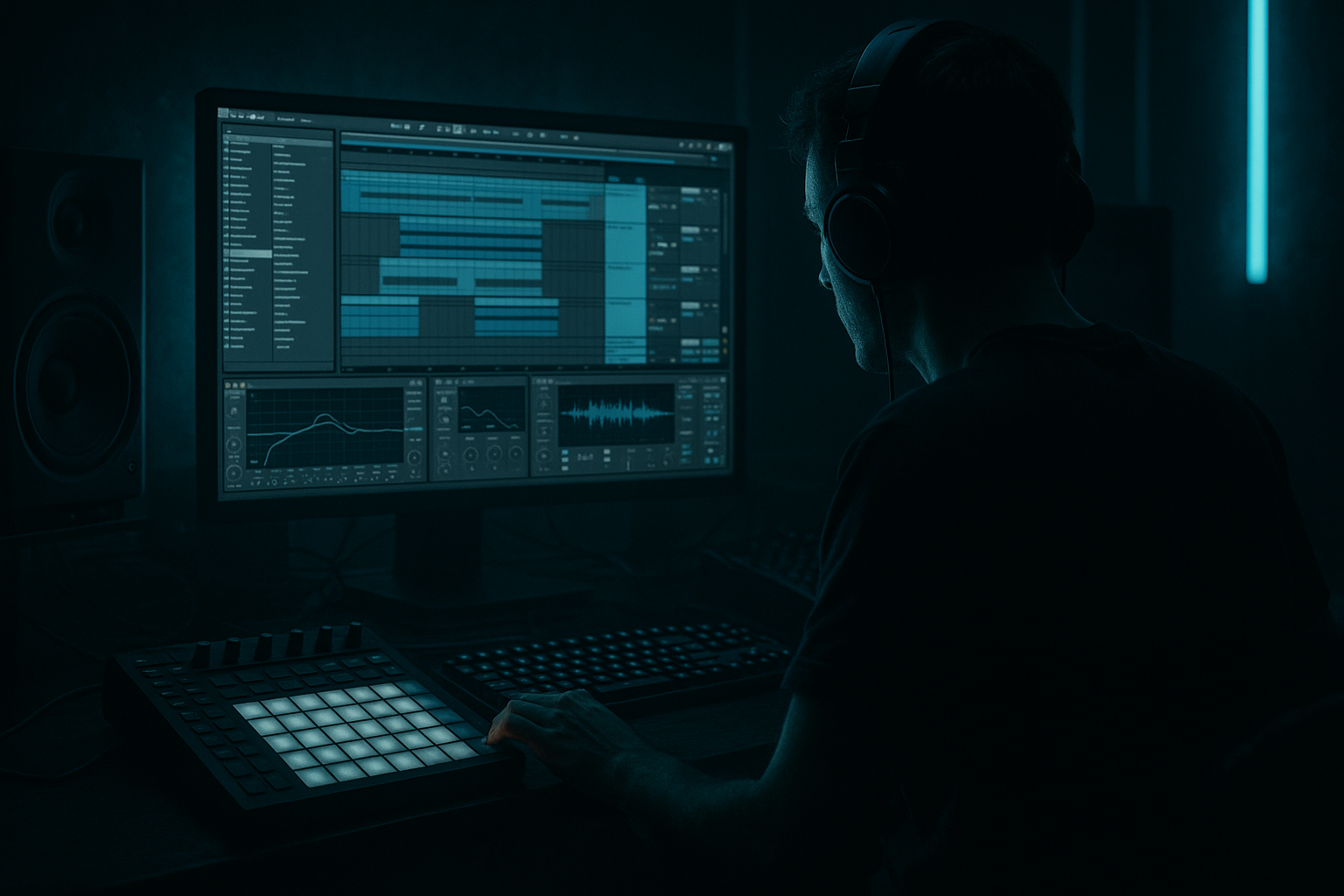
Main tutorial
```markdown
Retro Rave Drop Modulation (Modern Punch + Vintage Soul) in Ableton Live 12
Beginner Arrangement Lesson — Jungle / Oldskool DnB vibes 🥁🔥
---
1. Lesson overview
In this lesson you’ll learn how to arrange a retro-rave style drop that modulates (changes key center / bass note / vibe) while keeping it punchy and modern, but still raw and soulful like 90s jungle.
You’ll build a simple but effective structure:
- Rave intro → tension → drop A → modulation “course change” → drop B
- With oldskool drum language (breaks + kicks) and modern low-end control (tight sub + clean mix decisions)
- Jungle break + modern punch layer (tight kick + snare reinforcement)
- Reese or sub bass that feels 90s but hits like 2026
- Rave stab hook (classic minor chord stabs)
- A modulation moment that flips the energy into a new “course” (e.g., Em → Fm, or Em → Gm)
- Arrangement automation (filters, reverb throws, tape vibe) to glue it all
- Device: Hybrid Reverb
- Mode: Convolution
- Decay: 0.7–1.2 s
- Predelay: 10–25 ms
- HP filter: 250–400 Hz (keep low end clean)
- Device: Echo
- Time: 1/8 or 1/4 dotted
- Feedback: 25–45%
- Filter: HP around 250 Hz, LP around 6–9 kHz
- Add a touch of Noise inside Echo if you want texture
- Break filtered, stabs teased, bass minimal.
- Actions:
- On DRUMS (Break) add Auto Filter before saturation:
- Add a reverb throw at bar 8:
- Full drums + sub + reese + stabs.
- Bass notes: keep it simple and heavy. Example in E minor:
- Keep stabs repetitive—this is dance music.
- Your kick+snare must still feel strong even if you mute the break for a moment.
- E minor → F minor
- Add a short silence gap (1/8–1/4 beat) right before the new key hits.
- Open the reese filter more
- Add an extra drum fill every 4 or 8 bars
- Add a second stab variation or call/response
- Automate Roar/Saturator drive slightly higher (+1–2 dB)
- Add a ride or hat layer quietly for forward motion
- Add 1-bar break chop fill at bar 24 and bar 32
- On the group:
- Sub track: mostly sine, minimal distortion.
- Reese track: HP at 90–120 Hz.
- Avoid heavy reverb on anything below ~200 Hz.
- Filter cutoff (reese + break)
- Reverb send throws (stabs/snare)
- Mute/unmute small elements (hat, ghost snare, shaker)
- A short “air lift” EQ on the master just for 1 bar before Drop B (optional):
- Minor 2nd tension notes: In Drop B, occasionally hit the note one semitone above the root briefly (very jungle/darkside).
- Reese movement via automation: Automate Auto Filter cutoff with small rhythmic motion (not huge sweeps).
- Drum intimidation without loudness: Add short “thwack” layers to snare around 180–220 Hz and crisp around 4–6 kHz (EQ Eight + Drum Rack layers).
- FX that feel “tape”: Subtle Wow/Flutter (if available) or Chorus-Ensemble very low mix on stabs/breaks.
- Space discipline: Use Hybrid Reverb with HP filters and short decays. Dark isn’t “more reverb,” it’s “controlled space.”
- Use break + punch layering for jungle soul + modern translation 🥁
- Split bass into clean sub + gritty reese for power + character
- Write a short, rhythmic rave stab hook for identity 🎹
- Create a clear “course change” by modulating (e.g., +1 semitone) with a tight transition
- Use automation (filters, throws, mutes) to make the arrangement feel alive
You’ll work inside Ableton Live 12 using mostly stock devices.
---
2. What you will build
A full drop section (and the lead-in) with:
Target tempo: 165–175 BPM (we’ll use 172 BPM)
---
3. Step-by-step walkthrough
Step 0 — Set up the project (2 minutes)
1. Set tempo to 172 BPM.
2. Create these tracks:
- DRUMS (Break)
- DRUMS (Punch layer)
- BASS (Sub)
- BASS (Reese/Mid)
- MUSIC (Rave Stabs)
- FX (Noise/Risers/Impacts)
3. Create 2 Return tracks:
- Return A – Short Room (reverb)
- Return B – Dub Delay (delay)
Return A – Reverb (stock):
Return B – Delay (stock):
---
Step 1 — Build the jungle drums (Break + Punch)
#### 1A) Break track (vintage soul)
1. Drop in a classic break (Amen, Think, Funky Drummer style). If you don’t have one:
- Use any break sample, or a loop from a pack you own.
2. Right-click the clip → Warp: ON
- Warp mode: Complex Pro (for full loops), or Beats (if you want more chop bite)
3. If it feels too “clean,” add controlled grime:
- Device chain on DRUMS (Break):
1. EQ Eight:
- HP at 25–35 Hz
- small dip 250–400 Hz if boxy
- gentle shelf +1–2 dB at 8–10 kHz if dull
2. Saturator:
- Drive 2–5 dB
- Soft Clip ON ✅
3. Drum Buss:
- Drive 5–15%
- Boom: 0–10% (careful—don’t inflate subs)
- Transients: +5 to +20 for snap
#### 1B) Punch layer (modern impact)
This is your “club translation” layer underneath the break.
1. Add a Drum Rack on DRUMS (Punch layer) with:
- A tight kick (short, modern)
- A snare (crispy, not too long)
- Optional: closed hat for momentum
2. Program a simple 2-step DnB skeleton:
- Kick: 1 and “&” before 3 (varies by groove)
- Snare: 2 and 4
3. Glue it:
- Drum Buss on the punch layer:
- Drive 3–8%
- Transients +10
- EQ Eight:
- HP at 35–50 Hz (leave sub space for bass)
- Slight boost around 150–200 Hz on kick if needed, but keep it tight
Arrangement note:
Let the break be the personality. Let the punch layer be the translator.
---
Step 2 — Make a bass that can “modulate” cleanly
We’ll use two bass tracks: sub (clean) + reese/mid (character).
#### 2A) Sub bass (clean + stable)
1. Add Operator on BASS (Sub)
- Osc A: Sine
- Envelope:
- Attack 0 ms
- Decay 200–400 ms (optional)
- Sustain -inf if you want short notes, or keep sustain up for held notes
- Release 60–120 ms
2. Add EQ Eight:
- LP around 120–160 Hz (keep it pure)
3. Add Sidechain compression (stock Compressor) keyed from a Drum Bus / Kick trigger:
- Sidechain: ON → choose Punch kick track
- Ratio: 4:1
- Attack: 1–5 ms
- Release: 60–120 ms
- Gain reduction: aim 3–6 dB
#### 2B) Reese/Mid (vintage soul + movement)
1. Add Wavetable (or Operator) on BASS (Reese/Mid)
- Wavetable: something buzzy (basic saw works)
- Unison: 2–4 voices, low amount (subtle)
2. Add movement:
- Auto Filter:
- Type: LP24
- Cutoff around 200–800 Hz (automate later)
- Drive 2–6
3. Add grit:
- Roar (Ableton stock in Live 12) or Saturator if you prefer simple:
- Start with a mild preset, then reduce until it’s felt not fizzy
4. Keep it out of sub space:
- EQ Eight HP at 90–120 Hz
---
Step 3 — Create the rave stab hook (the “retro” signature) 🎹
1. Create a MIDI clip on MUSIC (Rave Stabs).
2. Use Simpler with a stab sample (oldschool piano stab, organ stab, or sampled chord hit).
- If you don’t have one, use Wavetable and play a minor chord with a short amp envelope.
3. Classic approach: minor chord stabs with offbeat rhythm.
- Example in E minor (easy starting point):
- Stab chord: E–G–B
- Pattern: short hits on the “&” (offbeats), occasional triplet-ish fills
4. Make it feel vintage:
- Device chain:
1. Auto Filter (HP around 150–250 Hz to clear low end)
2. Redux (very subtle):
- Downsample: 2–6
- Bit reduction: minimal or off (too much = gameboy)
3. Hybrid Reverb (send to Return A + a little insert if you want)
4. Chorus-Ensemble (light) for width
Key point: old rave stabs are short, bright, and rhythmic—don’t make them long pads.
---
Step 4 — Arrange the “drop modulate course”
Here’s a beginner-friendly arrangement map (32 bars total):
#### Bars 1–8: Pre-drop (tension + tease)
- Break track: automate Auto Filter cutoff slowly opening.
- Add noise riser (Operator noise or sample) on FX.
- Add a 1-bar vocal shot or “rewind” FX if you like.
Practical automation:
- Start cutoff: 400–800 Hz
- End cutoff by bar 8: full open
- Automate Send A up on the final stab/snare hit, then snap back down.
#### Bars 9–16: Drop A (main groove, key center 1)
- Sub follows: E – E – G – F# (or just E with variations)
Modern punch check:
#### Bars 17–18: Modulation “course change” (the pivot)
This is the signature moment: you flip the vibe without losing dancers.
Option A (easy + effective): lift by 1 semitone
Why it works: instant tension/brightness shift, classic rave “gear change.”
How to execute it cleanly:
1. Duplicate your bass MIDI + stab MIDI for bars 17–32.
2. Select notes in bars 17–32 and transpose +1 semitone.
3. Add a micro-break:
- Bar 17 beat 1: cut kick for 1 beat
- Add a crash/impact
- Add tape stop style moment (optional): use Echo with high feedback for a quick tail, or automation on pitch if you have a sample
Extra “90s” sauce:
#### Bars 19–32: Drop B (same groove, new key, more aggression)
Now you’re in the new center (F minor). Make it feel upgraded:
Arrangement upgrades for Drop B:
---
Step 5 — Make it hit: mix/arrangement moves (beginner-safe)
#### 5A) Drum bus glue (without killing transients)
Group your two drum tracks into a DRUMS GROUP:
- Glue Compressor
- Attack: 3 ms
- Release: Auto
- Ratio: 2:1
- GR: 1–3 dB max
- Soft Clip (via Saturator soft clip or Drum Buss) if peaks are wild
#### 5B) Keep the low end clean
#### 5C) Use automation as “arrangement”
Your modulation will feel 10x bigger if you automate:
- EQ Eight high shelf +1 dB at 8–10k only during the transition, then back
---
4. Common mistakes
1. Modulating everything at once
If bass, stabs, vocals, and FX all change instantly, it can sound like a mistake. Start with bass + stabs, keep drums constant.
2. Sub gets distorted or widened
Don’t chorus the sub. Keep sub mono and clean; put width on the mids.
3. Breaks too loud / too quiet
If the break dominates, your modern punch disappears. If it’s too quiet, it loses jungle identity. Balance both with the punch layer as your anchor.
4. Overlong reverb on stabs
Old rave is often short and snappy. Use reverb throws, not constant wash.
5. No energy escalation into Drop B
If Drop B is the same as Drop A but transposed, it can feel flat. Add one new element (hat, extra stab, darker bass movement).
---
5. Pro tips for darker/heavier DnB 🖤
---
6. Mini practice exercise (15–25 minutes)
1. Make an 8-bar drop loop (Drop A) with:
- Break + punch layer
- Sub + reese
- 1 stab hook
2. Duplicate it to make 16 bars.
3. Bars 9–16: transpose bass + stabs +1 semitone (your modulation).
4. Add one transition effect:
- 1/4 beat silence + impact, or
- reverb throw on the last stab before the modulation
5. Bounce a quick export and listen on:
- headphones
- small speakers (or phone speaker)
Check: Can you still feel the groove when the sub disappears? If not, your drums need more mid punch.
---
7. Recap
You now have a practical blueprint for retro rave drop modulation in Ableton Live 12:
If you want, tell me your chosen key (e.g., Em) and what break you’re using, and I’ll suggest a specific 32-bar arrangement with fills and bass note patterns for your exact vibe.
```

