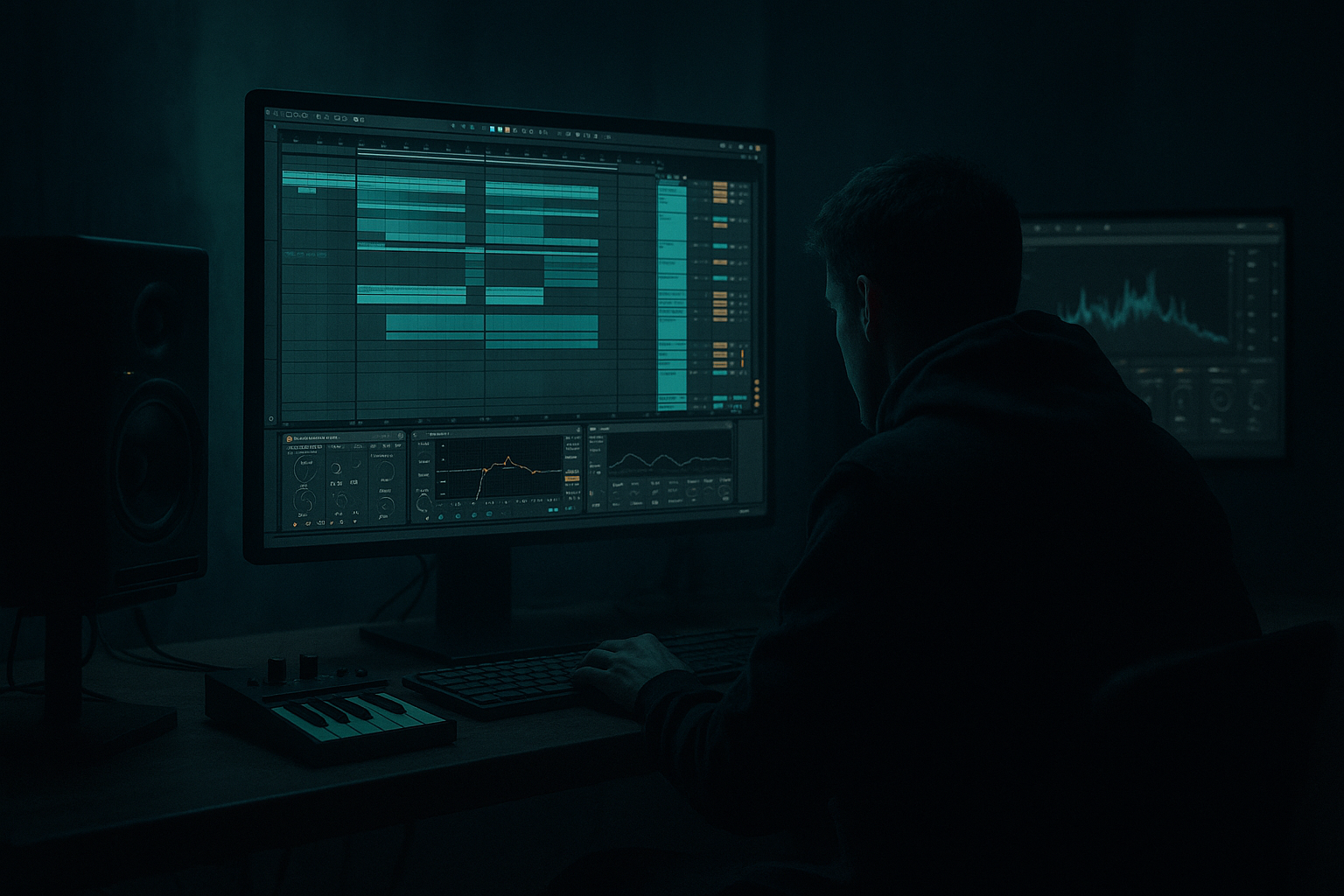
Main tutorial
Retro Rave Ableton Live 12 Ghost Note Masterclass
Crunchy sampler texture for jungle / oldskool DnB vibes 🥁🔥
---
1. Lesson overview
This lesson is about making ghost notes feel intentional—not just “extra hits.” In oldskool jungle/DnB, ghost notes are what create that rolling push-pull, especially when paired with crunchy sampled texture (think: Akai-era grit, rave break chops, noisy room tails, and preamp-ish saturation).
You’ll build:
- A main break with convincing ghost articulation
- A ghost-note layer bus that adds groove without clutter
- A crunchy sampler texture chain that feels retro but still hits in a modern mix
- A workflow you can reuse fast in Ableton Live 12
- Main break (A: “meat”)
- Ghost layer (B: “movement”)
- Crunch layer (C: “texture & dirt”)
- Drum bus processing that preserves transients but adds rave bite
- A classic break (Amen, Think, Hot Pants, Funky Drummer, etc.)
- Clean kick/snare (optional) to reinforce the break
- Put the break in Simpler (Slice mode) so you can re-sequence hits precisely.
- Keep one-shots in a Drum Rack as reinforcement.
- Kick: beat 1, and a pickup around 1.3–1.4
- Snare: beat 2 and 4 (solid)
- Keep the main snare velocities strong:
- Keep the kick consistent:
- Low-velocity snare taps before/after the backbeat
- Muted hat/ride fragments
- Tiny kick nudges that imply forward motion
- Before snare: on 1.4 (the 16th right before beat 2)
- After snare: on 2.2 or 2.3
- Before beat 4 snare: on 3.4
- After beat 4 snare: on 4.2
- Ghost snare: 12–45
- Ghost hats: 8–35
- Ghost kicks: 20–60 (rare; use sparingly)
- Track A: Main break hits
- Track B: Ghost-only break hits ✅
- Add a clean snare one-shot quietly under the break snare, not over it.
- Use a tiny piece of break ambience, room tone, or vinyl noise.
- Put it in Simpler and trigger it every bar (or continuously as audio).
- Auto Filter: HP at 300–600 Hz
- Redux: light (5–15% wet)
- Erosion:
- Utility: Mono below 150 Hz (or just keep the whole texture mono)
- Bars 1–2: main break only (minimal ghosts)
- Bars 3–4: introduce ghost layer at -8 to -6 dB
- Bars 5–6: add crunch automation (Redux wet +5–10%)
- Bars 7–8: pull ghosts back, add a fill (extra ghost run into bar 1)
- Ghost layer Utility Gain (simple & clean)
- Redux Dry/Wet
- Auto Filter cutoff (short “rave sweep” moments)
- Reverb send (tiny throws on fills only)
- Sidechain ghosts to the main snare (subtle):
- Parallel distortion return
- Dark hat control
- Fills = ghost clusters
- Build main hits first (kick/snare anchor), then add ghost notes as groove glue.
- Put ghosts on a separate layer so you can crunch them hard without wrecking the break.
- Use velocity discipline (quiet ghosts) and micro timing rules (push/pull).
- Create retro texture with Redux + Saturator + Drum Buss, then control it with filters/gate.
- Arrange ghost intensity over 8–16 bars for DJ-friendly momentum.
---
2. What you will build
A drum rack / group that sounds like:
Target vibe: 92–96 jungle meets rolling DnB—tight timing, punchy transients, dusty top end, and a bit of chaos 😈
---
3. Step-by-step walkthrough
Step 0 — Session prep (tempo, grid, swing)
1. Set tempo:
- Jungle: 160–170 BPM
- Oldskool rave DnB: 170–175 BPM
Start at 172 BPM.
2. In Groove Pool, load a groove:
- Try MPC 16 Swing 54–58 (subtle) or any shuffle that nudges hats/ghosts.
3. Set groove amount:
- Start at Groove: 30–45%
- Timing: leave default; don’t over-randomize yet.
> Goal: groove comes from consistent micro-feel + intentional ghost placement, not “humanize everything.”
---
Step 1 — Pick your source: break + clean one-shots
You need:
Workflow suggestion (best for control):
In Ableton:
1. Drag break audio onto a MIDI track → choose “Slice to New MIDI Track”
2. Slicing preset:
- Transient slicing
- Create Drum Rack with slices
3. Open the sliced track and locate:
- Main snare slice(s)
- Ghosty snare/hat bleed slices
- Kick slice(s)
---
Step 2 — Program the “spine” (main hits)
Create a 1-bar loop first. Use a classic DnB skeleton.
Typical oldskool backbone (1 bar in 4/4):
In MIDI:
- Snare (2 & 4): 105–127
- Kick: 95–120
Important: don’t add ghosts yet. Make the main hits slam first.
---
Step 3 — Ghost note strategy (the “why” and the “where”)
Ghost notes in jungle are usually:
#### Placement map (practical starting points)
In a 16th grid, place ghosts:
You’re creating anticipation and release.
#### Velocity rules (advanced but reliable)
> If a ghost “reads” as a real hit, it’s too loud or too bright.
---
Step 4 — Build a dedicated ghost-note layer (separate from main)
This is the secret: ghosts deserve their own processing so they can be crunchy and audible without wrecking the main transients.
#### Create layer tracks
1. Duplicate your sliced break MIDI clip to a new MIDI track.
2. On the duplicate:
- Remove main kicks/snares
- Keep only the ghost slices (snare taps, hat bleed, tiny bits)
Now you have:
Group them (Cmd/Ctrl+G) into a DRUMS group.
---
Step 5 — Crunchy sampler texture on the ghost layer (retro rave grit)
On Track B (Ghosts), build this chain:
#### Device Chain: “Ghost Crunch”
1. Simpler / Sampler settings (per slice)
- If using Simpler (Classic) for the ghost sound:
- Filter: ON
- Type: MS2 or PRD
- Freq: 4–9 kHz (tune by ear)
- Res: 0.3–0.8
- Amp Envelope:
- Attack: 0–3 ms
- Decay: 120–250 ms
- Sustain: -inf (or very low)
- Release: 30–80 ms
- Goal: short, papery ghosts that don’t smear.
2. Redux (digital crunch)
- Bit Reduction: 10–14 bits
- Downsample: 1.2–2.5
- Dry/Wet: 15–35%
- Keep it subtle; you want texture, not “8-bit drum solo.”
3. Saturator (preamp vibe)
- Mode: Analog Clip
- Drive: 2–6 dB
- Soft Clip: ON
- Output: trim so level matches bypass
4. Auto Filter (rave “telephone” control)
- HP filter at 150–250 Hz (remove low junk)
- Optional: light resonance 0.5–1.2
- Optional movement: slow LFO 0.05–0.12 Hz at tiny amount (1–3%) for subtle drift
5. Drum Buss (knit + smack)
- Drive: 2–8
- Crunch: 10–25%
- Transients: +5 to +15 (careful—on ghosts this can get clicky)
- Boom: OFF (usually) for ghost layer
6. Gate (tighten)
- Threshold so only intended ghost transients pass
- Return: fast, Floor: -inf
- This keeps noisy tails from building up.
Routing tip:
Send Track B to a Return with reverb instead of inserting reverb directly—keeps the groove clean.
---
Step 6 — Make ghosts groove with timing (micro-nudge, not random)
In Live 12:
1. Select ghost notes only.
2. Apply micro timing offsets:
- Push “pre-snare” ghosts slightly early: -5 to -12 ms
- Pull “post-snare” ghosts slightly late: +5 to +15 ms
3. Keep main snare mostly on-grid (or just a tiny late feel: +2 to +6 ms).
> DnB feels fast because the details are dancing around solid anchors.
---
Step 7 — Reinforce the main snare without killing break character
On Track A (Main break):
Chain suggestion (Main break):
1. EQ Eight
- HP: 25–35 Hz
- Small cut if boxy: 250–450 Hz (-2 to -4 dB)
- Small presence: 3–6 kHz (+1 to +3 dB) if needed
2. Glue Compressor
- Attack: 3–10 ms
- Release: Auto or 0.1–0.3 s
- Ratio: 2:1
- Gain reduction: 1–3 dB
3. Saturator (light)
- Drive: 1–3 dB, Soft Clip ON
---
Step 8 — Add a “Vinyl/room” crunch layer (optional but very authentic)
Create Track C (Texture):
Texture chain:
- Mode: Noise
- Freq: 4–8 kHz
- Amount: 0.2–1.2
Keep this very low. You want “air dirt,” not hiss domination.
---
Step 9 — Drum group bus: make it hit like a record
On the DRUMS Group:
1. EQ Eight
- HP at 20–30 Hz
- Gentle tilt if too bright (tiny high shelf -1 to -2 dB)
2. Drum Buss
- Drive: 2–6
- Crunch: 5–15%
- Transients: +5 to +10
- Boom: 0–10% around 50–60 Hz only if your kick needs weight
3. Limiter (only to catch peaks)
- Aim for 1–2 dB max peak reduction on wild hits
> If you’re slamming the drum limiter, your ghosts are probably too loud or too bright.
---
Step 10 — Arrangement ideas (DnB/jungle functional)
Your ghosts shouldn’t stay static for 5 minutes—arrange them like a DJ-friendly weapon 🎛️
8-bar loop plan:
Automation targets:
---
4. Common mistakes
1. Ghosts too loud
If you can “count” the ghost notes, they’re not ghosts anymore.
2. Too much low end in the ghost layer
Break slices often contain kick rumble—high-pass your ghosts.
3. Over-random timing
Random ≠ groove. Use consistent push/pull rules per position.
4. Crunch on the whole break instead of just ghosts
Crunch the details so the main transients stay punchy.
5. Reverb inserted on ghosts
Use sends. Insert reverb often smears your rhythmic clarity.
---
5. Pro tips for darker/heavier DnB 🖤
- Compressor on ghost layer, Sidechain from main snare
- Ratio 2:1, Attack 1–5 ms, Release 60–120 ms
- Only 1–3 dB reduction—this makes the backbeat dominate.
- Return track: Saturator (Drive 8–15 dB) → EQ Eight (HP 200 Hz) → Compressor
- Send tiny amounts from ghosts and hats to get that “angry air.”
- On ghost/hats: Auto Filter LP around 10–14 kHz to avoid harshness
- Then add presence with saturation instead of raw brightness.
- Do 2-beat fill: increase ghost density (extra 32nds) but keep velocity low.
- It’ll sound frantic without sounding “louder.”
---
6. Mini practice exercise (15 minutes)
1. Take one break and slice it to Drum Rack.
2. Make a 1-bar pattern:
- Main snare on 2 and 4
- Main kick on 1 + one extra syncopation
3. Duplicate the track:
- Remove main hits, keep only ghost candidates
4. Build the Ghost Crunch chain:
- Redux 20% wet, Saturator 4 dB, Drum Buss Crunch 15%
- HP filter at 200 Hz
5. Add 4 ghost notes:
- One before each snare, one after each snare
6. Nudge timing:
- Pre-snare ghosts: -8 ms
- Post-snare ghosts: +10 ms
7. Toggle ghost layer on/off:
- Your loop should feel like it “rolls” only when ghosts are on.
---
7. Recap
If you want, tell me what break you’re using (Amen/Think/etc.) and your target sub style (jungle, rollers, techy, crossbreed), and I’ll suggest exact ghost placements + a rack macro layout for fast performance/automation.

