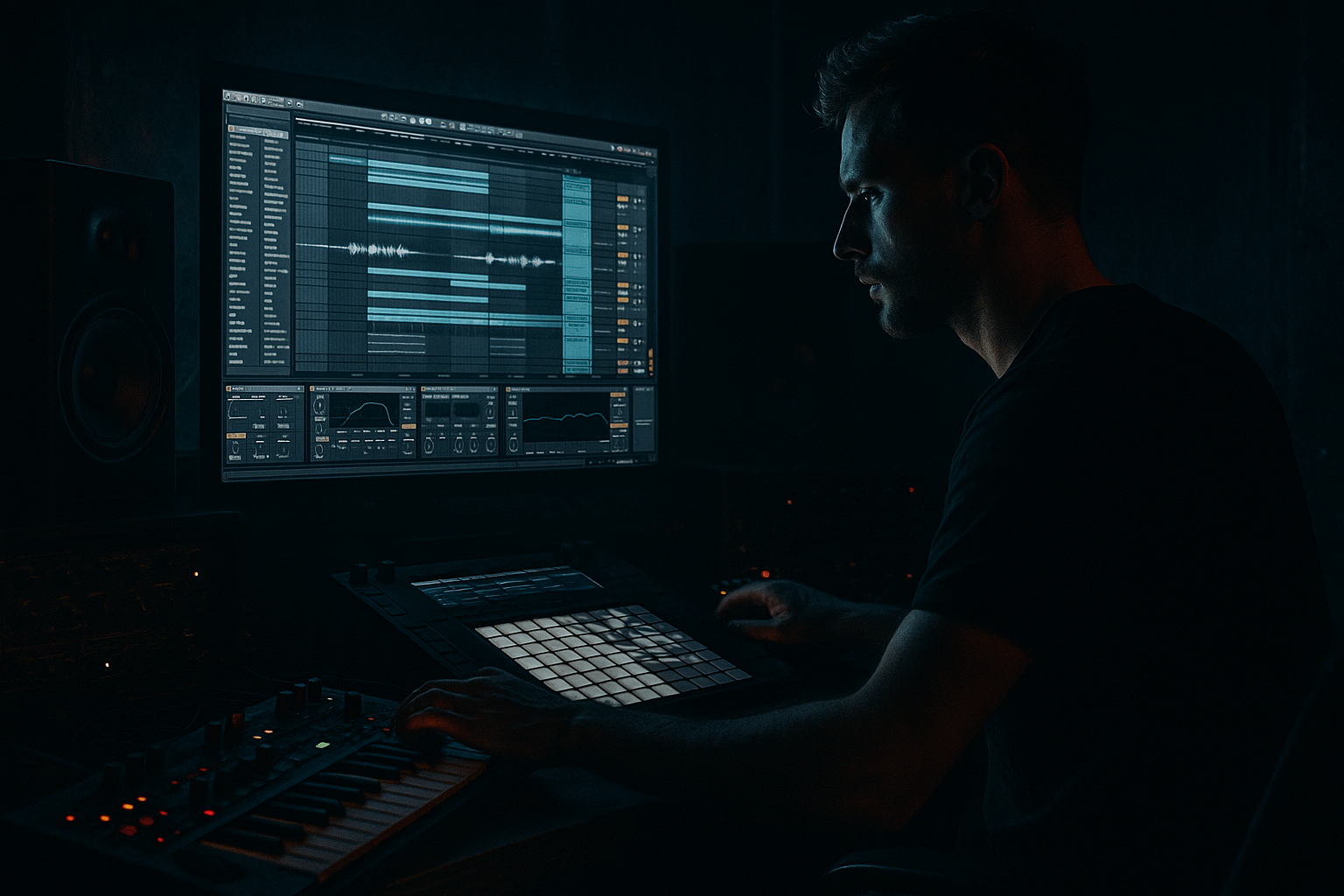
Main tutorial
Retro Rave Ableton Live 12 Breakbeat Blueprint for 90s-Inspired Darkness 🥁⚡
1. Lesson overview
In this lesson, you’ll build a dark, retro-rave drum and bass breakbeat system in Ableton Live 12 using resampling as the core creative method. The goal is not just to program a beat, but to mangle, re-capture, and re-purpose breaks until they feel like a proper 90s-inspired jungle/DnB hybrid: gritty, energetic, and slightly unstable in the best way.
We’ll focus on:
- chopping classic-style breakbeats
- resampling processed drums back into audio
- layering punch and texture
- creating variation without losing groove
- shaping a darker, heavier DnB drum bed that can support rewinds, atmospheres, and bass pressure
- a main breakbeat loop with swing and grit
- a resampled drum layer with extra crunch and compression
- a ghost percussion layer for movement
- a reverse/retrigger fill chain for transition energy
- a drum rack or layered drum bus that sounds like a dark retro rave record
- an arrangement-ready 8-bar and 16-bar loop for DnB/jungle-style tracks
- chopped Amen / Think / Hot Pants energy
- dark warehouse rave mood
- a little tape grime, a little digital bite
- rolling momentum, but with enough space for bassline call-and-response
- Warp
- Slice to New MIDI Track
- Simpler
- Drum Rack
- Resample
- Audio Effect Rack
- Glue Compressor
- Saturator
- Drum Buss
- Auto Filter
- EQ Eight
- Utility
- Beat Repeat
- Reverb / Hybrid Reverb
- Echo
- Transient shaping tools via Drum Buss / Envelope settings
- clear kick/snare structure
- enough ghost notes and hats
- character in the mids
- not too much room reverb if you want control
- Amen-style patterns
- Think-style dry funk breaks
- dusty 90s rave drum loops
- broken up hip-hop breaks with sharp snare transients
- Keep the main kick/snare spine recognizable
- Offset ghost notes slightly behind the grid
- Vary snare velocity if using MIDI pads
- Leave tiny gaps before key hits to make them punch harder
- MPC 16 Swing
- MPC 8 Swing
- or a subtle custom groove from another break
- Groove amount: 20–45%
- Timing: keep subtle
- Random: very low, if any
- chop a more cohesive sound
- capture compression tails
- print saturation artifacts
- build fresh material from your own processing
- glue
- color
- density
- better transient cohesion
- extra punch on snares
- snare tails that can become fills
- hats that can be used as ghost motion
- odd transient artifacts worth exploiting
- one strong main snare
- a syncopated kick
- ghost hits between the main backbeats
- at least one variation every 2 bars
- adds shuffle
- increases perceived tempo
- supports atmosphere
- keeps the groove alive under bass
- EQ Eight: high-pass at 150–250 Hz
- Drum Buss: lighter drive
- Redux or Erosion: subtle grit if you want a lo-fi edge
- Auto Pan: very subtle, slow movement if needed
- Utility: reduce gain and control stereo width
- a reversed snare or cymbal tail
- a stuttered kick-snare fill
- a micro-chop fill in the last half-bar
- a pitched-down snare hit for impact
- Warp markers for quick micro edits
- Simpler in Slice or Classic mode
- Beat Repeat
- Reverb or Hybrid Reverb
- Echo
- Beat Repeat
- Echo
- Reverb
- kick
- snare
- rim
- closed hat
- crash
- old-school ride
- Kick pad: clean punchy one-shot
- Snare pad: layered with the resampled break snare
- Hat pad: short, crisp, slightly distorted
- FX pad: noise hit or rave stab fragment
- Keep the sub of the kick controlled
- Use the break kick for character
- Use a punch layer only if the kick is disappearing
- Use Compressor with sidechain from the kick/snare bus
- Or use Glue Compressor if the bass is a group
- Attack: 1–10 ms
- Release: 50–120 ms
- Ratio: 2:1 to 4:1
- Threshold for 2–6 dB ducking
- Bars 1–2: stripped intro, filtered break, atmosphere
- Bars 3–4: bring in full break
- Bars 5–6: add ghost layer and extra hat movement
- Bars 7–8: fill, reverse hit, resampled transition, bass drop cue
- 1–4: intro / tension
- 5–8: main groove
- 9–12: variation with extra ghost chops
- 13–16: fill, break restart, impact hit, bass drop or breakdown cue
- filter sweep on drum bus
- reverb send rise before fills
- bit reduction or saturation increase in selected bars
- clip gain automation for snare emphasis
- reverse cymbal into downbeat
- your main drum stem
- an alternate arrangement layer
- a “drum performance” bounce for further editing
- clean
- saturated
- crushed
- filtered
- fill-heavy
- Saturator
- Drum Buss
- Glue Compressor
- EQ Eight removing lows
- one beat of Beat Repeat every 8 bars
- a reversed hat before the drop
- a tiny tape-stop-like edit on a fill
- one filtered break variation during breakdowns
- Use one break source only
- Resample at least twice
- Use at least one stock Ableton effect chain
- Make one fill variation in bar 4
- Does the loop feel darker after resampling?
- Are the snares hitting with authority?
- Is there enough motion between kicks and hats?
- Does bar 4 feel like a real transition point?
- Start with a strong break and get the groove right first
- Process the break bus before resampling
- Resample aggressively enough to create a new character
- Chop the resampled audio again for deeper control
- Add ghost layers, fills, and transitions from printed audio
- Keep the kick/snare relationship powerful and the low end controlled
- Arrange in phrases, not just loops
- a Ableton Live 12 device chain template
- a step-by-step project file layout
- or a companion tutorial for dark bass resampling to match the drums
This is an advanced workflow, so we’ll move fast and make choices deliberately. The main idea is:
> Build a break → process it → resample it → chop it again → layer it into a final drum performance.
That is how you get the raw, committed energy of old-school jungle while keeping the control and polish of Ableton Live 12. 🔥
---
2. What you will build
By the end, you’ll have:
Target sound
Think:
Core Ableton devices we’ll use
---
3. Step-by-step walkthrough
Step 1: Start with a strong break source
Choose a break that has:
Classic sources include breakbeat loops inspired by:
#### Practical setup
1. Drop the break into an audio track.
2. Set the project tempo around 170–174 BPM if you want classic DnB energy.
3. Warp the break:
- Try Beats mode
- Transients: 1/16 or 1/8 depending on material
- Preserve: 80–120
- Loop mode: off for now if you’re going to slice it
4. Make sure the first kick lands cleanly on the grid.
#### Tip
If the break feels too clean, don’t fix it yet. We’re going to make it uglier on purpose.
---
Step 2: Build a first pass break pattern
Before resampling, make a groove that already feels musical.
#### Option A: Slice to MIDI Track
1. Right-click the break.
2. Choose Slice to New MIDI Track.
3. Use:
- Transient slicing for naturally dynamic breaks
- 1/8 or 1/16 if you want more control and repeatability
Ableton will create a Drum Rack with slices mapped across pads.
#### Option B: Manual audio chopping
If you want more control, duplicate the break to several audio lanes and manually cut and rearrange slices.
---
Step 3: Tighten the groove with performance logic
A good dark DnB break is not rigid. It should feel like a player with attitude.
#### In the MIDI clip or audio arrangement:
#### Groove settings
Use the Groove Pool with:
Suggested settings:
You want movement, not drunkenness.
---
Step 4: Process the break bus before resampling
This is where the sound starts becoming retro-rave and dark.
Route your break slices or break loop to a drum bus and add a processing chain like this:
#### Example bus chain
1. EQ Eight
- High-pass at 25–35 Hz
- Small cut around 250–400 Hz if muddy
- Tiny boost around 3–6 kHz if snare needs bite
2. Drum Buss
- Drive: 5–15%
- Boom: use carefully, often 0–15%
- Transients: slightly up if the break is soft
- Damp: adjust to keep hats from getting harsh
3. Saturator
- Mode: Analog Clip or Soft Sine
- Drive: 2–6 dB
- Soft Clip: on
4. Glue Compressor
- Attack: 3–10 ms
- Release: Auto or 0.3–0.6 s
- Ratio: 2:1 or 4:1
- Aim for 1–3 dB gain reduction
5. Optional Auto Filter
- Slight LP movement for intro/fill sections
- Resonance very low
- Use automation later for rave sweep energy
This chain should make the break feel like it’s being pushed through an old PA or a rough sampler.
---
Step 5: Resample the processed break
Now capture the sound.
#### Method
1. Create a new audio track.
2. Set Audio From to Resample.
3. Arm the track.
4. Play your processed break loop and record 4–8 bars.
This gives you a new audio file containing the exact sound of your chain.
#### Why this matters
Resampling commits the character of your processing. It also lets you:
That’s the magic of advanced breakbeat production: print the vibe, then re-edit the print.
---
Step 6: Chop the resampled break again
Drag the resampled audio into a new track or into Simpler / Slice to New MIDI Track again.
This second-generation break usually sounds better than the original because it already has:
#### What to look for
#### Chopping strategy
Make a 1-bar or 2-bar pattern with:
For dark DnB, don’t overfill every space. Let the bassline breathe.
---
Step 7: Create a ghost layer for movement
Now build a second, quieter layer from the same resampled break or a different break.
#### What this layer does
#### Processing idea
On the ghost layer, use:
Keep it low in the mix. It should be felt more than heard.
---
Step 8: Build a fill and transition system with resampling
This is where advanced DnB arrangements get powerful.
#### Make a fill pass
Take your resampled break and create:
#### Useful devices
#### Example fill chain
On a return track or audio track:
- Interval: 1/8 or 1/16
- Grid: 1/16
- Chance: 20–50%
- Variation: moderate
- Gate: automate on/off
- Time: dotted 1/8 or 1/4
- Feedback: low to moderate
- Filter the repeats heavily
- Short decay for a warehouse smear
Resample the fill pass too. Then place those new audio fills at the ends of 8-bar phrases.
---
Step 9: Layer with one-shot reinforcement
A retro-rave break often benefits from tight reinforcement, especially in modern systems.
Add separate one-shots for:
#### Drum Rack chain idea
Inside a Drum Rack:
Then route the original break to this rack’s output or side-chain it conceptually by arrangement.
#### Kick layering advice
For dark DnB:
If you layer too much, the break loses its identity.
---
Step 10: Make the drum bus react to the bass
In DnB, drums and bass are not separate worlds. They need to coexist.
#### Sidechain setup
On your bass bus or bass instrument:
Suggested compressor settings:
For darker roller styles, keep the ducking tight but musical.
#### Important
If your drums are too compressed, the bass has nowhere to sit.
If your bass is too wide or too loud in the midrange, the break loses tension.
---
Step 11: Shape the arrangement like a 90s rave record
Now that you have your core loop, arrange it with intent.
#### 8-bar energy map
#### 16-bar progression
#### Automation ideas
This is where the old-school darkness comes alive.
---
Step 12: Final polish with resampling mindset
Before calling it done, print one more “performance” version.
#### Final resampling pass
1. Route the full drum group to Resample.
2. Record 8–16 bars with all key automations.
3. Bring the rendered audio back into Arrangement.
4. Cut, nudge, or repeat tiny phrases for emphasis.
This final print can be:
Advanced producers often do this to lock in vibe and avoid endless micro-tweaking.
---
4. Common mistakes
1. Over-chopping the break
If every hit is edited to death, the groove becomes stiff and lifeless.
Fix: Preserve the natural push-pull of the break. Leave some original phrasing intact.
2. Too much low end in the break
A classic break already has kick weight. If you layer more low-end without control, the mix turns cloudy.
Fix: High-pass ghost layers and use EQ Eight to clean the bus.
3. Resampling without committing to a sound
If you resample but don’t actually change anything meaningful, it’s just extra steps.
Fix: Make the processing obvious: saturation, compression, transient shaping, filtering, or weird time edits.
4. Excessive stereo widening on drums
Wide breaks can sound impressive solo but collapse in the club.
Fix: Keep main kicks/snare mostly centered. Use width on hats, FX, and ambience only.
5. Too much top-end distortion
Harsh hats and brittle snare fizz are a common problem in aggressive DnB.
Fix: Use EQ Eight, Drum Buss Damp, or a gentle high shelf cut. Monitor at moderate volume.
6. Forgetting phrase structure
A loop that bangs for 4 bars may still fail in a full track.
Fix: Design 8-bar and 16-bar variations before arranging the whole tune.
---
5. Pro tips for darker/heavier DnB
Tip 1: Print multiple versions of the same break
Make:
Then arrange like a live drummer changing intensity.
Tip 2: Use parallel nastiness
Create a return or parallel bus with:
Blend it underneath your clean drum bus for density without losing clarity.
Tip 3: Let snare tails become atmosphere
Resample long snare tails with reverb, then cut them into transitions or intro textures.
Tip 4: Pitch subtlety matters
A break pitched down just 1–3 semitones can become darker without losing identity.
Tip 5: Keep the kick/snare relationship strong
In jungle and DnB, the backbeat needs authority. If the snare is weak, the whole track feels small.
Tip 6: Use controlled chaos
Try:
Darkness is often about restraint, not constant aggression.
Tip 7: Resample your reverbs and delays
This is huge. Render FX tails, then re-chop them into hits or risers. That’s classic rave mentality with modern control. ✨
---
6. Mini practice exercise
Build a 4-bar dark break loop using only resampling.
Constraints
Suggested workflow
1. Load a break and slice it.
2. Create a basic 2-bar loop.
3. Process with:
- EQ Eight
- Drum Buss
- Glue Compressor
- Saturator
4. Resample it.
5. Chop the resampled audio into a new variation.
6. Add a ghost layer with high-passed hats.
7. Create a bar-4 fill using Beat Repeat or manual chop edits.
8. Bounce a final 4-bar loop.
What to listen for
---
7. Recap
You’ve now got a practical blueprint for building a retro rave, 90s-inspired dark DnB breakbeat in Ableton Live 12 using resampling as the engine of sound design.
Key takeaways
If you do this well, your drums will feel like a living performance rather than a loop on repeat — exactly the kind of energy that gives jungle and darker DnB its edge. 🖤
If you want, I can also turn this into:

