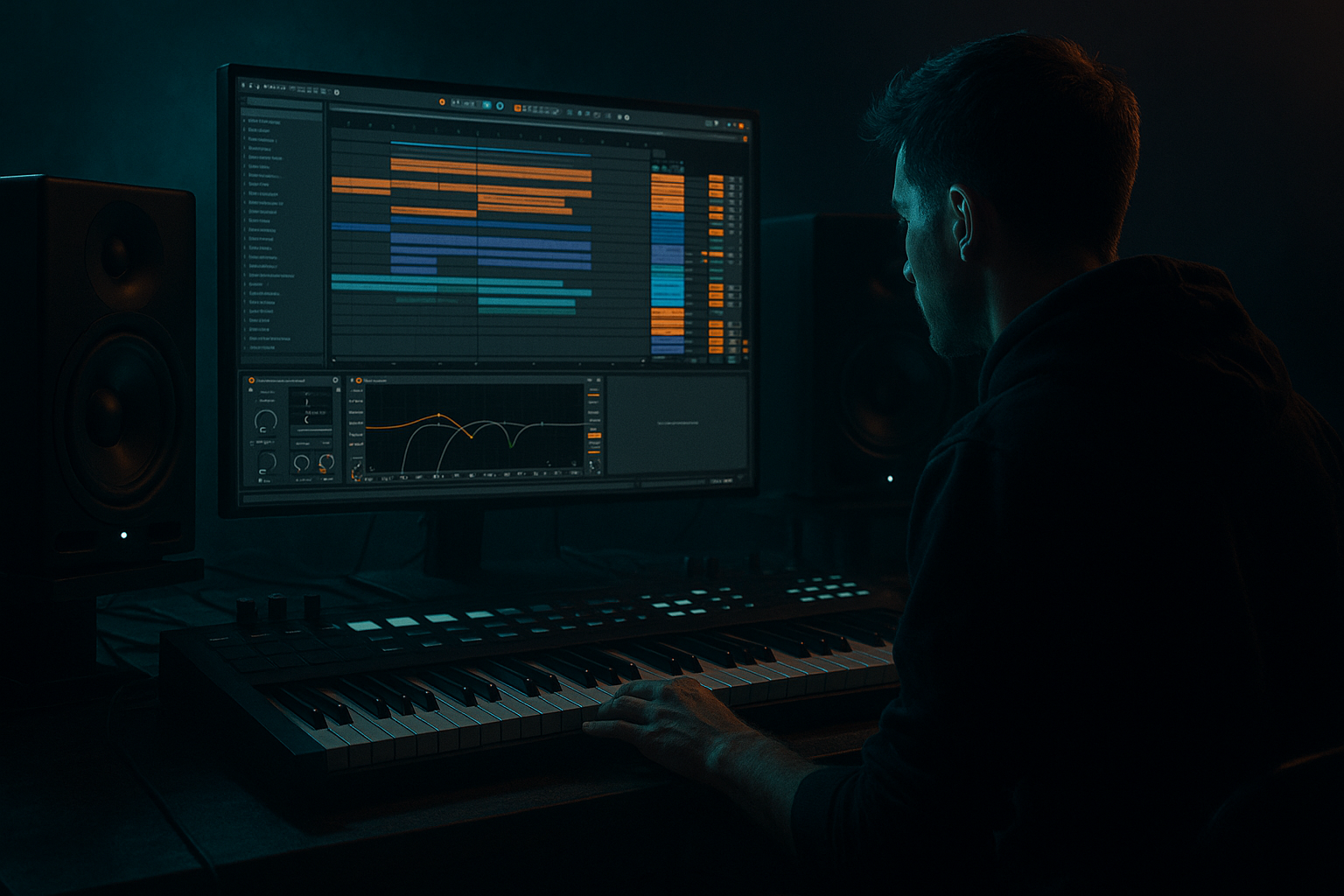
Main tutorial
Lesson Overview
Retro rave chopped-vinyl texture is one of those tricks that instantly gives a DnB track identity: part nostalgia, part menace, part “this came off a dusty 90s white label.” In Drum & Bass, it works especially well in rollers, jungle-influenced sections, darker jump-up intros, and mid-track switch-ups where you want the bassline to feel like it’s being physically “played” rather than just programmed.
The goal of this lesson is to build a bassline that feels like a chopped sample pulled from a rave record, then reshape it into a modern Ableton Live 12 bassline with sub weight, groove, and arrangement impact. You’ll use stock Ableton devices to create the texture, add vinyl-style instability, and arrange the part so it functions musically in a real DnB track — not just as a sound design exercise. 🎛️
Why this matters in DnB: retro-rave textures cut through because they bring strong midrange identity. DnB basslines often need a focused low end plus a recognisable mid character. A chopped-vinyl layer gives you that midrange hook, while the sub and drum programming keep the track club-ready. The trick is balancing grit and nostalgia with modern low-end discipline.
What You Will Build
You’ll build a bass part that has:
- A solid mono sub foundation
- A midrange chopped-vinyl bass layer with rave-style accents
- Short, rhythmic note phrases that feel like sample chops
- Subtle pitch and filter movement for “worn record” character
- A call-and-response arrangement between bass hits and drum gaps
- A DJ-friendly intro and a drop-ready 8-bar loop
- Enough texture to feel vintage, but enough control to sit in a modern DnB mix
- A MIDI track for sub
- A MIDI track for chopped-vinyl mid bass
- An audio track for resampling and texture prints
- Use a sine wave or a very soft saw/sine blend
- Turn off unnecessary modulation
- Set the amp envelope with a short attack, medium decay, and no release tail if you want tight roller-style hits
- Use root notes and occasional fifths or octave jumps
- Keep the rhythm sparse
- Leave holes around the snare backbeat and busy break moments
- Notes at bar 1 beat 1, beat 2.3, beat 3, and bar 2 beat 1.3
- Velocity can stay even, since the character will come from the mid layer
- Filter: low-pass or no filter if using a sine
- Glide/portamento: 20–50 ms for subtle movement if notes overlap
- Mono mode: on
- Output level: keep conservative
- A stab, rave chord fragment, old vocal chop, or a bright synth bite bounced to audio
- Resample it if needed, then drag it into Simpler
- Turn on Filter and set a low-pass around 120–300 Hz if the source is too bright
- Shorten the amp envelope so the sample behaves like a chop
- Adjust Start so each note grabs a slightly different bite of the source
- Enable Pitch and add small random or manual pitch offsets per note
- Use Slice Mode if your source has multiple transients or chopped hits
- Map filter cutoff to velocity if you want harder chops to open up more
- Amp attack: 0–5 ms
- Decay: 120–300 ms
- Sustain: low or zero for punchy chops
- Release: 30–80 ms
- Filter resonance: low to moderate, around 10–25%
- EQ Eight
- Saturator
- Auto Filter
- Chorus-Ensemble or Phaser-Flanger for very subtle motion
- Utility for mono control if needed
- EQ Eight: high-pass the mid layer around 90–140 Hz so the sub owns the bottom
- Saturator: Soft Clip on, Drive around 2–6 dB
- Auto Filter: automate cutoff in small movements, often between 200 Hz and 1.5 kHz depending on the tone
- Chorus-Ensemble: use lightly, Mix around 5–15% if you want a worn widening effect in the upper mids
- Utility: width can be reduced to 0–40% on the low-mid content to avoid stereo smear
- Use short notes
- Leave rests
- Offset some notes slightly ahead or behind the grid for groove
- Let the rhythm answer the snare, break fills, or ghost notes
- Bar 1: one strong hit on the 1, then a call phrase on beat 2.2 or 2.3
- Bar 2: leave space on the downbeat, then answer with a chopped syncopation before the snare
- Phrase A: lower-register notes, shorter and more rhythmic
- Phrase B: slightly higher note or octave jump, more accented
- Strong notes at 100–120
- Ghost notes around 45–75
- Accent specific syncopations to mimic chop variation
- Filter cutoff movements
- Small pitch shifts
- Different note velocities
- Reversed one-shot moments if they fit the vibe
- A printed “performance” version
- Easy chopping for fills and switch-ups
- More control over tiny timing details
- Duplicate the audio clip
- Trim silence
- Reverse the final transient of one chop for tension
- Create a 1-beat pickup before the drop
- Keep the sub mono with Utility
- Make sure the mid layer is high-passed enough to avoid fighting the sub
- Use EQ Eight to carve a small pocket around 50–80 Hz if the mid layer has low rumble
- If needed, add a Compressor or Glue Compressor very lightly for cohesion
- Sub should dominate below 90 Hz
- Mid bass should live roughly from 120 Hz upward, with character in the 300 Hz–2 kHz zone
- Avoid too much energy in the 180–250 Hz mud region
- 16-bar intro: filtered vinyl chops, drums slowly introduced, bass hinted with a high-passed texture
- 8-bar build: increase filter openness, add risers or noise, tease the chop rhythm
- 16-bar drop: full sub + chopped bass motif
- 8-bar switch-up: remove the sub for 2 bars and let the chopped texture take focus
- 16-bar second drop: variation with extra pitch movement or a new chop rhythm
- Start around 200–400 Hz high-pass or a very low cutoff
- Open it gradually toward the drop
- Add a short reverse crash or downlifter into the first full bass phrase
- Different note ending
- Extra ghost note
- One bar of silence before the phrase returns
- Higher octave answer in the second half
- Leave space right before the snare for a bass pickup
- Use a kick drum hit to trigger a slightly shorter bass note
- Duplicate a bar and remove one bass hit to create tension
- Add a ghost note in the bass after a break fill
- Hats and rimshots can echo the bass stabs
- A short noise tick can reinforce the attack of a chopped note
- A reverse cymbal can signal a bass switch-up
- Too much low end in the chopped layer
- Making the chop rhythm too busy
- Over-widening the bass
- Using too much distortion too early
- Not resampling enough
- Ignoring the drums
- Use a tiny bit of pitch drift on the chopped layer for unstable “worn vinyl” movement, but keep it subtle enough that tuning stays musical.
- Try automating Auto Filter cutoff in 2- or 4-bar arcs so the bass opens slightly on the turnaround and closes on the downbeat.
- Add a second mid layer an octave higher for one bar only in the drop. That creates a “lift” without making the whole section busy.
- For a heavier edge, put Saturator before the filter on one duplicate and blend it quietly underneath. This gives density without flattening the main sound.
- Use sidechain compression lightly from the kick or full drum bus so the chopped bass breathes with the groove. In darker DnB, 1–3 dB of gain reduction can be enough.
- If the track leans neuro or darker roller, use a very controlled LFO movement on the filter or frequency-focused modulation, but keep the chopped identity intact.
- Print one version with more grit and one with more clean attack, then automate between them during the arrangement for contrast.
- For extra underground character, chop the last transient of a phrase and reverse it into the next note. That creates a sticky, sampled feel that suits jungle and rave-inspired bass music.
- Build the sub first and keep it clean, mono, and sparse.
- Use Simpler and stock effects to turn a rave fragment into a chopped-vinyl bass texture.
- Phrase the chops like a DnB bassline: syncopated, spacious, and responsive to the drums.
- Resample early so you can edit the performance like audio.
- High-pass the texture layer and protect the low end.
- Arrange with drop variations, switch-ups, and DJ-friendly structure so the idea works in a real track.
Musically, think of a 174 BPM roller or darker jungle-influenced tune where the bassline answers the drums in syncopated bursts. The texture should feel like a sample being nudged, cut, and re-triggered across bar lines — not a smooth synth bass line. The result should work as a main bass motif in the drop, or as a featured switch-up inside a longer arrangement.
Step-by-Step Walkthrough
1. Set up the session around groove and headroom
Start with a fresh Ableton Live 12 project at 174 BPM. Put your kick/snare or break loop in first so the bass can react to the drum pocket, not the other way around. For this lesson, work with either a basic drum grid or an edited break loop with a strong backbeat.
Create three tracks:
Set your master headroom so peaks stay around -6 dB before any final limiting. That gives you space for bass movement and drum transients.
Why this works in DnB: bass design is always easier when the drum groove is already present. In Drum & Bass, the bassline has to lock with the kick/snare pattern and leave space for the break or top loop. If you write the bass in isolation, it often becomes too busy or too smooth.
2. Build a clean sub first with simple note phrasing
On the sub track, load Operator or Wavetable. Keep it simple:
Program a 1- or 2-bar MIDI pattern that supports the chopped texture:
A good starting point:
Suggested sub settings:
Group this sub with the bass layer later if you want shared processing, but keep it clean while programming.
3. Create the chopped-vinyl bass instrument with Simpler
On the mid bass track, load Simpler and set it to One-Shot or Classic depending on your source. This part is where the retro-rave identity lives.
Use a short audio source:
Now shape it into a playable bass texture:
To simulate chopped-vinyl instability:
Concrete settings to try:
The sound should feel like a sample being punched into a bass phrase, not a sustained synth note.
4. Add vinyl-like movement with stock Ableton effects
Now shape the texture chain on the mid bass track. Keep it controlled and mix-aware.
A solid stock chain:
Suggested moves:
If the source feels too clean, try a bit of Redux very subtly for lo-fi grit, but don’t crush it. The idea is “recorded and replayed,” not “destroyed.”
5. Program the chop rhythm like a bassline, not a loop
This is where the lesson becomes very DnB-specific. The chopped texture should have intentional phrasing that interacts with the drums. Think of it as a bassline with sample-like articulation.
Write a 2-bar MIDI phrase on the mid bass track:
A practical pattern approach:
Try a call-and-response structure:
Use velocities to create “slice emphasis”:
This is why it works in DnB: the groove needs to breathe around the snare and break edits. By phrasing the bass like a chopped sample, you create movement without filling every gap. That leaves room for drum energy and makes the bassline feel more rhythmic than melodic.
6. Resample the bass phrase for more character and faster arrangement decisions
Once you have a good 2-bar loop, resample it. Route the mid bass track to the audio track and record a few passes with slight automation changes:
Then cut the best bits into a new audio track. Use Warp only if needed; if the timing is already tight, keep edits manual for more natural feel.
This gives you:
You can now treat the bass almost like break editing:
This is especially useful in retro-rave / jungle crossover arrangements because the bass can behave like a sampled instrument rather than a perfectly quantised synth.
7. Layer the sub and chopped bass with discipline
Group your sub and chopped bass tracks into a Bass Group. This is where mix control matters.
Inside the group:
Concrete balance targets:
Check in mono. If the chopped layer disappears or becomes hollow, reduce widening and simplify the stereo effects. In DnB, stereo excitement is nice, but the low end must stay locked.
8. Shape the arrangement for a proper drop and DJ-friendly structure
Now arrange the bass into a track section that feels usable in a real DnB tune.
A strong arrangement idea:
For the intro, automate Auto Filter on the chopped bass:
For the drop, don’t run the exact same loop the whole time. Change one element every 8 bars:
This keeps the retro-rave loop from becoming static and makes it feel like a composed DnB bassline.
9. Add drum interaction and micro-edits
The chopped bass should interact with the drums rather than sit on top of them. If you have a break, use transient gaps and kick/snare accents to inform the bass rhythm.
Practical ideas:
You can also use Drum Rack or simpler percussion layers to mirror the chop rhythm:
This creates cohesion between bass and drums, which is critical in jungle-leaning DnB where the rhythm section is the main event.
Common Mistakes
Fix: high-pass the texture layer and let the sub own the bottom.
Fix: remove notes until the bass feels like it’s breathing with the snare.
Fix: keep the low end mono and only widen the upper mids lightly.
Fix: add saturation after EQ cleanup so the grit enhances, not muddies.
Fix: print your best phrases and edit them like audio; this often sounds more authentic and speeds up arrangement.
Fix: re-check note placement against the kick/snare and break accents. DnB basslines are rhythmic instruments.
Pro Tips for Darker / Heavier DnB
Mini Practice Exercise
Set a 15-minute timer and do this:
1. Make a 2-bar sub pattern in Operator at 174 BPM.
2. Load a short rave stab or synth bite into Simpler and turn it into a bass chop.
3. Program a rhythm with 4–6 notes per bar, leaving space around the snare.
4. Add EQ Eight, Saturator, and Auto Filter to the chop layer.
5. Resample one full pass to audio.
6. Delete or mute two notes and replace them with a reverse chop or shorter pickup.
7. Check the whole loop in mono.
8. Duplicate it into an 8-bar arrangement and change one detail every 2 bars.
Goal: make the bass feel like a played sample instrument, not a looped preset. Keep the sub clean and the mid layer dirty enough to carry the retro-rave vibe.
Recap
If you get the balance right, this technique gives you a bassline that feels retro, gritty, and undeniably Drum & Bass — with enough modern control to sit in a clean, heavy mix.

