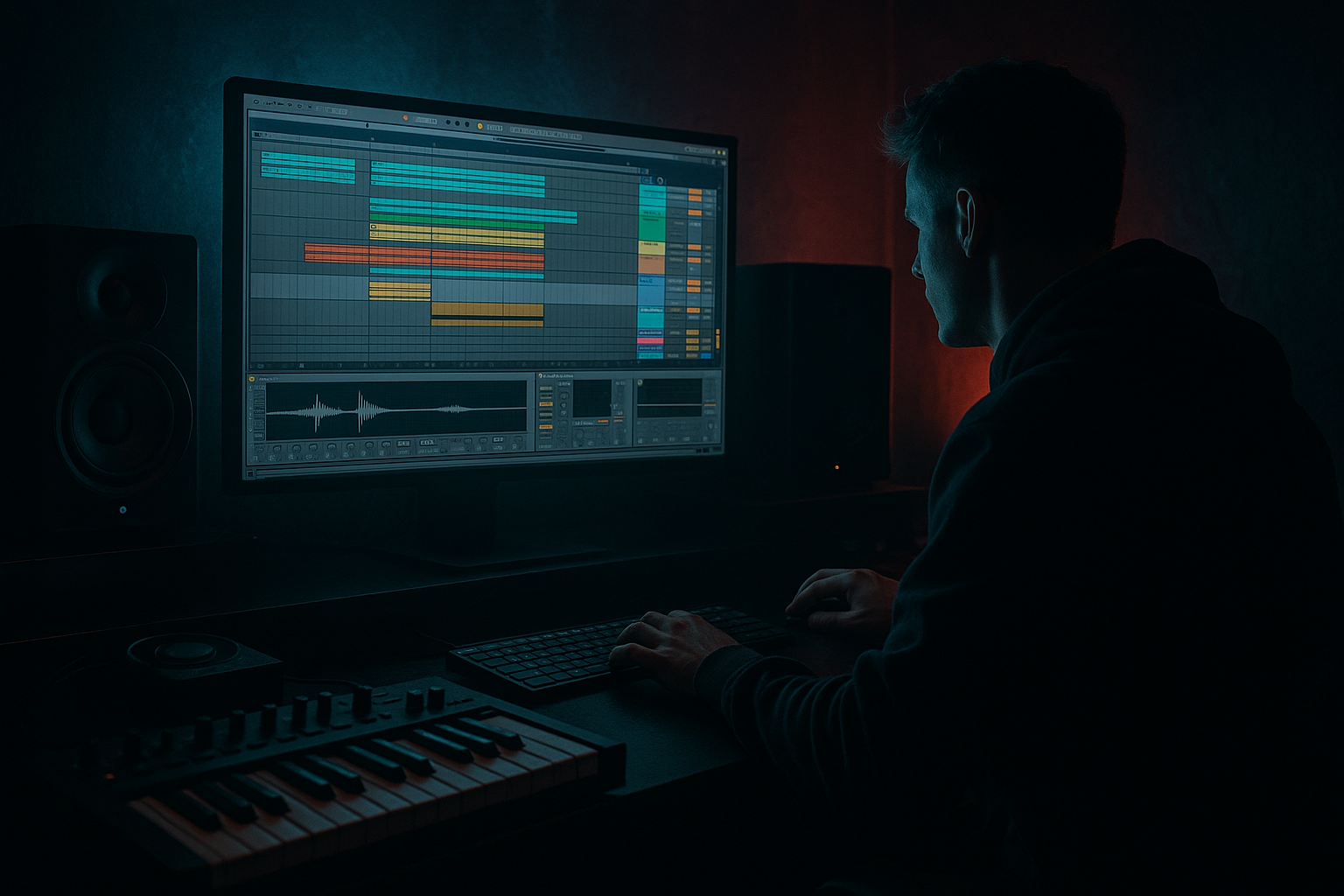
Main tutorial
Reese Ableton Live 12 Air Horn Hit Tutorial
Stock devices only — jungle / oldskool DnB FX design 🎛️🔥
1. Lesson overview
In this lesson you’ll build a classic Reese-based air horn hit in Ableton Live 12 using only stock devices. The goal is to create a hard, rude, ravey one-shot FX that feels at home in:
- jungle
- oldskool drum and bass
- rollers with ragga / rave influence
- dark amen edits and hype transitions
- mix-ready
- easy to resample
- controllable with MIDI
- designed for DnB arrangement pressure
- a thick detuned Reese layer
- a horn-like midrange formant
- a sharp attack
- a short, aggressive tail
- movement and stereo width
- optional delay/reverb throws for transition use
- Attack: instant, rude, slightly clicky
- Body: detuned saw thickness
- Tone: honky / horn-ish / synthetic brass
- Width: wide but controlled
- Energy: ideal for fill-ins, drop cues, and jungle edits
- 1-bar transition before a drop
- turnaround at end of 8s or 16s
- call-and-response with a vocal chop
- tension builder before re-entry of the drums
- accent on off-beats in a hardcore / ragga section
- Osc 1: Saw
- Osc 2: Saw
- Osc 3: Off or a very quiet square if needed
- Osc 1 level: 100%
- Osc 2 level: 80–90%
- Osc 2 detune: around +7 to +14 cents
- Osc 1 detune: around -7 to -14 cents
- Voices: 2–4
- Spread: moderate, not extreme
- Attack: 0–5 ms
- Decay: 250–500 ms
- Sustain: 0 to 20%
- Release: 100–250 ms
- Decay around 180–250 ms
- Sustain at 0
- Release around 80–120 ms
- Decay around 400–600 ms
- Release around 200–300 ms
- Filter type: Band-pass or low-pass with resonance
- Cutoff: start around 250–700 Hz depending on octave
- Resonance: medium-high, around 35–60%
- Drive: if available, push slightly
- Attack: 0 ms
- Decay: 150–400 ms
- Sustain: 0
- Amount: enough to sweep from darker to brighter
- Add Auto Filter after Wavetable
- Filter type: Band-pass or low-pass
- Drive: on
- Envelope follower: optional
- Use an Envelope via Shaper or MIDI automation if you want a more precise sweep
- Add a slow LFO to:
- LFO rate: 1/8 or 1/4, or use sync off and keep it slow
- Depth: very small
- You want the hit to wobble slightly, not become a bassline
- Macro 1 = Horn Formant
- Map it to filter cutoff + resonance + wavetable position
- Automate Macro 1 to rise quickly and fall
- Drive: +3 dB to +9 dB
- Soft Clip: on
- Output: trim to match level
- Frequency: 400 Hz to 1.5 kHz
- Drive: 10–30%
- Tone: adjust to taste
- Keep it focused, not fizzy
- Drive: 10–25%
- Crunch: 5–20%
- Boom: usually low or off for this FX
- Transients: +5 to +20 if you want extra snap
- High-pass: around 80–120 Hz
- Cut muddy area: around 200–400 Hz
- Boost presence: around 1.5–3.5 kHz
- Control harshness: around 6–9 kHz
- Use Width around 110–140%
- If the sound feels phasey, back it off
- Mode: subtle chorus
- Mix: low, around 10–20%
- Rate: slow
- Depth: low to medium
- Phase: 180°
- Rate: very slow or synced to 1/2 or 1 bar
- Amount: low
- Decay: 0.4–1.2 s
- Pre-delay: 10–25 ms
- Low cut: 200–400 Hz
- High cut: 6–9 kHz
- Wet: 5–15%
- one dry, punchy horn
- one heavily reverbed and filtered tail for transitions
- Time: 1/8 or dotted 1/8
- Feedback: 10–25%
- Filter: high-pass the repeats
- Wet: very low unless this is a special effect
- Horn Tone: dark to bright sweep
- Drive: +0 to +9 dB
- Width: 100% to 135%
- Tail: 0 to 18%
- Detune: subtle only, keep within musical sanity
- Root note of the track key
- Minor 2nd for tension
- Octave + fifth for a more “raid the rave” sound
- Try short stabs on the off-beats
- Bar 1 beat 4: one horn hit
- Bar 2 beat 4 + beat 1: call-and-response
- Two-hit pickup: short hit, then a slightly higher hit
- harder velocity = brighter, more aggressive
- softer velocity = darker, more controlled
- before drop 1
- end of 8-bar phrase
- before amen chop re-entry
- during a breakdown with vocal samples
- as a response to the snare fill
- an amen fill
- a sub drop
- a ragga vocal
- a reverse crash
- a tape stop effect
- Bars 1–8: build
- Bar 8 beat 4: horn hit
- Bar 9 beat 1: full drop
- Bar 15 beat 4: second horn variation
- Bar 16: fill + rewind
- lower the filter cutoff
- increase resonance slightly
- emphasize 700 Hz–2.5 kHz
- cut some 5–8 kHz if it’s too shiny
- same MIDI note
- one layer brighter and more distorted
- one layer darker, band-passed, and mono
- distort the midrange layer harder
- keep the top layer cleaner
- or use Audio Effect Rack chains split by EQ bands
- reverse it
- stretch it
- slice it into fills
- add tape stop or warp manipulation
- start the horn slightly filtered and narrow
- open it over 1/8 or 1/4 bar
- hit full brightness exactly on the drop
- Saw + saw
- Medium detune
- Band-pass filter
- Saturator
- Short reverb
- Lower cutoff
- More resonance
- Less high end
- Drum Buss crunch
- Narrower stereo image
- Brighter filter sweep
- More delay
- Wider chorus
- Longer tail
- Automate into the downbeat
- the end of a phrase
- before a drop
- after a drum fill
- which one cuts through best
- which one feels most “oldskool”
- which one works in mono
- which one supports the breakbeat strongest
- Wavetable or Analog
- detuned saws
- short amp envelope
- filter envelope or automation
- Saturator / Overdrive / Drum Buss
- EQ Eight
- Utility / Chorus-Ensemble
- optional Reverb / Delay
- the Reese detune gives movement
- the filter shaping creates the horn identity
- the distortion gives rave aggression
- the envelope keeps it punchy
- the mix control makes it usable in real DnB arrangements
- an Ableton device chain template
- a rack macro map
- or a sample-based version of the same oldskool DnB air horn sound.
This is not a bright, cheesy party horn. We’re making a gritty, wide, aggressive horn stab with a Reese core: detuned saws, motion, distortion, filtering, and a punchy envelope. Think of it as a rave signal flare for fills, drops, and rewind moments 😈
We’ll build it in a way that is:
---
2. What you will build
You’ll create an instrument rack that produces:
Final sound character
Best use cases
---
3. Step-by-step walkthrough
Step 1: Start with a clean MIDI track
Create a MIDI track and load:
1. Instrument Rack
2. Inside it, add Wavetable or Analog
- For this tutorial, start with Wavetable because Live 12 stock tools make the motion easier to shape.
3. Later we’ll add effects after the synth.
If you want a more oldskool feel, Analog works too. But for a modern hybrid jungle horn, Wavetable + distortion + filtering is the fastest path.
---
Step 2: Build the source tone in Wavetable
Oscillator setup
In Wavetable:
Set:
If your version gives you a unison/spread control:
Why this works
A Reese horn starts from detuned saw energy. The detune creates movement and tension; the horn effect comes later from filtering, envelope shaping, and distortion.
---
Step 3: Shape the amp envelope into a hit
In the Amp Envelope:
You want it to feel like a stab, not a pad.
For a tighter rave hit:
For a more epic oldskool horn:
---
Step 4: Add a horn-shaped filter movement
Now make it sound more like an air horn / brass hit rather than just a saw stab.
In Wavetable or with an added Auto Filter:
Option A: Use Wavetable’s filter
Add filter envelope
Set a filter envelope with:
This creates the classic “wah-horn” punch.
Option B: Use Auto Filter after the synth
If you want more control:
For DnB, a band-pass with resonance often feels most “horn-like,” while a low-pass sweep with distortion can feel heavier and darker.
---
Step 5: Add the Reese aggression with detune movement
To make it feel more like a Reese-derived FX hit, add motion that is subtle but alive.
In Wavetable:
- wavetable position, if using a more harmonically rich table
- filter cutoff
- oscillator fine pitch very lightly
Recommended modulation:
Better option for a one-shot:
Use a Macro to sweep the filter or wavetable position manually, then automate it per hit.
For example:
This gives a very usable transition horn movement.
---
Step 6: Distort it into DnB attitude
Now we move into the rude part 😎
Add Saturator first, then possibly Overdrive or Drum Buss.
Saturator
Suggested settings:
This thickens harmonics and brings the horn forward.
Overdrive
Use lightly if needed:
Drum Buss
Excellent for jungle-style aggression:
Tip
If it starts sounding too soft, add a bit more Saturator before the filter.
If it sounds harsh, move distortion after the filter and reduce highs with EQ.
---
Step 7: Use EQ Eight to make it sit like a real DnB FX
Add EQ Eight after distortion.
Start point:
- Keep low-end free for kick and sub
- Use a gentle bell cut if it gets boxy
- Great for “horn” bark
- If the distortion spits too hard
DnB-specific note
In jungle and DnB, FX often need to cut through dense break layering. The 1–4 kHz zone is where the ear catches impact, so don’t be afraid to shape there carefully.
---
Step 8: Add stereo width without losing punch
Use Utility, Chorus-Ensemble, or a very subtle Auto Pan.
Best stock approach:
#### Utility
#### Chorus-Ensemble
#### Auto Pan
Warning
Do not over-widen the core. A horn hit in DnB should still smack in mono. Keep the center strong.
---
Step 9: Add a tiny room or rave space
Use Reverb or Hybrid Reverb, but keep it controlled.
Reverb settings
You want it to feel like it exists in the room, not wash out the hit.
Pro DnB move
Duplicate the track and create a throw version:
Or use Return tracks for easy sends.
---
Step 10: Add rhythmic delay for rave character
A short Delay can make the horn feel more “system music.”
Delay settings
If you want a classic jungle echo, automate a delay send just on the last hit before the drop.
---
Step 11: Build a playable rack with macros
Now wrap the chain into an Instrument Rack and map macros.
Suggested macros
1. Horn Tone → filter cutoff / resonance
2. Detune → oscillator detune or unison amount
3. Drive → Saturator drive / Overdrive amount
4. Width → Utility width / chorus mix
5. Tail → Reverb wet / decay
6. Attack Snap → amp attack or transient shaping if used
This makes the sound fast to perform and automate in arrangement.
Very practical macro ranges
---
Step 12: Program the MIDI for impact
This sound is usually best as a single-note hit or a small motif.
MIDI note choices
Example phrase ideas
Velocity
Use velocity to vary:
If your synth supports velocity to filter or amp, map it.
---
Step 13: Arrangement ideas for jungle / oldskool DnB
Great placement
Classic jungle trick
Use the horn hit as a call, then answer with:
Oldskool structure idea
That’s pure sound system energy.
---
4. Common mistakes
1. Making it too bright
A lot of people overdo the high end and it turns into a harsh synth squeal.
Fix: reduce distortion highs, use EQ, and keep the horn more mid-forward.
2. Too much sub or low mid
This FX should not fight the kick/sub.
Fix: high-pass around 80–120 Hz and cut muddiness around 250–400 Hz.
3. Over-widening
If you make the Reese huge in stereo, it may disappear in mono.
Fix: keep the core centered and use width subtly.
4. Too much sustain
A horn hit that hangs too long loses impact.
Fix: shorten decay and release.
5. Using too much reverb
Great for atmosphere, bad for punch.
Fix: keep the dry hit dominant; use send automation for throws.
6. No filter movement
A static detuned saw just sounds like a synth stab.
Fix: add filter envelope or automation so it behaves like an air horn hit.
---
5. Pro tips for darker/heavier DnB
Tip 1: Push the formant into a darker zone
For darker jungle:
This makes it more menacing siren/horn, less rave toy.
Tip 2: Add a second layer for weight
Duplicate the instrument and make a second layer:
Blend them for depth.
Tip 3: Use frequency-specific distortion
Instead of globally crushing the sound:
Tip 4: Resample it
Bounce the horn to audio and reprocess it:
This is very jungle-friendly and gives a more organic result.
Tip 5: Automate the hit into the drop
A powerful trick:
That creates a real lift instead of just a static FX sample.
Tip 6: Pair it with break edits
If the horn lands with an amen chop or a snare flam, it instantly feels authentic.
The horn should punctuate the rhythm, not float on top of it.
---
6. Mini practice exercise
Exercise: Build three horn variations
Make these three versions in Ableton Live 12:
#### Version A: Classic rude horn
#### Version B: Dark dread horn
#### Version C: Rave transition horn
Challenge
Place all three in an 8-bar loop and test them at:
Listen for:
---
7. Recap
You’ve now built a Reese Ableton Live 12 air horn hit using stock devices only, designed specifically for jungle and DnB FX use.
Core chain recap
What makes it work
Final production mindset
For drum and bass, FX should do more than decorate — they should push energy, mark structure, and hype the drop. This horn hit should feel like it belongs on a sound system, not just in a synth demo. 🔊
If you want, I can also turn this into:

