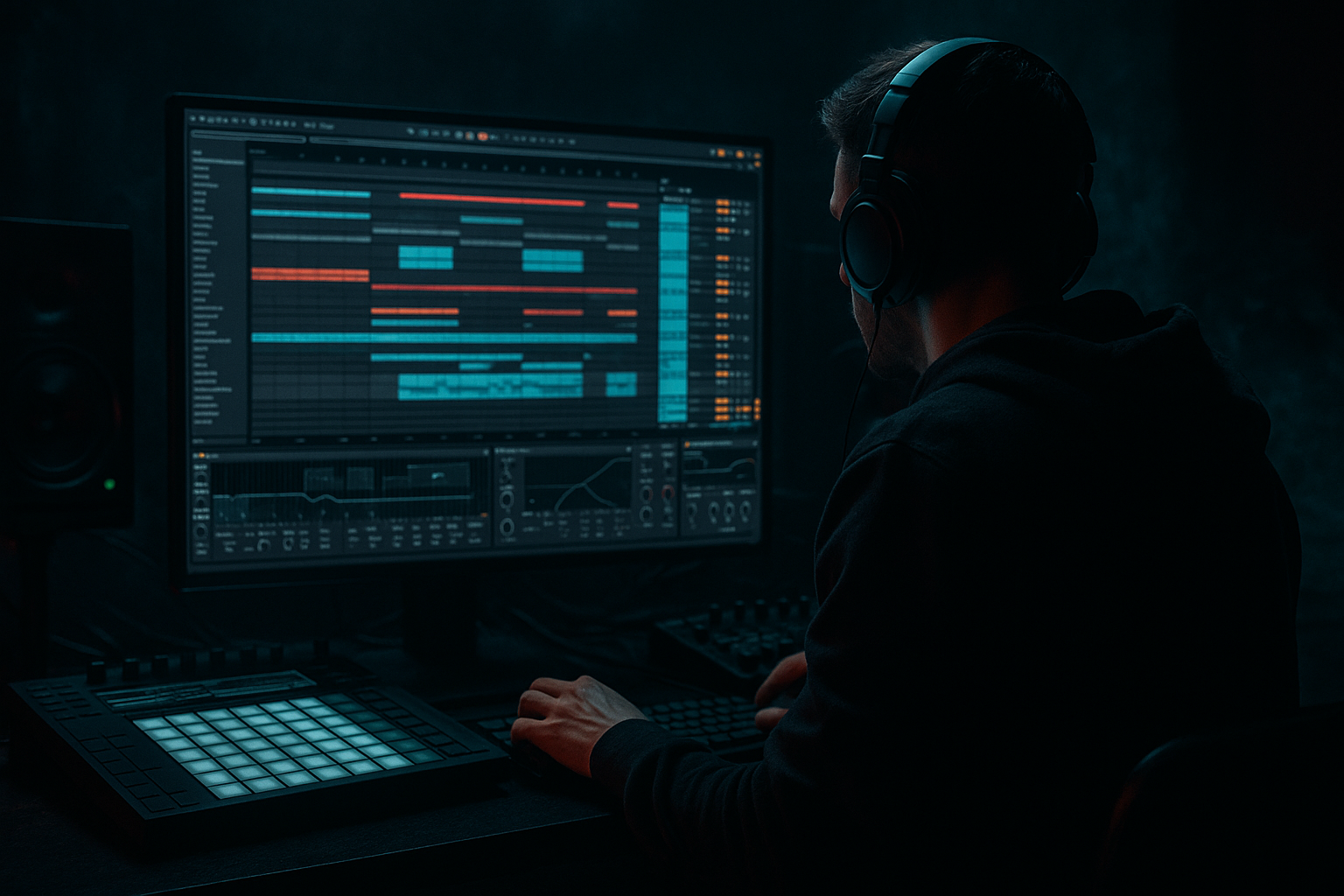
Main tutorial
Rebuild an Amen-style sub for VHS-rave color in Ableton Live 12
1. Lesson overview
In this lesson, you’ll build a dark, movement-filled sub layer that feels like it belongs under a classic Amen break / jungle / rave tune, but with that grainy VHS-rave color underneath. Think: low-end pressure, a little wobble and instability, and a touch of old-tape character without losing sub clarity. 🎛️
This is beginner-friendly, but we’ll work like real DnB producers do in Ableton Live 12:
- Start with a clean sub foundation
- Shape it with simple modulation
- Add controlled saturation and tape-style grime
- Make it sit with an Amen break and rolling drums
- Keep the low end solid in mono
- jungle intros
- rolling drum and bass drops
- darker halftime sections
- atmospheric breakdowns with “VHS rave” texture
- Operator for a pure sine sub
- Auto Filter for movement and tonal shaping
- Saturator for harmonics and audibility on small speakers
- Drum Buss or Redux for grime if needed
- Utility to keep the sub mono and controlled
- Optional Chorus-Ensemble or Echo on a send for atmosphere, not on the main sub
- anchors an Amen break
- feels deep and modern
- has a slightly haunted, tape-warped edge
- stays clean enough to club-test
- Waveform: Sine
- Transpose: 0
- Coarse: 0
- Fine: 0
- Voices: 1 if you want strict mono
- Glide: 0–50 ms for subtle movement, optional
- D1
- F1
- G1
- A1
- long D1
- short F1
- short G1
- return to D1
- one note per bar
- then add syncopation on the second half
- leave space for the break
- answer the kick/snare
- don’t overplay the low end
- Width: 0% or leave it unused since mono is the goal
- Gain: adjust if needed
- Bass Mono if you’re processing a wider layer later, but for a pure sub, simple mono is fine
- Filter type: Low-pass 24 dB or 12 dB
- Cutoff: start around 80–120 Hz if you want a darker sub, or higher if you need more harmonics
- Resonance: low, around 5–15%
- Drive: tiny amounts only, if needed
- lower cutoff in breakdowns
- slightly higher cutoff in drop sections
- tiny moves on phrase endings
- Drive: +2 to +6 dB
- Soft Clip: On
- Output: lower the output to compensate
- Dry/Wet: 30–70% depending on how dirty you want it
- a little edge
- more midrange harmonic content
- better translation outside of big sub monitors
- Downsample: very small amount
- Bit reduction: subtle
- Dry/Wet: 5–15%
- Drive: low to moderate
- Crunch: very low
- Boom: usually off for pure sub, or extremely subtle
- Transient: leave neutral
- Auto Filter cutoff
- Saturator drive
- Send amount to delay/reverb
- Clip gain or note velocity
- Shaper on a MIDI or audio effect chain
- Max for Live LFO if you have it
- Auto Pan set very subtly if used only as a movement tool on higher layers, not the sub itself
- harmonics
- textures
- parallel layers
- send effects
- High-pass at 120–180 Hz
- Cut harsh resonances if needed
- Boost a little around 300–800 Hz if you want more “radio/tape” presence
- Very low feedback
- Short delay time
- Filtered repeats
- Low dry/wet
- Does the sub leave space for the kick/snare?
- Is the snare still punching through at 2 and 4?
- Does the sub blur the break’s groove?
- Is the low end mono and stable?
- sub alone
- break alone
- sub + break
- sub + break + atmospheres
- filtered sub texture only
- no full bass weight yet
- add tape noise or ambience
- tease the Amen break
- open the filter slightly
- introduce the clean sub
- add a few ghost notes or slides
- full sub + Amen break
- texture layer tucked underneath
- automate tiny cutoff changes for movement
- remove the clean sub
- leave only the VHS layer, reverb tail, or filtered rumble
- D minor
- F minor
- G minor
- A minor
- Saturator
- Auto Filter
- subtle Chorus-Ensemble
- EQ Eight
- filter cutoff
- saturation drive
- send to ambience
- clip volume
- Operator sine only
- Utility
- no saturation
- no extras
- Operator
- Auto Filter
- Saturator at low drive
- Operator
- Auto Filter
- Saturator
- Redux lightly
- parallel high-passed texture layer
- Which version feels strongest under an Amen break?
- Which one is best for the drop?
- Which one works in the intro or breakdown?
- starting with a clean Operator sine
- keeping the low end mono and controlled
- adding movement with Auto Filter
- adding audibility with Saturator
- adding optional grime with Redux or Drum Buss
- using a parallel texture layer for atmosphere
- arranging it so it works with Amen breaks and rolling DnB drums 🎚️
By the end, you’ll have a sub patch / sub layer you can use in:
---
2. What you will build
You’ll create a sub bass chain in Ableton Live 12 with:
Final sound goal
A sub that:
---
3. Step-by-step walkthrough
Step 1: Set up a clean MIDI track
1. Create a MIDI track in Ableton Live 12.
2. Load Operator onto the track.
3. Name the track something like Sub Amen VHS so you stay organized.
Why Operator?
It’s the easiest stock device for a clean, accurate sub because it can generate a very pure sine wave.
---
Step 2: Build the pure sub in Operator
In Operator:
1. Click Oscillator A.
2. Set the waveform to Sine.
3. Turn off the other oscillators, or leave them unused.
4. Set Oscillator A level to full.
5. Make sure the filter section is bypassed or neutral for now.
6. Set Glide/Portamento only if you want sliding notes later.
Suggested starting settings
Why this matters
A clean sine gives you the true sub foundation. In DnB, this is the part that makes the system feel huge even when the mix is busy with breaks and atmospheres.
---
Step 3: Program a simple bassline
Now write a bass pattern that works with a rolling Amen-style drum loop.
#### Beginner-friendly pattern idea
Use notes around:
Try a pattern like:
Or keep it even simpler:
DnB tip
For jungle and rolling bass, sub patterns often work best when they:
If your Amen loop is busy, use fewer notes, not more.
---
Step 4: Add mono control with Utility
Insert Utility after Operator.
Set:
Important
Keep true sub frequencies mono.
This is especially important for DnB, because club systems and phase issues will destroy a wide sub fast.
---
Step 5: Shape the low end with Auto Filter
Add Auto Filter after Utility.
Use it gently to add movement and character.
#### Suggested settings
Automation idea
Automate the cutoff slightly so it opens more on transitions:
This gives that old rave tape “breathing” feel without turning the sub into a synth lead.
---
Step 6: Add harmonic weight with Saturator
Now add Saturator after Auto Filter.
This is a key step for making the sub audible on smaller speakers while keeping it deep.
#### Suggested starting settings
What to listen for
You don’t want distortion that buzzes all over the place.
You want:
DnB style tip
If your tune is leaning jungle, a slightly gritty sub can feel authentic, especially when paired with chopped Amen breaks and dubby FX. Keep it controlled, though.
---
Step 7: Add controlled VHS-style degradation with Redux or Drum Buss
For a more “VHS-rave” color, you can add one of these:
Option A: Redux
Use Redux lightly for bit-crush texture.
Suggested settings:
This gives a grainy edge without wrecking the low end.
Option B: Drum Buss
Use Drum Buss if you want a more aggressive, weighty character.
Suggested settings:
Warning
Do not overdo either device.
Your sub must still feel like a sub. If it sounds like fuzz, back off.
---
Step 8: Add subtle movement with LFO-style automation
Ableton Live 12 has strong modulation options, and even if you’re keeping this beginner-friendly, you can still create motion.
#### Easy approach: automate parameters manually
Automate:
#### If you want more movement
Use a device like:
Best practice
Keep the actual sub stable, and put the motion into:
That way the low end stays powerful.
---
Step 9: Add a parallel texture layer for VHS-rave color
This is where the atmosphere comes alive. 🌫️
Instead of dirtying the sub too much, duplicate the track or use a rack:
#### Parallel layer idea
1. Duplicate the sub track.
2. On the duplicate, add:
- EQ Eight
- Saturator
- Redux
- Echo
3. High-pass this layer so it doesn’t compete with the pure sub.
Suggested EQ Eight settings on the texture layer
Suggested Echo settings
This creates a ghostly, VHS-style trail while the original sub stays clean.
---
Step 10: Lock the whole chain to the break
Now place your Amen break and listen to the interaction.
#### What to check
Workflow suggestion
Loop 2 bars and test:
That’s the fastest way to hear if the low end is actually working.
---
Step 11: Arrangement ideas for a jungle/DnB track
Here’s a simple arrangement concept:
#### Intro
#### Build
#### Drop
#### Breakdown
This is a great way to make the drop feel bigger when the full sub returns.
---
4. Common mistakes
1. Making the sub too wide
A wide sub sounds cool in headphones but falls apart in clubs.
Keep the lowest part mono.
2. Overdistorting the sine
Too much Saturator or Redux turns a sub into noisy mush.
You want harmonics, not buzz overload.
3. Using too many notes
In DnB, a busy sub can fight the break.
Simple patterns usually hit harder.
4. Forgetting to compensate gain
Saturation and filtering often change level.
Match output volume so you’re judging tone, not loudness.
5. Putting reverb directly on the sub
Reverb on true sub usually muddies the mix fast.
If you want space, use a parallel high-passed layer instead.
6. Ignoring phase and low-end cleanup
Check your mix in mono occasionally.
If the low end disappears, something in the chain is too wide or phasey.
---
5. Pro tips for darker/heavier DnB
Tip 1: Use note choice for darkness
Stick to darker keys and tonal centers like:
These work really well for classic rolling bass music.
Tip 2: Create tension with small pitch moves
Try tiny slides or quick approach notes into the main sub note.
That gives it jungle flavor without needing a huge bass sound.
Tip 3: Layer a very quiet mid-bass
If the sub needs more presence, duplicate it and high-pass the copy.
Then process the copy with:
That gives a “full spectrum” bass while preserving the sub.
Tip 4: Use automation for phrase energy
Automate:
This helps your drop evolve instead of looping flat.
Tip 5: Test against the Amen break
The Amen is fast, dense, and full of transient information.
If your sub sounds great alone but messy with the break, simplify it.
---
6. Mini practice exercise
Exercise: Build 3 versions of the same sub
Create one 2-bar sub pattern and make three variations:
#### Version 1: Clean
#### Version 2: Warm
#### Version 3: VHS-rave dirty
What to compare
This teaches you how to choose the right bass character for different song sections.
---
7. Recap
You just built an Amen-style sub with VHS-rave color in Ableton Live 12 by:
The big takeaway
In drum and bass, the best sub is not always the biggest or dirtiest one.
It’s the one that locks with the drums, translates on systems, and leaves room for the rest of the track.
If you want, I can also turn this into a specific Ableton rack preset recipe with exact device order and knobs for a jungle/DnB sub chain.

