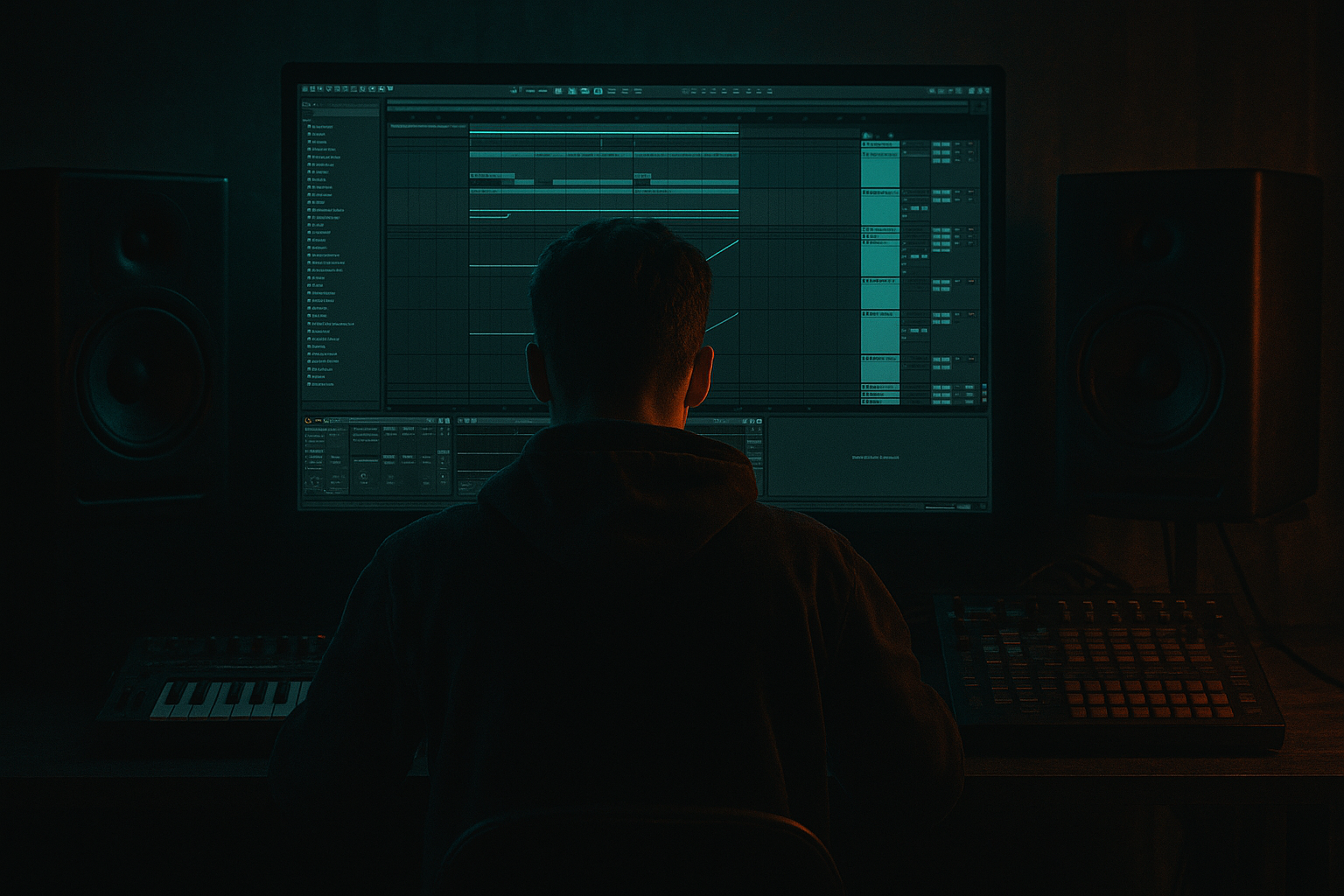
Main tutorial
Lesson Overview
This lesson is about building a clean pirate-signal style bass wobble from scratch in Ableton Live 12, then placing it so it works as a real arrangement device inside a jungle / oldskool DnB track. The goal is not just to make a “wub” sound — it’s to create a bass phrase that feels like it belongs in a proper DnB drop: rhythmic, tense, controlled, and ready to sit under breaks without smearing the low end.
In this style of track, the bass wobble usually lives as a call-and-response phrase with the drums. It might answer the snare, punctuate a 2-bar loop, or provide a signature hook in the first drop and then evolve for the second drop. For pirate-signal / oldskool jungle energy, the bass should feel a little mischievous and dangerous, but still disciplined enough to keep the kick, snare, and break edits readable.
Why it matters musically: a good wobble gives the track identity. Why it matters technically: if the wobble is too wide, too long, or too busy in the wrong registers, it will swallow the break and wreck the groove. The best versions are modular — they can be resampled, edited, muted, re-ordered, and automated like arrangement material.
By the end, you should be able to hear a bass phrase that:
- locks to the groove instead of fighting it
- has clear movement without collapsing the sub
- sounds energetic and “signal-like” rather than modern brostep-heavy
- can sit in a drop, then be edited into a later section without rebuilding from zero
- a solid mono sub foundation
- a midbass layer with controlled wobble movement
- a slightly ragged, piratical edge from saturation/filter movement
- a rhythmic pattern that answers the drums instead of smearing them
- a mix-ready result that can be printed to audio and dropped into an arrangement
- Use filter movement as drama, not decoration. In darker DnB, a small cutoff rise before the snare can feel more menacing than a huge sweep. A 1/8-note wobble that only opens a little can hit harder than a massive open filter because it stays controlled.
- Treat the midbass like a weapon and the sub like a foundation. If the mid layer is filthy, let it be filthy, but keep the sub almost boring. That contrast is what makes the bass feel big without losing club translation.
- Let one note be “wrong” on purpose. In pirate or underground energy, a single slightly more open, brighter, or more resonant note in a 2-bar phrase can become the hook. Use that sparingly so it sounds intentional, not random.
- Use negative space before the bass re-enters. A half-beat of silence before a drop-in can make the next wobble feel twice as aggressive. This is especially effective after a snare fill or break chop.
- Automate the bass like an arrangement event. Small changes across 8 or 16 bars keep the tune alive: filter a touch open, drive up slightly, note length shorter for the first half of the drop, then more open for the second half.
- Keep mono compatibility sacred below the sub region. If you want menace, get it from harmonics, timing, and phrasing — not from stereo tricks in the low end. Test the bass in mono and fix width in the mid layer, not the sub.
- Resample a few versions and choose the best attitude. A clean version, a dirtier version, and a slightly darker version can all work differently in the arrangement. The right one is usually the one that leaves the snare strongest.
- Use only Ableton stock devices.
- Keep the sub separate from the wobble layer.
- Use no more than 2 notes in the first bar and 3 notes in the second bar.
- Leave at least one clear gap for the snare.
- Commit the final phrase to audio.
- Does the bass still feel solid when heard with the break?
- Can you hear the snare clearly through the bass?
- Does the wobble sound like a phrase, not a constant effect?
- Does the mono test still hold the low end together?
This best suits jungle, oldskool DnB, roller-adjacent breakbeat DnB, and darker pirate-radio inspired bass music where attitude and arrangement are as important as raw sound design.
What You Will Build
You will build a tight, clean, oldskool-flavoured bass wobble phrase in Ableton Live 12 that has:
The finished sound should feel like a proper DnB bass callout: not too polished, not too huge, but definite and intentional. It should sit with breaks, have enough weight to hit on small systems, and still leave space for the snare crack and ghost-note detail. A successful result should sound like a bassline that makes the drop feel like it has a spine, not just a texture.
Step-by-Step Walkthrough
1. Start with the arrangement context before the sound design
Before you open any devices, place a simple 8-bar loop around your drums. For this lesson, use:
- a break or break-layered drum pattern
- a snare on 2 and 4, or a jungle-style snare placement
- a kick that already establishes the groove
- a placeholder sub note on the root
Put the bass idea into the drop context, not an isolated loop. In DnB, a wobble that feels exciting alone can disappear or clash once the break is running. Set the loop so you can immediately judge whether the bass phrase leaves space for the snare and break transients.
What to listen for: the bass should feel like it “bites” around the drums, not on top of every transient. If the kick disappears or the snare loses its crack, the bass is too broad or too constant.
2. Build the foundation with a simple instrument chain
On a MIDI track, start with Wavetable or Operator as the core source.
A practical stock chain for the main layer:
- Wavetable: start from a basic saw, square, or a simple wavetable with strong harmonics
- Auto Filter
- Saturator
- EQ Eight
- Compressor or Glue Compressor if needed for control
Keep the oscillator choice simple. For pirate-signal energy, the motion should come more from filtering and modulation than from a wildly complicated source.
Useful starting points:
- unison: keep low, or off on the sub layer
- wavetable position: near a harmonically rich but stable spot
- filter type: low-pass or band-pass for the wobble layer
- saturation drive: around 2–6 dB to start
- EQ low cut on the mid layer only: often around 100–150 Hz so the sub has room
If you use Operator, make a sine sub and a second oscillator layer for mid movement. That gives you cleaner separation than forcing one sound to do everything.
Why this works in DnB: the sub and the movement behave differently. The sub stays stable under fast break edits, while the wobble layer can be animated without destabilising the low end.
3. Separate the sub from the wobble early
This is the point where many basslines go wrong. Don’t let one patch do all the jobs. Make a split:
- Sub track: pure or nearly pure low bass, mono, no obvious wobble
- Midbass track: the expressive wobble, filtered and saturated
In Ableton, a clean way to do this is to duplicate the MIDI part:
- one track carries only the low note foundation
- another track carries the wobble layer an octave up, or with the low end filtered out
On the sub track:
- use Operator sine, or Wavetable with a very simple waveform
- keep it mono
- avoid heavy distortion
- low-pass if needed, or just keep it clean by design
On the wobble track:
- use Auto Filter with a low-pass cutoff in a range roughly between 150 Hz and 1.5 kHz depending on brightness
- use Saturator after the filter for edge
- EQ out unnecessary sub below about 80–120 Hz if the sound still carries low end
What to listen for: if the bass still feels powerful when the wobble layer is muted, your sub is working. If the bass collapses when the wobble layer is muted, your sub is not independent enough.
4. Program a short, DJ-friendly phrase instead of a constant drone
Make the bass pattern a 2-bar phrase first. Oldskool jungle and pirate-radio DnB often use basslines that are more memorable because they breathe. Try a pattern that leaves a deliberate gap before or after the snare, then answers with movement.
A strong starting structure:
- bar 1: a short hit on the offbeat, then a held note or tied note
- bar 2: a variation with one extra note, or a higher octave reply
- leave at least one clean pocket for a break accent or snare ghost
Use MIDI note lengths to shape phrasing:
- short notes for bite
- medium notes for bounce
- avoid holding the wobble constantly through every snare unless you want a wall-of-bass roller feel
For jungle oldskool energy, the bass often works best when it feels like it is punctuating the groove, not continuously narrating it.
Arrangement note: if you are building a drop, keep the first 8 bars simpler. Save the more aggressive variation for bars 9–16 or the second half of the drop.
5. Create wobble movement with controlled modulation
Now make the “pirate signal” motion. In Wavetable, map an LFO to the filter cutoff or wavetable position. In Auto Filter, you can automate cutoff directly, or modulate it with an LFO if your setup supports that workflow in your version.
Start with a wobble rate that feels rhythmically useful:
- 1/4 note for a broad, heavy sway
- 1/8 note for more urgency
- dotted or triplet feels can work in jungle, but only if the drums remain clear
Keep the modulation depth controlled. You want movement, not a filter sweeping so wide that the note stops sounding like a bass note.
A good starting range:
- cutoff opening: roughly 300 Hz to 1.2 kHz for a darker wobble
- resonance: moderate, not screaming, unless you want a more synthetic pirate edge
- LFO amount: just enough that each wobble has a shape change you can hear in the mix
What to listen for: the movement should be obvious enough that the line feels alive, but the bass should still read as the same note across the phrase. If each wobble sounds like a separate effect rather than one coherent instrument, reduce depth.
6. Add edge with saturation, but keep the low end disciplined
Put Saturator after the filter on the wobble layer. The goal is to generate harmonics that help the bass read on small speakers and through break layers.
Practical starting points:
- Drive: 2–6 dB
- Soft Clip: often useful for keeping peaks contained
- Output: trim down after driving so you keep level honest
If the bass needs more attitude, try Redux very subtly on the mid layer only, or use a bit of distortion from Saturator rather than making the waveform too complex.
Use EQ Eight after saturation:
- cut mud around 200–400 Hz if it clouds the snare zone
- tame harshness around 2.5–5 kHz if the wobble starts sounding fizzy
- keep the sub region under control by high-passing the mid layer if necessary
Why this works in DnB: jungle and oldskool DnB often need the bass to cut through busy drum programming. Harmonics help the bass stay audible without increasing sub level, which is exactly what you want when the break is already doing a lot.
7. Check the bass against the drums, not in solo
This is where you decide whether the idea is actually usable. Loop the 8 bars and listen with:
- break
- kick
- snare
- bass
Then mute the break for a moment and check whether the bass still has shape. After that, bring the break back in and listen again. The bass should leave space for:
- snare crack
- ghost notes
- kick transient
- any top-loop texture
If the bass fights the snare, try one of these:
- shorten the bass note so it releases before the snare hit
- automate the filter slightly down on the snare
- reduce saturation brightness
- move the bass hit a small amount earlier or later if the groove benefits from it
A useful mix-clarity check: switch to mono or test the bass in a narrow field. If the wobble disappears too much, the movement may be too dependent on stereo widening, which is risky for DnB club translation.
8. Choose your flavour: A or B
This is an important creative decision point.
A. Clean pirate wobble
- tighter filter movement
- moderate saturation
- clearer note definition
- better for a roller, a cleaner oldskool nod, or a DJ-friendly first drop
B. Heavier pirate signal
- more resonance
- more drive
- slightly darker filter starting point with bigger movement
- better for a more threatening second-drop variation or a rougher jungle mutation
If you choose A, keep the wobble more readable and let the drums carry more of the aggression.
If you choose B, make sure the sub remains separate and the mid layer is still controlled. Heavy is good; undefined is not.
Decision rule: if the track already has dense break edits and noisy FX, choose A. If the drums are simpler and you need more bass personality, choose B.
9. Print the bass to audio once the phrase works
When the MIDI version is working, commit it to audio. This is a workflow efficiency move that matters in arrangement-focused DnB. Once you print the phrase, you can:
- slice exact bass hits
- reverse individual tails
- fade specific wobble notes
- duplicate and rearrange sections quickly
- create fills without over-editing the synth patch
In Ableton, resample or freeze/flatten into audio and then cut the phrase into clips. This is especially useful if you want a pirate-signal bass to become part of the arrangement rather than a loop that never evolves.
Stop here if the current 2-bar phrase already hits hard with drums and the movement feels intentional. Commit it to audio before you start endlessly tweaking the synth. In DnB, arrangement often improves faster from editing audio than from polishing the source forever.
10. Build arrangement movement with edits, not more sound design
Once printed, make the bass evolve over 16 bars. A simple arrangement approach:
- bars 1–8: clean phrase, minimal variation
- bars 9–12: add a small rhythmic answer or octave lift
- bars 13–16: introduce a gap, reverse tail, or a filtered pickup into the next section
A strong oldskool-style move is to let the bass phrase drop out for half a bar before a snare accent, then re-enter with a slightly different note rhythm. This gives the listener a reset without needing a giant fill.
For a second drop, consider:
- one extra note in the answer phrase
- a more open filter on the last 4 bars
- a small automation rise in cutoff or drive
- a one-bar breakdown of bass with only sub and atmospheric residue, then slam back in
Keep the arrangement DJ-friendly. Leave clean endings and readable section boundaries so the track can be mixed by a DJ without the bass line trampling every transition.
Common Mistakes
1. Making the wobble too wide in the low end
- Why it hurts: wide low bass collapses poorly in mono and smears the kick/snare relationship.
- Fix: keep the sub mono, and only widen or move the mid layer above the sub region. High-pass the wobble layer if needed.
2. Using one patch for sub and movement
- Why it hurts: if the filter or saturation is doing everything, the sub loses stability every time the wobble changes.
- Fix: split the sub and midbass into separate tracks or separate layers, and process them differently.
3. Over-wobbling every beat
- Why it hurts: constant motion removes phrasing and makes the bass feel like wallpaper.
- Fix: program rests and short holds. Let the bass answer the drums instead of narrating continuously.
4. Driving saturation until the bass turns fizzy
- Why it hurts: you get apparent loudness, but the low-mid region becomes harsh and the snare loses clarity.
- Fix: lower drive, soft clip less aggressively, and use EQ Eight to tame 2.5–5 kHz if needed.
5. Ignoring the break when designing the bass
- Why it hurts: a bassline that sounds huge alone can fight the break’s ghost notes and transient detail.
- Fix: keep the loop running with the actual drums while you shape the bass. Adjust note lengths and filter movement based on that context.
6. Letting notes ring too long into the snare
- Why it hurts: the bass steals the snare’s punch and muddies the arrangement.
- Fix: shorten MIDI note lengths, add slight amplitude envelope reduction, or automate the filter down on the snare hit.
7. Forgetting to commit to audio
- Why it hurts: you stay stuck tweaking instead of arranging, and the line never becomes an actual part.
- Fix: once the phrase works, freeze/flatten or resample it and start editing the audio for fills, switch-ups, and drop structure.
Pro Tips for Darker / Heavier DnB
Mini Practice Exercise
Goal: Build a 2-bar pirate-signal bass wobble that works with a jungle break and can be dropped straight into an 8-bar arrangement.
Time box: 15 minutes.
Constraints:
Deliverable:
A resampled 2-bar bass clip with a clear wobble phrase, plus a second version with one arrangement variation for bars 9–16.
Quick self-check:
Recap
A clean pirate-signal bass wobble in Ableton Live 12 is built by splitting sub and movement, shaping the wobble as a phrase, and arranging it against the drums. Keep the sub stable, make the mid layer carry the attitude, and use saturation and filtering for character without wrecking clarity. Once it works, print it to audio and edit it like arrangement material. In DnB, the best basslines don’t just sound heavy — they make the whole drop feel structured, playable, and dangerous.

