Main tutorial
Lesson Overview
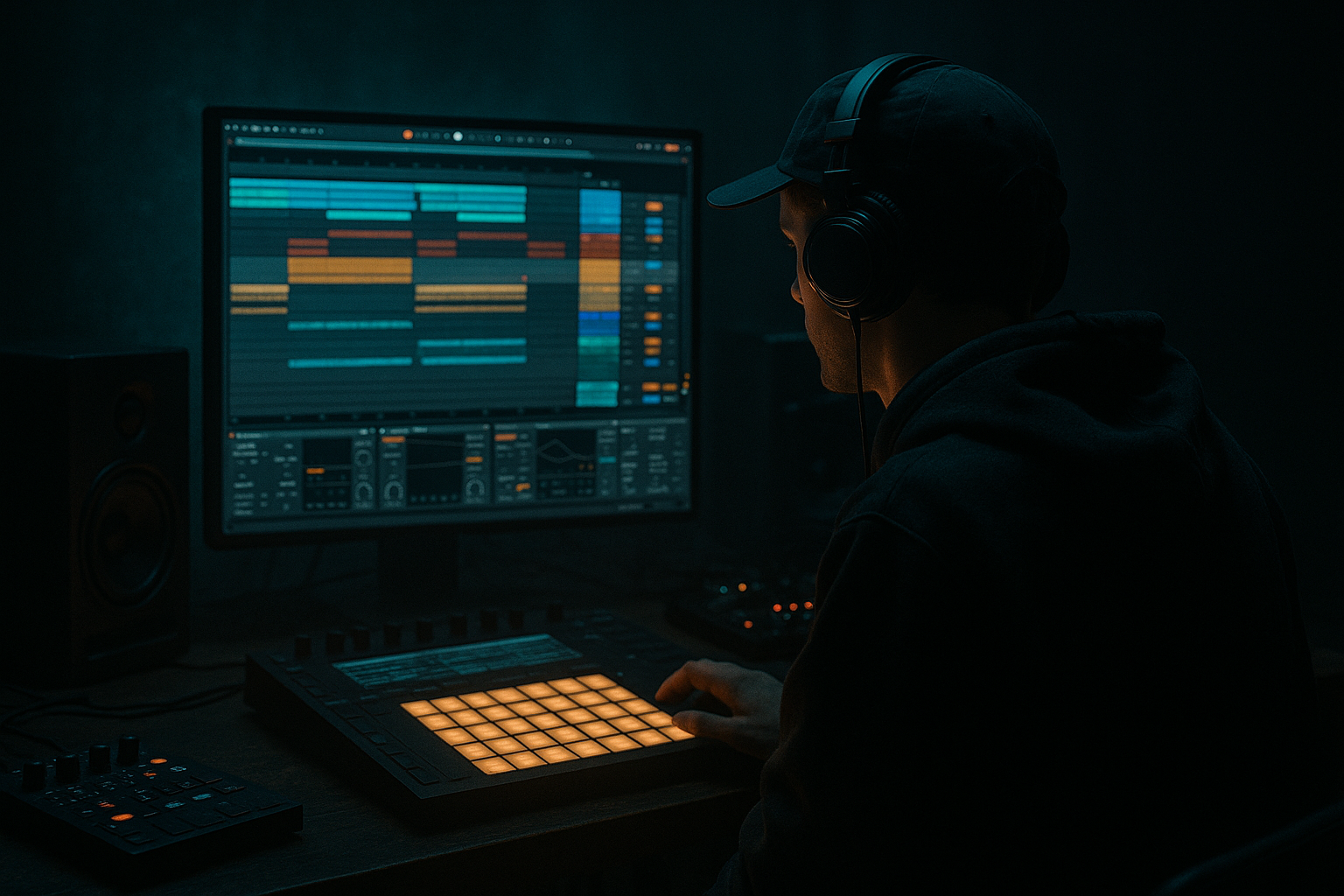
This lesson is about building a Pirate Radio-style break roll system in Ableton Live 12 for smoky warehouse, jungle, and oldskool DnB vibes. The goal is to create a drum movement setup that feels like it was lifted from a late-night tape broadcast: chopped breaks, pressure-filled ghost hits, rolling edits, and short tension bursts that keep the groove alive without sounding overproduced.
In DnB, especially jungle, rollers, and darker bass music, the difference between a loop that just repeats and a loop that drives the room is often the micro-variation in the drum roll system. Pirate radio energy comes from urgency: edits feel slightly chaotic, but the groove still locks hard. That’s what we’re building here.
This technique fits best in:
- 8-bar drum loops
- 16-bar intro / breakdown tension
- pre-drop roll-ins
- call-and-response drum switches
- DJ-friendly extended sections where the drums evolve without losing the floor
- a main chopped Amen-style break or any classic break loop
- ghost-note roll layers for extra swing and urgency
- a filtered noise/tape layer for smoky atmosphere
- a drum fill trigger lane for transitions
- automation-ready macro controls for roll intensity, tone, decay, and crunch
- a bus chain that glues the breaks together without flattening the transients
- a rolling pirate radio drum section
- with tight oldskool swing
- smoky room tone
- snappy top-end hats
- controlled low-mid grit
- and a sudden ramp-up into the drop when you need it
- Over-quantizing the break
- Too much roll density all the time
- Saturating the entire drum bus too hard
- Letting low-end junk build up under the breaks
- Making the roll too clean
- Stereo widening the wrong layers
- Resample your break bus
- Use filtered reverb returns, not huge wet drums
- Let the bassline answer the drums
- Use Drum Buss for movement, not just loudness
- Automate harshness, not just volume
- Keep a second version of the break system
- Reference old jungle and pirate radio energy
- Build the break as a layered system, not a single loop.
- Use ghost notes, velocity variation, and slight timing shifts for pirate-radio swing.
- Shape the sound with EQ Eight, Drum Buss, Saturator, Utility, Auto Filter, and Glue Compressor.
- Keep the roll intensity phrase-based, not constant.
- Preserve mono low end, punchy snare energy, and headroom.
- Use arrangement to make the drums breathe, rise, and hit like real underground DnB.
Why it matters: if your break rolls are too static, the track sounds looped. If they’re too busy, the groove collapses. This lesson gives you a system for keeping the drums animated, gritty, and mix-ready while staying authentic to oldskool DnB / jungle / pirate radio energy.
What You Will Build
You’ll build a multi-layer break roll rack in Ableton Live 12 that includes:
The result will sound like:
Think: a warehouse roller intro that starts sparse, then the break starts mutating, adding stabs of ghost hits, snare fills, and broken-up hats until it feels like the whole tune is leaning forward.
Step-by-Step Walkthrough
1. Build the break foundation on a dedicated drum group
- Create a new MIDI track or Audio track for your main break source. If you’re using audio, drop in a classic break sample and warp it carefully; if MIDI, use Drum Rack with sliced break hits.
- Route all drum layers into a Drum Group called something like `BREAK SYSTEM`.
- Inside that group, keep at least:
- `MAIN BREAK`
- `GHOST ROLL`
- `TOP HATS`
- `NOISE / TAPE`
- `FILL TRIGGERS`
- Why this works in DnB: jungle and oldskool DnB depend on layered drum phrasing, not just a single loop. Grouping lets you shape the whole roll while still preserving the character of each layer.
2. Choose a break that already has movement, then slice it intelligently
- Pick a break with a strong snare backbeat and enough ghost detail to cut up. Amen, Think, Apache, and similar breaks work well.
- In Clip View, enable Warp and try:
- Beats mode for punchy drum integrity
- Preserve = Transient or Tones depending on the source
- Transient Loop Mode = Repitch only if you want raw, pitched-up oldskool grit
- If the break is on audio, use Slice to New MIDI Track and slice by:
- Transient
- or 1/16 if the break is already rhythmically stable
- Keep slices tight around the snare and ghost hits. Don’t over-edit the whole break into sterile perfection.
- Parameter suggestions:
- Warp Transient preserve for sharper drum edge
- Fade/clip envelope release around 5–20 ms to prevent clicks without softening the hits too much
3. Program the core groove before the roll
- Start with a simple 2-bar or 4-bar pattern in your main break lane. The goal is a groove that already feels like it can carry the track before any fancy roll edits.
- Keep the core emphasis on:
- snare on 2 and 4
- kick-led motion around the offbeats
- ghost hits that pull into the backbeat
- In MIDI, nudge a few notes slightly late:
- snare ghosts around 5–15 ms late
- light hats around 10–20 ms ahead or behind depending on feel
- Use Groove Pool with a classic swing source or extract groove from the break itself.
- Suggested groove moves:
- Groove Amount around 20–50%
- Timing strength moderate, velocity slightly preserved
- This gives you the pirate-radio lilt without turning the drums into a rigid grid pattern.
4. Create the roll layer with note density and velocity design
- Duplicate the break lane and turn it into your roll layer.
- In the roll section, increase note density only in strategic moments:
- last 1 bar before the drop
- last 2 beats before a switch
- bar 7–8 of an 8-bar phrase
- Use shorter note lengths, especially on hats and ghost snares, to create a ratcheting effect.
- In Ableton’s MIDI editor, shape velocity so the roll feels human:
- main hits around 90–120
- ghost hits around 35–75
- accent notes peaking at 110–127
- A useful trick is to stack a few fast ghost notes on one snare lane, but vary velocity and timing slightly. This creates the “spiral-up” feel heard in old tape edits.
- If you’re using a Drum Rack, map the break slices to pads and play the roll in real time, then quantize lightly at 1/16 or 1/32 with 50–75% strength.
5. Shape the roll with stock Ableton devices
- On the `GHOST ROLL` or `MAIN BREAK` group, add:
- Drum Buss for weight and glue
- Saturator for edge
- EQ Eight for cleanup
- Utility for mono control on low end
- Example chain:
- EQ Eight: high-pass very gently around 25–35 Hz to clear sub rumble; small cut around 250–400 Hz if the loop gets cloudy
- Drum Buss: Drive around 5–15%, Crunch around 2–8%, Boom kept low or off for this layer
- Saturator: Soft Clip on, Drive 2–6 dB
- If the snare loses snap, reduce saturation and add a tiny boost around 2–5 kHz with EQ Eight.
- For the roll layer, don’t over-compress. You want motion, not a flat brick.
6. Add a smoky atmosphere layer that acts like pirate radio dust
- Create a separate audio or MIDI track for noise, vinyl texture, room hiss, or filtered ambience.
- Use Operator, Analog, or a sampled noise source if you want to synthesize it inside Live.
- Process it with:
- Auto Filter: low-pass around 1.5–6 kHz, automate cutoff during transitions
- Redux very lightly for grain
- Echo with short delay time and low feedback if you want a hazy tail
- Keep this layer subtle. It should feel like smoke, not a lead sound.
- Automate the filter to open slightly as the roll intensifies, then clamp it back down at the drop. That creates the sensation of the room “breathing.”
- This atmospheric layer is especially effective in warehouse-techy jungle because it adds size without adding clutter.
7. Design the transition fill and call-and-response moments
- Build a separate `FILL TRIGGERS` lane for fills that happen at the end of phrases.
- Use short bursts of:
- snare drags
- kick/snare doubles
- hat stutters
- reverse or downbeat-style hits
- Keep the fill in conversation with the bassline. For example:
- if the bass answers on the offbeat, let the drum fill occupy the empty space just before it
- if the bassline is dense, make the roll more minimal
- Arrangement context example: in an 8-bar drop, use bars 1–4 for the main groove, bars 5–6 for subtle roll buildup, and bars 7–8 for the full pirate-radio fill before a second switch or drop repetition.
- In DnB, this works because the listener feels the phrase turning over. You’re not just adding fills — you’re telegraphing the next section.
8. Automate intensity with Macro controls in an Instrument Rack or Audio Effect Rack
- Group your drum processing into an Audio Effect Rack and map key controls to Macros:
- Macro 1: Roll Intensity
- Macro 2: Tone
- Macro 3: Crunch
- Macro 4: Width
- Macro 5: Atmosphere
- Macro 6: Transient Bite
- Map examples:
- Roll Intensity → track volume of ghost roll lane + Auto Filter cutoff
- Tone → EQ Eight high shelf or low-pass cutoff
- Crunch → Saturator Drive / Drum Buss Drive
- Width → Utility width on top layer only
- Automation ideas:
- slowly raise Roll Intensity over 4 or 8 bars
- open Tone by 5–15% before the drop
- increase Crunch only on the last 1–2 bars
- This gives you a fast, performance-friendly way to develop tension without rebuilding the pattern every time.
9. Glue the drum bus without killing the break character
- On the `BREAK SYSTEM` group, add final bus processing carefully:
- Glue Compressor: Ratio 2:1 or 4:1, Attack 10–30 ms, Release Auto or 0.1–0.3 s
- Aim for only 1–3 dB of gain reduction on peaks
- EQ Eight for final corrective cuts if needed
- Keep the kick and snare punch intact. If the compressor starts making the loop sound small, back off and use less gain reduction.
- Check mono compatibility with Utility. Keep low end centered and clean.
- A good rule: if the break sounds exciting solo but weak in the mix, your bus processing is probably too aggressive. In DnB, the drums must stay forward, not flattened.
10. Arrange it like a proper underground DnB section
- Use the roll system across the track instead of only in the drop.
- A strong arrangement might look like:
- Intro: filtered break + atmosphere + light hats
- Bars 17–32: first groove introduction with minimal roll
- Bars 33–48: full break movement, ghost-note buildup
- Last 2 bars before drop: aggressive roll, fill, and filter lift
- Drop: strip back the atmosphere and let the core drum/bass relationship hit hard
- For DJ-friendliness, keep the intro/outro sections clean enough to mix. Let the pirate-radio tension live in the middle and pre-drop sections.
- This keeps the track functional for selectors while still giving you that smoky, tape-saturated underground feel.
Common Mistakes
- Fix: loosen timing with Groove Pool, manual nudges, and lighter quantize strength. Oldskool DnB breathes.
- Fix: reserve the densest roll for phrase endings and switch-ups. Constant pressure kills impact.
- Fix: saturate layers individually first, then use only gentle bus glue.
- Fix: high-pass non-bass drum layers around 25–35 Hz, and check for muddiness around 200–400 Hz.
- Fix: keep some velocity variation, slight timing offsets, and a touch of roughness. Pirate radio vibes are imperfect by design.
- Fix: keep kick, snare core, and sub mono. If you widen anything, do it on tops, ambience, or textures only.
Pro Tips for Darker / Heavier DnB
- Once the roll feels good, record it to audio and chop the resampled file. This can give you a more cohesive, grimey feel than endless MIDI tweaking.
- Send snare ghosts or fill hits to a return with Reverb or Echo, then low-pass the return heavily. You get space without washing out the punch.
- In darker DnB, the groove gets heavier when the bass phrasing and drum rolls are in conversation. Leave gaps for the bass to “speak.”
- A small amount of Crunch plus Transients can make a break feel more animated. Keep Boom very controlled unless you specifically want extra low-mid pressure.
- Use EQ Eight or Auto Filter to tame sharpness during dense rolls, then reopen the top for the drop. This adds tension without changing the pattern.
- One version for the main section, one more stripped version for DJ intro/outro. This helps finishing speed and arrangement clarity.
- Listen for how the drums are left slightly raw, with edits that feel “played” rather than machine-perfect. That’s the vibe you’re chasing.
Mini Practice Exercise
Set a timer for 15 minutes and build one full pirate-radio roll phrase in Ableton Live.
1. Choose one break and slice it to a Drum Rack.
2. Program a 2-bar groove with a clear snare backbeat.
3. Duplicate it into a second lane and add a 1-bar roll-up at the end.
4. Add Ghost notes with velocities ranging from 40–80.
5. Put Drum Buss and Saturator on the break group.
6. Add Auto Filter to a noise/texture layer and automate the cutoff open over the last bar.
7. Create one 8-bar arrangement loop:
- bars 1–4: basic groove
- bars 5–6: increased movement
- bars 7–8: full roll and fill
8. Bounce the section to audio and listen once in mono.
Goal: by the end, you should have a loop that feels like it’s gathering pressure, not just repeating.
Recap
If you get the groove, the whole tune starts sounding like a proper smoky warehouse transmission — raw, urgent, and unmistakably jungle.

