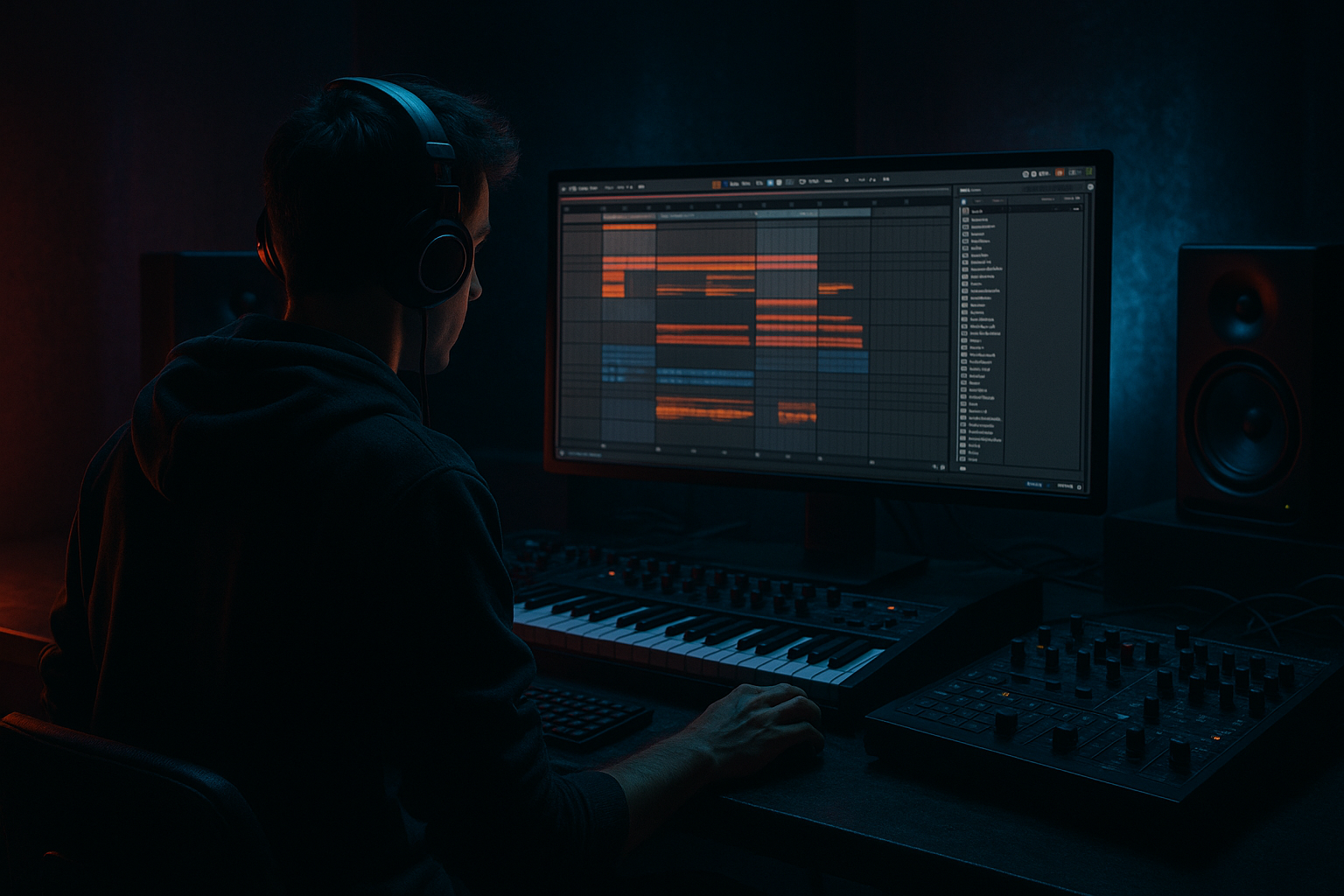
Main tutorial
Lesson Overview
In this lesson, you’ll build a pitch-driven percussion layering workflow for jungle / oldskool DnB vibes using Ableton Live 12 Session View, then turn the strongest moments into a proper Arrangement View section that feels like a real record, not just a loop. The focus is on taking a simple percussion loop or break-derived layer, then using pitch movement, layering, and automation to create that classic DnB sense of momentum: the snare talking, the hats breathing, and the percussion shifting just enough to keep the drop alive.
This matters because in Drum & Bass, percussion isn’t just “top end decoration” — it’s part of the groove engine. In jungle and oldskool rollers, a pitched percussion layer can add:
- a melodic rhythmic hook
- a call-and-response against the bassline
- variation between 4- or 8-bar phrases without needing a full drum fill
- extra tension before drop points, breakdowns, and switch-ups
- a main break or shuffle loop
- a pitched percussion layer built from a rim, tom, conga, or chopped break fragment
- a second high percussion layer with subtle pitch motion for top-end energy
- a return FX chain for space and transition hits
- an Arrangement View section with automation that evolves over 16–32 bars
- a rolling jungle beat with slightly pitched tom/rim accents
- a modulating percussion line that hints at pitch movement without sounding like a synth melody
- oldskool-style break edits and snare lifts
- a darker DnB intro/drop where percussion fills the gaps between the kick/snare grid and the bass movement
- Over-pitching the percussion
- Too much low-mid buildup
- Ignoring the kick and sub relationship
- Making every bar different
- Using pitch movement without rhythmic purpose
- Pitch down a short percussion hit and saturate it lightly to create a dark, tribal accent that sits under a rolling bassline.
- Layer a bright top tick with a lower tom or rim so the ear hears both transient and body.
- Use Auto Filter with resonance modestly raised to accentuate the pitch sweep without making it whistly. A cutoff move in the 1–5 kHz range can add tension fast.
- Print your best pitch-moved clip to audio and chop it as a texture layer. Resampling often gives darker DnB more grit and permanence.
- Add very short reverb on only selected hits using a send. Keep the return filtered so it doesn’t cloud the groove.
- Make the last hit of a 4-bar phrase slightly louder or higher than the others. That tiny lift can make the entire drop feel more intentional.
- Use Drum Buss on the percussion group for edge, but keep it subtle. Too much drive can flatten the oldskool swing.
- Check the track in mono to make sure the pitch layer still reads clearly when the DJ system collapses the stereo field.
- Use Session View to audition pitch-moved percussion ideas fast.
- Keep the percussion rhythmic first, tonal second.
- Use Simpler, Drum Rack, EQ Eight, Saturator, Auto Filter, Glue Compressor, and Drum Buss to shape the layer.
- Move into Arrangement View only after you find a phrase that actually grooves.
- In DnB, small pitch changes can create big energy when they’re tied to phrase structure, snare placement, and bass call-and-response.
- The best results usually come from subtle pitch motion, disciplined layering, and clean arrangement contrast.
You’ll use Session View for fast experimentation, then capture the best variations into Arrangement View so the track develops like a DJ-friendly, finished tune. This is a workflow lesson, but the result is very musical: a layered drum section with movement, identity, and oldschool character that still sits cleanly in a modern DnB mix. 🔥
What You Will Build
By the end, you’ll have a compact but powerful percussion system made of:
Musically, this sounds like:
A strong reference point is the classic jungle technique of making percussion feel almost “sung” through pitch, but keeping it rhythm-first. The result should work in a roller, a darker halftime-to-fulltime switch, or a break-heavy 170 section.
Step-by-Step Walkthrough
1. Set up a Session View percussion scene with clear lanes
Start in Session View with 3 audio tracks:
- Track 1: your main break
- Track 2: your pitched percussion layer
- Track 3: a top percussion / shaker / hat layer
If you’re starting from raw audio, slice a break to a Drum Rack or drag in individual hits. For the pitched layer, choose a sound with a defined body: a tom, rim, conga, bongo, woodblock, or a chopped break tail. Oldskool DnB often works best when the layer has enough transient to “speak,” but not so much low end that it muddies the kick/sub.
On the main break track, use Warp if needed, but don’t over-tighten it. For jungle movement, a little human push-pull is good. If the loop is too rigid, use Groove Pool and try a subtle swing around 54–58% or a swing groove pulled from a classic break feel.
The key here is to build a Session View loop bank where each clip can be tested quickly against the bassline later.
2. Create the pitch layer with a stock device chain
On the pitched percussion track, add:
- Simpler if using a one-shot or chopped audio hit
- or a Drum Rack pad if you want to trigger multiple pitched hits
- then EQ Eight and Saturator
If you’re using Simpler, set it to One-Shot and shorten the release so hits don’t smear. A useful starting point:
- Attack: 0–2 ms
- Decay/Release: short, under about 200 ms for tight hits
- Transpose: tune by ear to match the track’s tonal center
For jungle-style pitch movement, don’t treat the percussion like a drum kit with fixed tuning. Instead, make it sit around a musically useful range:
- try -5 to +7 semitones depending on the source
- for darker material, stay closer to -3 to +3 semitones
- for more urgent oldskool energy, automate movement of 2–5 semitones
Use EQ Eight to high-pass the layer around 180–300 Hz so it doesn’t fight the kick or sub. Then add Saturator with Drive around 2–6 dB and keep Soft Clip on if the layer needs bite without harsh peaks.
Why this works in DnB: the pitch change gives the ear something to track across fast drum patterns, so a short percussion hit can function like both rhythm and motif.
3. Program a 1-bar phrase that feels like a jungle hook
In Session View, clip-launch a 1-bar MIDI pattern on the pitched layer. Keep it simple at first:
- place hits on off-beats
- emphasize the “and” of 2 and the “and” of 4
- add one ghost hit or quieter note before the snare
If you’re using a Drum Rack, program 3–5 notes max. The goal is not complexity; it’s a memorable rhythmic contour.
For example, a 170 BPM oldskool phrase might use:
- one lower-pitched hit at the start of bar 1
- a slightly higher hit before the snare
- a shorter, brighter hit on the turnaround at bar end
Set velocity with intention:
- main accents around 95–110
- ghost hits around 40–70
This keeps the groove organic and lets the pitch movement feel expressive instead of robotic.
4. Automate pitch like a drummer, not a synth programmer
This is the core of the lesson. Use Ableton’s stock automation on the pitched layer to create movement over 4- or 8-bar phrases.
Good places to automate:
- Simpler Transpose
- Clip Envelope > MIDI Pitch if you’re working in MIDI
- Auto Filter Frequency for pitch-adjacent movement if the source is audio
- Sampler/Simpler Filter cutoff for extra motion after pitch shifts
Two practical approaches:
- Subtle movement: automate pitch in steps of ±1 to ±2 semitones between sections
- Obvious jungle hook: move between 0, +3, +5 semitones across 4 bars
Keep the automation musical. For oldskool DnB, a common move is:
- bar 1: lower, rounder hit
- bar 2: slightly brighter or higher hit
- bar 3: tension hit with filter open
- bar 4: return to the original pitch
This creates a phrase that feels like it’s answering the bassline. It’s especially effective if your bass is already doing a short call-and-response pattern.
5. Shape the layer with groove, timing, and ghost notes
Now refine feel. Open Groove Pool and test a swing groove lightly on the pitched percussion only. Don’t overdo it — this layer should support the break, not drag it out of time.
Try:
- Timing: around 10–20%
- Random: low, around 2–8%
- Velocity: moderate if you want more human bounce
In the MIDI clip, nudge a couple of hits slightly late by a few milliseconds if the beat feels too stiff. The best oldskool jungle percussion often has tiny imperfections that make the groove breathe.
Add ghost notes near snare hits or between kick placements. In DnB, ghost notes help mask transitions between phrases and keep energy alive while the bassline is holding a note. If the bass is sparse, the ghost percussion becomes the rhythmic glue.
6. Build variation in Session View using clip duplicates
Duplicate your main percussion clips into 2–3 variations:
- Clip A: basic groove
- Clip B: pitch rises slightly in the second half
- Clip C: a stripped version with one or two missing hits
- optional Clip D: fill version with a short pitch jump or filter sweep
This is where Session View shines. Instead of drawing a full arrangement immediately, perform the energy. Launch clips live and listen for what makes the drop feel bigger or the breakdown feel more tense.
Keep each variation disciplined:
- remove one hit to create space
- add one pitch jump for a small lift
- use a one-bar fill only at phrase ends
In darker DnB, less is often more. A small change in pitch or density can be more powerful than a huge fill.
7. Resample or freeze the best loop for faster commitment
When a variation feels right, commit it. Use one of Ableton’s workflow tools:
- Freeze and Flatten
- Resampling to a new audio track
- or simply bounce the best Session loop into Arrangement View
Resampling is especially useful here because pitched percussion can get more character when printed. Once rendered, the transients and tone become fixed, and you can chop them like break material.
If you resample:
- record 4 or 8 bars of the best pitch motion
- keep the audio clean and labeled
- audition if the bounced version feels punchier than the MIDI playback
This helps you move from “idea mode” to “track mode.” In DnB workflow, that shift is crucial.
8. Move into Arrangement View and sketch the phrase arc
Drag your best Session clips into Arrangement View and build a 16–32 bar section. Think like a DJ and an editor:
- bars 1–8: establish groove
- bars 9–16: open up the pitch movement or add a second layer
- bars 17–24: create tension with a fill or filter rise
- bars 25–32: drop the layer back or switch to a new variation
A practical arrangement example for a jungle-style drop:
- 4 bars of stripped intro drums
- 8 bars of full break + pitched percussion
- 4 bars with a pitch rise and extra hat layer
- 4 bars breakdown or bass pause
- 8 bars of drop variation with a new pitch contour
Use Arrangement automation on:
- Simpler Transpose
- Auto Filter cutoff
- Send A/B reverb or delay
- Utility gain for phrase-level emphasis
This is where the technique becomes a full arrangement tool instead of just a loop trick.
9. Glue the percussion to the drums and bass bus
Route your break, pitched layer, and top percussion to a Drum Bus or group. On the group, use:
- Glue Compressor with light reduction, around 1–3 dB
- EQ Eight for small cleanup
- Drum Buss if you want more snap and density
Use Drum Buss carefully:
- Drive: low to moderate
- Transient: slightly up if the layer needs crack
- Boom: only if it won’t interfere with sub bass
Keep your bass and drums from masking each other. In darker DnB, the percussion can be aggressive, but the sub should still own the true low end. Check mono compatibility with Utility on the master or drum bus and keep the lower percussion layers tidy.
If the pitch layer fights the bass, carve space with:
- a small dip around 200–500 Hz
- or sidechain-style ducking using Compressor triggered by the kick/snare if necessary
10. Final polish: automate contrast, not chaos
Add final movement to your arrangement, but keep it controlled. A strong DnB section usually needs contrast more than constant motion.
Use automation to:
- mute the pitched layer for 1 bar before a drop
- widen the top percussion slightly with Utility or Auto Pan on high layers only
- bring in reverb throws on selected percussion hits
- open the filter for the last 2 bars of a phrase
One very effective move: automate the pitched percussion to climb by 2 semitones over the last 4 bars before the drop, then snap it back on the first bar of the drop. That creates tension without turning into a cheesy riser.
Keep the section DJ-friendly. If you’re making oldskool-inspired DnB, leave space at the intro/outro so the percussion doesn’t overcrowd the mix when mixed by a DJ.
Common Mistakes
- If the pitch moves too far, it stops feeling like drums and starts sounding like a random sample effect.
- Fix: stay within ±1 to ±5 semitones unless the source is very tonal.
- Pitched toms and break fragments can pile up around 200–600 Hz.
- Fix: use EQ Eight high-pass and small surgical cuts.
- A great percussion hook is useless if it masks the low end.
- Fix: keep percussion layers lean and mono-compatible below the upper mids.
- Constant changes kill the hypnotic roller energy.
- Fix: repeat the phrase, then vary only one thing at a time.
- Pitch automation should support groove and arrangement.
- Fix: align movement with snare turns, fills, or 4/8-bar phrase endings.
Pro Tips for Darker / Heavier DnB
Mini Practice Exercise
Spend 10–20 minutes making a 4-bar percussion hook and turning it into an 8-bar arrangement variation.
1. Pick one break or one percussion one-shot.
2. Build a 1-bar loop in Session View with 3–5 hits.
3. Create two versions:
- Version A: static pitch
- Version B: pitch rises by 2–4 semitones in the last half of the bar
4. Add a second layer, like a shaker or hat, with a different rhythm.
5. Apply light Saturator and EQ Eight cleanup.
6. Launch both clips and decide which one feels more like a real DnB phrase.
7. Drag the better version into Arrangement View and duplicate it for 8 bars.
8. Automate one change only: filter cutoff, pitch, or send reverb on the final 2 bars.
9. Bounce or resample the strongest moment.
10. Re-listen and ask: does the percussion feel like a hook, or just a loop?
If you want to push it further, mute the bass for the first 2 bars and listen to whether the percussion still carries tension on its own.

