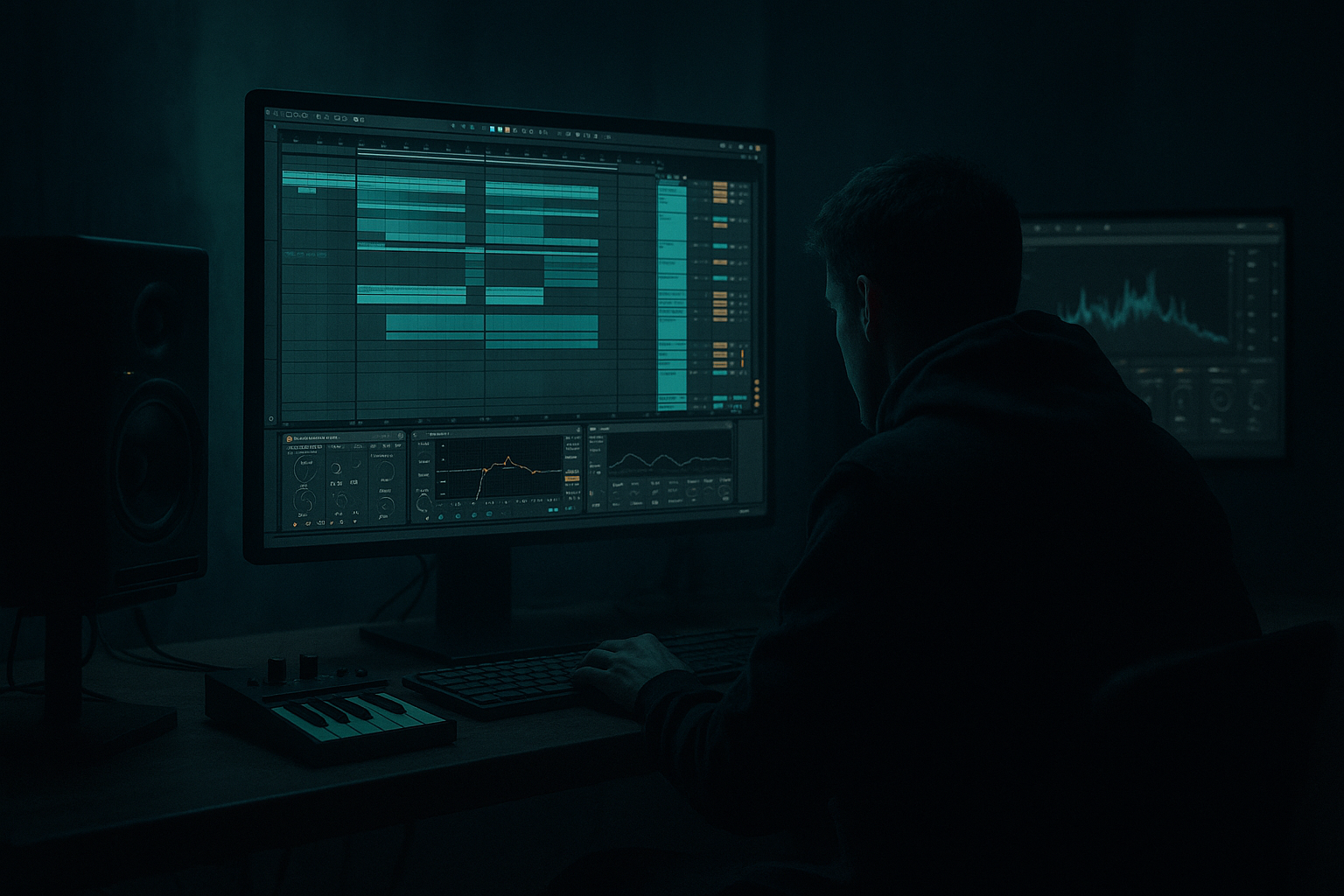
Main tutorial
```markdown
Oldskool Rave Bass Hooks at 170 BPM (Ableton Live) 🔊⚡
Skill level: Intermediate
Category: Basslines (Drum & Bass / Jungle / Rolling)
---
1. Lesson overview
Oldskool rave bass hooks in DnB are all about simple, bold notes, a gritty mid-bass character, and tight movement with the drums at 170 BPM. Think early jungle/rave DNA: Hoover-ish aggression, Reese weight, stabby call-and-response, and lots of rhythmic space so the groove rolls.
In this lesson you’ll build a hooky mid-bass + sub system in Ableton Live using mostly stock devices, with a workflow that fits modern DnB mixdowns.
---
2. What you will build
You’ll end up with:
- A 2-layer bass:
- A classic 2-bar hook at 170 BPM with syncopation and gaps for drums
- Sidechain + envelope shaping so it slots with the kick/snare
- Arrangement variations (A/B phrases, fills, call/response) to keep it rolling
- HP filter around 90–120 Hz (24 dB/oct)
- Optional: gentle boost around 700 Hz–1.5 kHz if you need more “rave speak”.
- Mode: Analog Clip or Soft Sine
- Drive: 4–10 dB
- Turn on Soft Clip
- Output: adjust so you’re not slamming your master
- Mode: try Classic
- Amount: 15–30%
- Rate: 0.20–0.60 Hz (slow movement = oldskool)
- Width: 80–120%
- Filter type: Lowpass (24 dB)
- Envelope: small amount (5–15) for pluck movement
- LFO (optional): 1/8 or 1/4, very subtle
- Bar 1: F1 (1/8), rest (1/16), F1 (1/16), C2 (1/8), rest (1/8), D#1 (1/16), F1 (1/16)
- Bar 2: F1 (1/8), A♭1 (1/16), rest (1/16), C2 (1/8), rest (1/16), C2 (1/16), D#1 (1/8)
- Add octave pops (C2, F2) sparingly
- Use short notes to feel “stabby”
- Put a couple of anticipations (notes that hit just before the snare)
- Use a Ghost Kick (a muted kick pattern) to get consistent pumping even when the main kick drops out.
- Put Utility on SUB: Width = 0%
- Consider Utility on BASS BUS with Bass Mono (if using Live’s utility features) or just keep sub isolated.
- Intro (16 bars): tease the RAVE MID with HP filter + no sub
- Drop (32 bars): full SUB + RAVE MID hook
- Mid-drop variation (next 32):
- Auto Filter cutoff rises over 8 bars into the drop 🔥
- Saturator Drive +2 dB for the last 8 bars
- Chorus amount down slightly when drums get busy (clarity wins)
- Parallel distortion (mid only):
- Resample + chop:
- Add “note growls” with filter envelope:
- Use Drum Buss on the mid layer (carefully):
- Pitch drops before impact:
- You built a clean mono SUB with Operator and kept it stable.
- You made a rave-style MID using Wavetable + Saturator + Chorus + Filter movement.
- You wrote a 2-bar syncopated hook that fits rolling DnB drums at 170 BPM.
- You used sidechain compression to lock bass and kick together.
- You learned arrangement tricks to keep the hook evolving every 4–8 bars.
- SUB layer: clean, mono, consistent low-end
- RAVE MID layer: gritty/chorused/saturated hook that reads on small speakers
---
3. Step-by-step walkthrough
Step 0 — Session setup (fast + DnB-ready) 🧱
1. Set Tempo = 170 BPM
2. In Preferences → Record/Warp/Launch:
- Warp Mode defaults are fine; just ensure your audio isn’t getting weirdly warped later.
3. Create these tracks:
- MIDI Track: “SUB”
- MIDI Track: “RAVE MID”
- Group them into a group called “BASS BUS”
4. Optional but smart: create a Return track called “ROOM” with a small reverb later (we’ll keep sub dry!).
---
Step 1 — Build the SUB (clean + consistent) 🎯
Instrument: Operator (stock)
1. Drop Operator on the SUB track.
2. Operator settings:
- Algorithm: `1 (only Osc A)` (simple sine)
- Osc A: Sine
- Level: 0 dB (adjust later)
3. Add MIDI note range discipline:
- Write your sub mostly around F1–A#1 (43–58 Hz to ~58 Hz is weighty; adjust to your tune).
4. Add an EQ Eight after Operator:
- Enable HP filter at 25–30 Hz (24 dB/oct) to remove rumble
- Optional: tiny dip if your room lies to you—don’t over-EQ sub.
5. Add Glue Compressor (optional but useful):
- Attack: 10 ms
- Release: Auto
- Ratio: 2:1
- Aim for 1–2 dB of gain reduction on peaks (keeps sub stable)
Key rule: Sub stays mono and dry. No chorus, no wide reverb.
---
Step 2 — Create the RAVE MID (oldskool hook character) 🧨
We’ll do a “rave mid” that can lean Reese/Hoover-ish without losing DnB clarity.
Instrument: Wavetable (stock)
(You can do this in Operator too, but Wavetable makes it quick.)
1. Drop Wavetable on the RAVE MID track.
2. Oscillator setup:
- Osc 1: Basic Shapes (saw-ish), Position around 75–90% (brighter)
- Osc 2: Basic Shapes (square/saw mix), slightly different position
- Unison: `Classic` / 2–4 voices
- Keep it moderate; too much unison will smear the groove.
3. Tuning:
- Detune Osc 2 by +7 to +15 cents (classic width/chorus vibe)
4. Filter:
- Use LP24
- Set Cutoff around 200–600 Hz to start (we’ll animate later)
- Add Drive about 10–20%
5. Amp envelope (tight DnB bass):
- Attack: 0–5 ms
- Decay: 200–400 ms
- Sustain: ~0.6–0.8
- Release: 80–150 ms (avoid long tails at 170)
---
Step 3 — Turn it into an “oldskool hook” (movement + grit) 🌀
Now we’ll add classic rave motion: chorus, saturation, and filter automation.
#### Device chain (RAVE MID) recommended:
1. EQ Eight (pre-tone shaping)
2. Saturator
3. Chorus-Ensemble
4. Auto Filter (for rhythmic sweeps)
5. Compressor (sidechain from kick)
1) EQ Eight (pre)
This keeps the mid-bass out of sub territory.
2) Saturator
This is the “glue” that makes it feel like a record.
3) Chorus-Ensemble
This gives that nostalgic smear without washing the groove.
4) Auto Filter
Better: automate cutoff for phrase energy.
---
Step 4 — Write a 2-bar oldskool rave bass hook (170 BPM) ✍️
We’re going for syncopated DnB/jungle phrasing: hits around the kick/snare but leaving air.
Grid: 1/16
Length: 2 bars loop
Try this as a starting pattern (in F minor vibe, but adapt):
How to make it “rave”:
Workflow tip:
Duplicate the MIDI from SUB → RAVE MID, then edit the MID layer to be more rhythmic while keeping SUB more stable.
---
Step 5 — Lock the bass to the drums (sidechain + shaping) 🥁
DnB at 170 needs bass that breathes with the kick.
1. On RAVE MID, add Compressor (Ableton stock).
2. Enable Sidechain
3. Sidechain input: your Kick track (or a clean ghost kick if you prefer)
4. Settings:
- Ratio: 4:1
- Attack: 0.2–1 ms
- Release: 60–120 ms (set to groove; adjust by ear)
- Aim for 3–6 dB GR on kick hits
Optional advanced:
---
Step 6 — Glue the layers (BASS BUS processing) 🧩
Group SUB + RAVE MID → BASS BUS and process lightly.
On BASS BUS:
1. EQ Eight
- Check buildup around 200–350 Hz (mud zone)
- Gentle dip if needed (1–3 dB)
2. Glue Compressor
- Attack 10 ms, Release Auto, Ratio 2:1
- Aim for 1–2 dB GR (just to “hold hands”)
3. Limiter (safety, not loudness)
- Ceiling: -0.3 dB
- Should barely work—if it’s slamming, fix levels earlier.
Mono management:
---
Step 7 — Add arrangement energy (rave hook phrasing) 🧨🏁
Oldskool hooks hit harder when they evolve every 4/8 bars.
Try this structure (DnB-friendly):
- Change last 2 notes every 2 bars
- Add a 1-bar fill: automate Auto Filter cutoff upward
- Add a gated moment (mute SUB for 1/2 bar before a snare)
Automation ideas:
---
4. Common mistakes 🚫
1. Sub too wide
- If your low end feels “phasey,” force SUB to mono (Utility Width 0%).
2. Too much chorus on the mid
- Rave vibe is good, but DnB needs punch. If the bass loses definition, reduce Unison/Chorus.
3. No space for snare
- If your hook hits on every 1/16, it’ll fight the groove. Leave rests.
4. Over-saturating the whole bass bus
- Saturate the mid layer, not the sub. Keep sub clean.
5. Sidechain release wrong
- Too fast = clicky/weak; too slow = bass disappears. Tune release to the kick spacing.
---
5. Pro tips for darker/heavier DnB 🕶️
Duplicate RAVE MID → heavily distort with Overdrive / Amp / Pedal, then blend quietly for aggression.
Freeze/Flatten the RAVE MID, then slice audio hits and re-groove them for proper jungle chaos.
Increase Auto Filter envelope amount and shorten decay for a nasty “ow” on certain notes.
On RAVE MID only, set:
- Drive 5–15
- Crunch 5–20
- Boom OFF (Boom can mess low end)
This can give that brutal modern edge while staying rave-rooted.
Automate a quick -2 to -5 semitone dip on the last 1/8 before a drop (classic tension trick).
---
6. Mini practice exercise 🧪
Goal: Make 3 variations of the same 2-bar hook.
1. Start with your base hook.
2. Duplicate it 3 times (total 8 bars).
3. Variations:
- Variation A (Bars 1–2): base hook
- Variation B (Bars 3–4): change the final note to the 5th (e.g., C)
- Variation C (Bars 5–6): remove one note (add space) and add a short octave stab
- Variation D (Bars 7–8): automate Auto Filter cutoff up and add a 1/4-note “hold” before bar 9
4. Render a quick bounce and listen on low volume:
If the hook still reads clearly at low volume, you’ve nailed the mid character. ✅
---
7. Recap ✅
If you want, tell me your target vibe (e.g., 94 jungle, early RAM, modern rollers with oldskool flavor), and what key you’re writing in—I can give you a custom 2-bar MIDI hook + exact device macros to map for performance.
```

