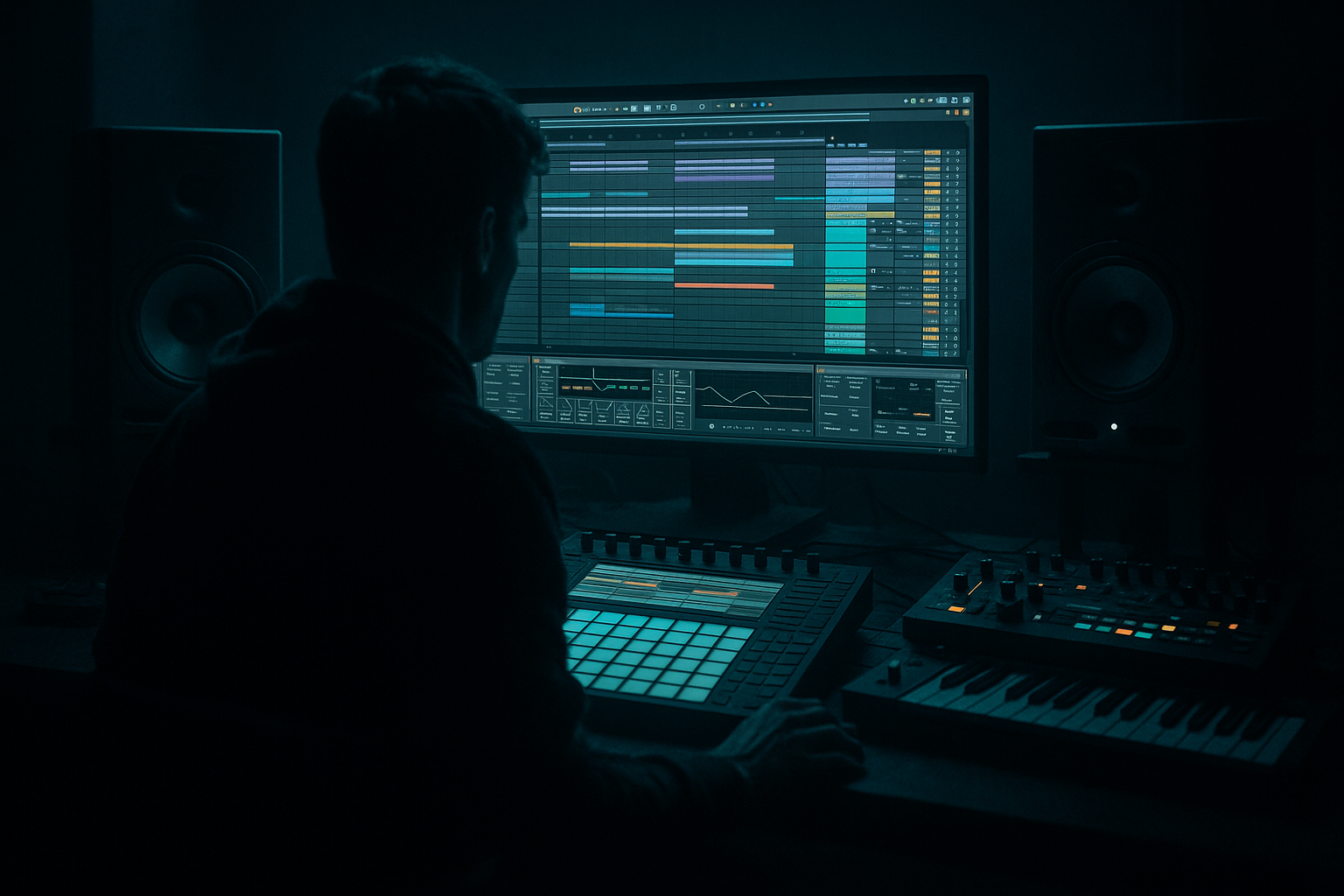
Main tutorial
Offset a Reese Patch for VHS-Rave Color in Ableton Live 12
Drum & Bass / Jungle FX tutorial for oldskool vibes 🎛️🥁
1. Lesson overview
In this lesson, you’ll learn how to offset a Reese bass patch so it feels more detuned, smeared, and “VHS-rave” colored—the kind of texture that works in jungle, oldskool DnB, ragga-influenced rollers, and early warehouse rave atmospheres.
The goal is not to just make a bigger Reese. The goal is to make it feel like it has been:
- slightly shifted off-center
- run through tape / VHS / analogue-style degradation
- widened and phase-wobbled in a musical way
- still solid in mono enough for club playback
- Wavetable or Analog
- Chorus-Ensemble
- Frequency Shifter
- Saturator
- Drift or Echo for movement
- Utility for width and mono control
- EQ Eight for cleanup
- optional Roar for modern grit
- a centered low-end core for weight
- a slightly offset upper Reese layer for movement and color
- VHS-style modulation artifacts
- a controlled stereo image
- enough character to sit under breaks, chopped amen edits, and rave stabs
- murky jungle intro bass with tape wobble
- ravey mid-bass that feels “slightly broken”
- oldskool roller bass with a haunted stereo smear
- dark, nostalgic bassline energy without sounding muddy
- Osc 1: Saw
- Osc 2: Saw
- Unison: 2 voices on each oscillator
- Detune: low, around 6–12%
- Osc 2 Fine: detune slightly, around +7 to +15 cents
- Filter: Low-pass 24 dB
- Filter Drive: small amount, around 10–20%
- Amp Envelope: short attack, medium decay if you want a stabby bass; longer sustain if you want a rolling bass
- Attack: 0–5 ms
- Decay: 200–400 ms
- Sustain: 60–100%
- Release: 80–150 ms
- Keep Osc 1 centered
- Detune Osc 2 by a small amount
- Add slight phase or unison differences if available
- If using Analog, pan the oscillators slightly apart
- Mode: Fine
- Shift Amount: try +1.5 Hz to +8 Hz
- Dry/Wet: 5–20%
- Stereo: On, but subtle
- Feedback: 0 or very low
- Mode: Chorus
- Rate: 0.20–0.60 Hz
- Amount: 15–35%
- Delay: low
- Feedback: small amount, around 5–15%
- Width: 120–160%
- Low band: mono, clean
- Mid/High band: widened, processed, offset
- Low-pass around 120 Hz
- Use Utility to set Width = 0%
- Keep it clean or lightly saturated
- High-pass around 120–180 Hz
- Add your FX chain here:
- Drive: 2–6 dB
- Curve: default or slightly softened
- Color: use a little if needed
- Soft Clip: On
- Drive: modest
- Tone: slightly dark
- Dynamics: moderate
- Wet/Dry: around 20–40%
- Frequency Shifter amount
- Chorus rate
- Filter cutoff
- Saturator drive
- Width on the color chain
- Bars 1–4: subtle movement
- Bars 5–8: slightly more shift and width
- Last 1/2 bar: filter closes for tension
- Time: 1/8 or 1/16 dotted
- Feedback: low, 5–15%
- Filter: roll off highs
- Modulation: subtle
- Dry/Wet: 5–10%
- Offbeat bass hits under chopped breaks
- Call-and-response with snare or rimshot accents
- Sustained Reese notes entering after the drum fill
- Pitch movement every 2 or 4 bars
- Short bass pickups before the drop
- Bar 1–2: sparse bass hits
- Bar 3–4: more notes
- Bar 5–8: open filter and widened color layer
- Drop: slam back into a tight mono sub + dirty offset mid layer
- Remove muddiness around 200–400 Hz if needed
- Tame harshness around 2–5 kHz
- Make space for breaks and snare transient
- Bass frequencies below 120 Hz: keep mono
- Width on color layer: 110–140%
- Gain: trim to match your mix
- metallic
- out of tune
- phasey in a bad way
- Mono compatibility
- Correlation meter
- how the bass sits with kicks and snares
- Cutoff: medium-low
- Resonance: low to moderate
- Envelope amount: enough to open slightly at the start of the note
- Keep it mono
- Follow the root notes
- Avoid FX on the sub except maybe gentle saturation
- chop it
- reverse a tail
- pitch it down for breakdowns
- bounce to audio and warp creatively
- Auto Pan with very low amount for subtle movement
- LFO Tool equivalent via automation or MIDI modulation
- Drift for analog-style drift and instability
- intro atmosphere
- fill under break edits
- transition bed before the drop
- shadow layer behind a cleaner main bass
- wide but controlled
- vintage but not weak
- dark, rolling, and clearly DnB
- start with a solid Reese synth patch
- create a sub/character split
- use Frequency Shifter for subtle off-axis movement
- add Chorus-Ensemble for tape-like smear
- use Saturator/Roar for harmonic grit
- keep the sub mono
- automate movement for vibe and progression
- always check the mix in mono and with drums
In Ableton Live 12, this can be done with a smart chain using stock devices like:
This is a very practical sound design + FX workflow for oldskool DnB basses. Let’s build it. 🚀
---
2. What you will build
You’ll create a layered Reese bass that has:
Final result sound
Think:
---
3. Step-by-step walkthrough
Step 1: Build the base Reese patch
Start with a new MIDI track and load Wavetable.
#### Wavetable settings
Use a simple, stable starting point:
#### Suggested envelope starting point
For a more classic jungle bassline, use a sustained note and let modulation do the movement.
---
Step 2: Make the Reese “offset”
The trick here is that the bass should feel like it’s not perfectly aligned across both sides of the stereo field.
There are two strong ways to do this in Ableton Live 12.
---
#### Method A: Detune one oscillator slightly differently
This is the cleanest musical offset.
This creates a more organic beating pattern that feels like a Reese but with movement that’s a bit “wrong” in a good way.
---
#### Method B: Use a subtle Frequency Shifter offset
Add Frequency Shifter after the synth.
#### Frequency Shifter settings
This creates the imperfect VHS-style phase smear.
You’re not trying to make it obviously metallic. You’re trying to make the reese feel like it has drifted a little off-axis.
Important: Use very small values. In DnB, too much frequency shifting can destroy the weight.
---
Step 3: Add a VHS-style modulation layer
Now let’s make it feel like the patch has been “aged” or “warped.”
Add Chorus-Ensemble after the synth or after the Frequency Shifter.
#### Chorus-Ensemble settings
Try this as a starting point:
This gives the Reese that worn tape spread—especially effective on sustained notes or offbeat bass stabs.
If you want a more obvious retro-rave flavor, increase the depth slightly, but keep the low end controlled.
---
Step 4: Control the low end with split processing
This is crucial in DnB.
You want the sub to remain centered while the character layer gets the stereo smear.
#### Best workflow: Audio Effect Rack
Put your bass in an Audio Effect Rack and split it into:
##### How to set it up
1. Drop Audio Effect Rack on the bass track.
2. Create two chains:
- SUB
- REese Color
3. Use EQ Eight at the start of each chain to filter:
##### SUB chain:
##### REese Color chain:
- Frequency Shifter
- Chorus-Ensemble
- Saturator
- small amount of reverb if needed
This is the most practical way to keep your jungle low end powerful while still getting that VHS-rave gloss.
---
Step 5: Add saturation for tape-style color
Insert Saturator on the Reese Color chain.
#### Saturator settings
This adds harmonics so the bass feels more present on smaller speakers, like old pirate radio systems or worn club rigs.
If you want a grittier oldskool edge, try Roar instead:
#### Roar starting point
Roar can make the bass feel like it has passed through a battered rave system without completely flattening it.
---
Step 6: Add movement with automation
A VHS-rave sound becomes convincing when it moves over time.
Automate one or more of these:
#### Good automation ideas
For an 8-bar loop:
This works especially well in intro bass phrases and breakdown-to-drop transitions.
---
Step 7: Add oldskool ambience carefully
If you want more VHS atmosphere, use Echo or a very short Reverb on the color layer only.
#### Echo settings
This can give the Reese a ghostly tail, like it’s bouncing around an empty warehouse.
Be careful: in jungle and DnB, too much ambience on bass can blur the groove. Use it sparingly.
---
Step 8: Lock it to the drum arrangement
This sound becomes much more effective when it interacts with drums.
#### Arrangement ideas for DnB/jungle:
A classic approach:
This keeps the sound musical, not just a static texture.
---
Step 9: Final cleanup with EQ and Utility
Use EQ Eight after the processed bass chain.
#### EQ goals
Then use Utility:
If the bass sounds wide but weak, reduce width before you reduce volume.
That usually fixes the problem faster.
---
4. Common mistakes
1. Making the offset too extreme
If the frequency shift or detune is too strong, the Reese becomes:
Keep the offset subtle. The movement should feel like attitude, not malfunction.
---
2. Widening the sub
This is a classic mistake in bass music.
If you stereo widen below about 120 Hz, the bass can disappear in mono and lose club weight.
Fix: keep sub mono with Utility or by splitting the rack.
---
3. Overusing chorus
Chorus is great for VHS flavor, but too much makes the bass blurry and weak.
Fix: use it on the mid/high layer only, and keep the dry low-end core separate.
---
4. Ignoring phase issues
Two saws, detuning, chorus, and frequency shifting can create phase cancellation.
Fix: constantly check:
---
5. Not filtering the character layer
If the Reese color layer still has too much low end, the mix gets muddy fast.
Fix: high-pass the color layer around 120–180 Hz.
---
5. Pro tips for darker/heavier DnB
Tip 1: Use a darker filter envelope
For deeper rave/jungle pressure, use a low-pass filter with a slightly snappy envelope.
This gives the bass more “speak” without becoming bright.
---
Tip 2: Layer with a pure sub
Use a separate Operator or Wavetable sine underneath.
That lets your offset Reese stay expressive while the sub provides physical impact.
---
Tip 3: Sample your own Reese
Once you like the movement, resample 4 or 8 bars of it.
Then:
This is very jungle-friendly and gives you more control over the vibe.
---
Tip 4: Add tape-style instability with modulation
Try small modulation to imitate worn VHS playback.
Useful devices:
A tiny amount goes a long way.
---
Tip 5: Use it as a texture, not just a bassline
This sound can work as:
In DnB, this is gold because it adds narrative to the arrangement 🎧
---
6. Mini practice exercise
Exercise: Build a 4-bar VHS Reese roller
1. Create a Wavetable Reese on a MIDI track.
2. Add Utility and set the lower band mono in an Audio Effect Rack.
3. High-pass the color layer at 150 Hz.
4. Add:
- Frequency Shifter at +3 Hz
- Chorus-Ensemble with subtle rate and depth
- Saturator with 3 dB drive
5. Program a 4-bar MIDI pattern using:
- root notes on bar 1 and 3
- passing notes on bar 2 and 4
6. Automate the Frequency Shifter amount slowly over 4 bars.
7. Bounce to audio and compare:
- full stereo
- mono
- with drums
8. Then rework it so it sits under:
- a chopped amen loop
- a punchy snare
- a simple sub layer
Goal
Make the bass sound:
---
7. Recap
To offset a Reese patch for VHS-rave color in Ableton Live 12:
The magic is in the balance:
enough offset to sound haunted and nostalgic, but not so much that you lose club power. 🔊
If you want, I can also turn this into a device-chain preset blueprint for Ableton Live 12, or give you a second version specifically for darker neuro-jungle / ravey halftime DnB.

