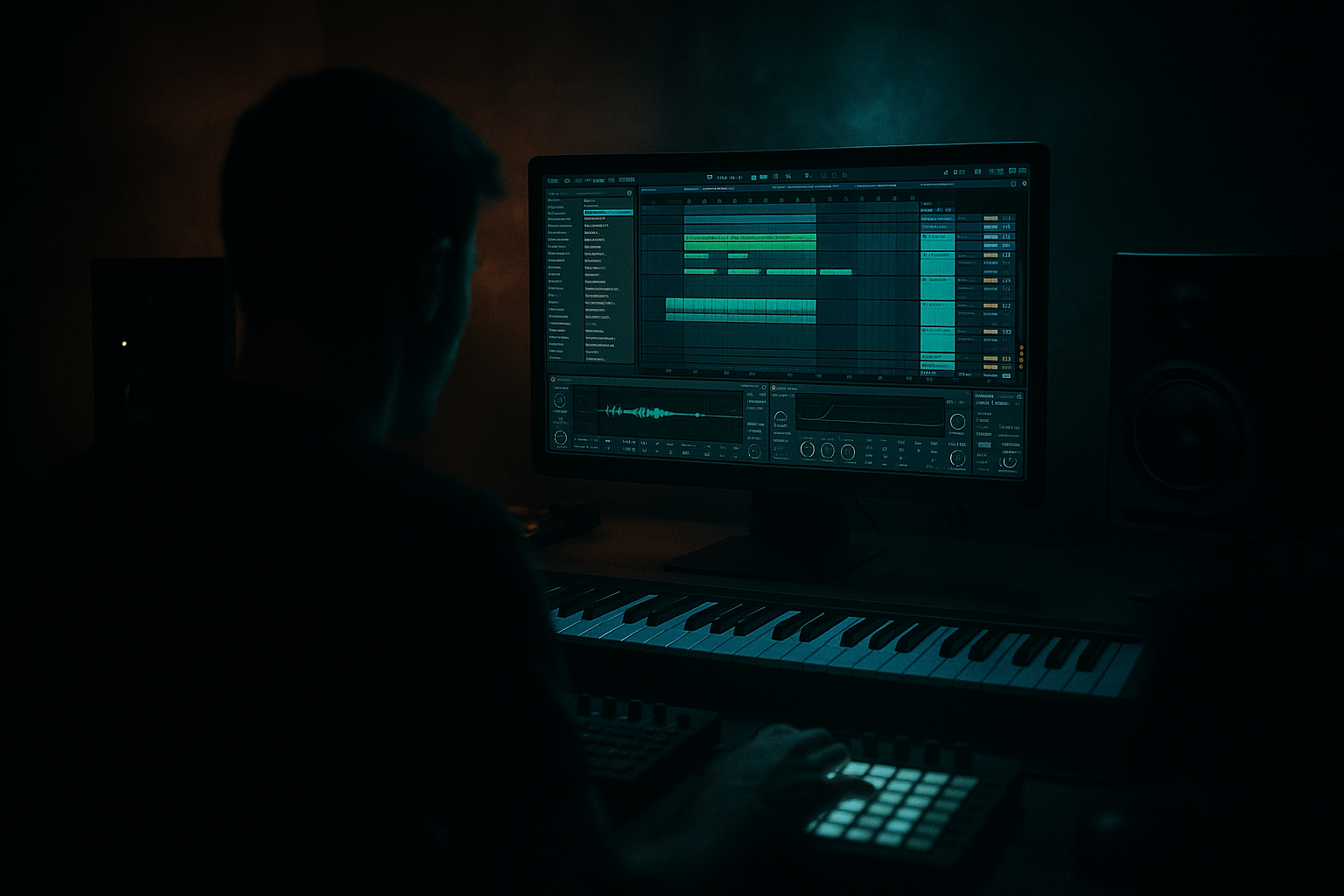
Main tutorial
Offset a Chop with Minimal CPU Load in Ableton Live 12 for Jungle / Oldskool DnB Vocals
1. Lesson overview
In jungle and oldskool drum and bass, vocal chops often work best when they feel slightly displaced, rhythmically surprising, and cheap-to-run enough that you can keep building a huge arrangement without melting your CPU. 😈
This lesson shows you how to create a deliberately offset vocal chop in Ableton Live 12 using a workflow that stays light on CPU while keeping the chops tight, musical, and easy to arrange.
We’ll focus on:
- Audio clip warping and transient placement
- Simplified device chains
- Using stock Ableton devices only
- Creating offset timing without heavy samplers or complex Max devices
- Making the chop sit in a classic jungle / oldskool DnB pocket
- chopped ragga vocal energy
- gritty call-and-response phrasing
- slightly late or “dragging” vocal placement
- fast arrangement changes without loading CPU-heavy instruments
- trigger a short vocal phrase
- offset the chop by a few milliseconds or a 16th-note grid shift
- retain groove against a breakbeat
- stay lightweight with minimal devices
- be easy to duplicate and mutate for fills, drops, and switch-ups
- a chopped “yeah / oi / come on”
- placed slightly behind the snare or ahead of the hat
- processed with only a few stock devices:
- intro tension
- pre-drop tease
- drop callouts
- breakdown atmosphere
- rinse-and-repeat DJ-friendly loops
- clear consonants: t, k, p, s, sh
- a short phrase or single word
- natural attitude or patter
- minimal low-end rumble
- “come again”
- “make some noise”
- “move”
- “check it”
- “original”
- “soundboy”
- Seg. BPM: let Live detect it, or set manually if needed
- Preserve: 1/16 or Transients if available
- Transient Loop Mode: choose a tighter setting if the chop is repetitive
- move the clip start a few milliseconds early or late
- or shift the whole clip by 1/64, 1/32, or 1/16 note
- or nudge the warp marker so the attack lands just behind the snare
- place the chop slightly late on the offbeat
- or make it answer the snare, not land with it
- Audio clip playback
- a few warp markers
- no instrument device at all
- very light CPU
- fast editing
- easy MIDI sequencing
- perfect for oldskool vocal stab programming
- just after the snare on 2 and 4
- as a response to the kick on 1
- tucked behind a ghost note in the break
- in the gap between break hits
- Bar 1 beat 2: vocal chop
- Bar 1 beat 3.3: second chop
- Bar 2 beat 1.4: short tail chop
- Bar 2 beat 4: callout
- nudge the note later by 5–20 ms
- or use groove with a light shuffle
- or deliberately quantize to 1/16 and then manually move one hit late
- compact
- aggressive
- rhythmic
- easy to automate
- cheap on CPU
- Clip Start Position in Simpler
- Filter Cutoff
- Delay Feedback
- Reverb Send only on certain hits
- Saturator Drive for the drop
- Volume for phrase accents
- automate the filter to open just before the chop
- then cut it suddenly after the hit
- this makes the phrase feel like a sampled rave stab
- Reverb
- or Echo into Reverb
- or just Delay with filtered repeats
- Intro: filtered vocal chop, no bass, just breaks and tension
- First drop: short phrase every 2 bars
- Second 8 bars: increase density, add a double chop answer
- Breakdown: let one long chop ring with delay
- Drop reload: reuse the same chop but shift it by a 16th for variation
- 1/16
- 1/32
- or a few milliseconds
- high-pass harder
- low-pass around 8–12 kHz if it’s too bright
- focus on the midrange bite
- Drive lightly
- keep the top end from fizzing out
- short feedback
- low-pass the repeats
- sync to dotted 8th or 1/4 for oldskool dancehall bounce
- pitch one layer down slightly
- filter it darker
- keep it low in the mix
- use Gate after reverb on a return
- or automate a hard cut on the send
- Version A: straight chopped phrase
- Version B: late-offset chop
- Version C: late-offset chop with a delay throw on the last hit
- start with a clean vocal phrase
- use Audio Clip Warp or Simpler
- offset the chop by a few ms or a small grid division
- keep the chain light with EQ Eight, Saturator, Auto Filter, and one send effect
- use groove and manual nudging to make it sit with the break
- arrange it like a DJ tool: call, response, variation, reload
This is especially useful when you want that:
---
2. What you will build
You’ll build a single vocal chop track that can do all of this:
End result
A practical vocal texture like:
- EQ Eight
- Simpler or Clip View
- Saturator
- Auto Filter
- Delay or Echo
- optional Glue Compressor
You’ll be able to build phrases for:
---
3. Step-by-step walkthrough
Step 1: Pick a vocal with strong transients
For jungle and oldskool DnB, choose a vocal that has:
Good examples:
If the sample is too long, trim it before you do anything else.
#### Why this matters
A clean transient gives you a better offset chop because the rhythmic feel will read instantly against the break.
---
Step 2: Put the vocal in an Audio Track first
For minimal CPU, start with an Audio Track instead of loading a sampler rack immediately.
1. Drag the vocal onto an empty Audio Track
2. Turn on Warp
3. Set the warp mode:
- Beats for rhythmic slices and crisp transients
- Complex Pro only if you need more natural vocal tone, but it uses more CPU
4. If the vocal is short and percussive, Beats is usually the better jungle choice
#### Recommended settings
---
Step 3: Create your chop with Clip View markers
Open the clip and work in the waveform.
1. Find the exact transient you want
2. Add Warp Markers around the phrase
3. Make a very short segment, usually:
- 1/8 note
- 1/16 note
- or just a consonant + vowel tail
4. Pull the clip start slightly early if you want it to “lean into” the beat
#### Offset technique
To create a chop that feels offset:
For classic jungle tension:
That tiny delay creates swing and grit without needing heavy processing.
---
Step 4: Use the simplest playback method possible
If you only need one-shot vocal chops, the lightest setup is often:
But if you want to trigger chops musically, load the sample into Simpler.
#### Lightweight Simpler setup
1. Drag the sample into Simpler
2. Set mode to Classic
3. Turn Warp off unless needed
4. Enable One-Shot if it’s a trigger chop
5. Shorten Amp Release to avoid overlap
6. Set Trigger so the sample fires cleanly on each MIDI note
Why Simpler?
---
Step 5: Offset the chop using MIDI placement
Now create a MIDI clip and program the vocal hits.
#### Practical DnB placement ideas
Try placing the chop:
Example 2-bar idea:
#### Offset by feel
Instead of landing exactly on the grid:
This is how you get that slightly drunk, ragga, swingy jungle phrasing without cluttering the mix.
---
Step 6: Add groove without heavy CPU
Use Ableton’s Groove Pool if you want the vocal chop to ride the break.
#### Suggested approach
1. Apply a groove from a breakbeat or swing template
2. Keep Timing around 10–25%
3. Keep Random low or off for tightness
4. Use Velocity lightly if you want human variation
This works well when the vocal chop should feel like part of the drum pattern rather than sitting on top of it.
---
Step 7: Build a lean stock device chain
Now let’s process it without wasting CPU.
#### Minimal chain option
1. EQ Eight
- High-pass around 120–200 Hz
- Cut mud around 250–500 Hz if needed
- Add a small presence boost around 2–5 kHz if the chop is dull
2. Saturator
- Soft Clip: On
- Drive: 2–6 dB
- Use it for density and grit
3. Auto Filter
- Slight low-pass movement for tension
- Use gentle resonance if you want a nasal ragga edge
4. Delay or Echo
- Keep it sync’d to tempo
- Use short feedback for space without masking the break
5. Optional Glue Compressor
- just a touch of reduction
- aim for 1–2 dB max on peaks
#### Why this chain works
It keeps the vocal:
---
Step 8: Make the offset feel intentional with automation
The offset chop becomes more exciting when you automate how it appears.
#### Great automation targets
For jungle tension:
---
Step 9: Use a Return track for ambience instead of loading reverb everywhere
If you want to keep CPU low, don’t load separate reverbs on every vocal track.
#### Better workflow
Create one Return Track with:
Then send your vocal chop sparingly.
This saves CPU and helps glue the vocals into the same space as your breaks and bass.
---
Step 10: Arrange it like a DnB producer
Vocal chops in jungle and oldskool DnB work best when they act like DJ tools and rhythmic hooks.
#### Arrangement ideas
#### Classic DnB trick
Duplicate the chop track and offset one copy by:
Then mute one copy every other bar for call-and-response energy.
---
4. Common mistakes
1. Over-processing the vocal
Too many effects will make the chop muddy and expensive CPU-wise.
Fix: Start with EQ, saturation, and one time-based effect only.
---
2. Landing every chop exactly on the grid
Perfect grid placement often kills the swing in jungle.
Fix: Nudge some chops slightly late or early. Let the break breathe.
---
3. Using Complex Pro when you don’t need it
It sounds nice, but it can be unnecessary for short chopped phrases.
Fix: Use Beats warp or Simpler for most jungle chops.
---
4. Too much low end in the vocal
Vocals with rumble fight the kick and sub.
Fix: High-pass aggressively if needed, often around 120–200 Hz.
---
5. Forgetting to shorten release in Simpler
Long release tails blur the groove.
Fix: Keep release short unless you specifically want a smeared echo effect.
---
6. Overusing reverb
Huge verb can destroy the punch of a fast DnB arrangement.
Fix: Use send effects and automate them only where needed.
---
5. Pro tips for darker/heavier DnB
Dark vocal processing ideas
If you want deeper, nastier, or more menacing jungle energy:
#### A. Band-limit the vocal
Use EQ Eight:
This creates that murky warehouse vibe.
#### B. Add controlled distortion
Use Saturator or Overdrive
This helps the chop cut through Reese basses and distorted drums.
#### C. Use filtered delay throws
Send only the last word of a chop into Echo
#### D. Double the chop with octave texture
Duplicate the vocal and:
This works especially well in darker roller tunes.
#### E. Gate the ambience
If you want a more brutal vibe:
That gives you chopped-up rave tension rather than wash.
---
6. Mini practice exercise
Exercise: Build a 2-bar offset vocal chop loop
#### Goal
Create a jungle-style vocal answer that sits slightly behind the beat and costs almost no CPU.
#### Steps
1. Pick a short vocal sample with one strong consonant
2. Drop it onto an Audio Track
3. Warp it in Beats
4. Slice a 1/8 or 1/16 segment
5. Duplicate it into a 2-bar MIDI or audio pattern
6. Offset every second chop by 10 ms or 1/32 note
7. Add:
- EQ Eight
- Saturator
- optional Delay
8. High-pass the vocal
9. Automate the filter cutoff over 2 bars
10. Bounce the result to audio if your arrangement starts getting dense
#### Challenge variation
Make 3 versions:
Then compare which one feels most “jungle” against your break.
---
7. Recap
To offset a vocal chop with minimal CPU in Ableton Live 12 for jungle / oldskool DnB:
The key is not just chopping the vocal — it’s placing it like a drummer would. That’s where the oldskool DnB magic lives. 🔥
If you want, I can also give you:
1. a rack preset-style device chain, or
2. a bar-by-bar MIDI pattern example for a jungle vocal chop.

