DNB COLLEGE

Drum & Bass Ableton Live 12 Tutorials

LESSON DETAIL

Nightbus: ride groove bounce for deep jungle atmosphere in Ableton Live 12 (Advanced)

An AI-generated advanced Ableton lesson focused on Nightbus: ride groove bounce for deep jungle atmosphere in Ableton Live 12 in the Workflow area of drum and bass production.

Back to lessons
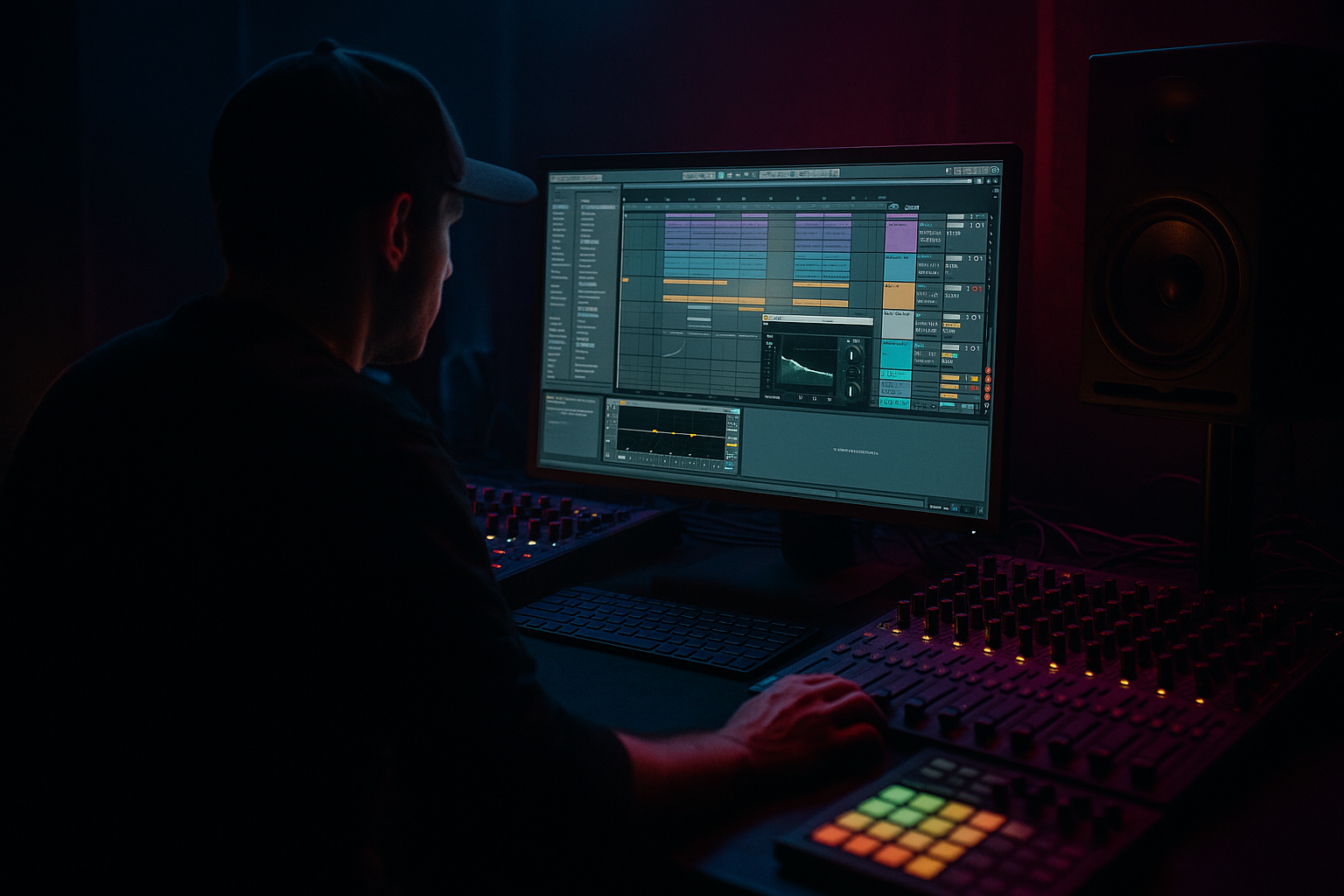
Nightbus: ride groove bounce for deep jungle atmosphere in Ableton Live 12 (Advanced) cover image

Narrated lesson audio

The voice track includes the tutorial plus extra teacher commentary.

Open audio file

Main tutorial

Lesson Overview

“Nightbus” is the kind of DnB groove that feels like rolling through wet streets at 2am: deep, patient, slightly swung, and full of atmosphere. In Ableton Live 12, the goal is not just to make a bassline hit hard — it’s to make the whole loop breathe like a moving vehicle: drum bounce in the chassis, sub weight in the floor, and a dark jungle mood in the air 🌑

This lesson focuses on a ride groove bounce that sits between deep jungle atmosphere and modern rollers discipline. That means:

  • a break-led drum feel with ghost notes and syncopation
  • a sub and reese relationship that leaves space for the drums
  • subtle modulation and resampling for movement
  • arrangement workflow that turns an 8-bar loop into a DJ-friendly, replayable section
  • Why this matters in DnB: the best nightbus-style tracks don’t rely on constant fills or huge drops. They create motion through micro-changes — hats shifting, rides opening, bass phrasing tightening, atmospheres passing by like streetlights. That’s what makes a loop feel alive and makes a drop carry for 16–32 bars without getting tired.

    Use this as a practical workflow for deep jungle / dark rollers / half-step-adjacent pressure inside Ableton Live 12, with stock devices only.

    What You Will Build

    By the end, you’ll have a focused 8-bar DnB loop that includes:

  • a tight break foundation with edited ghosts, punchy snare layering, and swing
  • a ride-led bounce that gives the groove forward motion without crowding the hats
  • a sub layer that anchors the low end cleanly in mono
  • a mid-bass reese / texture layer with controlled stereo width and motion
  • atmospheric FX and transitions that make the loop feel like a moving scene, not just a pattern
  • a simple arrangement block that can become an intro, drop, or breakdown seed
  • Musically, think:

  • BPM: 172–174
  • Key center: minor or modal, often with a dark pedal note
  • Vibe: urban, damp, nocturnal, rolling, slightly uneasy
  • Use case: opening drop, second drop variation, or a B-section groove after a sparse breakdown
  • Step-by-Step Walkthrough

    1. Build a fast, reusable session template first

    Before placing notes, set up a working group layout in Ableton Live 12:

    - Group 1: Drums

    - Group 2: Bass

    - Group 3: Atmospheres / FX

    - Group 4: Arrangement markers / reference lane

    On the Master, place:

    - Spectrum for quick tonal checks

    - Utility with Width at 0% temporarily for mono checks

    - Limiter only for safety while writing, not for loudness chasing

    In the Drums group, create separate tracks for:

    - Kick

    - Main Snare / Clap

    - Break

    - Hats / Ride

    - Percs / Foley

    In the Bass group, create:

    - Sub

    - Reese / Mid Bass

    - Texture / Top movement

    Why this workflow works in DnB: you need fast decisions. DnB arrangement moves quickly, and a clean template prevents you from overbuilding the loop before the groove is right. Advanced producers often lose time by sound-designing too early; the template forces you to lock the pocket first.

    2. Start with a break that already implies motion

    Drag in a clean jungle-usable break or chopped drum loop and warp it in Beats mode. If the source is at a different tempo, use transient preservation and keep the groove natural rather than grid-tight.

    Practical settings:

    - Warp Mode: Beats

    - Preserve: Transients

    - Transient Loop: off unless needed

    - Warp marker cleanup: remove any obvious flams or ugly timing drift

    Now slice the break to MIDI or edit it directly. Keep the core accents but carve space for your kick/snare or main snare layer. Aim for:

    - strong backbeat on 2 and 4, or a DnB snare placement around the standard 2 and 4 feel

    - ghost hits before the snare

    - small closed-hat chatter around the off-beats

    Add a Drum Buss on the break bus with subtle drive:

    - Drive: 5–12%

    - Boom: low or off if the break is already heavy

    - Crunch: 3–8%

    - Transients: slightly positive if the break needs snap

    Then use EQ Eight to tighten the loop:

    - high-pass the break around 80–120 Hz if sub is separate

    - notch any harsh snare ring around 3–6 kHz if needed

    Advanced tip: duplicate the break clip and make one version slightly more open for later arrangement sections. Keep the “main” break drier so the groove stays readable.

    3. Program the ride groove as the main bounce engine

    The “ride groove” in this style is not just a cymbal pattern — it’s the motion layer that gives the track its motorway feel. Use a ride or bright hat sample, then shape it so it pushes the bars forward without turning the top end into static noise.

    In MIDI:

    - place rides on off-beats or lightly syncopated 1/8 and 1/16 placements

    - leave holes around the snare so the backbeat can breathe

    - vary velocity significantly: try a range around 55–105

    - use slightly shifted timing on ghost rides, but avoid sloppy timing on the main accents

    Stock devices and workflow:

    - Put Groove Pool swing on a subtle break-friendly groove if the loop feels too grid-locked

    - Use Velocity MIDI effect if you want to compress the dynamic spread slightly

    - Send the ride to a bus with Auto Filter:

    - small high-pass around 150–250 Hz

    - very gentle resonance if you want a sharper metallic edge

    Two concrete parameter ideas:

    - Ride decay on the sample: keep it short to medium, around 150–400 ms

    - High shelf on EQ Eight: a slight boost around 8–12 kHz if the ride needs air, but only a dB or two

    Why this works in DnB: rides often create the perception of speed more than actual note density. In rollers and deep jungle, a well-phrased ride makes a track feel faster without needing busier drums.

    4. Design the sub as a separate, disciplined instrument

    Your sub should be simple, centered, and phrase-aware. In dark DnB, the sub often does more emotional work than the mid bass because it defines the weight of the nightbus roll.

    Create a Wavetable or Operator sub patch:

    - sine or near-sine source

    - mono playback

    - no stereo widening

    - envelope with short attack and controlled release

    Good starting settings:

    - Attack: 0–5 ms

    - Decay/Sustain: use sustained notes with note lengths doing the shaping

    - Release: 40–120 ms

    - Filter: low-pass if needed, but usually keep it clean

    Add Saturator lightly for audibility on small speakers:

    - Drive: 1–4 dB

    - Soft Clip: on

    - Output compensated to match level

    Then process with Utility:

    - Width: 0%

    - Gain: adjust for headroom

    - Bass Mono if you’re using Live 12’s utility workflow around mono discipline

    Program the sub with fewer notes than you think. Leave rests after snare hits or during busy break moments. That call-and-response space is a huge part of the nightbus feel.

    Practical phrasing idea:

    - Root note for 1 bar

    - small pickup note before bar 3 or bar 4

    - occasional octave drop into the next phrase

    Keep the sub locked to the kick/break relationship. If the kick is fighting the sub, don’t just EQ harder — change note length and placement first.

    5. Build a reese or mid-bass layer that answers the drums

    The mid-bass should not carry the entire low end. It should add attitude, stereo movement, and harmonic pressure above the sub.

    Start with Wavetable:

    - Osc 1: saw or analog-style table

    - Osc 2: detuned saw or slightly different wavetable

    - add mild unison, but not huge width

    - low-pass filter with movement from an envelope or LFO

    Suggested settings:

    - Detune: subtle, enough for beating but not chorus wash

    - Filter cutoff: around 150–600 Hz depending on the tone

    - Filter envelope amount: modest, enough for note attack motion

    - LFO rate: slow, around 1/2 bar to 2 bars if you want evolving movement

    Then process:

    - Saturator or Overdrive for bite

    - Auto Filter for movement automation

    - EQ Eight to remove unnecessary sub under ~100 Hz

    - Utility to narrow width below the low mids if the patch gets messy

    A strong advanced workflow is to split the bass into layers:

    - Sub: mono, clean, simple

    - Mid bass: gritty, moving, mid-focused

    - Top texture: filtered noise or a resampled layer with transient detail

    If you want a darker, neuro-leaning edge, automate a notch or bandpass sweep in the 300–1.2 kHz region so the bass “speaks” in phrases instead of droning constantly.

    6. Use resampling to turn static tone into night atmosphere

    Resampling is where the nightbus vibe gets cinematic. Create an audio track set to Resampling or route your bass bus to a new audio track, then record 4–8 bars of the bass motion and selective drum ambience.

    Once recorded:

    - chop out the best moments

    - reverse one or two transitional hits

    - time-stretch a texture fragment for background haze

    - use Warp in Complex or Complex Pro only where needed for texture, not for drums

    Practical resampling targets:

    - a bass growl tail after a note release

    - a ride hit with room tone

    - a ghosted drum fill that lands before the snare

    - a filtered atmospheric stab

    Then process resampled clips with:

    - Echo for short dark repeats

    - time: 1/8 or dotted 1/8

    - feedback: 10–25%

    - filter the repeats darker than the dry signal

    - Reverb very subtly for distance

    - decay: short to medium

    - pre-delay: small but present

    - Auto Filter automation for pass-bys

    This is a workflow move, not just a sound-design trick: resampling gives you unique material that feels like a real performance rather than loop repetition.

    7. Lock the drum-to-bass pocket with call-and-response

    A nightbus groove needs dialogue. The drums should not simply support the bass; they should speak against it.

    Build an 8-bar phrase where:

    - bars 1–2 establish the core loop

    - bars 3–4 add a small drum or bass variation

    - bars 5–6 intensify the ride or ghost percussion

    - bars 7–8 create a turnaround into the next section

    Example musical context:

    - In bars 1–4, the bass holds a root-heavy figure with a small pickup before bar 4

    - In bars 5–8, the bass answers the snare with a short two-note sting while the ride opens slightly

    Use automation on:

    - bass filter cutoff

    - ride send to reverb

    - drum bus saturation amount

    - delay throws on the final snare or percussion hit

    A good DnB arrangement choice is to keep the first 4 bars relatively restrained and make bars 5–8 feel like the “night train accelerating.” That way, when the next 16 bars land, the listener feels progression rather than repetition.

    8. Shape the buses, not just the individual sounds

    Advanced DnB mixing is often about bus discipline. Put the drums through a Drum Bus and the bass layers through a Bass Bus so you can shape groups instead of fixing everything per clip.

    On Drum Bus:

    - Glue Compressor with gentle gain reduction

    - Ratio: 2:1 or 4:1

    - Attack: 10–30 ms

    - Release: Auto or 0.1–0.3 s

    - Drum Buss for glue and density

    - EQ Eight for cleanup

    On Bass Bus:

    - EQ Eight to keep sub and mid roles separate

    - Saturator to unify harmonics

    - Utility for width control

    Check headroom:

    - keep your master well below clipping

    - don’t chase loudness while writing

    - leave space for later arrangement and mastering moves

    Mono check:

    - collapse to mono periodically with Utility

    - verify the sub stays stable

    - make sure the ride and mid-bass still feel clear when width is removed

    Why this works in DnB: the genre is extremely low-end dependent, and the difference between “massive” and “messy” is often bus discipline, not more processing.

    9. Turn the loop into a real arrangement block

    Don’t stop at the loop. Build a mini arrangement that could actually sit in a track.

    A strong structure for this style:

    - Intro (8–16 bars): atmos, filtered drums, tease the ride

    - Drop A (16 bars): full groove, restrained variation

    - Drop A2 (16 bars): add a bass answer or extra percussion

    - Break (8 bars): strip back drums, keep tension with texture

    - Drop B (16 bars): altered ride pattern, more bass movement, denser ghosts

    In Ableton, use Arrangement View and add markers for:

    - intro

    - build

    - drop 1

    - switch

    - break

    - drop 2

    Transition ideas:

    - low-pass the bass on the final bar before a switch-up

    - automate reverb send up on one snare hit, then hard-cut back to dry drums

    - insert a one-beat stop or half-bar mute before the next drop

    - use an impact or reversed cymbal sparingly, not constantly

    Keep it DJ-friendly by preserving a solid intro/outro with:

    - drums only

    - filtered bass tease

    - no unnecessary melodic clutter

    Common Mistakes

  • Making the ride too loud
  • - Fix: lower the ride 2–5 dB and use velocity variation instead of volume.

  • Letting the sub overlap every drum hit
  • - Fix: shorten note lengths, leave strategic rests, and test in mono.

  • Over-widening the bass
  • - Fix: keep sub mono and restrict width to upper harmonics only.

  • Using too much distortion on the drum bus
  • - Fix: reduce drive and compare with the dry bus; preserve transients.

  • Building the drop before the loop groove is solid
  • - Fix: finish the 8-bar core first, then arrange.

  • Ignoring break timing
  • - Fix: clean warp markers and ghost-note placement so the loop swings naturally.

  • Adding too many FX layers
  • - Fix: choose one or two atmospheric gestures per 8 bars, not constant noise.

    Pro Tips for Darker / Heavier DnB

  • Layer a very low, lightly saturated sub harmonic under the main sub only when the note needs extra pressure. Keep it subtle and mono.
  • Automate the reese filter opening only on phrase endings so the bass “talks” instead of washing the whole bar.
  • Use short echo throws on select drum ghosts to create urban depth without clutter.
  • Sidechain the mid-bass gently to the kick/snare pattern so the groove breathes, but don’t over-compress the life out of the break.
  • Resample a filtered drum+ride pass and tuck it under the main loop at very low level for movement.
  • Use tiny snare pitch differences between layers to create thickness without a fake layered-clap sound.
  • Create a contrast rule: if the drums are busy, simplify the bass; if the bass gets more active, strip the ride.
  • Darken the ambience, not the entire mix — keep the bass and drums readable while the FX layer carries the mood.
  • Mini Practice Exercise

    Set a 15-minute timer and build a nightbus loop from scratch in Ableton Live 12:

    1. Choose a break and warp it cleanly.

    2. Add a ride pattern that pushes the groove but leaves snare space.

    3. Write a mono sub line with only 3–5 notes over 4 bars.

    4. Create a reese or mid-bass response line with one small variation per 2 bars.

    5. Resample 4 bars of the combined groove.

    6. Chop one resampled texture into a reverse swell or filtered pass-by.

    7. Build an 8-bar arrangement with one intro bar and one switch-up bar.

    8. Do a mono check and adjust the bass so the low end stays tight.

    Goal: finish with a loop that feels like it could open a DJ set or sit under a dark vocal sample.

    Recap

  • Start with the drum pocket, not the bass sound.
  • Use the ride as a motion layer to create bounce and forward movement.
  • Keep the sub mono, simple, and phrase-aware.
  • Make the mid-bass answer the drums, not fight them.
  • Use resampling, bus processing, and automation to create atmosphere and progression.
  • Turn the loop into an arrangement block so the groove survives beyond 8 bars.

If the track feels like a wet, rolling midnight journey with weight in the floor and tension in the air, you’ve got the Nightbus energy right 🚍🔊


Ask GPT about this lesson

Chat with the lesson tutor, get follow-up help, or use quick actions.

Bigup 👽 Ask me anything about this lesson and I’ll answer in context.

Narration script

Show spoken script
Welcome to Nightbus: ride groove bounce for deep jungle atmosphere in Ableton Live 12, advanced edition.

In this lesson, we’re building that late-night DnB feeling where the track doesn’t just hit hard, it rolls. Think wet streets, low streetlights, engine hum, and that steady pressure of a bus moving through the city at 2 a.m. The goal is not maximum density. The goal is motion, space, and micro-change. That’s what makes a loop feel alive in this style.

We’re going to use stock devices only, and we’re going to work like experienced producers do: lock the groove first, then add the bass, then shape the atmosphere, then turn the loop into a real arrangement block. If you try to sound-design everything before the pocket is right, you’ll just end up polishing the wrong thing. So first: the workflow.

Start by setting up a clean session layout in Ableton Live 12. Group your tracks into Drums, Bass, Atmospheres and FX, and a lane for arrangement notes or markers if you like to stay organized. On the master, put Spectrum for quick tonal checks, Utility for mono checking, and a Limiter only as safety while you write. Not for loudness chasing, just for protection. Inside the Drums group, make separate tracks for kick, main snare or clap, break, hats or ride, and percs or foley. In the Bass group, split out sub, mid-bass or reese, and top texture. That separation matters in drum and bass because you need to make fast decisions, and you need to hear exactly what each layer is doing.

Now let’s build the break foundation. Drag in a clean break or a chopped drum loop and warp it in Beats mode. Keep the transients preserved, and don’t over-tighten it to the grid. A little human swing is a good thing here. In jungle and deep rollers, the contrast between the solid anchor hits and the slightly loose ghost notes is part of the pulse. Clean up any obvious flams or ugly drift, but don’t sterilize it.

Once the break is sitting right, decide what the core accents are doing. You want that snare backbeat energy, ghost notes leading into it, and a bit of hat chatter around the off-beats. If the break already has low-end weight, high-pass it around 80 to 120 hertz so it leaves room for the sub. Then add Drum Buss gently. A little drive, a touch of crunch, maybe some transient lift if it needs more snap. Keep it subtle. If the break starts sounding crushed, back off. Then use EQ Eight to notch any harsh snare ring or boxy buildup, but only where needed.

Here’s a useful advanced move: duplicate the break clip. Keep one version as your main groove, and make a slightly more open version for later in the arrangement. That way the loop can evolve without rewriting the whole drum part. This is one of those small workflow moves that saves a ton of time later.

Now for the ride groove, which in this style is not just a bright top layer. The ride is your motion engine. It’s almost like a second metronome, nudging the listener forward and creating that motorway sensation. Program a ride or bright hat pattern that pushes the bar without crowding the snare. Off-beats work well, or lightly syncopated 1/8 and 1/16 movement. Leave holes around the snare so it can breathe. Vary velocity a lot. Think somewhere between about 55 and 105, not everything slammed at one level.

This is important: the ride should feel driven, not looped. One way to do that is to make alternate bars slightly different. Keep the same sound, but shift a few notes, maybe add a pickup before the snare on one bar and go sparser on the next. That small change can make the groove feel like it’s moving through traffic instead of circling the same block. If the top end starts feeling too rigid, use a subtle Groove Pool swing or a bit of the Velocity MIDI effect to smooth the dynamics without killing the rhythm.

You can also process the ride with a light Auto Filter, maybe a small high-pass around 150 to 250 hertz, just to clean out any low junk. If the ride needs more air, a tiny high-shelf boost around 8 to 12 kilohertz can help, but only a little. In this style, too much ride is a common mistake. The ride should add speed and tension, not turn the mix into static.

Next is the sub, and this part needs discipline. Your sub should be mono, simple, and phrase-aware. Use Wavetable or Operator with a sine or near-sine source. Keep it clean. Short attack, controlled release, and no stereo widening. You can add a little Saturator so it speaks on smaller speakers, but only lightly. The point is not to make it dirty. The point is to make it present.

Write fewer notes than you think you need. Seriously. In dark DnB, space is part of the groove. Let the sub leave room after snare hits or during busy break moments. A root note that holds, a small pickup before the phrase turns, maybe an octave drop into the next section. That kind of phrasing is enough. If the sub is fighting the kick or the break, don’t just EQ harder. First shorten the note lengths and check the placement. Often that solves the problem before any processing does.

Now let’s design the mid-bass, the reese or texture layer. This is where the attitude lives. The mid-bass should not carry the entire low end. That’s the sub’s job. Instead, the mid-bass adds harmonic pressure and motion above it. Start with Wavetable. Use a saw or analog-style wavetable, maybe two oscillators with subtle detune. Keep the width controlled. Add a low-pass filter with movement from an envelope or a slow LFO, and think in phrases, not constant motion. If the cutoff is too open all the time, the bass just washes across the mix and stops speaking.

A nice advanced approach is to split the bass into layers: a clean mono sub, a gritty mid-bass, and a top texture or noisy resampled layer. That dirty-clean split is a big part of getting the nightbus vibe without wrecking the low end. Use Saturator or Overdrive for bite, EQ Eight to remove sub from the mid-bass, and Utility to control width in the low mids. If you want a darker, more neuro-leaning feel, automate a notch or bandpass movement in the mids so the bass feels like it’s talking in phrases.

Now here’s where the atmosphere starts to appear: resampling. This is one of the best ways to turn a static loop into a moving scene. Set up an audio track to record the combined groove or route your bass bus to a new track and capture four to eight bars. Then chop it. Pull out the best moments. Reverse a transition hit. Time-stretch a texture fragment. Use Warp in a texture-friendly mode where needed, but don’t abuse it on drums. Keep the drums rhythmic and the texture loose.

The best resampling targets are usually little things: a bass tail after release, a ride hit with room tone, a ghost fill before the snare, a filtered stab, a bit of drum ambience. Then process those clips lightly with Echo, maybe a short dark repeat, or a subtle Reverb to push them back in space. Use Auto Filter automation to make pass-bys. The key is that resampling gives you something that feels performed, not just programmed. It’s a huge part of making the loop feel cinematic.

At this point, start thinking in call-and-response. The drums should talk to the bass, not just sit underneath it. A strong nightbus phrase often works in pairs of tension states. One pass is more restrained, maybe the bass is simpler and the drums are clearer. The next pass opens up, maybe the ride gets denser or the bass answers the snare with a short sting. Then you alternate that energy every four or eight bars so the arrangement doesn’t flatten out.

A really useful workflow trick here is to use clip envelopes first, before you reach for long device automation lanes. In Ableton Live 12, clip-level filter or volume changes can be faster and more musical for micro-edits. Use device automation when you want broader movement, like a filter opening across eight bars or a send increasing before a transition. But for tiny edits, keep it inside the clip. That’s faster and cleaner.

Now let’s shape the buses. Put your drums through a Drum Bus and your bass layers through a Bass Bus. This is where advanced DnB mixing gets efficient. On the Drum Bus, use a gentle Glue Compressor, maybe a bit of Drum Buss for density, then EQ Eight for cleanup. Don’t overdo the compression. You want glue, not a flattened brick. On the Bass Bus, use EQ Eight to separate sub and mid roles, a bit of Saturator to unify the harmonics, and Utility for width control. Keep checking headroom. Don’t push the master into clipping just because the loop is exciting. The mix should feel strong but still breathe.

Also, do periodic mono checks. Collapse the mix with Utility and listen for what falls apart. The sub should stay stable, the ride should still read clearly, and the mid-bass should remain focused. If something disappears in mono, fix the width problem at the source instead of just making the whole thing louder.

Now turn the loop into a real arrangement block. Don’t stop at the 8-bar idea. Build something that could actually live inside a track. A good structure for this style is an intro with atmos and filtered drums, then a full 16-bar drop, then a variation with an extra percussion answer or bass reply, then a breakdown, then a second drop with more ride motion and deeper ghost notes. Use arrangement markers so you can see the shape of the section clearly.

For transitions, keep it tasteful. A low-pass on the bass on the final bar before the switch. A reverb throw on a snare hit, then snap back to dry. A one-beat stop. Maybe a reversed cymbal, but not every four bars. The trick is restraint. You want the listener to feel movement, not hear constant “look at me” effects.

A common mistake in this style is making the ride too loud. The ride should be motion, not the lead instrument. Another mistake is letting the sub overlap every drum hit. That’s where the groove gets muddy. Shorten the notes, leave space, and test in mono. Also, don’t over-widen the bass. Keep the sub dead center and only widen the upper harmonics if needed. And definitely don’t build the whole drop before the loop groove is solid. The loop is the foundation.

Here’s a pro way to think about darker DnB: darken the atmosphere, not the whole mix. Let the drums and bass stay readable. Keep the low end controlled. Then use the FX layer, the resampled textures, and the small echoes to carry the mood. That’s what gives you depth without losing power.

If you want to push it further, try alternating ride patterns every two bars. Bar A can emphasize off-beats, bar B can add a pickup before the snare, bar C can get a bit denser, bar D can go sparse again. Same sound, different timing. That’s enough to create progression. Or build a drop A and a drop A-minus version. Version one is full groove. Version two removes one drum layer and thins the ride. That contrast gives the track breathing room.

Another strong idea is to create a shadow groove layer. Duplicate the drum loop, strip it down to transient fragments, filter it heavily, and tuck it under the main drums. You’ll get this impression of a second room or distant traffic without crowding the mix. It’s a very effective way to deepen the atmosphere.

And for bass phrasing, remember this: note length is often more powerful than note count. You can use the same notes and make the line feel totally different just by changing sustain. Short for pressure, medium for glide, long only at phrase endings. That’s how you make the bass feel conversational.

Before you wrap the idea, print references of your own loop at different stages. Make a dry bounce, a bus-processed bounce, and a resampled bounce. That way you can hear whether your changes are improving the groove or just making it louder. That’s a simple move, but it’s incredibly useful when you’re deep in the details and starting to lose perspective.

As a quick practice challenge, set a 15-minute timer and build a nightbus loop from scratch. Choose and warp a break. Add a ride pattern that pushes forward but leaves snare space. Write a mono sub line with only three to five notes over four bars. Create a mid-bass response with one small variation every two bars. Resample four bars of the groove. Chop one resampled texture into a reverse swell or filtered pass-by. Then build an eight-bar arrangement with one intro bar and one switch-up bar, and do a mono check to tighten the low end.

If you finish with a loop that feels like it could open a DJ set, or sit under a dark vocal sample, you’ve got it. If it feels like a wet, rolling midnight journey with weight in the floor and tension in the air, that’s the Nightbus energy.

So remember the core logic: start with the drum pocket, use the ride as a motion layer, keep the sub mono and phrase-aware, make the mid-bass answer the drums, and use resampling, bus processing, and automation to create atmosphere and progression. Build the loop so it survives beyond eight bars. That’s the real advanced workflow.

Alright, let’s make that city night move.

mickeybeam

Go to drumbasscd.com for +100 drum and bass YouTube channels all in one place - tune in!

Generating PDF preview…