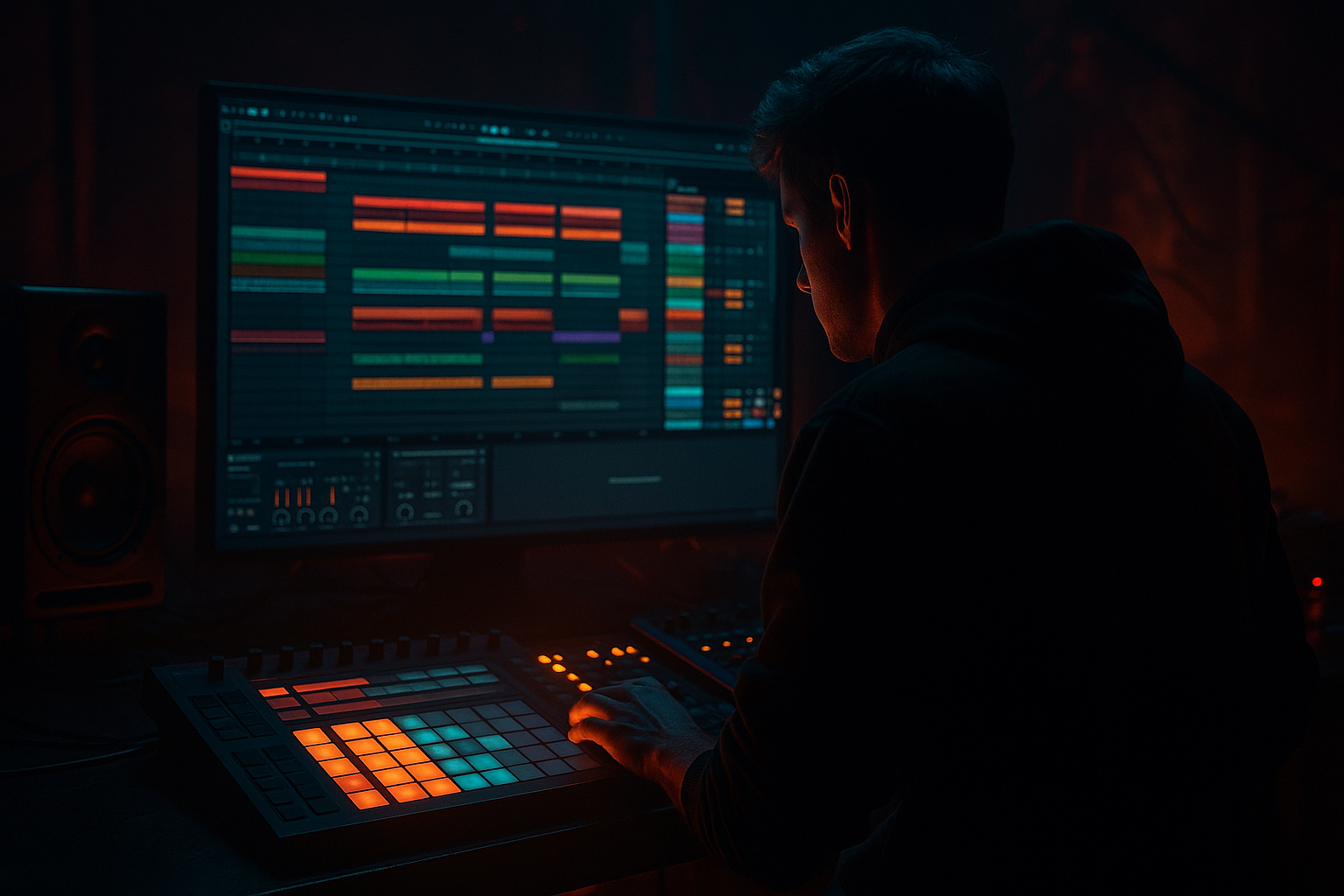
Main tutorial
Lesson Overview
In this lesson, you’ll build a Nightbus-style chop arrangement in Ableton Live 12 using resampling, with the goal of creating that oldskool jungle / DnB roll-up energy that feels gritty, chopped, and moving. This is the kind of technique that sits right at the heart of a strong Arrangement: you take a simple break, resample it into new playable audio, slice it into musical phrases, then rearrange it into a full track section with tension, release, and switch-ups.
Why this matters in Drum & Bass: a lot of great DnB is not built from endless layers. It’s built from one or two strong loops, carefully edited. Resampling forces you to commit to a sound, which helps you make better arrangement decisions faster. That’s especially useful for jungle and oldskool-inspired DnB, where chopped breaks, bass stabs, and space between hits are what make the groove feel alive.
In Ableton Live 12, this workflow is especially smooth because you can use:
- Simper / Drum Rack / Simplers for fast chop playback
- Resampling audio tracks to capture the exact vibe of your processing
- Auto Filter, Saturator, Drum Buss, Echo, Reverb, Utility for DnB-friendly shaping
- Warp, slice, consolidate, and duplicate for arrangement building
- A resampled break chopped into playable slices
- A second resampled version with extra grit, filtering, or FX
- A bass phrase that works like a call-and-response with the drums
- An Arrangement with:
- Basic mix control so the low end stays clean and the drums still hit hard
- Breakbeat pressure
- Loose swing
- Short bass phrases
- Dark texture
- Oldskool jungle movement, but cleaned up enough to work in modern DnB
- Over-chopping the break
- Bass fighting the snare
- Too much low-end stereo
- Resampling too cleanly
- Looping forever without arrangement
- FX washing out the drums
- Use call-and-response between break and bass
- Print a distorted version of the break, then blend it quietly
- Automate filter movement on the bass, not just volume
- Keep sub notes simple
- Use micro-fills before major transitions
- Leave a little ugly in the sound
- Check harshness around the top end
- Resampling is powerful in DnB because it turns a loop into something playable and arrangable.
- Keep the workflow simple: break, print, chop, bass, arrange.
- Use Ableton stock devices like Saturator, Drum Buss, Auto Filter, EQ Eight, Utility, Echo, and Reverb to shape the vibe.
- In jungle and oldskool DnB, the groove comes from drum edits, space, and call-and-response.
- Strong arrangements use small changes every 4 or 8 bars to keep energy moving.
- For dark, heavy DnB, focus on sub discipline, drum impact, and controlled grit rather than overloading the mix.
The end result should feel like a night-time bus ride through broken beats: moody, restless, and constantly evolving. Think intro atmosphere, a chopped break that comes in with tension, a bass phrase that answers the drums, then a switch-up that keeps the listener locked in. 🌘
What You Will Build
You will create a 4 to 8 bar chopped jungle/DnB idea based on a resampled break and a simple bass movement, then arrange it into a short intro-to-drop section.
Specifically, you’ll end up with:
- a DJ-friendly intro
- a tension-building pre-drop
- a main drop section
- a small switch-up or fill
Musically, the vibe should feel like:
Step-by-Step Walkthrough
1. Set your project up for a fast DnB arrangement
Start with a blank Live set and set the tempo to 170–174 BPM. For a Nightbus / jungle-style idea, 172 BPM is a great middle ground.
Create these tracks:
- Track 1: Break Source
- Track 2: Resampled Break
- Track 3: Bass
- Track 4: Atmos / FX
- Track 5: Drum Fill / Top Loop (optional)
Keep the session simple. Beginner-friendly DnB works best when you can hear exactly what each part is doing. Drop a reference track into an audio track if you like, and use it only as a vibe check for arrangement energy and density.
Arrangement goal for now: make a short 16-bar section with clear tension and a drop.
2. Find or load a break, then chop the groove into a playable loop
Put a classic break or any gritty drum loop onto Track 1. If it’s an audio clip, warp it so it sits tightly to the grid. For jungle-style timing, don’t over-quantize everything into robotic perfection.
Good beginner move:
- Loop 2 bars
- Use Clip View to make sure the break sits well
- Try a small amount of swing by nudging slices later rather than quantizing hard
If you’re using Live’s stock tools, you can:
- Drag the break into a Drum Rack via Slice to New MIDI Track
- Choose a slicing preset like Transient or Beat
- Play slices from a MIDI clip to create a custom chop pattern
Why this works in DnB: oldskool jungle energy often comes from reordering real drum hits, not just looping them. The groove feels alive because the kick/snare relationship keeps changing slightly.
3. Resample the break with a little dirt and movement
This is the core of the lesson. Create a new audio track called Resampled Break and set its input to Resampling.
On the Break Source track, add a simple processing chain before resampling:
- EQ Eight: high-pass gently around 25–35 Hz to clear sub-rumble
- Saturator: Drive around 2–6 dB
- Drum Buss: Drive around 5–15%, Boom low or off for now
- Optional Auto Filter: low-pass sweep or gentle band movement
Record 4–8 bars of the break into the Resampled Break track.
The point is not to destroy the break. The point is to capture a version with:
- more character
- a slightly compressed feel
- a stable, printable tone
After recording, consolidate the best section so you have one clean audio clip to work with.
4. Slice the resampled audio into chops and turn it into a musical pattern
Take your resampled break and slice it again if needed, or use the raw audio clip directly in Arrangement.
A beginner-friendly chop approach:
- Find 1 strong bar of drums
- Duplicate it across 2 or 4 bars
- Cut the audio clip at key transient points
- Rearrange the pieces so snare hits, ghost notes, and little drum flams become part of the groove
Focus on these DnB-friendly chop shapes:
- Snare answer: a chopped snare after the main backbeat
- Ghost note push: tiny hits before the snare
- Pickup fill: a quick break fill at the end of bar 4 or 8
- Reverse-style tension: short chopped tail before the drop
Keep the edits musical, not random. In jungle and rollers, the best chops feel like the break is “talking back” to itself.
If you want a more playable setup, load the resampled break into Simpler in Slice mode. That makes it easier to trigger slices from MIDI and build variations without constantly cutting audio.
5. Build a bass idea that answers the chop
Now add a bass line that leaves room for the drums. For a beginner, keep it simple: one bass sound, one clear rhythm, no overcomplication.
Use one of Live’s stock instruments:
- Operator for a clean sub
- Wavetable for a reese-style movement
- Analog if you want a rougher oldschool tone
A simple bass chain:
- Operator: sine wave sub foundation
- Add a second oscillator or layer in Wavetable for midrange movement
- Put Saturator after it for harmonics
- Use Utility to keep the sub mono
Starter settings:
- Sub layer: keep it mostly mono, low-pass if needed
- Saturator Drive: 1–4 dB
- Filter cutoff on the mid layer: somewhere in the 200 Hz to 1.2 kHz zone depending on tone
Make the bass phrase short and rhythmic. For jungle/DnB, bass often works best when it:
- leaves space for the snare
- plays a call-and-response with the chop
- uses repeated notes with slight variation
Example musical context:
- Bars 1–2: drum chops establish the groove
- Bar 3: bass answers with a short phrase
- Bar 4: drum fill and bass rest
- Bars 5–8: bass and drums repeat with a new variation
6. Use arrangement blocks, not endless looping
Switch to Arrangement View and build a clear 16-bar structure. This is where the lesson becomes a real track idea instead of a loop.
Use this simple DnB arrangement map:
- Bars 1–4: Intro / tension
- filtered break
- atmosphere
- no full bass yet
- Bars 5–8: First drop phrase
- full chopped break
- bass answers the drums
- Bars 9–12: Variation
- remove one drum layer
- change bass rhythm
- add a fill or reverse hit
- Bars 13–16: Switch-up / mini breakdown
- strip energy back
- tease the main groove again
Duplicate clips first, then edit. Don’t try to invent every bar from scratch. In DnB, arrangement speed matters because your best ideas happen when you hear the groove in context.
Add simple automation:
- Auto Filter cutoff opening over 4 or 8 bars
- Reverb send increased just before a transition
- Echo throw on the last snare or chopped vocal hit
- Utility gain slightly down in the intro, full level at the drop
7. Shape the drums so the chop hits harder
The break should sound strong, but the arrangement also needs control. Use stock mixing tools to make the drums sit like a proper DnB foundation.
On the drum or break bus, try:
- EQ Eight: cut any harshness around 3–6 kHz if the hats get spiky
- Drum Buss: Drive 5–10%, Crunch lightly if needed
- Glue Compressor: gentle control, around 2:1, just a couple dB of gain reduction
- Utility: mono-check any low drum layers
For a cleaner low end:
- keep kick and sub from fighting
- high-pass non-bass elements carefully
- avoid too much stereo on anything below about 120 Hz
Why this works in DnB: the listener needs to feel both the impact of the break and the weight of the sub. If they blur together, the groove loses punch fast.
8. Add atmosphere and transition FX the DnB way
A Nightbus vibe needs space, not just drums. Add one or two atmosphere layers:
- rain, vinyl noise, industrial hum, distant ambience, or filtered noise
- use Auto Filter to automate darkness and movement
- use Reverb with a long decay, but keep the dry sound controlled
Good beginner transition moves:
- reverse a chopped snare and fade it into the drop
- automate a high-pass filter opening on ambience
- use Echo on one drum hit at the end of a phrase
- create a short downlifter with noise and filter movement
Keep FX subtle. In darker DnB, atmosphere should make the groove feel bigger, not bury the drums.
9. Print a second resample for final energy and edit it into the arrangement
This is the “make it feel like a record” step. Create another resampling pass, but this time capture:
- the chopped drums
- the bass
- maybe a touch of FX
Record 4 bars of your almost-finished drop into a new audio track. Then:
- slice the best moments
- place those slices into the arrangement
- use them as fills, pickups, or alternate drop hits
This gives you a more committed, performance-style result. In DnB, this often creates the little “one-off” moments that make a section memorable.
Try one simple automation pass on the printed audio:
- cut the filter briefly before the drop
- mute the bass for half a bar before a restart
- bring in a chopped fill on bar 8 or 16
That tiny switch-up can make the whole arrangement feel more intentional.
10. Do a quick arrangement check before moving on
Play the full 16 bars and ask:
- Does the first 4 bars build curiosity?
- Does the drop land clearly?
- Is there enough space between bass hits and snare hits?
- Does the loop change at least once before it feels repetitive?
If the answer is no, make one of these beginner-safe changes:
- remove a bass note
- shorten one chop
- add a fill at the end of bar 4 or 8
- automate a filter more clearly
- mute the sub for a moment to create impact
In Arrangement, small changes are often more effective than adding more sounds.
Common Mistakes
- Fix: keep one or two recognizable drum phrases intact so the groove still breathes.
- Fix: leave space on the backbeat. If the snare hits on 2 and 4, avoid stacking the bass directly on top unless it’s intentional.
- Fix: use Utility to keep sub frequencies mono and check your bass in mono regularly.
- Fix: add a little Saturator or Drum Buss before printing. Jungle and oldskool DnB usually benefit from some grit.
- Fix: duplicate into 4-bar blocks and make one clear change every 4 or 8 bars.
- Fix: automate FX lower than you think, especially reverb and delay. Keep the break the star.
Pro Tips for Darker / Heavier DnB
- Let the drums say something, then let the bass answer. This gives the track a proper conversation, which is huge in rollers and jungle.
- Resample a dirtier break with Saturator and Drum Buss, then tuck it under the clean version for extra bite.
- A bass that opens slightly over 4 bars feels more alive than one that just gets louder.
- For heavier DnB, a steady sub foundation often hits harder than busy note writing.
- A 1/2-bar snare roll, reversed chop, or tiny break edit can make a drop feel much bigger.
- A perfectly polished break can lose the underground feel. A touch of distortion or uneven chop timing can be the character.
- If the hats or edited break slices get too sharp, reduce the harsh area with EQ Eight around 4–8 kHz.
Mini Practice Exercise
Spend 10–20 minutes making one 8-bar Nightbus-style phrase:
1. Load a break and set the project to 172 BPM.
2. Resample 4 bars of the break with light Saturator and Drum Buss.
3. Chop the resampled audio into at least 6 slices.
4. Write a bass pattern using Operator or Wavetable with just 2–4 notes.
5. Arrange 8 bars:
- bars 1–2: filtered drums + atmosphere
- bars 3–4: full chop enters
- bars 5–6: bass answers
- bars 7–8: small fill and reset
6. Add one automation move:
- filter opening
- reverb throw
- or bass cutoff movement
7. Export or play it back and listen in mono for balance.
Goal: make it feel like a real DnB section, not just a loop.

