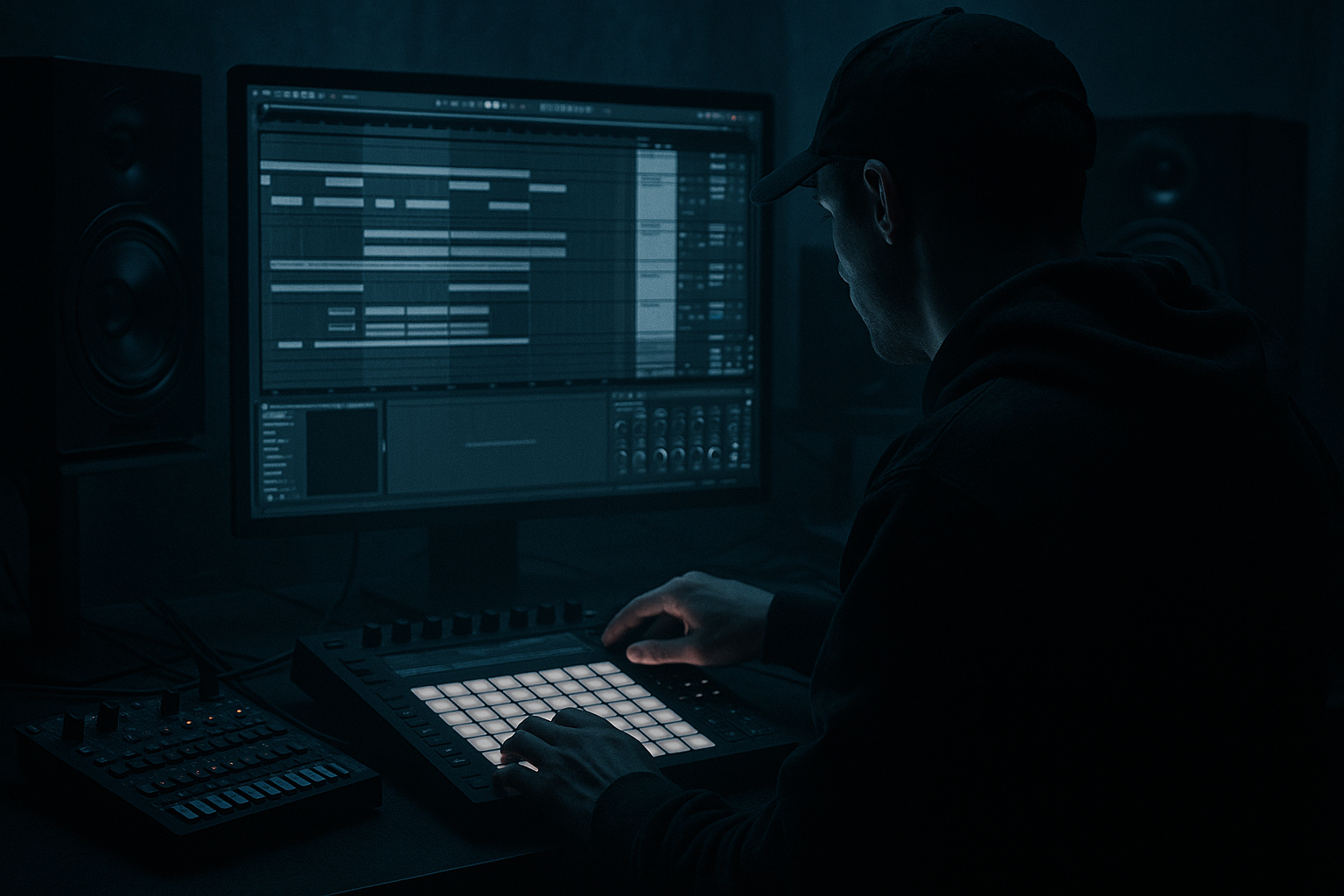
Main tutorial
Motif Variation Across Sections (Smoky Late‑Night Moods) — Advanced DnB in Ableton Live 🌙🎛️
1) Lesson overview
In late‑night drum & bass, the vibe often comes from one strong motif (a 2–4 bar musical “identity”) that evolves across the arrangement without losing its hypnotic pull. This lesson shows you how to vary a motif across intro → drop → mid‑section → second drop → outro using Ableton Live stock tools—keeping it rolling, smoky, and restrained rather than “EDM obvious”.
We’ll focus on micro-variation (timing, tone, re-voicing, space, automation) and sectional contrast (density, register, stereo, call/response), while staying rooted in jungle/DnB phrasing (8/16/32 bar logic, tension/release).
---
2) What you will build
A 64–96 bar DnB sketch with:
- A 4‑bar motif (keys/pad or reese “hook”) that feels noir and late-night
- 3–5 variations of that motif used across sections
- A rolling drum backbone + bass that supports the motif instead of crowding it
- An arrangement that feels like a continuous story, not copy/paste loops
- Algorithm: Hall (or Convolution “Dark Hall” if you prefer)
- Decay: 3.5–5.5 s
- Predelay: 20–35 ms
- EQ: HP around 250–400 Hz, LP around 7–10 kHz
- Wet 100% (it’s a return)
- Mode: Stereo
- Time: 1/8D or 1/4 (try 1/8D for noir bounce)
- Feedback: 20–35%
- Filter: HP 250 Hz, LP 6–8 kHz
- Modulation: small (2–6%) for haze
- Wet 100%
- Wavetable for a smoky key/reese hybrid
- Analog for warmer, simpler tone
- Keep it simple: 3–6 notes total over 4 bars.
- Use minor 7 / minor 9 color without going full jazz.
- Add space: motifs in late-night DnB often feel like “answers”, not constant noodling.
- Bar 1: F (short), Ab (short), C (held)
- Bar 2: Rest → Eb (short) → C (short)
- Bar 3: F (short) → G (ghost/passing) → Ab (held)
- Bar 4: Rest → C (short) → F (short)
- Quantize to 1/16 with Amount 50–70%
- Kick on 1
- Snare on 2 and 4 (classic)
- Hats/ghosts: 1/16 shuffles and a few 1/32 pushes
- Drum Rack (or individual tracks)
- Drum Buss on DRUMS group
- Glue Compressor lightly (1–2 dB GR)
- Use Operator for sub:
- Compressor on motif, sidechain from DRUMS bus
- Ratio 2:1 to 4:1, Attack 5–15 ms, Release 80–160 ms
- Aim 1–3 dB gain reduction (subtle)
- Set scale to F minor, then deliberately “break” it with 1–2 notes for tension.
- Freeze + Flatten the motif track for a section, then:
- Add Grain Delay very low mix for grit:
- Intro (16 bars): Variation A (ghost), minimal drums/foley
- Build (8 bars): A → B transition (filter opening, less reverb)
- Drop 1 (32 bars): Variation B, full drums + bass
- Mid / Breakdown (16 bars): Variation C, pull drums back to tops + snare, add atmos
- Drop 2 (32 bars): Variation D, heavier bass or more percussion
- Outro (16 bars): Variation E
- Auto Filter cutoff: open into drops, close into breakdowns
- Saturator drive: +1–2 dB in drop 2 for urgency
- Reverb send: push at the end of phrases (bar 8/16/32)
- Delay throw: automate Echo send on one note only at phrase ends
- Use negative space as variation: removing the motif for 2 bars before it returns often hits harder than adding notes.
- Layer “air” not “chords”: a thin noise layer (Wavetable noise osc or Operator noise) into reverb creates smoke without harmonic clutter.
- Resample for menace: bounce motif audio, then process with:
- Tension notes = dosage: one outside-scale passing tone once per 8 bars can feel genius; every bar feels wrong.
- Microtiming matters: push a motif note 5–15 ms late against the snare for drunken noir swing (advanced feel move).
- Drum/bass “masking slots”: when motif plays, reduce hat density or pull back a bass mid layer via automation.
- A strong late-night DnB track often rides one motif—the art is variation, not replacement.
- Build variations by controlling rhythm, register, harmony, density, and space.
- Use Ableton stock tools (Auto Filter, Echo, Hybrid Reverb, Saturator, Utility, EQ Eight, Compressor) to morph the motif across sections.
- Keep DnB phrasing tight (8/16/32), and let micro-edits deliver movement every 2–4 bars.
Target mood: smoky, dim club, rain on windows, sub-heavy but elegant 🌫️
---
3) Step-by-step walkthrough
Step 0 — Session setup (fast but important)
1. Tempo: 172–176 BPM (pick 174 BPM).
2. Key: choose something dark/easy like F minor or G minor.
3. Create groups:
- DRUMS
- BASS
- MOTIF (Music)
- FX / ATMOS
4. Set Return tracks:
- A: Reverb (Hybrid Reverb)
- B: Delay (Echo)
Return A (Hybrid Reverb) settings (starting point):
Return B (Echo) settings:
---
Step 1 — Design a “late‑night” motif (4 bars, minimal notes)
Pick one instrument for the motif. Two good DnB-safe choices:
(You can also use a sampled jazz chord stab, but we’ll build it from synth for control.)
#### Motif instrument chain (stock, reliable)
Track: MOTIF
1. Wavetable
- Osc 1: Basic Shapes (sine/triangle-ish)
- Osc 2: Saw (low level)
- Unison: 2–4 voices, Amount low (10–20%) for subtle width
- Filter: LP24, cutoff ~ 400–1.5k (we’ll automate), drive 2–6
2. Saturator
- Soft Clip ON
- Drive: 2–6 dB (don’t crush; just thicken)
3. Chorus-Ensemble (optional, subtle)
- Amount low (10–20%), Rate slow
4. Auto Filter (for extra motion)
- LP12, Envelope small, or LFO slow (0.03–0.08 Hz)
5. Utility
- Width: 80–110% (keep it controlled)
6. EQ Eight
- HP at 120–200 Hz (leave room for sub/bass)
- Gentle dip at 300–500 Hz if it gets boxy
#### Write the motif (musical content)
Example (in F minor):
Ableton tip: record it in, then quantize lightly:
You want a human lean, not robotic grid.
---
Step 2 — Lock the drums + bass around the motif (so variations read clearly)
You’re advanced, so you likely have drum racks ready. The key here: don’t over-write drums while designing motif variation.
Quick drum backbone (rolling DnB):
DRUMS group suggestions:
- Drive 5–15
- Boom: 20–40 Hz (low), Amount low
- Transients: +5 to +15
Bass: keep it supportive initially—simple sub following root notes of motif.
- Sine wave, mono, slight Saturator
- Sidechain with Compressor from kick (2–5 dB GR)
---
Step 3 — Create motif variations (the core of the lesson) 🔥
You’ll create 3–5 deliberate variations of the same motif, each designed to fit a section role.
#### Variation A: “Intro ghost” (thin, distant, filtered)
Goal: tease motif without giving it away fully.
How:
1. Duplicate motif clip → rename `Motif_A_Intro`.
2. In clip view:
- Remove 1–2 notes (make it more minimal).
- Increase note lengths slightly on held notes (more float).
3. Automate tone:
- Auto Filter cutoff: start ~300–500 Hz, rise to ~1.2 kHz over 8–16 bars.
4. Send more to Reverb/Delay:
- Reverb send: +3 to +8 dB vs drop
- Delay send: moderate, but filtered
Result: motif feels like smoke in the room 🌫️
---
#### Variation B: “Drop anchor” (clearer rhythm + tighter envelope)
Goal: motif becomes a hook that locks with the groove.
How:
1. Duplicate → `Motif_B_Drop`.
2. Tighten envelope:
- In Wavetable, reduce Amp Release to keep it punchier.
3. Rhythmic clarity:
- Add a short “answer” note right after snare in bar 2 or 4 (classic call/response with backbeat).
4. Reduce reverb:
- Pull down sends so drums/bass feel forward.
Ableton move: add sidechain “duck” so motif breathes with the kick/snare:
---
#### Variation C: “Mid‑section reharmonize” (same contour, new chord color)
Goal: it still reads as the motif, but emotionally shifts (late‑night = tasteful harmony change).
How:
1. Duplicate → `Motif_C_Mid`.
2. Keep the rhythm mostly identical (contour recognition).
3. Change one harmonic target:
- If you’re in F minor, try implying Dbmaj7 or Eb7sus flavors.
- Example: move Ab to A natural briefly (tension), or swap C → B natural as a passing tone (careful, very spicy).
4. Support with texture:
- Add a quiet pad layer (Analog) doing just root + 5th, filtered low, wide.
- Or use Hybrid Reverb slightly more for this section.
Ableton tool: Scale MIDI effect (if you want guardrails):
---
#### Variation D: “Second drop switch” (register flip + call/response)
Goal: make Drop 2 feel bigger without changing everything.
How:
1. Duplicate → `Motif_D_Drop2`.
2. Register flip:
- Transpose the motif up +12 semitones (or down -12) but thin it so it doesn’t crowd vocals/leads.
3. Make it conversational:
- Bar 1–2: motif plays
- Bar 3–4: motif rests; a resampled FX tail or bass fill answers
Workflow trick (Ableton resample):
- Slice the audio to a new MIDI track (Convert to Drum Rack) or just chop in audio.
- Freq 1–3 kHz, Time tiny, Dry/Wet 5–12%
---
#### Variation E: “Outro dissolve” (rhythm stays, clarity fades)
Goal: motif decays into atmosphere.
How:
1. Duplicate → `Motif_E_Outro`.
2. Keep MIDI the same as drop version, but automate:
- Filter cutoff down
- Reverb send up
- Utility width down slowly toward mono (50–80%) for “distance”
3. Optional: Redux (very subtle) to make it feel like it’s coming from another room:
- Downsample small amount, Dry/Wet 5–10%
---
Step 4 — Arrange using DnB phrasing (so variations land)
A practical template (adjust as needed):
Key DnB detail: make changes on 8/16 bar boundaries, but sprinkle micro-edits every 2–4 bars (a hat drop, ghost snare, bass fill, motif tail).
---
Step 5 — Transitions: make the motif “morph” rather than “switch”
To avoid obvious copy/paste, use automation bridges:
Ableton technique: “one-note throw”
1. Put Echo on return.
2. Automate send to spike only on the last note of bar 4 or 8.
3. Immediately pull it back.
This is a staple for late-night “trail into darkness” 🖤
---
4) Common mistakes
1. Changing too much at once
If you change notes and rhythm and sound and mix, the motif loses identity.
2. Over-reverbing the drop
Late-night ≠ washed out. Keep the drop dry-forward, atmosphere sits behind.
3. Motif fights the bass
HP your motif and manage low mids (200–500 Hz). Let bass own the power.
4. No phrasing logic
DnB demands 8/16/32 bar sense. Random changes feel amateur fast.
5. Stereo too wide too early
Save width for impact. Intro often works better more mono/narrow.
---
5) Pro tips for darker/heavier DnB 🥷
- Saturator → EQ Eight (low-pass) → Amp (tiny drive) → Hybrid Reverb
---
6) Mini practice exercise (30–45 minutes) 🧪
1. Write a 2-bar motif in F minor using only 5 notes total.
2. Make three variations:
- A: filtered + reverb-heavy (intro)
- B: tight + sidechained (drop)
- C: reharmonized (same rhythm, one changed target note)
3. Arrange 48 bars:
- 16 intro (A)
- 16 drop (B)
- 16 mid (C)
4. Add one delay throw at bar 16 and bar 32.
5. Bounce a quick reference and ask:
- Can you hum the motif in all sections?
- Does each section have a different emotional “lighting”?
---
7) Recap ✅
If you want, tell me your preferred substyle (deep/rollers, jungle, neuro-leaning, autonomic-ish) and whether your motif is keys, reese, or sampled, and I’ll suggest a tailored motif device chain + an exact 96-bar arrangement map.

