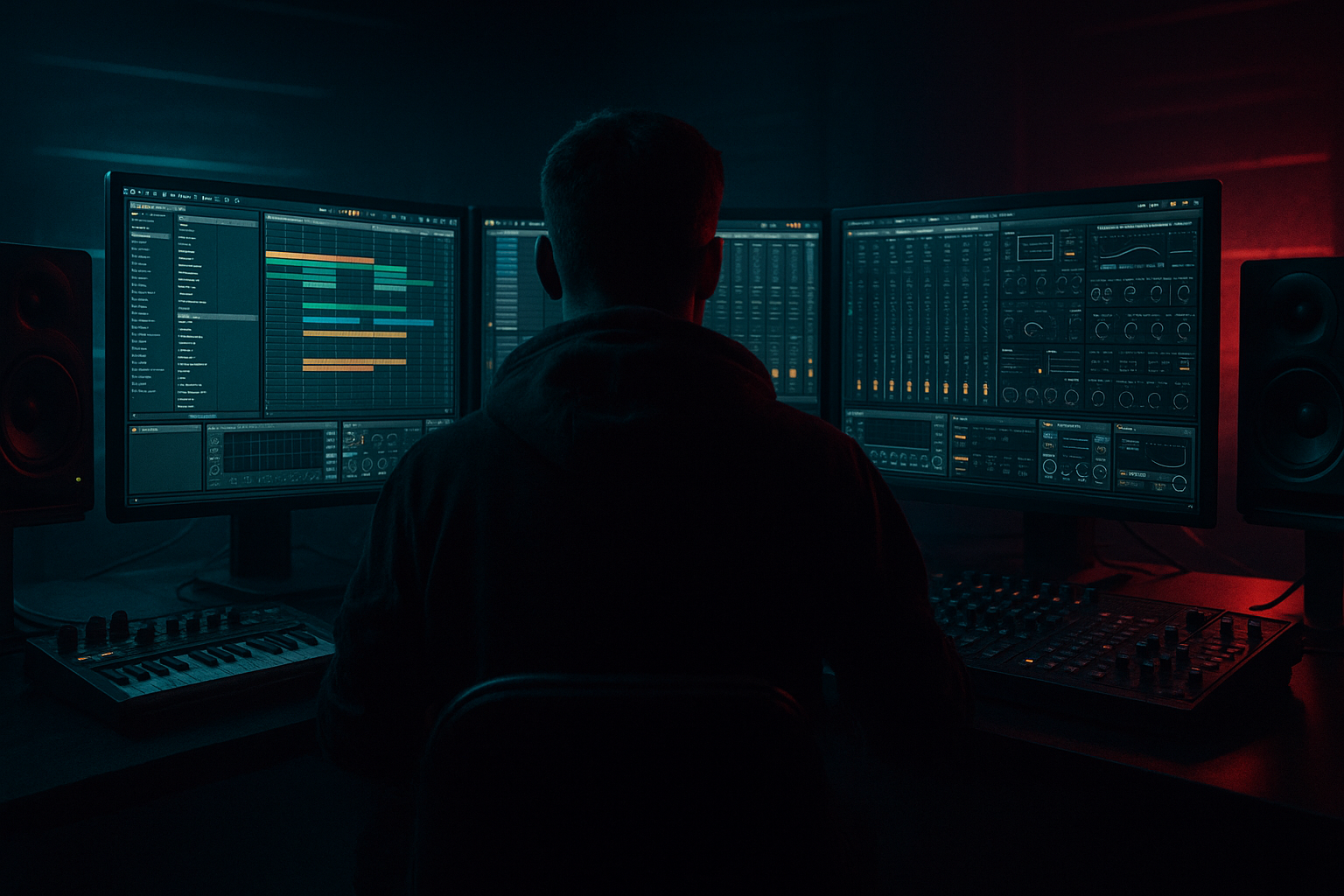
Main tutorial
Lesson Overview
In this lesson, you’ll build a moonlit jungle-style snare snap balance in Ableton Live 12 by using Session View to prototype the groove, then Arrangement View to shape the release of energy across a full DnB section. The goal is not just to make the snare louder — it’s to make the snare feel sharp, alive, and controlled against a rolling drum-and-bass bed, with the right amount of crack in the upper mids and the right amount of body so it cuts through a dark bassline without sounding thin.
This technique matters a lot in DnB because the snare is often the emotional anchor of the drop. In jungle, rollers, neuro, and darker halftime-influenced DnB, the snare helps define the backbeat, momentum, and tension release. If the snare is too soft, the drop loses authority. If it’s too snappy or too bright, the mix can get harsh and fatiguing fast. The “moonlit” vibe here means we’re aiming for a snare that feels clean, nocturnal, and punchy — not glossy pop-drum energy.
You’ll use Ableton’s stock tools to:
- balance the snare against kick and bass,
- add controlled snap with EQ and transient shaping,
- move between spontaneous Session View testing and structured Arrangement View automation,
- and create a drop that feels like it belongs in a proper DnB set.
- a tight drum loop,
- a snare layer that has both body and snap,
- a rolling bassline that stays out of the snare’s way,
- FX automation that opens the energy into the drop,
- and a clear Session View sketch that becomes a polished Arrangement View section.
- bars 1–4: stripped intro to the groove,
- bars 5–8: drum loop establishes the pocket,
- bars 9–12: bass enters and competes with the snare,
- bars 13–16: snare automation and FX make the drop hit harder.
- a little low-mid body around the 180–250 Hz area,
- a clear crack/snap around 2–5 kHz,
- and controlled brightness so it cuts on small speakers without turning brittle.
- reverb send amount,
- filter movement,
- drum bus saturation,
- and a final snare emphasis for the drop transition.
- Making the snare too bright too early
- Adding too much reverb to the snare
- Letting the bass fight the snare body
- Overcompressing the drum bus
- Testing only in solo
- Skipping arrangement automation
- Keep the snare mostly dry in the main drop, then add short FX only at phrase ends. That’s a classic darker DnB move: impact first, atmosphere second.
- Use subtle saturation instead of big EQ boosts. A little Saturator or Drum Buss Drive often sounds more natural than pushing the top end too hard.
- Make the bass leave room on the snare hits. Even a tiny dip in bass energy during the snare moment can make the whole drop feel more powerful.
- Try ghost notes at low velocity. In jungle and rollers, quiet snare ghosts add shuffle and tension without stealing the main backbeat.
- Automate a touch more reverb only before transitions. This gives the snare a cinematic tail, but keeps the core hit tight.
- Use filtered ambience for mood. A low, dark pad or vinyl-style texture under the drums helps the snare feel more “moonlit” and less exposed.
- Check the snare against your kick at 174 BPM. In fast DnB, the snare has less time to be heard, so transient clarity matters more than sheer loudness.
- In DnB, the snare is a main structural element, not just another drum.
- Balance comes from body + snap, not from making the snare simply louder.
- Use Session View to test quickly, then Arrangement View to automate energy and transitions.
- Stock Ableton tools like EQ Eight, Drum Buss, Saturator, Reverb, Echo, Auto Filter, and Utility are enough to get a strong result.
- Keep the snare clear against the bass, use FX tastefully, and automate small changes to make the drop feel alive.
This is a beginner-friendly workflow, but it’s absolutely the kind of process producers use to finish tracks faster and make better arrangement decisions. 🌙
What You Will Build
You’ll build a 16-bar DnB drop section with:
Musically, the result should feel like:
The snare will sit in a sweet spot where it has:
You’ll also learn how to use Session View for fast idea testing, then bring that into Arrangement View to automate:
Step-by-Step Walkthrough
1. Start with a clean DnB session template
Open a fresh Live 12 set at 170–174 BPM. For this lesson, use 174 BPM, since it’s a classic jungle / DnB tempo and makes the snare placement feel natural.
Create these tracks:
- Drums Group
- Bass
- FX
- optional Atmosphere
Inside the Drums Group, place:
- a kick sample,
- a snare sample,
- a closed hat,
- a breakbeat layer if you have one.
Keep your group organized right away. For beginner workflow, this matters because DnB sessions can get messy fast.
On the Drums Group, load:
- Drum Buss for glue and snap,
- EQ Eight for cleanup.
Good starting settings for the Drum Buss:
- Drive: 5–12%
- Transient: +5 to +20
- Boom: off for now, or keep very low
Why this works in DnB: the snare needs transient energy to cut through dense bass and fast drum programming. Drum Buss can enhance the front edge of the snare without needing heavy compression.
2. Build the snare as a two-part sound: body + snap
In DnB, a single snare sample can work, but beginners often get better results by thinking in two layers:
- one layer for weight/body,
- one layer for snap/noise/attack.
If you only have one snare sample, duplicate it onto two MIDI/audio tracks or use two clips in the same Drum Rack pad. Then process them differently:
Body layer
- Use EQ Eight
- Boost gently around 180–240 Hz if the snare feels too thin
- Cut a little around 400–600 Hz if it sounds boxy
Snap layer
- Use EQ Eight
- High-pass around 300–500 Hz
- Boost lightly around 2.5–4.5 kHz for crack
- If it gets harsh, pull down 6–8 kHz slightly
If you want a bit of grit, add Saturator to the snap layer:
- Drive: +2 to +6 dB
- Soft Clip: on
- Keep it subtle; you want edge, not fuzz overload
This balance is the core of the lesson. The “moonlit jungle” feel comes from a snare that has bite in the dark, not a giant bright pop.
3. Program a simple Session View loop to test the groove
Switch to Session View and create a 1-bar or 2-bar clip for the drums.
Keep the pattern simple:
- Kick on the strong downbeats and a few DnB syncopations
- Snare on beat 2 and beat 4
- Light hats around the snare for movement
- Optional breakbeat ghosts tucked very low in volume
A beginner-safe starting point:
- place the snare on 2 and 4
- add a ghost snare 1/16 before beat 2 or 4 at very low velocity
- make sure the main snare still clearly leads
In Session View, loop the clip and listen for one question:
Does the snare snap through the groove, or does it disappear behind the kick and hats?
This is where you make fast choices. Session View helps you hear the balance without getting distracted by a full arrangement too early.
4. Shape the snare with Drum Buss, EQ Eight, and simple gain discipline
On the snare track or Drum Group, make small moves first.
Try these starter settings:
- EQ Eight
- Cut a little around 250–400 Hz if the snare feels muddy
- Boost gently around 3 kHz if it needs crack
- Drum Buss
- Transient: +10 to +15
- Drive: 5–8%
- Utility
- Reduce or increase gain to keep the snare from jumping too far ahead of the kick
Aim for a snare that feels present but not painful. In DnB, the snare often sits just ahead of the listener’s attention. If it’s too loud, the whole drop feels smaller because the bass has nowhere to land.
Quick rule: if your snare sounds great soloed but harsh in the loop, lower the 2–5 kHz zone a bit and reduce overall track gain before adding more processing.
5. Add FX around the snare instead of overprocessing the snare itself
This is where the “FX” category comes alive. In darker DnB, the snare often feels bigger because of the space and movement around it, not because the snare itself is overloaded.
On an Audio Effect Return, add:
- Reverb
- Echo or Delay
- optional Auto Filter
Reverb starting point:
- Decay Time: 0.6–1.2 s
- Pre-Delay: 15–30 ms
- Low Cut: around 200–400 Hz
- High Cut: around 6–9 kHz
Use send automation rather than drowning the snare in reverb. In DnB, too much snare reverb kills impact and makes the groove smear.
For a dark, moonlit feel, keep the reverb short and filtered. That gives the snare a shadow around it without washing out the transient.
For the FX track, add a short riser or reverse texture leading into the drop. A simple filtered noise sweep or reversed cymbal works fine. Keep it subtle and supportive.
6. Use Session View to compare snare balance against bass without arranging yet
Add a bass loop in Session View. Keep it simple and classic DnB:
- a reese-style bass with movement,
- or a sub + mid layer if you’re just starting out.
Put Utility on the bass and keep the low end mostly mono.
If you use Operator, Wavetable, or Analog, start with a rounded low end and a mid layer that has motion.
Bass starter checks:
- sub level should support, not dominate
- mid layer can be slightly saturated
- stereo width should be kept under control below the low end
Now listen for the snare in context:
- Is the snare still snapping through when the bass enters?
- Does the bass mask the snare’s body?
- Is the snare too sharp after the bass comes in?
If the snare disappears when the bass enters, try:
- reducing bass around 200–400 Hz
- slightly boosting the snare body around 180–220 Hz
- or increasing snare transient a little via Drum Buss
If the snare becomes too harsh with bass playing, lower the snare snap boost at 3–5 kHz by a small amount and check again.
7. Move the clip into Arrangement View and build the drop energy
Once the loop feels right in Session View, drag the clips into Arrangement View.
Create a simple 16-bar section:
- Bars 1–4: intro texture + light drum hints
- Bars 5–8: drums full in, bass still restrained
- Bars 9–12: bass enters more strongly
- Bars 13–16: add FX and snare emphasis for lift
This is where arrangement matters. A snare that feels balanced in a loop can still feel weak in a full arrangement if the energy doesn’t evolve. Arrangement View lets you shape that evolution.
Add automation to:
- Reverb send on the snare at the end of a phrase
- Auto Filter on FX or bass for tension
- Utility gain for a tiny snare lift into a fill
- Drum Buss Drive for a slight energy increase into the drop
A useful beginner automation move:
- increase snare reverb send only in the last 1/2 bar before the drop
- then cut it dry again on the downbeat
That creates tension without losing punch.
8. Create a snare-led transition that feels intentional
In the last 1–2 bars before a section change, make the snare do a little more work.
Options:
- add a snare fill with a quick double hit
- automate a tiny bit more Drive on Drum Buss
- add a short Echo send on the final snare hit
- open an Auto Filter slightly on a texture or FX layer
Keep the fill tasteful. For beginner DnB, one extra snare hit or a simple 1/16 pickup is enough.
Musical context example:
Imagine a dark jungle roller where the first 8 bars are sparse and hypnotic. The snare is dry and firm. In bar 8, you automate a touch more reverb send on the last snare, add a reversed hat into bar 9, then drop back into a dry, punchy snare. That contrast makes the section feel bigger without needing a huge sound design change.
Why this works in DnB: fast tempos make tiny changes feel meaningful. A small snare FX move can create a major sense of lift because the listener hears it repeated so quickly.
9. Final check: balance the snare at low volume and in mono
Drop the master volume low and listen again. If the snare still feels clear, you’re in a good place.
Then place Utility on the Master or bass bus and use Mono to check low-end focus.
You’re listening for:
- snare still visible in the mix,
- bass not swallowing the backbeat,
- no harsh top-end spikes.
If the snare only works loud, it’s probably too dependent on brightness.
If it works quietly, it’s likely balanced better.
Make one last small adjustment:
- if the snare is too soft, raise its track gain a tiny amount
- if it pokes too much, reduce the 3–5 kHz zone slightly
- if it feels flat, add a touch more transient with Drum Buss
Common Mistakes
Fix: reduce the 3–6 kHz boost and focus on transient shape first.
Fix: use send automation, short decay, and a high-pass on the reverb return.
Fix: cut a little bass energy in the low-mids, especially around 200–400 Hz if needed.
Fix: use Drum Buss and EQ first; keep compression light so the snare keeps its snap.
Fix: always check the snare with bass and hats playing. DnB is about context.
Fix: even small snare FX changes across 16 bars make the track feel intentional and finished.
Pro Tips for Darker / Heavier DnB
Mini Practice Exercise
Set a timer for 15 minutes and do this:
1. Build a 2-bar drum loop in Session View at 174 BPM.
2. Add one snare layer or two snare layers if you can.
3. Process the snare with:
- EQ Eight
- Drum Buss
- optional Saturator
4. Add a bass loop underneath, even if it’s simple.
5. Make the snare feel balanced in the loop by adjusting:
- snare gain,
- 180–240 Hz body,
- 3–5 kHz snap,
- bass low-mid space.
6. Drag the loop into Arrangement View and automate:
- one reverb send rise before the final bar,
- one tiny FX swell into the loop repeat.
7. Listen once in mono and make one final adjustment.
Goal: by the end, your snare should still cut clearly when the bass is playing, and the loop should feel like a real DnB section rather than a random drum clip.

