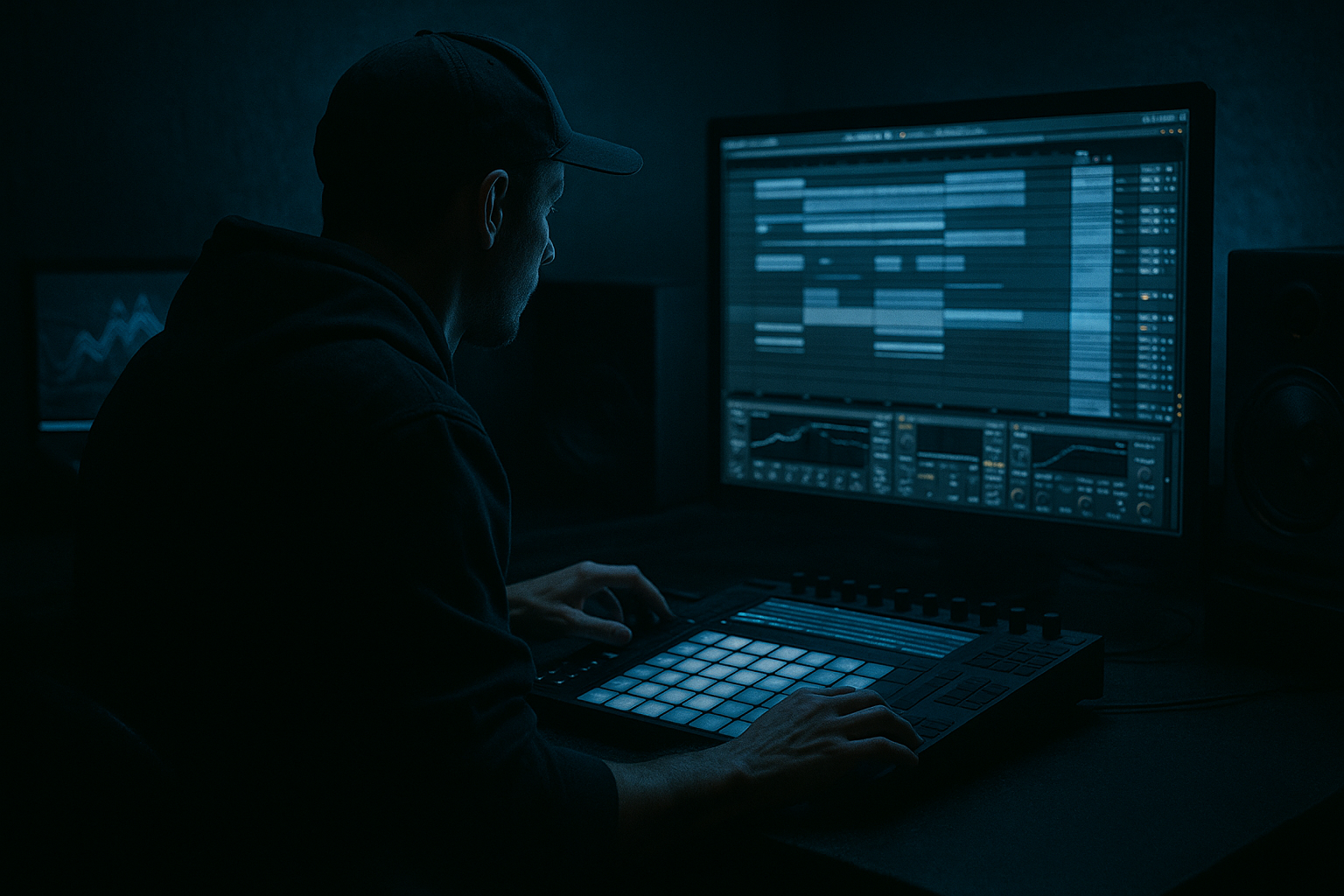
Main tutorial
Moonlit Jungle: Ableton Live 12 Swing Breakdown for Pirate-Radio Energy 🌙📻
Skill level: Advanced
Category: Drums (DnB / Jungle)
---
1. Lesson overview
This lesson is about building a classic jungle/DnB swing breakdown that feels like it’s being broadcast from a dodgy pirate station at 2AM—loose, hypnotic, gritty, and ready to slam back into the drop.
You’ll create a breakdown that:
- Keeps groove and forward motion (no “dead air” breakdowns)
- Uses Ableton Live 12’s Groove Pool + microtiming to get that shuffled, human, late-night funk
- Layers ghost notes, filtered breaks, tape-ish saturation, and radio-band limitation for vibe
- Transitions cleanly into a heavy drop with energy ramps and impact design
- A ghosted / filtered Amen-style loop that swings and breathes
- A minimal kick/snare “anchor” that keeps dancers locked
- A pirate-radio “transmission” bus: band-limited, saturated, wobbly, and noisy
- A tight re-entry using snare pickups, reverse hits, and a swing snap-back
- Reverb: Decay `0.6–1.2s`, Pre-delay `10–25ms`, Low Cut `250–400 Hz`, High Cut `6–8 kHz`
- Saturator: Soft Clip ON, Drive `2–5 dB`
- EQ Eight: cut a bit around `300–500 Hz` if boxy
- Hybrid Reverb: Algorithmic Hall, Decay `3–6s`, Low Cut `400–800 Hz`, High Cut `4–6 kHz`
- Auto Filter: Band-pass around `1.5–3 kHz`, gentle resonance
- Utility: Width `70–110%` (taste), Gain down to keep it subtle
- Kick: `1.1` and light kick or ghost on `1.3.3` (optional)
- Snare: `1.2` and `1.4` (standard DnB backbeat)
- Keep velocities consistent initially (`~100–115`), then humanize slightly later.
- EQ Eight: roll sub below `30–40 Hz`, small dip `200–350 Hz` if muddy
- Drum Buss: Drive `5–15%`, Boom `0–10%` @ `50–80 Hz` (careful—breakdown shouldn’t steal sub from the drop)
- Glue Compressor: 1–2 dB GR, slowish attack `10–30ms`, release `Auto`
- Hit Commit (in Groove Pool) once it feels right, so edits/slices follow the groove.
- In MIDI editor, nudge selected ghost notes late by `+8 to +18 ms`
- Nudge occasional hat ticks early by `-3 to -8 ms` to create push-pull
- Keep main snare on-grid or only slightly late (`+0 to +5 ms`) so it still “commands”
- Auto Filter: Low-pass starting around `8–12 kHz` in first 4 bars, automate down to `2–4 kHz` by bar 8
- Saturator: Drive `3–7 dB`, Soft Clip ON
- Redux (tiny): Downsample just a touch (`1.2–1.8`) for grit
- EQ Eight:
- Timing `20–40%`, Random `4–10%`
- EQ Eight: High-pass `300–600 Hz`
- Auto Pan (subtle): Amount `10–20%`, Rate `1/8 or 1/4`, Phase `180°` (keep it wide but not seasick)
- Drum Buss (light): Drive `2–6%`
- First 8 bars of breakdown: more band-limited
- Bars 9–16: slowly open the low-pass from `~5 kHz → 10–14 kHz` to “tune in”
- DRUM ANCHOR: snare on 2/4, maybe no kick at first 2 bars
- BREAK LAYER: filtered (LP ~8–10k) and quieter
- Add RADIO VERB send on ghost hits only
- Bring in kick quietly (or sporadic)
- Increase break volume slightly
- Automate DRUMS Group low-pass down to ~4–6k briefly (paradox: darker = more tension)
- Add little fills: 1-beat snare roll with swing applied
- Add noise swell (create an Audio track with white noise sample or use Operator noise):
- Sprinkle short dub delays:
- Reduce band-limit gradually (open highs)
- Add snare pickups in bar 16:
- Last half-beat: hard mute the break layer for a vacuum, then slam into drop
- DRUMS Group Utility gain down -inf (tiny gap)
- Reverb tail continues (send-only), then drop hits dry and massive
- Over-swinging the main snare: If the backbeat drifts, the dancefloor confidence collapses. Keep the main snare mostly anchored.
- Letting random timing touch everything equally: Random is spice. Apply it more to tops/ghosts, less to kick/snare fundamentals.
- Band-limiting too early with no evolution: A breakdown needs movement. Automate filters, sends, and saturation subtly over time.
- No low-end plan: Even if the breakdown is band-limited, make sure you’re not masking the eventual sub space with unnecessary 120–250 Hz mud.
- Too many fills: Pirate energy is about tension and restraint—choose 2–3 signature moments, not constant fireworks.
- Swing contrast: Keep breakdown swing loose, then tighten slightly on the drop (reduce Groove Timing by ~10–20% or swap to a tighter groove). That contrast hits hard.
- Parallel crunch on breaks: Duplicate BREAK LAYER → heavy saturate + compress + low-pass ~3–5k → blend quietly for menace.
- “Night air” hats: Low-pass tops a bit and boost a narrow band around `7–9 kHz` only if needed—dark doesn’t mean dull, it means controlled.
- Ghost snare pitch trick: Pitch some ghost snares down `-1 to -3 semitones` (Clip Transpose or in Simpler) for mood.
- Transient control: Use Drum Buss Transients (negative) on harsh breaks, then add bite back with EQ around `2–4 kHz`.
- You built a swing-heavy jungle breakdown that keeps momentum, not a dead stop.
- You used Groove Pool + microtiming to get that late-night shuffle.
- You created a pirate-radio transmission bus with band-limiting, saturation, and controlled compression.
- You arranged tension across 16 bars with automation, restraint, and a clean re-entry into the drop.
---
2. What you will build
A 16-bar breakdown (at ~172–176 BPM) with:
---
3. Step-by-step walkthrough
A) Session setup (tempo, routing, and drum architecture)
1. Set tempo: `174 BPM` (classic rolling pocket).
2. Create 3 drum tracks:
- DRUM ANCHOR (one-shot kick + snare, minimal)
- BREAK LAYER (Amen/Funky break slice or loop)
- TOPS & GHOSTS (shakers, rides, ghost snares, foley ticks)
3. Group them into DRUMS (Group).
4. Create two Return tracks:
- A: DUB ROOM (short, gritty space)
- B: RADIO VERB (longer, washed “broadcast haze”)
Return A (DUB ROOM) device chain (stock):
Return B (RADIO VERB) chain:
---
B) Build the “anchor” groove (minimal but authoritative) 🥁
The breakdown should feel like it could drop at any moment.
1. On DRUM ANCHOR, load a Drum Rack.
2. Choose:
- Kick: short, punchy (not subby)
- Snare: snappy, mid-forward (jungle-ish crack)
Pattern (2 bars):
Processing chain (DRUM ANCHOR) (stock):
---
C) Break layer: make it swing like moonlit funk 🌒
This is where pirate-radio jungle lives. You want late hats, lazy ghost snares, and a rolling pocket.
#### Option 1: Loop + Groove Pool (fast and effective)
1. Drag in an Amen-ish loop onto BREAK LAYER.
2. Warp mode: Complex Pro (or Beats if it’s very percussive; try both).
3. Set Warp ON, ensure it’s tight to 174 BPM.
Groove Pool workflow (Ableton Live 12):
1. Open Groove Pool.
2. Add a groove:
- Start with something like MPC 16 Swing 57–63 (or any shuffled 16th groove).
3. Drag the groove onto the break clip.
4. In Groove Pool, set:
- Timing: `30–55%` (advanced tip: do less than you think)
- Velocity: `10–25%` (lets hits breathe)
- Random: `2–8%` (micro instability = “broadcast life”)
- Base: `1/16` (jungle shuffle territory)
Now commit if needed:
#### Option 2: Slice to MIDI for surgical ghost funk (advanced)
1. Right-click break → Slice to New MIDI Track
2. Slicing preset: Transient (usually best), or 1/16 if it’s clean.
3. In the resulting Drum Rack:
- Delete/disable overly busy slices
- Emphasize:
- main snare hits
- ghost snares
- little hat ticks
Microtiming (the secret sauce):
Break processing chain (BREAK LAYER) (stock):
- High-pass `80–120 Hz` (keep drop’s sub clean)
- Small boost `1.5–3 kHz` if you need “radio bite”
---
D) Tops & ghosts: the “pirate operator” shuffle 🏴☠️
On TOPS & GHOSTS, program super-light movement so the breakdown still rolls.
1. Add Closed hat 1/16 pattern, but:
- Remove 20–40% of steps (syncopation)
- Accents on offbeats
2. Add ghost snare hits leading into main snare:
- Place low-velocity taps at `1.1.4`, `1.2.3`, `1.3.4`, `1.4.3` (example spots)
- Velocities: `15–45`
Groove Pool: Apply same groove as break, but lower Timing (tops can get messy).
Processing (TOPS & GHOSTS):
---
E) The pirate-radio “transmission” bus 📻 (group processing that sells the concept)
On the DRUMS Group, create this chain (stock devices):
1. EQ Eight (band-limit like a transmitter):
- High-pass: `120–200 Hz`
- Low-pass: `4.5–7 kHz`
- Optional: tiny peak at `2.2 kHz` for “AM bite”
2. Saturator:
- Drive `2–6 dB`, Soft Clip ON
- If it gets harsh, back off and instead push the next stage slightly
3. Pedal (optional but tasty):
- Mode: OD
- Drive low (`5–15%`)
- Tone to taste (don’t fry the hats)
4. Compressor (not Glue—regular Compressor for “broadcast clamp”):
- Ratio `2:1–4:1`
- Attack `3–10 ms`
- Release `60–140 ms`
- Aim: 1–3 dB GR on peaks
5. Vinyl Distortion (optional noise/age):
- Tracing Model on, Drive very low
- Crackle low (you don’t want cheesy vinyl—just a hint)
Automation idea:
---
F) Arrangement: 16 bars that actually build tension
Here’s a practical blueprint:
#### Bars 1–4: “Tuning in”
#### Bars 5–8: “Signal locks”
#### Bars 9–12: “Interference + hype”
- Band-pass it 1–4k, automate resonance slightly
- Use Echo on a return (1/8 dotted or 1/4), Feedback low, filter it dark
#### Bars 13–16: “Re-entry setup”
- Classic: 1/16 or 1/32 snare build, but keep swing until the last beat
Drop impact trick:
At the very last 1/4 note before drop, automate:
---
4. Common mistakes
---
5. Pro tips for darker/heavier DnB 🕶️
---
6. Mini practice exercise (15–25 minutes) ⏱️
1. Take a break loop and make two versions:
- Version A: Groove Timing `35%`, Random `3%`
- Version B: Groove Timing `55%`, Random `8%`
2. For each version, create a 8-bar breakdown with:
- DRUM ANCHOR snare on 2/4
- Band-limit automation on the DRUMS Group (LP 12k → 5k → 12k)
- One “interference moment” using Echo or Hybrid Reverb send
3. Bounce both and decide which feels more “pirate radio” and which feels more “club-ready”.
---
7. Recap ✅
If you want, tell me your target subgenre (deep/techy roller, oldschool jungle, foghorn, neuro-leaning) and what break you’re using, and I’ll tailor groove values + a bar-by-bar breakdown map to match that exact vibe.

