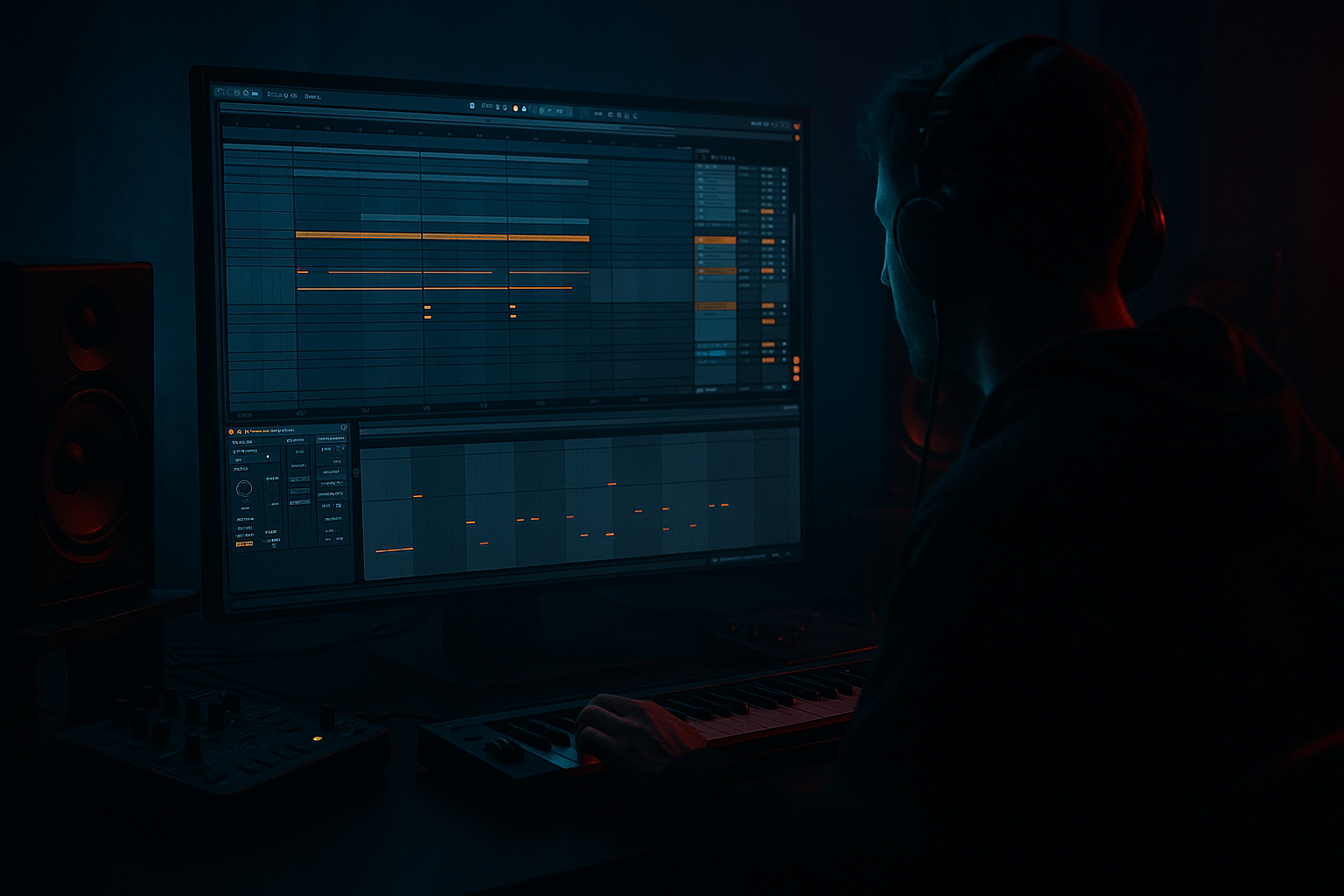
Main tutorial
Lesson Overview
An automation-first jungle edit is one of the fastest ways to turn a loop into a real Drum & Bass section that feels alive, urgent, and mix-ready. In this lesson, you’ll build a modulating jungle edit in Ableton Live 12 by treating automation as the main compositional tool, not an afterthought.
This approach fits perfectly in the 8- or 16-bar transition into a drop, a mid-track switch-up, or a DJ-friendly edit that keeps energy moving between full sections. Instead of relying on huge new sound design every few bars, you’ll make the existing material evolve through filter motion, resampling, drum edits, bass rephrasing, FX throws, and arrangement changes. That is very DnB: tight drums, controlled low end, and constant momentum.
Why this matters in DnB:
- Jungle and rollers rely on variation without losing impact
- Automation keeps edits exciting while preserving the core groove
- It helps you create tension/release without cluttering the mix
- It makes your track feel arranged, not just looped
- A chopped break loop that mutates over time
- A bassline that shifts between sub-focused support and gritty mid movement
- Filter sweeps, reverb throws, and delay cuts that create motion
- A drum fill that opens space for the drop or next phrase
- A compact arrangement that feels like a real DnB section, not just a loop
- A pre-drop edit after a filtered breakdown
- A half-time-to-jungle switch-up in a roller
- A dark intro mutation that leads into the first drop
- A DJ tool-style 8-bar bridge between two heavy sections
- Automating too many things at once
- Letting the sub get stereo or blurry
- Overdoing reverb on drums
- Making the break too busy to breathe
- Changing bass tone but forgetting the arrangement
- Printing without checking the mix
- Use Saturator or Drum Buss on the bass mid layer, not the sub, so you get aggression without destroying low-end clarity.
- Duplicate the bass and split roles:
- Automate the reese’s filter resonance slightly higher in tension bars for that menacing “wobble under pressure” feel.
- For darker edits, keep FX short and surgical. A huge washed-out tail can kill the roller feel.
- Use EQ Eight to carve space around the snare fundamental if the bass gets too dense in the 150–250 Hz zone.
- Add a subtle frequency dip on the bass during snare hits so the drums feel heavier without changing the bass note.
- If the break feels too clean, resample it and add a little Crunch or Drive on the drum bus, then trim the top end with EQ.
- For a more underground jungle edge, let one chopped break layer stay slightly raw while the main drums remain controlled.
- Use call-and-response phrasing: bass answers the break, then the break answers the bass. That interplay is a huge part of classic DnB momentum.
- Build the edit from a strong break + bass foundation
- Use automation as composition, not decoration
- Keep the sub mono and the bass movement controlled
- Resample early so you can create fast audio edits
- Shape tension with filters, throws, fills, and phrase resets
- In DnB, the best edits feel like they’re constantly moving forward while staying punchy and clear
We’ll use Ableton stock tools like Auto Filter, Utility, Saturator, Drum Buss, EQ Eight, Reverb, Delay, and resampling workflow to build a darker, more modular edit that sounds intentional and club-ready.
What You Will Build
By the end, you’ll have a 4- to 8-bar jungle edit with:
Musically, this could sit as:
The end result should feel like: same loop, but every bar has a reason to exist.
Step-by-Step Walkthrough
1. Set up a tight source loop before adding any automation
Start with a loop that already works rhythmically:
- A classic break-based drum pattern
- A sub or reese bass line with simple notes
- One or two FX elements such as a noise sweep, vocal chop, or hit
Keep the loop short: 2 or 4 bars. In DnB, a smaller canvas helps you shape movement faster.
Inside Ableton Live 12:
- Put drums on a Drum Rack or audio track
- Keep bass on a separate MIDI track or audio track
- Group drums to a Drum Bus
- Group bass to a Bass Bus
On the bass bus, add Utility and set bass mono management early:
- Bass below around 120 Hz should stay centered
- Use Utility’s Width = 0% if you’ve got stereo mess in the sub layer
- If you’re layering a stereo reese, keep the sub separate and mono
This first step matters because automation is only powerful if the core groove is already strong. In DnB, the edit should enhance the rhythm, not rescue it.
2. Build the jungle feel with break edits before modulating anything else
Take your drum break and make it feel chopped and performed. If you already have a break loop, duplicate it to a second track or use slices in Simpler/Drum Rack.
Practical edit moves:
- Cut the break into 1/8, 1/16, and occasional 1/32 slices
- Add a few ghost hits before the snare
- Push one or two hits slightly early to create urgency
- Leave some gaps so the groove breathes
If using Simpler:
- Set it to Slice mode
- Slice by transient
- Route slices to MIDI for better edit control
If using audio:
- Use warp markers sparingly
- Cut and nudge clips directly on the grid
Add Drum Buss to the drum group:
- Drive: 5–15%
- Boom: low or off unless the break needs extra weight
- Crunch: subtle, around 5–20% for texture
- Transient: +5 to +20 for bite
Why this works in DnB: jungle edits feel alive because the break is constantly being reframed, not just looped. The micro-variations keep the listener locked even when the arrangement is sparse.
3. Create the bass movement with automation-first phrasing
Now shape the bassline like a conversation with the drums. Keep the MIDI simple at first. Think in terms of call-and-response rather than constant note density.
A strong intermediate DnB tactic:
- Use a sub note on the main downbeat
- Let the mid-bass answer on the offbeat or the tail of the bar
- Leave room for kick/snare impact
On the bass track, use:
- Wavetable for a clean modulated bass
- Or Operator for a solid sub foundation
- Add Saturator after the synth for harmonic presence
Suggested starting settings:
- Saturator Drive: 2–6 dB
- Soft Clip: On
- Auto Filter: Low-pass around 120–300 Hz for evolving movement
- Resonance: 10–25% if you want a more nasal jungle edge
Automation-first workflow:
- Automate the filter cutoff
- Automate device on/off for extra bass layers
- Automate wavetable position or oscillator level
- Automate Utility gain for bass throws or phrase drops
Keep the automation musical:
- Open the filter slightly on bar 1
- Darken it on bar 2
- Widen the movement in bar 3
- Pull it back down before the snare reset in bar 4
This creates a sense of progression without needing a new bass sound every bar.
4. Use automation lanes to animate the whole edit, not just the synth
This is the core of the lesson. In an automation-first workflow, you’re not “adding automation later.” You’re composing with automation from the start.
In Arrangement View, automate:
- Auto Filter cutoff on bass and atmospheres
- Reverb dry/wet for momentary throws
- Delay feedback for one-shot tails
- Drum Buss transient or drive to intensify a fill
- EQ Eight filter to strip low end from FX sections
- Utility gain for momentary ducking or push
A practical automation pattern for an 8-bar edit:
- Bars 1–2: relatively dry, tight, focused
- Bar 3: filter opens and FX starts to rise
- Bar 4: bass narrows, drum fill appears
- Bars 5–6: more distortion or mids, tension increases
- Bar 7: short reverb or delay throw on a snare or vocal hit
- Bar 8: sudden cleanup to prepare the drop or next section
If you want a jungle-style surge, automate a break group’s Auto Filter with a low-pass sweep:
- Start around 180–300 Hz
- Open toward 4–8 kHz over 1–2 bars
- Add a touch of resonance for tension
- Pull it back abruptly before the impact
Keep automation curves deliberate. In DnB, extreme automation can get messy fast, so the goal is controlled motion.
5. Resample a pass so you can edit the automation as audio
Once the main movement is working, print it. This is one of the best intermediate techniques for making a jungle edit feel finished.
In Ableton:
- Create a new audio track
- Set input to Resampling
- Record a pass of your drum/bass/FX section
Why resample?
- It lets you make audio edits instead of endless parameter tweaks
- You can cut, reverse, reverse-tail, and splice moments very quickly
- It captures the interaction between automation, distortion, and groove
After resampling:
- Chop the printed audio into 1-bar or half-bar pieces
- Reverse one tail into a snare hit
- Leave a tiny gap before the next downbeat for impact
- Add a very short fade on each cut to avoid clicks
You can also apply Warp sparingly to tighten a fill or shift a transient. For jungle edits, small audio edits often feel more human than over-programmed MIDI.
6. Design a transition that tells the listener the edit is changing state
Your edit needs a turning point. This is where the “modulate” part becomes musical rather than just technical.
Build a short transition using:
- A riser or noise sweep
- A snare roll or break chop acceleration
- A bass mute on the last half-bar
- A hit or stab on the downbeat
Stock-device workflow:
- Auto Filter on noise for the rise
- Reverb with a large size but low dry/wet for a short tail
- Delay with feedback automation for a quick spin-up
- Echo can work too if you want more textured movement, but keep it restrained
Arrangement suggestion:
- On the last 1 bar before the next phrase, remove the sub
- Let only top drums and a filtered FX element continue
- Add a snare pickup or fast hat run
- Reintroduce the bass with a stronger, wider mid layer on the next downbeat
This gives you a classic DnB arrangement principle: strip back, then slam back in.
7. Balance the low end and mids so the movement still hits hard
Automation can easily ruin mix clarity if the bass keeps changing too wildly. Use a clean routing strategy.
On the drum group:
- Use EQ Eight to remove unnecessary low rumble if the break is muddy
- High-pass non-essential percussion around 150–250 Hz
- Let the kick/snare impact stay clear
On the bass group:
- Keep the sub separate if possible
- Use Utility to mono the low end
- If the reese or mid-bass gets too wide, narrow it during dense drum sections
Good balancing habits:
- Check the track at low volume
- Toggle mono on the master or a utility on the mix bus
- Make sure the snare still pops when the bass automation opens up
- Leave headroom; don’t chase loudness during the edit build
A useful rule: if the automation makes the track feel bigger but the kick/snare get smaller, the arrangement is too busy. In DnB, drums are the engine.
8. Add final edit detail with tiny automation gestures
This is where your track goes from solid to replay-worthy. Add small changes that reward repeat listens.
Great finishing gestures:
- Automate reverb dry/wet up for one snare hit only
- Cut the bass for a single 1/16 or 1/8 to create a drop-in pocket
- Nudge a hat or rim shot forward for urgency
- Automate Saturator Drive slightly higher in the final bar of the phrase
- Mute a bass layer for one beat and bring it back stronger
A few concrete ideas:
- Bass filter cutoff: move from 180 Hz to 700 Hz over 2 bars, then snap back
- Reverb dry/wet on a snare throw: 8–18%
- Delay feedback on a vocal stab: 15–35% briefly, then back to near zero
- Drum Buss transient: automate from +5 to +15 during a fill
These tiny gestures are what make a jungle edit feel “performed,” especially when repeated in a DJ context.
Common Mistakes
- Fix: choose one main motion per section, usually filter or bass energy, then support it with one or two smaller moves.
- Fix: keep sub mono with Utility, and separate the sub from the moving mid-bass.
- Fix: use short throws, automate the effect only on specific hits, and keep the core snare dry and punchy.
- Fix: leave empty spaces. In DnB, the groove needs contrast or the energy flattens out.
- Fix: make sure the edit has a clear phrase arc: setup, tension, impact, reset.
- Fix: bounce or resample after verifying kick/snare balance and low-end discipline.
Pro Tips for Darker / Heavier DnB
- One track for sub only
- One track for mid reese / movement
Mini Practice Exercise
Spend 10–20 minutes building a 4-bar jungle edit using only stock Ableton tools.
1. Start with a 2-bar break loop and a simple sub/reese bass.
2. Add Auto Filter to the bass and automate the cutoff across the 4 bars.
3. Add Drum Buss to the drum group and automate Drive or Transient in the last bar.
4. Create one snare reverb throw using Reverb or Delay on a send, only for a single hit.
5. Resample the whole 4-bar loop to a new audio track.
6. Cut the resampled audio into 4–6 pieces and make one reverse or gap edit before the final downbeat.
7. Check the result in mono and adjust the bass level if the drums disappear.
Goal: make it feel like a miniature DnB phrase with clear movement, not a static loop.

