Main tutorial
1. Lesson Overview
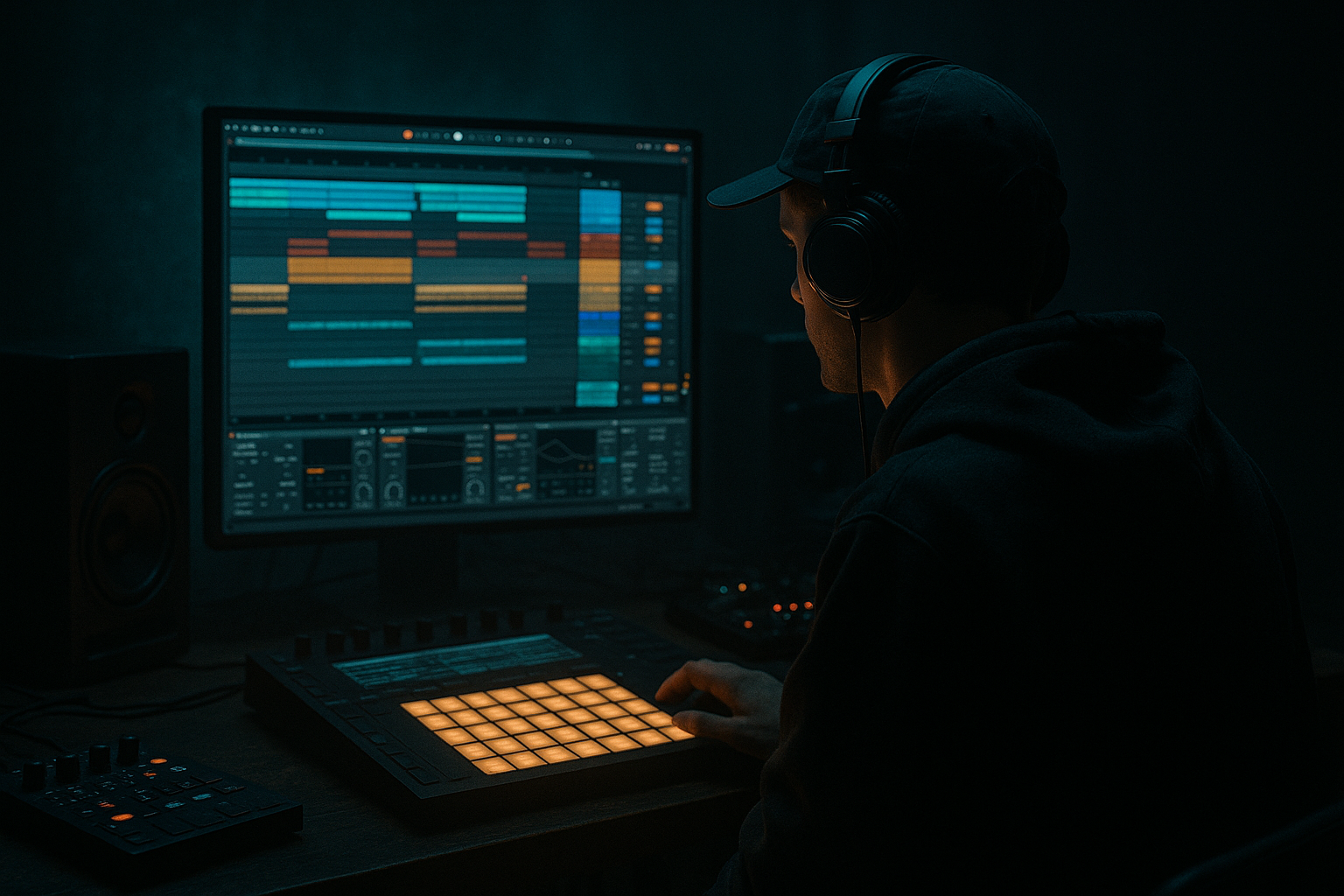
This intermediate Atmospheres lesson teaches "Midnight Amen a subsine workflow: saturate and arrange in Ableton Live 12". You’ll take an Amen break (classic chopped loop) and a focused subsine bass, process them with Ableton stock devices to create a dark, atmospheric Drum & Bass bed, and then arrange that material into a usable section. Emphasis: tasteful saturation on both the break and the subsine, preserving sub-fundamentals while adding harmonic grit and space for atmosphere.
2. What You Will Build
- A processed Amen break group that functions as both rhythm and texture (gritty mids, airy tails).
- A warm, controlled subsine bass (mono below ~100 Hz) with harmonic saturation layered into the mids.
- A short arrangement outline (intro → build → half-time atmospheric section → full DnB loop) with automation on saturation, reverb, and filter to create movement.
- Create two audio tracks: "Amen Raw" and "Subsine Raw". Drag your Amen break into "Amen Raw" (a clean 1–2 bar sample). Create an Instrument Rack on "Subsine Raw" using Wavetable (or Operator) with a pure sine oscillator for the sub.
- Create a Group track named "Rhythm + Sub". Put both tracks in the group. Add a Return track for reverb (Return A: Hybrid Reverb), and Return B for delay (Echo).
- Use Drum Buss before Saturator to fatten transients without distorting the Saturator’s harmonics.
- If you want more lo-fi grit, add Redux set to low bit depth or low sample rate with Dry/Wet ~10–15% after Saturator.
- Wavetable: oscillator 1 set to Pure Sine, octave -2 to -3 (tune to project key). Filter off or low resonance.
- Use an Amp envelope with quick attack, medium sustain, no release (short sustain for tight DnB sub, or add small release if you want glide).
- If you want slight movement, add a very slow LFO modulating Osc Pitch or Filter Frequency (depth tiny).
- Duplicate the Subsine track, call it "Sub-Mid". Use Wavetable with a partial saw or triangle tuned slightly above the fundamental (detune tiny).
- Place a Saturator and an Amp > Chorus/Chorus-Ensemble to widen mid harmonics. High-pass the layer at 80–120 Hz so it doesn’t conflict with sub fundamentals.
- Send this layer to Return A (Hybrid Reverb) moderately to sit as atmospheric warmth.
- Use Utility or an EQ/LFO crossover: On the grouped "Rhythm + Sub" bus, insert EQ Eight with two bands: a low shelf to ensure sub fundamental sits at desired level; or use Multiband Dynamics to compress only lows.
- To force mono below a crossover: put Utility on the Group, but more precise: create an Audio Effect Rack -> Chain 1 (Low) and Chain 2 (High). In Chain 1, place EQ Eight centered low-pass at 120 Hz, plus Utility set to Mono (Width 0%). In Chain 2, place a high-pass at 120 Hz and Width 100%. Set crossfade between chains to smooth. This keeps real subs mono while keeping width in highs.
- Add Compressor (or Glue) to Subsine Raw with sidechain input from the Amen break/hard kick. Set Attack fast (0–5 ms), Release quick-medium (80–200 ms), Ratio 4:1, Threshold to duck the sub gently when the kick/hit occurs.
- For DnB punch, sidechain to the Amen's critical transient bus or the kick layer.
- Return A (Hybrid Reverb) settings: Low Damp 0–30%, Size 30–50% for a tight room-to-hall, Diffusion low to mid, Low Cut ~200–400 Hz on reverb to avoid muddying. Pre-delay 20–40 ms to preserve transients.
- Add Spectral Resonator or Spectral Time on Amen sends for ghosted textures: low wet/dry (~10–20%) and automatable pitch shift for night-time vibes.
- Automate the send amount from Amen and Sub-Mid to Hybrid Reverb across arrangement to open the atmosphere during the half-time or breakdown.
- Create marker sections: Intro (bars 1–16), Build (17–32), Half-time Atmosphere (33–48), Full DnB Loop (49–80).
- Intro: start with Sub-Mid + long Hybrid Reverb tails, Amen muted or filtered with low-pass at 3–4 kHz and a high-cut automation rising toward the drop.
- Build: Bring in processed Amen but keep kick transient damped; increase Saturator Drive on Amen slowly from 0 to 30% wet to add grit.
- Half-time Atmosphere: Mute main drum transients, longer reverb sends, increase Spectral Time wet/dry on Amen to smear rhythms; reduce Subsine level by -3 to -6 dB and automate Saturator Dry/Wet on Subsine to drop in harmonic presence.
- Drop / Full DnB Loop: Restore full Amen with Drum Buss accent; set Saturator on Subsine back to 20–35% wet and resume sidechain pumping.
- Automate Hybrid Reverb size or dry/wet on key moments to create movement (e.g., reverb wet up during breakdowns).
- On Group output, add EQ Eight for final corrective EQ; a Glue Compressor for coherence (2:1, gentle), and Limiter if needed to catch peaks.
- Consider an additional Saturator in parallel (via send) to taste for extreme color — keep wet/dry controlled.
- Crushing the subs with saturation: placing heavy Saturator/Post-Drive directly on the sub fundamental without filtering will smear low end. Fix: low-pass the Saturator’s input or mix a parallel processed mid-layer.
- Over-saturating the Amen break: too much drive makes it sound brittle and masks the atmospheric reverb tails. Use Dry/Wet and automation.
- Not mono’ing the low end: stereo subs create phase issues and poor translation on club systems. Always mono below ~100–120 Hz.
- Sidechaining the wrong element: sidechaining sub to a full, reverby Amen will cause pumping and unstable bass. Sidechain to the transient/kick layer only.
- Reverbing the fundamental sub too heavily: reverb on real sub frequencies causes rumble and mud. High-pass reverb sends at ~200–400 Hz.
- Use an Audio Effect Rack with macros for quick performance control: map Saturator Drive, Reverb Send, and Sub Mono Width to three macros called "Grit", "Space", "Sub-Mono".
- Automate Saturator Dry/Wet rather than drive alone for more musical control—this preserves dynamics while adding color.
- For authentic Amen texture, slice the break in Simpler (Slice Mode) and add subtle randomization on Start Position and Transpose for humanized chop textures.
- Use Spectral Resonator with low mix to create harmonic echoes off the Amen transient — set pitch to octave multiples of your key to stay tonal.
- Bounce stems of the Amen with different saturation states (clean, mid-saturated, heavily saturated) and arrange them across the track for variety without changing device chains in place.
3. Step-by-Step Walkthrough
Note: This walkthrough explicitly follows the "Midnight Amen a subsine workflow: saturate and arrange in Ableton Live 12" concept. Use Arrangement View for automation. Start with a tempo around 174 BPM (classic DnB).
A. Session prep and importing
B. Amen break processing chain (Amen Raw)
Insert, in this order:
1. Utility — set Width to 80–90% to broaden very slightly (you’ll mono the low end later).
2. EQ Eight — high-pass at 40–60 Hz (24 dB/oct) to carve space for the subsine. Make a slight dip ~200–400 Hz (-1.5 to -3 dB) to reduce boxiness.
3. Drum Buss — apply subtle drive (Drive 1–3), Decay ~10–15, Boom at 0.2–0.4 to add transient weight and harmonics.
4. Saturator — Mode: Analog Clip or Soft Sine; Drive 2–5 dB, Curve slightly up; set Dry/Wet to ~30–40%. This is the main mids harmonic enhancer.
5. EQ Eight — a gentle high-shelf boost above 6–10 kHz (~1–2 dB) to give air for atmosphere processing.
6. Glue Compressor — 2:1 ratio, 3–10 ms attack, 50–200 ms release, threshold to get 2–4 dB gain reduction for cohesion.
7. Hybrid Reverb (send via Return A) — send 10–20% (use the send knob), Predelay 10–30 ms, Diffusion low, Size moderate, Mix low on the send (we’ll automate send).
Processing notes:
C. Subsine instrument and saturation chain (Subsine Raw)
Instrument:
FX chain (insert on Subsine Raw):
1. Utility — set Mono Left/Right to Mono below crossover; set Width to 100% then route Utility to set to 0–60 Hz mono later (for precise control see step E).
2. EQ Eight — very gentle low-pass around 800–1000 Hz to keep sub pure; cut anywhere unnecessary in the mids if you plan to layer a mid-saturation layer.
3. Saturator — Mode: Soft Sine or Analog Clip; Drive 1.5–4 dB; set Density low and Dry/Wet ~20–35%. This subtly creates harmonics so the bass can be heard on small speakers.
4. Multiband Dynamics — compress upper bands (above ~120 Hz) slightly to glue; keep lowest band transparent.
5. Glue Compressor — gentle bus compression (2:1) if needed.
6. Utility (post) — set Gain to balance level, and, crucial: use Width automation to pull mono below ~120 Hz. Alternatively create a Simpler/External EQ crossover method below.
Important: keep the sine below 100 Hz clean. If Saturator introduces low-end distortion, use EQ to notch or low-pass the distorted harmonics out of sub fundamental.
D. Layering a mid/texture layer for subsine (optional but recommended)
E. Low-frequency control & mono management
F. Sidechain and rhythmic breathing
G. Atmosphere processing (sends & automation)
H. Arrangement tips (apply the Midnight Amen a subsine workflow: saturate and arrange in Ableton Live 12)
I. Final bus processing and limiting
4. Common Mistakes
5. Pro Tips
6. Mini Practice Exercise
Goal: Create a 32-bar loop implementing the Midnight Amen a subsine workflow: saturate and arrange in Ableton Live 12.
Steps:
1. Import a 2-bar Amen break and a Wavetable sine sub tuned to your key.
2. Build the Amen chain: Utility → EQ Eight (HP 50 Hz) → Drum Buss → Saturator (Analog Clip, Drive 3 dB, Dry/Wet 35%) → Glue.
3. Build the Subsine chain: Wavetable sine → EQ Eight (LP 1000 Hz) → Saturator (Drive 2 dB, Dry/Wet 25%) → Utility (mono low).
4. Add Hybrid Reverb on Return A; high-pass the reverb at 250 Hz.
5. Create a 32-bar arrangement: bars 1–8 intro (sub + reverb), 9–16 bring in filtered Amen (automation low-pass rising), 17–24 open Amen full, 25–32 half-time atmospheric breakdown (mute main Amen transients, increase reverb send).
6. Add sidechain compression on the sub keyed to the Amen’s kick, threshold for gentle ducking.
7. Export the 32-bar loop and compare with/without Saturator toggled to hear the difference.
7. Recap
This lesson demonstrated the "Midnight Amen a subsine workflow: saturate and arrange in Ableton Live 12". You learned how to process an Amen break with Drum Buss, Saturator, and Hybrid Reverb to create gritty textures; how to craft a clean, saturated subsine that carries both sub fundamentals and harmonic presence; how to manage mono low-end and apply sidechain; and how to arrange these elements into a moody DnB structure. Use the recommended device order, automation targets, and the Mini Practice Exercise to internalize the workflow and make it your own.

