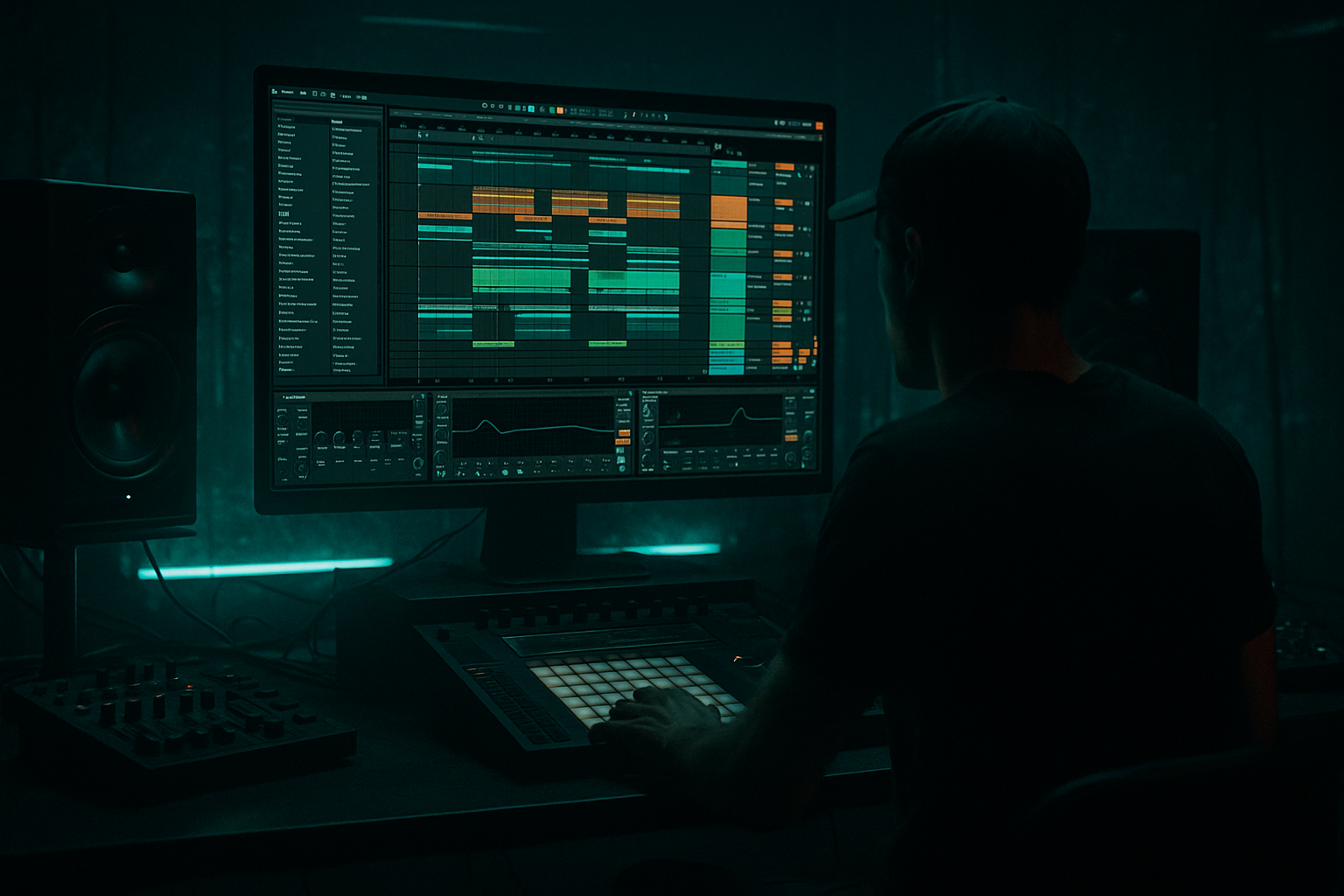
Main tutorial
Method for DJ Intro for VHS-Rave Color in Ableton Live 12 for Jungle / Oldskool DnB Vibes
1. Lesson overview
A DJ intro in jungle or oldskool DnB is not just “8 bars of drums.” It’s the part that tells the listener what world they’ve stepped into: dusty, gritty, tape-warped, ravey, and functional for mixing. If you want that VHS-rave colour, the goal is to make the intro feel like it was pulled from a warped cassette of a 1994 pirate radio set: filtered, slightly unstable, dark, but still driving.
In Ableton Live 12, we’ll build an intro that has:
- A solid DJ-friendly mix-in
- Oldskool jungle drum energy
- Taped, degraded atmospherics
- Subtle rave colour without overcrowding the spectrum
- A clean arrangement path into the first drop 🔥
- Club intros for DJs to beatmatch
- Mix-friendly album versions
- Jungle / breakbeat sections before the drop
- Atmospheric openings for deeper rolling DnB
- Drum Rack
- Simpler
- Auto Filter
- Echo
- Hybrid Reverb
- Drum Buss
- Saturator
- Redux
- Utility
- Roar or Saturator for edge
- EQ Eight
- Gate
- Shaper or Envelope Follower if needed for movement
- 16 bars = short and effective
- 32 bars = better for DJ mixing and atmosphere building
- Bars 1–8: Atmosphere + filtered break ghosting
- Bars 9–16: Fuller drum presence + faint rave stabs
- Bars 17–24: More motion, filter opening, bass tease
- Bars 25–32: Transition cue into drop
- Clear downbeat
- Repetition that helps beatmatching
- Not too many random fills too early
- Enough space for a DJ to count bars confidently
- Amen-style break
- Think / Funky Drummer / Hot Pants type material
- Any gritty break with transient detail
- EQ Eight
- Drum Buss
- Saturator
- Auto Filter
- Track A: filtered and distant
- Track B: more open, delayed entry, or heavily gated
- White noise from Operator or Analog
- Room tone or field recording
- Vinyl crackle sample
- Hum / hiss sample
- Short reversed ambience
- HP around 200–500 Hz
- LP around 6–10 kHz
- Narrow cut if a frequency screams
- Bit reduction: subtle, around 12–16 bits
- Downsample lightly for grime
- Keep it tasteful — just enough to feel cheap and worn
- Use a slow LFO or manual automation
- Add gentle movement between 300 Hz and 3 kHz
- Time: 1/8D or 1/4
- Feedback: 15–35%
- Add modulation a little
- Filter the repeats so they don’t fight the drums
- Short to medium decay
- High cut fairly low
- Keep the texture behind the drums
- Use Warp with slight timing imperfections
- Or automate detune/pitch very subtly on a resampled ambience clip
- If you resample, slightly move clip start points for a “tape wobble” feel
- Minor rave stab
- M1-style organ hit
- Short piano chord
- Brass stab
- Detuned synth chord
- Sampled break-era rave chord fragment
- Minor 7th
- Minor 9th
- Suspended intervals
- Octave-doubled stabs
- Note length: 1/16 to 1/8
- Velocity variation: important
- Leave space between hits
- Auto Filter
- Chorus-Ensemble
- Saturator
- Echo
- Reverb
- First 8 bars: barely there, maybe one stab every 4 bars
- Bars 9–16: more consistent, call-and-response with drums
- Bars 17–24: slightly more rhythmic
- Bars 25–32: reduce or filter out for the drop handoff
- Auto Filter cutoff
- Reverb decay or dry/wet
- Echo feedback
- Drum Buss transients
- Utility width
- Saturator drive
- EQ high-pass on atmospheres
- Resonance peaks for tension
- Break muted or low-passed
- Atmosphere wide and washed
- One or two filtered stabs only
- Open break slightly
- Add transient punch
- Bring in one more stab layer
- Subtle delay throws on offbeat hits
- More break detail
- Some snare ghosting
- Filter opening becomes obvious
- Add tension with a riser or reversed FX
- Reduce ambience slightly
- Pull down low-end from the intro layer
- Set up the incoming drop with a clean cue
- Keep the first 8 bars simple
- Avoid too many broadband impacts at bar 1
- Ensure drums are locked to the grid
- Leave space for a DJ to mix in another tune
- Keep sub mostly absent until the transition
- Make sure the first downbeat is obvious
- Start with filtered percussion and atmosphere
- Bring full snare detail a few bars later
- Avoid a huge drop-style fill too early
- Use a 2-bar or 4-bar cue accent before the main section
- Redux for digital grime
- Saturator for tape-like density
- Auto Filter for bandwidth shaping
- Frequency Shifter for subtle instability
- Echo for smeared space
- Hybrid Reverb for colored ambience
- Drums punchy enough to guide the mix
- Atmosphere degraded and wide
- Stabs rough but readable
- Stick to minor keys
- Try Phrygian flavor with a flattened second
- Use dissonant intervals sparingly
- Let one unstable note hang in the background
- Use a filtered sub swell
- Hint at the bass via a resonant low-pass movement
- Introduce a bass pickup in the last 4–8 bars
- Reverse them
- Slice them
- Reprocess through Echo/Redux
- Re-layer at lower volume
- Push Drive until the break bites
- Add a touch of Boom only if it doesn’t blur the kick/snare relationship
- Use Transient to restore punch after filtering
- Keep kick and sub mono
- Use Utility to narrow low layers
- Let only atmosphere and higher stabs spread wide
- 1 breakbeat loop
- 1 texture/noise layer
- 1 rave stab sound
- 1 transition FX layer
- Dark
- Mixable
- Gritty
- Rave-adjacent
- Not overcrowded
- Start with a functional DJ mix-in
- Add a filtered breakbeat foundation
- Layer in tape-style atmosphere
- Introduce ghost rave stabs
- Automate movement slowly and musically
- Keep the low end controlled until the transition
- EQ Eight
- Drum Buss
- Saturator
- Redux
- Auto Filter
- Echo
- Hybrid Reverb
- Utility
- Simpler
- The intro must feel alive
- It must be mix-friendly
- It must sound like old tape with attitude 🎛️
This approach is especially useful for:
We’ll use Ableton stock devices throughout, including:
---
2. What you will build
You will build a 16- to 32-bar VHS-rave intro with these layers:
1. Filtered breakbeat bed
A chopped jungle break loop with low-end removed at first, gradually opening up.
2. Taped atmosphere layer
Noise, room tone, vinyl-style texture, or sampled VHS hiss, heavily filtered and modulated.
3. Rave stabs / ghost chords
Short minor stabs, M1-style chord hits, or rave organ fragments, smeared and degraded.
4. Subtle low-end tease
Not full bass yet — just hints of sub movement or a filtered bass pickup.
5. Transition riser / mix cue
A reverse texture, tape stop, or filter opening that says “drop coming.”
The result should work as a DJ-friendly intro that feels like a lost jungle tape, but still gives modern clarity and punch.
---
3. Step-by-step walkthrough
Step 1: Set up the arrangement for DJ usability
Before adding sound design, decide the intro’s functional length.
Recommended structure
Arrangement map example
For DJ friendliness, make sure the intro has:
---
Step 2: Build the drum foundation with an oldskool break
Choose your break
Use a classic break sample or any broken-beat loop that can be chopped:
In Ableton Live 12
1. Drop the break into Simpler or directly onto an audio track.
2. Set it to Slice mode if you want manual chop control.
3. If you prefer a loop, warp it carefully:
- Use Complex Pro only if needed
- For harder rhythmic breaks, Beats or Re-Pitch often gives a more authentic feel
Processing chain for the break
Put this on the break track:
EQ Eight → Drum Buss → Saturator → Auto Filter
Suggested starting settings:
- HP filter around 30–40 Hz
- Small cut around 250–400 Hz if muddy
- Slight boost around 3–6 kHz if you need snare snap
- Drive: 5–15%
- Transients: +5 to +20
- Boom: subtle or off at first
- Soft Clip: On
- Drive: 2–6 dB
- Use Analog Clip if you want a rougher edge
- Start low-pass around 300–800 Hz
- Resonance: modest, around 0.5–1.2
- Automate open slowly over 16 bars
Pro move
Duplicate the break onto two tracks:
This lets you fade in detail gradually, which is perfect for a VHS-rave intro.
---
Step 3: Create VHS texture with noise and tape-style instability
The “VHS” feeling comes from degradation, instability, and bandwidth limitation. Don’t overdo it — you want character, not mud.
Texture source ideas
Build a texture rack
Create an audio track and chain:
EQ Eight → Redux → Auto Filter → Echo → Reverb
#### EQ Eight
#### Redux
#### Auto Filter
#### Echo
#### Reverb or Hybrid Reverb
Extra VHS trick
Add very subtle pitch instability:
---
Step 4: Add rave colour with ghost stabs and chord fragments
This is where the intro starts to glow. In jungle and oldskool DnB, the rave flavor often comes from short stabby chords, not lush pads.
Sound choices
MIDI programming
Use simple minor shapes:
Keep them short:
Processing chain
Auto Filter → Chorus-Ensemble → Saturator → Echo → Reverb
Suggested settings:
- Start low-passed
- Automate opening on phrase changes
- Subtle width
- Don’t make it too glossy
- Use sparingly for that “warped stereo” feel
- Light drive
- Soft clip on
- Short repeats, filtered
- Feedback low to moderate
- Short/medium
- Dark tone
- Keep the dry signal more forward than the wet
Arrangement suggestion
Introduce stabs like this:
---
Step 5: Shape the intro with automation, not just layering
The magic is in the movement. A VHS-rave intro lives or dies by automation.
Automate these parameters:
Practical automation blueprint
#### Bars 1–8
#### Bars 9–16
#### Bars 17–24
#### Bars 25–32
Automation tip
For oldskool energy, automate in long curves, not hyper-fast modern EDM sweeps. Jungle often feels stronger when the movement is a little rough and human.
---
Step 6: Make it feel like DJ material
A great intro must be mixable.
Checklist
DJ-friendly technique
If you want the intro to be especially usable:
This lets DJs phrase-match cleanly when layering the tune.
---
Step 7: Add “VHS-rave” degradation tastefully
This is where the character comes from. The sound should feel worn, not broken.
Stock Ableton devices that help
Good degradation recipe
On a texture bus:
1. EQ Eight to narrow the band
2. Redux lightly
3. Saturator with soft clip
4. Echo with filtered repeats
5. Hybrid Reverb with a dark room or plate
6. Utility to control width and mono compatibility
Important
Do not make everything lo-fi.
If every element is degraded, the intro loses focus. Keep:
That contrast is what makes the mood work.
---
4. Common mistakes
1. Over-filtering the entire intro
If everything is low-passed too heavily, the section feels dull instead of mysterious. Keep some midrange clarity so the drums and stabs still speak.
2. Too much reverb on breaks
Big reverb can destroy jungle rhythm. Use reverb on sends or keep wet levels moderate so the break remains punchy.
3. Making the intro too busy
A DJ intro should support mixing. If you add fills, stabs, FX, and bass all at once, the groove gets cluttered.
4. Using modern clean sounds
Ultra-clean pads and pristine supersaws can fight the VHS-rave concept. Choose rough, sample-based, or synthesized sounds with character.
5. Overdoing bitcrushing
A little Redux goes a long way. Too much downsampling makes the intro sound thin and cheap rather than nostalgic and powerful.
6. No arrangement evolution
If bar 1 and bar 16 sound almost identical, the intro lacks narrative. Build a clear progression.
---
5. Pro tips for darker/heavier DnB
Use darker harmonic movement
For heavier jungle/DnB moods:
Make the low end feel implied
Instead of full bass early on:
Resample your own FX
Print your atmospheres and stabs to audio, then:
This adds the “archived tape” feeling that works so well in jungle.
Use Drum Buss carefully
For heavier intros:
Add subtle mono pressure
VHS-rave colour often feels wide, but the core groove should still hit center.
Add small pitch imperfections
A tiny pitch drift on a stab or ambience layer can make the intro feel genuinely “aged.” Keep it subtle enough that it reads as character, not tuning error.
---
6. Mini practice exercise
Goal
Build a 16-bar jungle DJ intro with VHS-rave colour in Ableton Live 12.
Rules
Use only stock devices and these elements:
Steps
1. Load a break into Simpler and slice it.
2. Create a processed break chain:
- EQ Eight
- Drum Buss
- Saturator
- Auto Filter
3. Add a noise layer with:
- EQ Eight
- Redux
- Echo
- Hybrid Reverb
4. Program 2–3 minor stabs in MIDI.
5. Automate the stab filter cutoff from dark to open across 16 bars.
6. In the last 4 bars, add a reverse FX or filter sweep.
7. Resample the whole intro and listen back as audio only.
Challenge
Make the intro feel:
If it sounds impressive solo but would confuse a DJ in the mix, simplify it.
---
7. Recap
A strong VHS-rave DJ intro for jungle / oldskool DnB is built from controlled degradation, filtered energy, and arrangement discipline.
The core method:
Ableton stock devices that matter most:
Final mindset
Think like a jungle producer and a DJ at the same time:
If you want, I can also turn this into:
1. a 32-bar Ableton arrangement template, or
2. a device-chain preset recipe for each layer.

