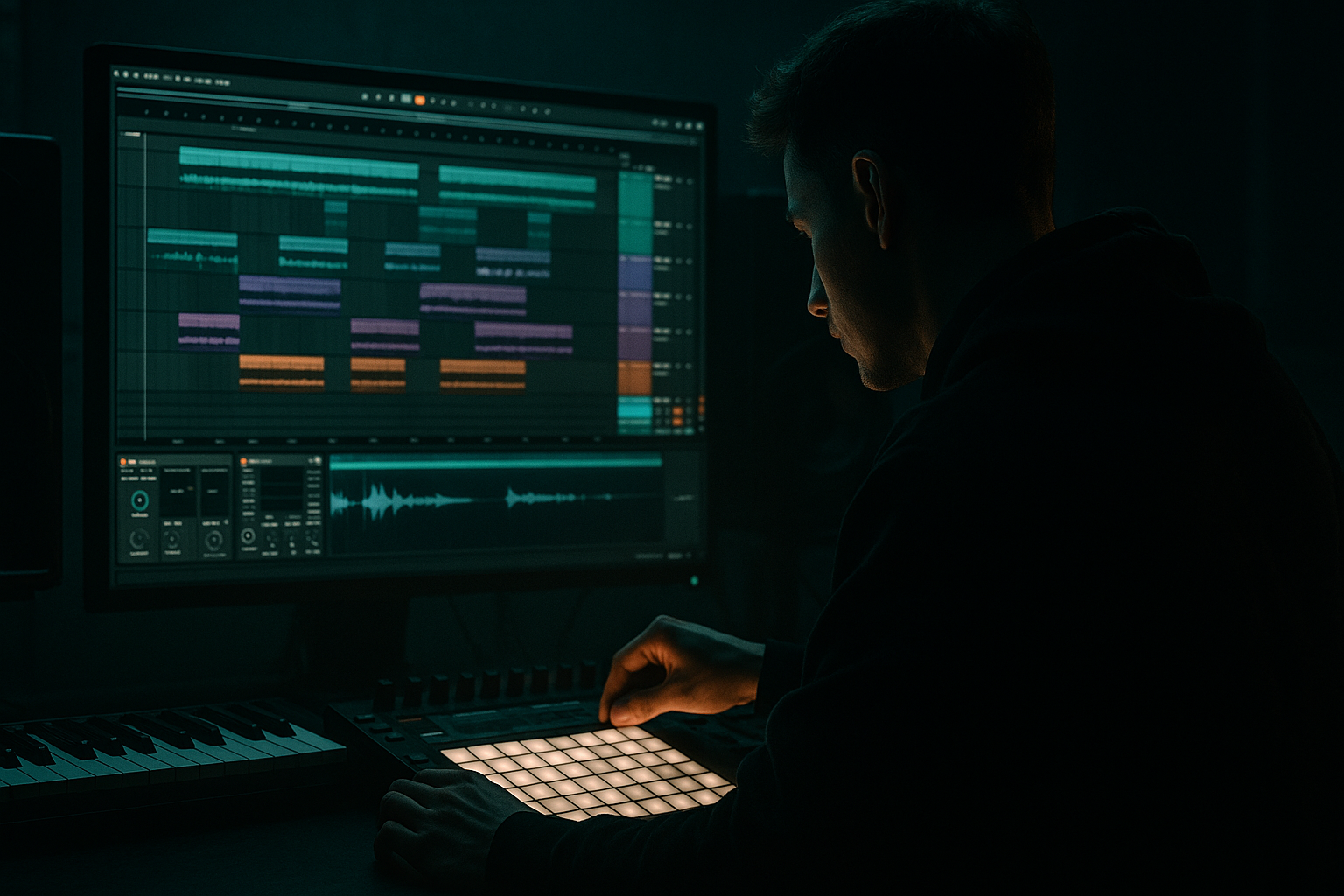
Main tutorial
Lesson Overview
This lesson is about building a Low-End Pressure think-break switchup swing inside Ableton Live 12: a tight edit where the drums briefly shift from straight forward propulsion into a more broken, swinging pocket, while the bass stays physically heavy and the low end never loses its authority.
In a DnB track, this kind of move usually lives:
- at the end of an 8-bar phrase,
- as a 2-bar or 4-bar switch before the next section,
- or as a second-drop variation that makes the track feel alive without derailing the dancefloor.
- Musically, it creates contrast: the track breathes, then snaps back harder.
- Technically, it lets you reframe the groove without changing the core bass sound.
- On the floor, it keeps DJs and dancers locked because the edit still respects the grid, phrase length, and low-end weight.
- rollers that need subtle movement,
- darker half-step or stepper-adjacent DnB,
- minimal / stripped club cuts,
- neuro-influenced rollers where the bass is already dense and the drums need a fresh angle,
- and jungle-informed modern DnB where break edits can inject urgency without turning into chaos.
- feels like the track “leans sideways” for a moment,
- keeps the kick and sub relationship intact,
- adds swing and broken-energy tension,
- and lands back into the main groove with more pressure than before.
- sonically like a clipped, gritty break pattern with clear snare identity and controlled top-end,
- rhythmically like a swung interruption that still pushes forward,
- functionally like a transition, fill, or second-drop variation,
- and mix-ready enough that it can survive full drums and bass without becoming a messy midrange cloud.
- Keep the sub boring on purpose when the drums get clever. If the switchup is doing rhythmic movement, the sub should often stay simple and solid. That contrast makes the groove feel bigger, not smaller.
- Use negative space as a weapon. A short gap before the first swung hit can feel harder than adding more percussion. In darker DnB, absence often creates more menace than density.
- Let one percussion layer carry the swing, not five. If every element is animated, nothing feels intentional. Pick one main break gesture and let the others support it quietly.
- Dirty the break midrange, not the sub. If you want more underground character, saturate the break around the body and snare crack, but keep the bottom octave stable.
- Use a second-drop evolution. Repeat the same switchup later, but remove one hit or shift one accent. That tiny difference makes the track feel developed rather than looped.
- Protect mono compatibility with a quick Utility check. If the switchup collapses when narrowed, the problem is usually too much stereo percussion or a widened effect on low percussion layers.
- Let the snare stay recognisable. In heavy DnB, the snare is often the audience’s handrail. You can distort the world around it, but if the snare identity disappears, the edit loses authority.
- Use only Ableton stock devices.
- Keep the sub and kick mono-centred.
- Use no more than 8 drum hits across the 2-bar switchup, excluding the main kick/snare backbone.
- Include at least one delayed ghost note or swung percussion hit.
- Keep one repeated anchor hit so the listener still recognizes the groove.
- A 2-bar audio or MIDI clip that alternates one straight-pressure bar with one swung think-break bar.
- A second pass where you slightly change the edit for variation.
- Can you still feel the downbeat clearly?
- Does the switchup sound like a deliberate phrase move rather than a random fill?
- If you mute the bass, does the drum edit still feel rhythmically convincing?
- If you narrow the track to mono, does the switchup retain its punch?
- Put the think-break switchup on a phrase boundary so it feels like an arrangement event, not a random fill.
- Keep the kick and sub stable; let the swing live in ghosts, hats, and break fragments.
- Use EQ, saturation, and Drum Buss to make the break feel loud, dark, and controlled.
- Choose one identity: leaning swing or brittle snap.
- Check the edit in full context, then commit it to audio once the pressure is right.
- In darker DnB, the best switchups create contrast without sacrificing low-end authority.
Why it matters:
This works especially well in:
By the end, you should be able to hear a switchup that:
What You Will Build
You’ll build a 2-bar think-break switchup that sits inside a larger DnB arrangement and functions like a controlled groove mutation.
The finished result should feel:
Success sounds like this: the listener clearly hears the groove change, but the track does not lose its low-end spine or dancefloor intent. The switchup should feel intentional, not like a random drum fill.
Step-by-Step Walkthrough
1. Start with a clean 8-bar drum-and-bass loop, then choose the exact phrase where the switchup will happen
Build or locate an 8-bar section with:
- a stable kick/snare backbone,
- a sub or bassline that occupies the downbeats,
- and enough headroom so the edit can get louder in perception, not just in level.
In Ableton Live, place your switchup at the end of a phrase:
- most commonly bars 7–8 of an 8-bar loop,
- or bars 15–16 if you’re building a 16-bar drop.
Why this matters: DnB lives and dies on phrase logic. A think-break switchup works because the ear expects repetition, then gets a controlled disruption right before the next impact.
What to listen for:
- Does the current groove already have enough tension that a switchup will feel like a payoff?
- Or is the section too busy, meaning the edit will just blur into the arrangement?
If the groove is already dense, keep the switchup shorter: 1 bar of mutation can hit harder than 2 bars of over-editing.
2. Extract a break or build a break-like layer from your drum bus
You have two valid routes here:
A. Break sample route
- Drop a break into a new Audio Track.
- Use Ableton’s Clip View to slice the break manually or by transient.
- Keep the original groove information if it already has the right swing.
B. Programmed break route
- Use your kick, snare, ghost snare, and hat layers as separate MIDI or audio elements.
- Build a break pattern that imitates a think-break rather than a full old-school jungle loop.
For this lesson, the goal is not a full amen workout. It’s a think-break switchup: a compact, smart variation with broken rhythm and pressure.
If you’re using a break sample, get it into shape with:
- Simpler in Slice mode if you want fast chopping,
- or manual audio slicing if you want surgical control.
Keep the slices tight enough that the transient hits, but not so tight that the groove feels sterilized.
3. Shape the break into a swing pocket using timing, not just groove templates
The “swing” in a think-break switchup should feel intentional, not drunken.
In Ableton:
- nudge selected slices a few milliseconds late or early,
- or use clip warping to preserve the main break character while changing the pocket,
- then compare against the grid.
Practical timing rule:
- let the kick stay closest to grid,
- allow ghost notes and hat fragments to sit slightly late,
- and let some snare lead-ins feel just ahead of the beat if you want urgency.
For a more rolling feel, try:
- shifting select 16th-note ghost hits by roughly 5–15 ms,
- delaying a second snare ghost by a tiny amount,
- or letting the last hit of the bar drag just enough to pull the next downbeat harder.
Why this works in DnB: the sub and kick need certainty, but the percussion can bend. That contrast creates pressure without weakening the floor.
What to listen for:
- If the break feels “late” but still locked, you’re in the zone.
- If the groove sounds lazy or detached from the bass, the swing is too loose.
4. Decide between two switchup flavours: “leaning swing” or “brittle snap”
This is your first real creative decision.
Option A: Leaning swing
- Use more ghost notes, a busier hi-hat pattern, and slightly delayed snares.
- Good for rollers, darker groove tracks, and music that wants to feel sly rather than aggressive.
- This version often works best when the bassline is heavy and simple.
Option B: Brittle snap
- Use fewer hits, sharper gaps, and stronger transient contrast.
- Good for neuro-leaning drops, stop-start tension, and more machine-like edits.
- This version works best when the bass itself is already moving a lot.
Do not try to combine both equally. Pick one identity per switchup.
A simple rule:
- If the bassline is dense and animated, choose brittle snap.
- If the bassline is more restrained, choose leaning swing.
5. Control the break with a stock device chain that keeps it punchy and dark
A reliable Ableton stock chain for a break switchup:
EQ Eight → Saturator → Drum Buss
Use it like this:
- EQ Eight: high-pass only the unnecessary rumble below roughly 25–35 Hz; if the break is muddy, dip gently around 180–350 Hz.
- Saturator: add subtle drive, often around 1–4 dB depending on how clean the break is.
- Drum Buss: use light drive and transient emphasis; keep the boom subtle unless you specifically want the break to thicken the drop.
If the break is too sharp and modern, you can soften the top slightly with:
- a gentle shelf down above 8–10 kHz,
- or a small cut if the hats are spitting too much.
Why this chain works:
- EQ clears space for the bass.
- Saturation makes the break read louder without relying on pure level.
- Drum Buss adds density and gives the edit that “printed” feel that fits club DnB.
Stop here if the break already feels like it’s punching through the mix. Don’t over-process it just because it’s a switchup.
6. Build the low-end pressure separately, then make the drums bow around it
The key to this technique is that the break switchup should feel powerful because the low end stays disciplined.
If you have a bassline track:
- keep the sub mostly mono and stable,
- avoid dramatic stereo width on anything below roughly 120 Hz,
- and make sure the bass note pattern still clearly supports the kick.
A practical stock-device chain for the bass side:
EQ Eight → Saturator → Compressor
- EQ Eight: remove unnecessary low-mid fog if the break is crowding the bass, often around 200–500 Hz depending on the source.
- Saturator: add enough harmonics that the bass remains audible on smaller systems.
- Compressor: only if needed, to catch rogue peaks and stop the switchup from jumping out unevenly.
What to listen for:
- The kick should still read as the point of impact.
- The sub should feel physically present, not just visible on meters.
- The break should add motion, not steal the front edge from the kick.
If the bass and break are fighting, reduce the break’s low-mid energy before touching the bass level. In DnB, low-mid clutter around the switchup is often the real problem, not the sub itself.
7. Use automation to create a phrase-level “lean in” before the switchup
The switchup hits harder if the previous bar sets it up.
In the bar before the edit, automate one or two of these:
- a low-pass filter opening slightly on the break,
- a subtle increase in Saturator drive,
- a tiny rise in reverb send on one snare hit,
- or a short decay change on a hat layer.
Practical ranges:
- low-pass movement might go from roughly 8–12 kHz opening to full brightness,
- a reverb send can be just enough for a tail to bloom without washing the downbeat,
- and a small gain lift of 1–2 dB can make the switchup feel bigger without clipping.
This is especially effective in darker DnB because tension comes from restraint. You don’t need a huge riser if the phrase change itself is clean.
Workflow efficiency tip: automate the most obvious movement first, then bounce the result. Don’t keep stacking micro-automation before you know the switchup lands.
8. Check the edit against the full drum-and-bass context, not in solo
This is where many good loops die: they sound clever in isolation but fail when the kick, snare, sub, and bass all arrive together.
Put the full section in playback and listen for:
- whether the snare still feels like the anchor,
- whether the kick loses its transient during the switchup,
- and whether the bassline still defines the drop’s weight.
A successful result should feel like the room gets pulled forward, not like the groove falls apart.
If the break is masking the snare, trim its body around the snare’s fundamental area or reduce overlapping hits on that beat.
If the kick loses definition, shorten the break hit that lands nearest to it, or move the edit so the kick breathes.
If the bass feels too thin during the switchup, don’t just turn it up. Try re-centering the break’s midrange instead.
9. Commit the switchup to audio once the groove works
Once the edit feels good, print it.
In Ableton, consolidating or resampling the switchup into audio helps you:
- tighten timing,
- reduce accidental over-editing,
- and commit to the rhythmic identity instead of endlessly changing it.
This is a big DnB finishing move: once the pressure is right, commit it so you can arrange around it like a real record.
A clean commit point:
- after the swing feels locked,
- after the bass and drums are balanced,
- and before you start adding extra FX that may obscure the core idea.
If you hear yourself endlessly tweaking the same 2 bars, that’s the sign to print it and move on.
10. Extend the idea into arrangement: make the switchup do a job
Don’t leave the switchup as a disconnected loop trick. Use it as a functional arrangement device.
Good placements:
- end of first drop: 2 bars of think-break swing to refresh the energy before the next section,
- pre-second-drop: 1 bar stripped tension, then a 2-bar swing edit that makes the next drop feel earned,
- mid-drop variation: every 8 bars, use the switchup as a call-and-response to avoid monotony.
Example phrasing:
- Bars 1–4: main groove, straight pressure
- Bars 5–6: bass motif variation
- Bars 7–8: think-break switchup with swing and broken hats
- Bar 9: return to the main kick/snare anchor with a stronger first hit
That last bar matters. The switchup should make the return feel heavier.
Common Mistakes
1. Making the break too busy
- Why it hurts: the groove loses hierarchy, and the listener stops hearing the snare and kick as anchors.
- Fix: remove one hit from every second bar, or mute low-value ghost notes before the main backbeat.
2. Swinging the kick as much as the hats
- Why it hurts: the low-end pulse stops being reliable, which weakens the dancefloor drive.
- Fix: keep the kick closest to the grid and let hats, ghosts, and extra percussion carry the swing.
3. Letting the break’s low mids mask the bass
- Why it hurts: the track sounds thick on headphones but loses pressure on a system.
- Fix: use EQ Eight to reduce mud around 180–350 Hz, then re-check with the bass in context.
4. Over-saturating the edit
- Why it hurts: the transient edge turns into fuzz, and the snare stops cutting.
- Fix: back off Saturator drive, or use smaller increments and compare at matched loudness.
5. Creating stereo width in the low end
- Why it hurts: mono compatibility collapses and the club impact becomes unstable.
- Fix: keep sub and kick elements centered; if you want width, apply it to higher percussion only.
6. Switching grooves without phrase logic
- Why it hurts: the edit feels random instead of like a deliberate switch.
- Fix: place the switchup at 2-, 4-, or 8-bar boundaries so DJs and dancers can feel the architecture.
7. Polishing the break so much that it loses attitude
- Why it hurts: the switchup becomes clean but small.
- Fix: retain a little grit in the transient layer and let some roughness live in the midrange.
Pro Tips for Darker / Heavier DnB
Mini Practice Exercise
Goal: Build a 2-bar think-break switchup that can sit inside a dark DnB drop without weakening the kick, snare, or sub.
Time box: 15 minutes
Constraints:
Deliverable:
Quick self-check:

