Main tutorial
```markdown
Low-End Pressure in Ableton Live 12 🔊
Automation-first edit workflow for jungle / oldskool DnB arrangement (Intermediate)
---
1. Lesson overview 🎛️
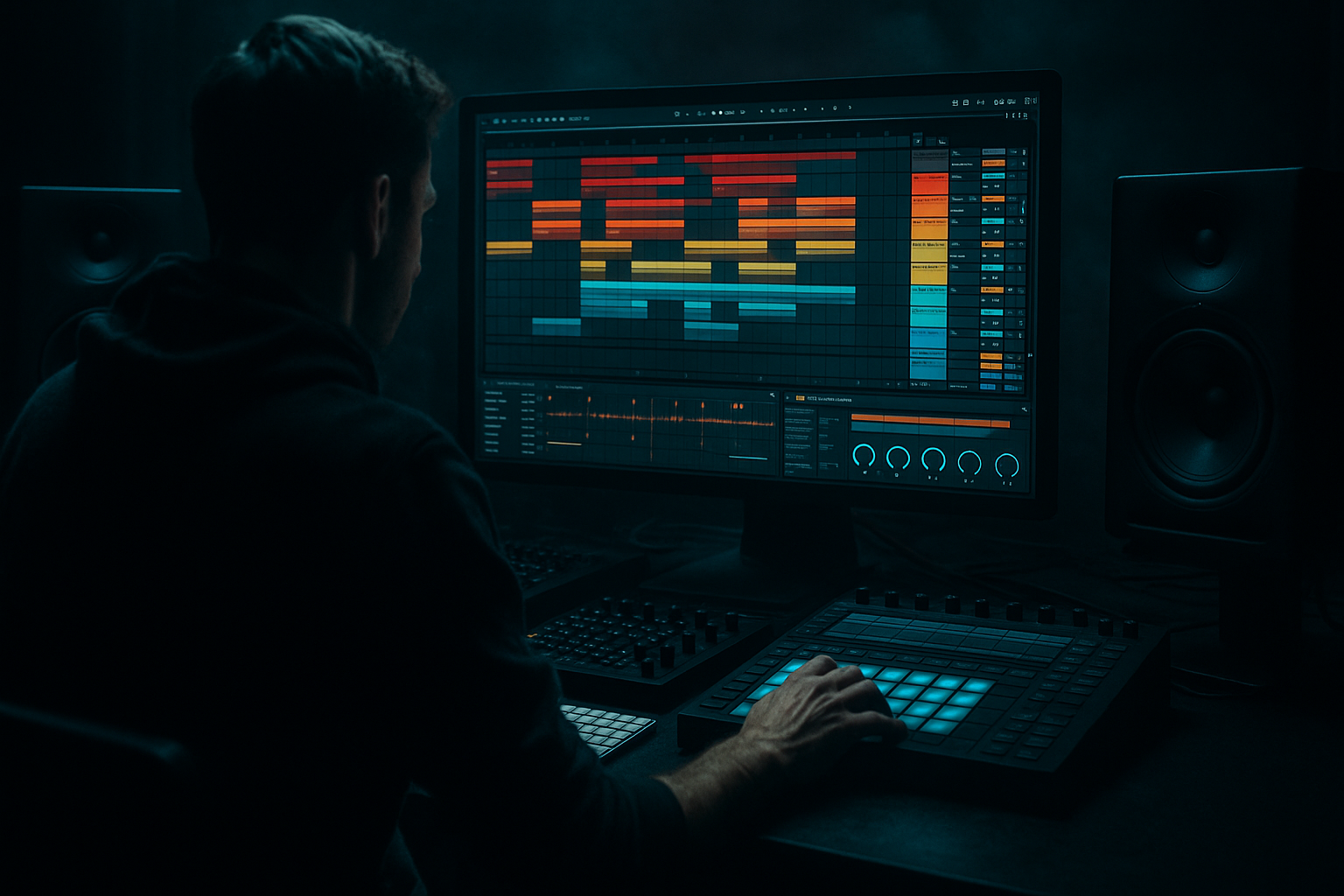
This lesson is about arranging jungle / oldskool DnB with maximum low-end pressure using an automation-first workflow in Ableton Live 12.
You’ll focus on:
- Building weight + movement in the bass without ruining headroom
- Using automation as your main arrangement tool (not “afterthought” polish)
- Creating classic jungle edit energy: drops, filter rides, mutes, rewinds, and stutters
- Keeping kick + sub locked while rearranging breaks aggressively
- Intro (16 bars): filtered break + hints of sub
- Drop (16 bars): full low-end + break edits
- Mid (16 bars): variation (bass automation + fills)
- Second drop (16–32 bars): heavier/denser, darker automation
- Outro (8–16 bars): DJ-friendly roll-out
- A sub/bass bus that stays consistent
- A break bus that’s constantly moving (but controlled)
- Automation lanes that create momentum and “pressure”
- EQ Eight, Auto Filter, Saturator, Glue Compressor
- Utility (gain + width + mono control)
- Drum Buss (for smack, careful with low end)
- Limiter (for safety while building)
- Shaper (if available in your Live 12 suite setup) / Auto Pan for rhythm gating
- Instrument: Operator
- MIDI note range: typically F–A# (43–58 Hz-ish region depending on key)
- Sub level (small moves only)
- Sub filter (rare, subtle)
- Sub note rhythm (variation sections)
- Wavetable suggestion:
- Or Operator with 2 saw-like partials via additive approach.
- Sub owns 30–90 Hz
- Reese owns 90–400 Hz (and some texture above)
- EQ Eight
- Drum Buss
- Glue Compressor
- Breaks Filter Freq (Auto Filter LP)
- Breaks Reverb Send (big dubby tails on fills)
- Breaks “Gate” (Auto Pan with 0° phase for tremolo-style rhythmic cuts)
- Breaks: lowpass filtered and/or bandpassed
- Sub: either off for first 8 bars, or extremely low volume
- Atmos: vinyl crackle, pads, sirens, little FX
- Breaks Auto Filter Frequency:
- Reese Filter: slowly opens a little, but keep bass energy minimal until the drop
- Add a 1-bar tape-stop style moment (optional): use Frequency Shifter (fine mode) automation or just a quick mute + FX hit.
- Sub comes in clean and centered
- Reese opens slightly + distortion energy
- Break edits increase density
- Kick stays stable
- Sub track Utility Gain: tiny ramp +0.5 to +1.5 dB into the first 4 bars (don’t overdo it)
- Reese Auto Filter: open slightly more than intro (e.g., 300 → 900 Hz movement)
- Breaks send to short room reverb: increase on snare fills only (automation “spikes”)
- Every 4 bars: add a 1-beat stutter (repeat a snare or ghost) using MIDI note repeats in the sliced rack.
- Bar 31–32: do a classic roll (16th notes on a snare slice) leading into the next section.
- Switch Reese rhythm (syncopate, add triplet touches)
- Change Reese filter movement (more “talking” automation)
- Drop kick for 2 bars and let break carry (then slam kick back)
- Reese filter: more dramatic curves (draw ramps, not straight lines)
- Saturator Drive automation on Reese: +2–4 dB on the 2nd half of phrases
- Breaks: quick high-cut dips (like DJ EQ moves) at the end of 8-bar phrases
- A second break layer (quiet) for texture (e.g., Think under Amen)
- A short “foghorn-ish” stab (filtered, rhythmic)
- Extra ride/shaker for propulsion
- Breaks filter opens wider than Drop 1 (more top)
- Reese saturation increases slightly
- Add master “energy lift” automation using subtle bus moves (not heavy mastering)
- Glue Compressor (gentle)
- EQ Eight (optional)
- Hard cut to outro, or
- Rewind FX (short, tasteful), then slam a final hit.
- On SUB track: Compressor
- Sub: mono
- Kick fundamental: mostly mono
- Break highs: can be wider (but don’t over-widen transients)
- Auto Filter frequency (Breaks + Reese)
- Reverb send spikes (snare fills)
- Delay send throws (last word of a stab, last snare before phrase)
- Utility Gain (tiny lifts/dips for impact)
- Saturator Drive (controlled aggression increases)
- Use “negative space” for heaviness
- Controlled distortion layers
- Pitch automation for menace
- Break texture layering
- Darkness comes from midrange control
- headphones + small speakers
- Low-end pressure in jungle/DnB comes from clean sub + controlled mid-bass + dynamic break edits.
- Use an automation-first arrangement: filter rides, send throws, tiny gain moves, and density changes create momentum.
- Keep the sub simple, mono, and stable; let movement live in the reese and breaks.
- Work fast by building automation blocks, duplicating phrases, and resampling for oldskool cut-up energy.
The mindset: You don’t “finish a loop,” you “perform the arrangement” with automation. ✅
---
2. What you will build 🧱
A short but release-ready 64-bar (or 96-bar) jungle/DnB arrangement including:
You’ll end with:
---
3. Step-by-step walkthrough 🧭
Step 0 — Session setup (fast + correct)
1. Tempo: 160–172 BPM (classic jungle often 165–170).
2. In Arrangement View, set loop brace to 64 bars to start.
3. Create these tracks (color them!):
- Kick (audio or drum rack)
- Breaks (audio; ideally 2 layers)
- Sub (MIDI)
- Reese/Low Mid Bass (MIDI or audio resample)
- Atmos/FX
- Pads/Stabs
4. Create two Groups:
- DRUMS BUS (Kick + Breaks)
- BASS BUS (Sub + Reese)
Ableton stock tools you’ll use a lot:
---
Step 1 — Build an “always-solid” low-end chain (Sub track)
Your sub is your anchor. Keep it simple and consistent.
SUB (MIDI)
- Osc A: Sine
- Add a touch of harmonics: enable Osc B very quietly (sine or triangle), -24 to -30 dB
Device chain (Sub track):
1. EQ Eight
- HPF at 20 Hz (24 dB slope)
- Optional tiny dip if muddy: 120–200 Hz -1 to -3 dB
2. Saturator
- Mode: Soft Sine or Analog Clip
- Drive: 1–4 dB
- Keep “Output” matched (don’t let it just get louder)
3. Utility
- Bass Mono: Width 0% (or use “Mono” if preferred)
- Gain: set so sub is strong but not clipping the bus
Automation-first rule:
Before arranging, decide what can move:
Keep sub stable. Movement mostly comes from the reese + drums.
---
Step 2 — Reese / low-mid bass that creates “pressure” (movement layer)
Oldskool jungle weight often comes from mid-bass + breaks, not just pure sub.
REESE (MIDI with Wavetable or Operator)
- Osc 1: Saw / Basic shapes
- Osc 2: Slight detune (5–15 cents)
- Unison: 2–4 voices (don’t go huge)
Device chain (Reese track):
1. Auto Filter
- Type: LP24
- Freq: start around 200–800 Hz (you’ll automate this)
- Drive: small (1–3)
2. Saturator
- Drive: 3–8 dB depending on tone
3. EQ Eight
- HPF around 80–120 Hz (leave room for sub)
- Shape annoying resonances (often 200–400 Hz)
4. Compressor (or Glue)
- Gentle control, 2:1, slow-ish attack (10–30 ms), medium release
5. Utility
- Width: 80–120% (keep sub mono; reese can be wider)
Key principle:
---
Step 3 — Breaks workflow: slice, edit, automate like jungle 🔪
Use audio breaks (Amen, Think, etc.) and treat them like you’re on an old sampler—just faster.
1. Drag break into Breaks track.
2. Right-click → Slice to New MIDI Track
- Slicing preset: Transient
- Use Built-in slicing preset first (quick).
3. In the new Drum Rack, group pads (kicks/snares) if needed.
Breaks Drum Rack chain (inside rack or on track):
- HPF 30–50 Hz (you already have kick+sub)
- If harsh: dip 3–6 kHz slightly
- Drive: 2–10 (watch low-end!)
- Crunch: 0–10
- Boom: OFF or very low (Boom can fight your sub)
- Attack: 3–10 ms
- Release: Auto
- GR: 1–3 dB average
Automation-first move:
Before you even arrange, decide 3 “performance macros” and map them:
---
Step 4 — Make your arrangement using automation lanes first 🎚️
Now you’ll create the song by writing automation gestures across 64 bars.
#### 4A) Intro (Bars 1–16): tease the low-end
Automation to draw:
- Bars 1–8: ~200–600 Hz
- Bars 9–16: rise to ~2–6 kHz (open up)
Classic jungle move:
At bar 16, do a 1/2-bar or 1-bar mute of the breaks (silence = tension).
---
#### 4B) Drop 1 (Bars 17–32): full pressure
At the drop, don’t just “add tracks.” Make it hit via:
Automation to draw:
Break edit idea (very jungle):
---
#### 4C) Mid variation (Bars 33–48): change the bass behavior
To keep “pressure,” you need contrast without losing the low-end foundation.
Choose ONE main variation:
Automation to draw:
Ableton trick:
Resample the Reese to audio, then do clip fades and reverse hits for oldskool bite.
---
#### 4D) Drop 2 (Bars 49–64 or 49–80): darker + heavier 🖤
This is where you push weight while keeping the mix intact.
Add 1–2 of these:
Automation focus here:
On BASS BUS:
- Ratio 2:1, Attack 10 ms, Release Auto, GR 1–2 dB
- Tiny broad dip at 200–300 Hz if it clouds the break
DJ-friendly move:
At the end (bar 63–64), do a 1-bar drum fill, then either:
---
Step 5 — Sidechain and low-end “rules” (so it hits every time)
For jungle, you don’t need extreme EDM pumping. Use controlled ducking.
Sidechain (Sub ducked by Kick):
- Sidechain input: Kick
- Ratio: 2:1 to 4:1
- Attack: 1–5 ms
- Release: 50–120 ms (tempo-dependent)
- Gain reduction: aim 1–3 dB, peaks maybe 4 dB
Optional: also duck Reese slightly from snare (tiny), to keep snare crack clean.
Mono discipline:
---
Step 6 — Automation editing workflow in Live 12 (fast + musical) ⚡
This is the “edit workflow” part: how to actually work quickly.
Workflow habits:
1. Create automation lanes early
- Press `A` to show automation.
- Draw broad strokes first (8–16 bar gestures).
2. Use “automation blocks”
- Make a great 8-bar automation phrase, then duplicate it and edit variation points.
3. Use clip gain + fades on audio
- Jungle edits often need micro-control. Use clip gain rather than smashing compressors.
4. Consolidate & resample
- Resample complex bass + break edits to audio so you can do classic cut-up moves.
Go-to automation targets (DnB arrangement essentials):
---
4. Common mistakes 🚫
1. Sub and reese fighting
- If your reese has energy below ~90 Hz, you’ll lose clean pressure fast.
2. Over-saturating the bass bus
- Loud ≠ heavy. Too much saturation eats transient clarity and headroom.
3. Automating everything
- Automation-first doesn’t mean automation-everywhere. Pick high impact lanes.
4. Breaks too wide or too crushed
- Jungle breaks need punch and air. Don’t flatten them with heavy limiting early.
5. No contrast between sections
- If Drop 1 and Drop 2 are identical, the track feels stuck even if the loop is good.
---
5. Pro tips for darker/heavier DnB 🕳️
- Mute the kick for 1 bar before Drop 2, then bring it back with full sub.
- Duplicate Reese → highpass at 250–400 Hz → saturate harder → blend quietly.
- Automate a short reese note down -2 to -5 semitones at phrase ends (quick slides).
- Add a very quiet “roomy” top break, highpassed at 500 Hz, to add grit without mud.
- If 300–600 Hz is a swamp, your track won’t feel heavy—just cloudy. Carve gently.
---
6. Mini practice exercise 🎯 (20 minutes)
Goal: Create a 16-bar drop that feels like a real jungle record.
1. Make an 8-bar loop with:
- Kick + Break slices
- Sub (simple pattern)
- Reese (simple rhythm)
2. Duplicate to 16 bars.
3. Add ONLY these automations:
- Breaks filter frequency (one gesture across 16 bars)
- Reese filter frequency (two different 8-bar shapes)
- Reverb send spike on snare fill at bar 8 and bar 16
4. Add exactly two edit moments:
- 1-beat stutter at bar 7.4 (end of phrase)
- 1-bar snare roll at bar 15
Export a quick bounce and listen on:
Check: Does the sub remain consistent while the track feels like it’s evolving?
---
7. Recap ✅
If you want, tell me your target vibe (e.g., 94 jungle, techstep, modern rollers) and your track key/BPM, and I’ll give you a specific 64-bar arrangement blueprint with exact automation shapes.
```

