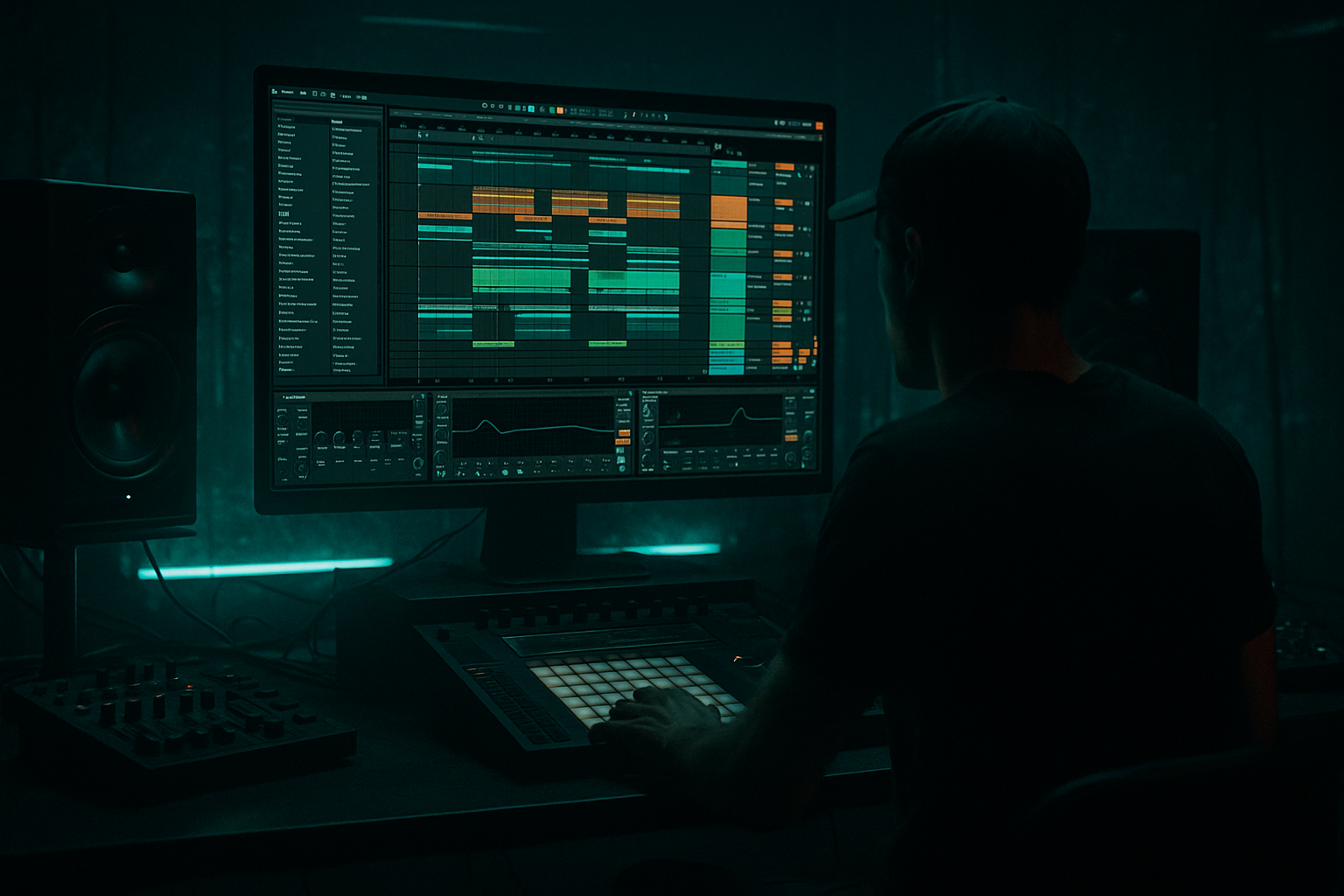
Main tutorial
Intro Humanize Framework with Breakbeat Surgery in Ableton Live 12 🥁⚡
1. Lesson overview
In this lesson, you’ll learn how to turn a raw breakbeat into a human, energetic, DnB-ready drum pattern using Ableton Live 12. The goal is not to make your drums perfectly grid-locked — it’s to give them life, swing, variation, and impact while keeping them tight enough for drum and bass.
This is a core sampling skill for:
- Jungle-style breakbeats
- Rolling DnB drum beds
- Intro tension loops
- Humanized drum programming that still hits hard
- A sliced breakbeat loop in Ableton Live 12
- A humanized intro drum groove
- A clean drum rack / Simpler-based break surgery workflow
- A basic DnB intro arrangement with evolving drums
- Optional dark/heavy processing for jungle, neuro, or rolling styles
- Clear kick and snare transients
- A bit of room tone or ambience
- A natural groove, not too quantized
- Enough character to survive slicing
- Old funk breaks
- Amen-style breaks
- Think-style breaks
- Any dusty loop with movement
- Strong snare on 2 and 4
- Little in-between hits
- A natural “push and pull”
- Slight imperfections that sound alive
- Warp: On
- If the break is fairly steady, try Beats warp mode
- Set the correct original tempo if needed
- Turn on Loop if you're auditioning
- Slicing preset: Drum Rack
- Slice by: Transients
- Preserve: Transients / Beat tracking depending on the break
- Keep the main snare hits
- Keep the kick pattern
- Remove some unnecessary slices
- Reintroduce ghost hits and small fills
- Leave tiny gaps for air
- Bar 1–2: mostly original groove
- Bar 3–4: add extra ghost notes or reverse snippets
- Bar 5–8: more density
- Bar 9–16: build tension with layers and fills
- Micro timing variation
- Velocity variation
- Selective duplication or omission of hits
- Subtle groove offset
- Nudging some ghost hits slightly late
- Pushing a few hats slightly ahead
- Leaving the main snare mostly tight
- Use MIDI note nudge
- Zoom in and manually move some notes a few milliseconds
- Avoid randomizing everything
- Kick and snare: mostly stable
- Ghost notes and percussion: freer
- Fills: more exaggerated movement
- Main snare: high velocity
- Ghost snare taps: medium-low velocity
- Hat ticks: varying velocities
- Break accents: occasional higher hits for emphasis
- Select notes and adjust velocity by hand
- Use velocity lanes to create patterns like:
- Timing: 10–25%
- Random: 5–10%
- Velocity: 5–15%
- A clean kick
- A clean snare
- Optional top loop or hat layer
- Drum Rack for layering
- Simpler for one-shot hits
- EQ Eight to clean frequencies
- Saturator for punch
- Glue Compressor for drum bus cohesion
- Drum Buss for weight and transient control
- Use the break for character and groove
- Use separate kick/snare samples for impact
- Keep the layered hits slightly lower in volume than you think
- Add EQ Eight
- High-pass gently if needed around 30–40 Hz
- Cut muddy buildup around 200–400 Hz if the loop sounds boxy
- Use a small boost around 3–6 kHz if the snare needs snap
- Try a small dip around 7–10 kHz
- Use Saturator instead of aggressive EQ boost
- EQ Eight
- Saturator
- Optional Compressor or Transient shaping via Drum Buss
- Just hats or filtered break fragments
- Low-pass the loop
- Minimal kick support
- Bring in full break
- Add snare layers
- Slight groove swing
- Add extra ghost hits
- Increase velocity on key accents
- Introduce reverse break slices or fills
- Add automation
- Open the filter
- Increase percussion density
- Use a fill at the end of bar 16
- Auto Filter cutoff
- Reverb send
- Delay send
- Saturator drive
- Drum Buss crunch
- EQ Eight low cut
- Start with a low-pass filtered break
- Slowly open the filter over 8 bars
- Increase saturation near the transition
- Add a short reverb throw on the last snare before the drop
- Fast momentum
- Snare-led phrasing
- Syncopated ghost notes
- Forward motion
- Energy without clutter
- Strong snare on 2 and 4
- Busy hats and percussion around it
- Ghost notes that fill the space
- A loop that feels like it’s constantly moving
- Saturator Drive: subtle, around 2–6 dB
- Drum Buss Crunch: low to moderate
- Keep the low end tight
- Break = mids/highs and groove
- Kick = low punch
- Snare = crack
- Bass = separate sub and mid bass
- Start with a low-pass filter
- Add reverb with dark decay
- Keep the drums muffled until the transition
- Glue Compressor
- Saturator
- EQ Eight
- Version A: cleaner rolling intro
- Version B: darker, heavier, more jungle-influenced
- Which one feels more alive?
- Which one feels more like a drop intro?
- Which one has better momentum?
- a screen-by-screen Ableton Live 12 walkthrough
- a Drum Rack chain template
- or a follow-along 16-bar MIDI pattern example.
We’ll use a practical intro humanize framework:
1. Choose a break
2. Slice it
3. Rebuild the groove
4. Humanize timing and velocity
5. Add layers and processing
6. Arrange it into a proper intro
You’ll be working mostly with stock Ableton devices and simple editing tools, so this is fully beginner-friendly.
---
2. What you will build
By the end of this lesson, you’ll have:
Think of it as a 16-bar intro groove that starts sparse and becomes more intense, perfect before the bass drop or first full section.
---
3. Step-by-step walkthrough
Step 1: Find the right break
Start with a break that has:
Good sources:
For DnB, look for breaks that already feel propulsive and syncopated. You want something with a strong backbeat but also enough ghost notes to create motion.
#### What to listen for
---
Step 2: Warp and prep the sample
Drag your break into an audio track.
#### Settings to check:
If the break is already tight and you want to preserve the feel, don’t over-warp it. The more you warp a break, the more you risk flattening the groove.
#### Practical tip
If the break drifts a little, don’t panic. For intro material, a little loose timing can actually sound more authentic.
---
Step 3: Slice the break into a Drum Rack
Now we get into the surgery.
#### Option A: Slice to New MIDI Track
1. Right-click the break
2. Choose Slice to New MIDI Track
3. In the slicing menu, choose:
- Slice by: Transients for a detailed break surgery workflow
- Or Slice by: Beat if you want a simpler approach
#### Recommended settings for beginners:
This creates a Drum Rack with each slice mapped to a MIDI pad, which is ideal for rebuilding the groove.
---
Step 4: Rebuild the groove from the slices
Now open the MIDI clip created by slicing.
You’ll likely see one note per slice. This is where humanization starts.
#### Your goal
Don’t just loop the break as-is. Rebuild a version that keeps the character but gives you control.
Try this:
#### A simple DnB intro pattern approach
Use the break in a call-and-response way:
This creates a feeling of progression instead of a static loop.
---
Step 5: Humanize with timing and velocity
This is the core of the lesson.
In drum and bass, humanization means:
#### Timing
Don’t make every slice land exactly on the grid.
Try:
In Ableton:
A good rule:
#### Velocity
Velocity is huge for human feel.
Try this:
In Ableton’s MIDI editor:
- strong / soft / soft / medium
- medium / soft / strong / soft
This creates motion without changing the rhythm too much.
---
Step 6: Add groove with Groove Pool
Ableton Live’s Groove Pool is perfect for intro humanization.
#### How to use it
1. Open the Groove Pool
2. Try a groove like:
- MPC swing
- 16th swing
- A lightly swung drum groove from a reference loop
3. Apply it subtly to your MIDI clip
#### Recommended starting point
Keep it subtle. Too much swing can turn DnB into something lazy. We want controlled looseness, not sloppy timing.
---
Step 7: Layer with clean drums
Breaks alone are great, but in DnB they often benefit from extra support.
Create a second drum track with:
#### Stock Ableton devices to use
#### Suggested layering approach
This preserves the break feel while making it hit harder in a club mix.
---
Step 8: Clean the slices
Breaks often contain extra low-end rumble and unwanted spill.
#### On the break track or Drum Rack chain:
If the break is harsh:
#### Drum Rack chain idea
For each slice or pad:
---
Step 9: Add intro development
A strong DnB intro should evolve.
Try arranging your break surgery into sections:
#### Bars 1–4: sparse introduction
#### Bars 5–8: groove revealed
#### Bars 9–12: tension rises
#### Bars 13–16: lead-in to drop
This is very effective for jungle and rolling intro sections.
---
Step 10: Use automation for movement
Automation makes the humanized break feel like a real build.
Useful things to automate:
#### Practical intro automation ideas
This gives the intro progression and tension.
---
Step 11: Make it feel like DnB
To keep it rooted in drum and bass, think about:
#### Typical DnB drum feel
If the groove feels too relaxed, tighten the main backbeat.
If it feels too rigid, loosen ghost notes and add small timing offsets.
---
4. Common mistakes
Over-quantizing everything
If every slice lands perfectly on the grid, the break loses its soul.
Fix: Keep core hits tight, but leave smaller details slightly loose.
Too much swing
A little groove is good. Too much swing can make DnB feel sluggish.
Fix: Start with low groove percentages and build carefully.
Ignoring velocities
A flat velocity pattern sounds robotic.
Fix: Manually shape the velocity of ghost hits and hats.
Overprocessing the break
Too much EQ, compression, and saturation can destroy the character.
Fix: Make subtle moves and listen in context.
Leaving muddy low-end in the break
Old breaks often have extra bass and room rumble.
Fix: High-pass gently and carve mud with EQ Eight.
Layering too loudly
If your added kick/snare layers dominate, the break loses identity.
Fix: Let the break remain the main character.
---
5. Pro tips for darker/heavier DnB
If you want a darker, heavier vibe, try these techniques:
1. Layer with a punchy sub-kick
Use a clean kick sample with a tight transient and a short tail.
2. Add controlled saturation
Use Saturator or Drum Buss to thicken the break.
Suggested starting points:
3. Use band-limited processing
If the break is too wide and messy, split frequency roles:
4. Filter the intro
For darker intros:
5. Add reverse slices
Reverse a few break fragments or snare tails for tension before fills.
6. Use ghost notes as menace
In darker DnB, ghost notes should be felt more than heard.
Keep them low in velocity and slightly late.
7. Try parallel drum bussing
Create a return track or parallel chain with:
Blend it in gently for extra aggression without crushing the main groove.
---
6. Mini practice exercise
Goal
Build a 4-bar intro loop using one break and one added drum layer.
Steps
1. Pick a break with strong snare hits.
2. Slice it to a Drum Rack.
3. Rebuild a 4-bar pattern.
4. Remove at least 20% of the slices.
5. Vary the velocities of ghost hits.
6. Apply subtle swing in Groove Pool.
7. Add one clean snare layer on beats 2 and 4.
8. Automate a filter opening over the 4 bars.
Challenge version
Make two versions:
Compare them and ask:
---
7. Recap
Here’s the full beginner workflow:
1. Choose a break with character
2. Warp it lightly, if needed
3. Slice it into a Drum Rack
4. Rebuild the groove instead of looping it blindly
5. Humanize timing and velocity
6. Add subtle Groove Pool swing
7. Layer clean drums for impact
8. Clean with EQ, saturation, and compression
9. Automate filters and effects for intro movement
10. Arrange the loop so it evolves into the drop
The big idea is this:
In DnB, humanization is not randomization — it’s controlled imperfection.
That’s what gives breakbeats their energy, swing, and jungle DNA 🥁🔥
If you want, I can also turn this into:

