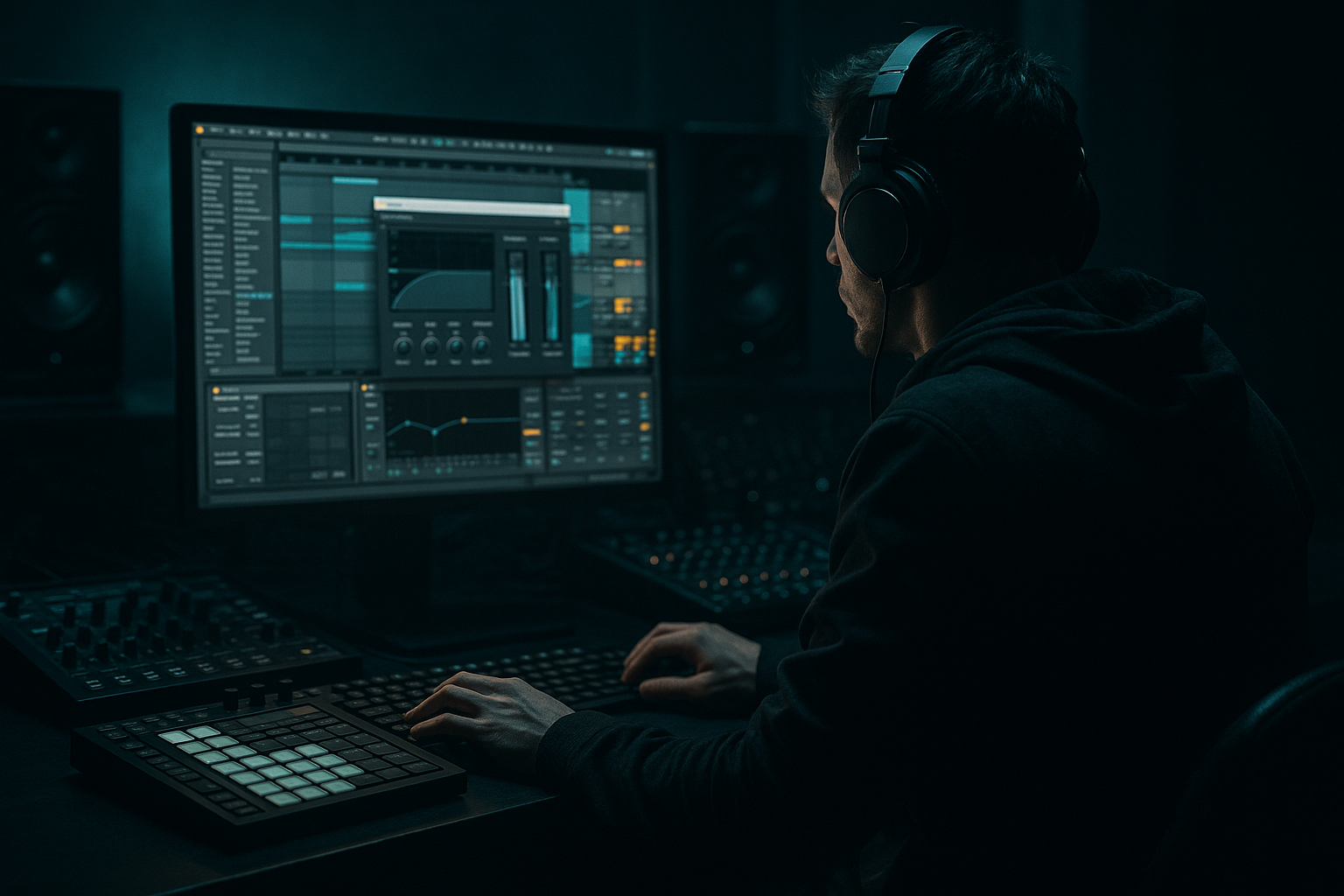
Main tutorial
Hot Pants Break Roll Widen Deep Dive for Sunrise Set Emotion in Ableton Live 12
A beginner-friendly workflow tutorial for jungle / oldskool DnB vibes 🌅🥁
1. Lesson overview
In this lesson, you’ll learn how to take the classic Hot Pants break style of drum programming and turn it into a wide, emotional break roll that works beautifully in a sunrise set context.
The goal is not just “make it faster.”
The goal is to make the break:
- feel rolling and alive
- open up stereo width without sounding messy
- create emotional lift for an early-morning jungle / oldskool DnB section
- stay tight enough for club systems
- a Hot Pants break chop
- a rolling 16th-note or 32nd-note variation
- stereo widening that feels energetic, not fake
- ghost notes, reverses, and fills
- a simple drum bus chain for glue
- arrangement ideas for a sunrise intro / breakdown / lift
- jungle intros
- rolling atmospheric DnB
- oldskool rave-style transitions
- emotional peak-to-sunrise movement ☀️
- Kick/snare backbone that respects the original break
- Add ghost hits between main snare hits
- Use 1/16 note repetition on hats or light snare fragments
- Leave a few gaps so the groove breathes
- use the Draw tool to place hits quickly
- vary velocity so repeated notes don’t sound robotic
- keep the main snare strong, ghost hits softer
- Main snare: 110–127
- Ghost snare / rim / break fragments: 35–85
- Hats / top fragments: 40–100
- Bars 1–2: loose, spacious break
- Bar 3: more ghost notes
- Bar 4: denser roll + small fill into the next phrase
- Center layer: kick, snare, main body
- Wide layer: hats, shuffles, tiny break fragments, reverses, ambience
- High-pass around 150–250 Hz
- Remove low-end from the wide layer
- This prevents phase issues and keeps the kick/snare solid
- Drive: 5–15%
- Crunch: light to medium
- Boom: usually off for the wide layer
- Use it to add bite and presence
- Mode: subtle, not extreme
- Amount: low to medium
- Keep it gentle for stereo movement
- Width: 120–160%
- Use sparingly
- If the sound gets blurry, reduce width immediately
- Very small amount
- Short decay: 0.3–0.9 sec
- Pre-delay: 10–25 ms
- High-pass the reverb return if needed
- Very short delay times
- Low feedback
- Filtered top end
- Great for atmospheric sunrise tails
- short plate reverb
- dubby delay
- filtered wash
- Hybrid Reverb
- small room / plate
- decay around 0.5–1.2 sec
- low cut around 200 Hz
- high cut around 7–10 kHz
- Echo
- sync delay like 1/8 or 3/16
- low feedback
- filter the repeats
- Reverb send up into transitions
- Utility width slightly wider in the buildup
- EQ Eight high-pass on atmos layers rising slowly
- Drum Buss Drive increasing slightly for tension
- Filter frequency if you want a soft opening effect
- Bars 1–2: dry and tight
- Bars 3–4: add reverb send on chopped hats
- Final 1/2 bar: widen the top layer and add a fill
- a quick snare drag
- a tiny reverse break slice
- a 2-hit snare flam
- a short tom or rim accent
- Bars 1–2: dry break groove, low atmosphere
- Bars 3–4: add ghost notes + subtle wide tops
- Bars 5–6: increase roll density, bring in return delay
- Bars 7–8: lift with automation, fill, and wider top-end shimmer
- Drop the kick out briefly to let the break breathe
- Use one bar of stripped drums before the full roll returns
- Bring in a soft pad or amen-style texture underneath
- Let the reverb tail bloom just before the next section
- keep the wide layer more filtered
- use distortion on the top fragments only
- add ghost snares with a more aggressive transient
- layer a rimshot or metallic hit under the roll
- use Redux subtly for grime and aliasing
- Saturator for bite
- Drum Buss for attack and crunch
- Redux for lo-fi darkness
- Auto Filter for sweeping tension
- Transient shaping through Drum Buss rather than over-EQing
- Does the groove still hit?
- Does the roll feel like it builds?
- Are the wide layers exciting but not muddy?
- Does it feel like sunrise emotion rather than just random fills?
- Start with a solid break chop and groove
- Use density and velocity to create the roll
- Separate center punch from wide texture
- Use stock Ableton devices like:
- Automate width and space for emotional lift
- Keep the low end focused and mono-friendly
We’ll build this in Ableton Live 12, using stock devices and a practical workflow you can repeat in real tracks.
---
2. What you will build
By the end, you’ll have a loop that includes:
This is ideal for:
---
3. Step-by-step walkthrough
Step 1: Load and prep your break
1. Create a new MIDI track or audio track.
2. Drag in a Hot Pants break sample.
3. If it’s audio, turn on Warp and set the correct tempo handling:
- For a loop, choose Beats mode
- Start with Preserve: 1/16 or 1/8 depending on the source
4. Set your project tempo somewhere between:
- 165–174 BPM for classic jungle / DnB
- 160–168 BPM if you want a more emotional sunrise drift
Tip: If the break is old and crunchy, don’t clean it too much. That grit is part of the character.
---
Step 2: Slice the break for control
For beginner workflow, the easiest method is:
1. Right-click the break clip.
2. Choose Slice to New MIDI Track.
3. In the slicing dialogue, use:
- Transient slicing for natural break chops
- Built-in sampler or Simpler as the slicing instrument
This gives you individual hits you can reprogram.
If you want a more oldskool feel, keep the original groove and only layer extra hits on top.
---
Step 3: Build a basic jungle pattern first
Before widening anything, get the rhythm right.
Program a simple 1-bar groove like this:
In Ableton’s MIDI Note Editor:
Good starting velocity idea:
This gives you movement before you even touch stereo effects.
---
Step 4: Create the “roll” feel
A break roll in DnB usually comes from rhythmic density increasing.
Try this:
1. Duplicate your break clip over 2 or 4 bars.
2. In the second half of the phrase, increase note activity:
- add extra 1/16 notes
- then introduce 1/32 bursts only at the end of a phrase
3. Use velocity ramps so the roll builds energy
4. Cut small fragments of the break and repeat them
A simple emotional rise can be:
This is great for sunrise energy because it feels like the track is slowly waking up.
---
Step 5: Add width the smart way
This is the “deep dive” part.
Widening is powerful, but in DnB it must be controlled.
#### Best approach: split the break into layers
Instead of widening the full drum bus immediately, create layers:
This keeps the punch in the middle and the motion out wide.
---
Step 6: Build a stock Ableton device chain for the wide layer
On the wide layer track, try this stock chain:
#### 1. EQ Eight
#### 2. Drum Buss
#### 3. Chorus-Ensemble
#### 4. Utility
#### 5. Reverb or Hybrid Reverb
#### 6. Optional: Echo
Important:
Do not widen the kick and main snare too much. Keep the core punch relatively mono.
---
Step 7: Use Return tracks for atmosphere
A sunrise DnB roll often sounds bigger because of space, not just width.
Create return tracks for:
#### Return A: short ambience
#### Return B: echo wash
Send only the break fragments, ghost hits, and fills to these returns.
This helps create that early-morning floating feeling without smearing the groove.
---
Step 8: Use automation to make the roll emotional
Sunrise emotion comes from movement over time.
Automate:
Example automation move:
This makes the break feel like it is opening up with the sun 🌅
---
Step 9: Add a classic oldskool DnB fill
For authentic jungle flavor, add a fill every 4 or 8 bars.
Try:
In Ableton:
1. Copy the last beat of the bar.
2. Slice a fragment.
3. Reverse one copy if it’s an audio clip.
4. Pan the fill lightly left/right if it’s only a top layer.
Keep fills short and purposeful. Oldskool DnB works when the groove keeps moving.
---
Step 10: Arrange it like a sunrise section
Here’s a practical arrangement idea:
#### 8-bar sunrise phrase
You can repeat this structure with slight variations.
#### Great arrangement tricks:
That’s how you create emotion without losing the DnB drive.
---
4. Common mistakes
1. Making everything wide
If you widen the kick, snare, and low mids too much, the groove loses impact.
Fix: keep low-end and core snare more centered.
---
2. Overusing reverb
Too much reverb turns a break into mush.
Fix: use short decay times and high-pass the reverb return.
---
3. Too much compression on the break
Heavy compression can flatten the swing.
Fix: use light glue only, and keep transients alive.
---
4. Ignoring velocity
A roll with identical velocities sounds fake.
Fix: vary each repeated hit. Even small changes matter.
---
5. No contrast
If the break is always busy, it stops feeling emotional.
Fix: alternate dense sections with open spaces.
---
6. Phase issues from stereo widening
Some widening tools can make the drums sound hollow in mono.
Fix: test in mono with Utility and keep low-end mono.
---
5. Pro tips for darker/heavier DnB
If you want to take this technique into a darker direction, try these:
Darker break roll ideas
Useful Ableton devices for heavier vibes
Heavy DnB workflow tip
Keep the core break centered, then make the tops nasty and wide.
That gives you power plus atmosphere.
---
6. Mini practice exercise
Try this 15-minute exercise:
Exercise goal
Create a 4-bar Hot Pants break roll that opens up emotionally.
Steps
1. Load a Hot Pants break into a track.
2. Slice it to MIDI.
3. Program a 4-bar loop:
- Bar 1: simple groove
- Bar 2: add ghost notes
- Bar 3: increase note density
- Bar 4: add a fill and a final roll burst
4. Create a second track for wide top layers.
5. Add:
- EQ Eight high-pass at 200 Hz
- Chorus-Ensemble
- Utility width at 130%
6. Send small amounts to Reverb and Echo returns.
7. Automate the reverb send up in the final bar.
8. Listen in mono, then stereo.
What to listen for
Repeat the exercise with a darker version and compare.
---
7. Recap
You’ve now got a practical workflow for building a Hot Pants break roll widen in Ableton Live 12 for jungle / oldskool DnB sunrise emotion.
Key takeaways
- Simpler
- Drum Buss
- EQ Eight
- Chorus-Ensemble
- Utility
- Hybrid Reverb
- Echo
If you want, I can also turn this into:
1. a bar-by-bar MIDI pattern example,
2. an Ableton device chain preset, or
3. a full jungle breakdown arrangement template.

